
Analytical Instrumentation for Critical Industrial Measurements
Blue Dragon Technology
Blue Dragon Technology metals, mining and materials measurement solutions for elemental analysis, water quality, sulfur, temperature and flow monitoring.

Metals, Mining & Materials Measurement Solutions: From Exploration to Process Monitoring

Mining and materials operations depend on measurement at very different stages—from exploration and mine-face screening through sample preparation, laboratory quality control, water management and metallurgical processing.

The measurement objective changes as material moves through the operation. A field geologist may need rapid information about elemental variation, while a laboratory may require controlled analysis of a prepared sample. Elsewhere in the plant, operators may need continuous visibility into water condition, total sulfur, temperature or flow.

There is therefore no single instrument that addresses every mining and materials measurement requirement. Effective instrumentation combines the appropriate technologies with representative sampling, suitable calibration, application-specific installation and a clear understanding of how the resulting data will be used.

This article examines how field XRF, laboratory XRF, water analysis and process instrumentation can support measurement workflows from exploration through finished-material quality control and metallurgical processing.

Metals, Mining & Materials Measurement Solutions: Video Overview

The Blue Dragon Technology presentation below provides an overview of measurement opportunities across mining and materials operations, including field elemental screening, laboratory verification, water monitoring, total sulfur measurement, temperature measurement and flow measurement.

The sections below expand on these measurement areas and show how different technologies can fit into a broader mine-to-material measurement strategy.
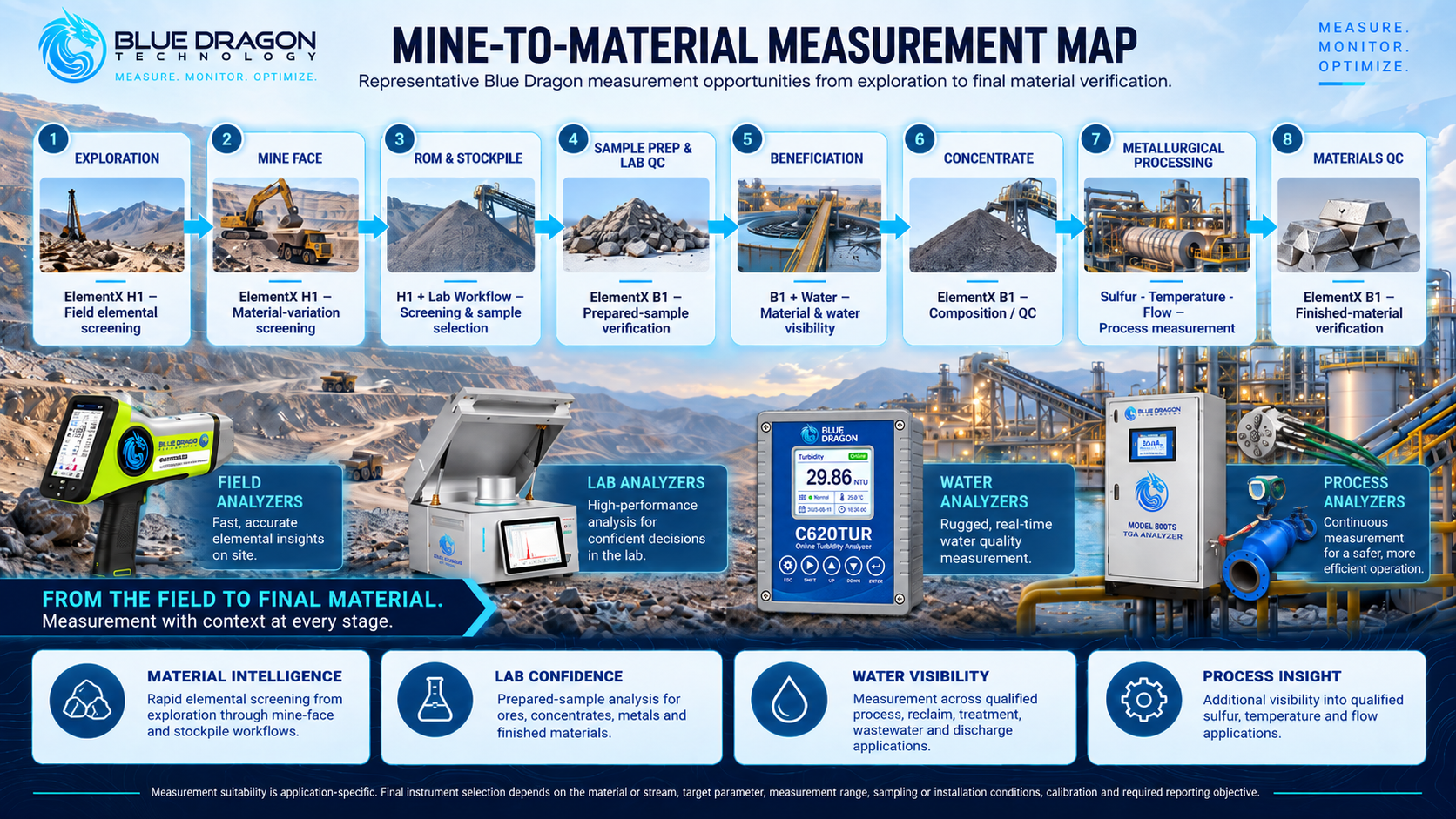
Mine-to-material measurement map showing field XRF, laboratory analysis, water monitoring and process measurement across mining operations.

Representative measurement opportunities across the mining and materials chain, linking field material intelligence, laboratory verification, water visibility and process measurement.

Understanding the Mine-to-Material Measurement Chain

Mining operations transform naturally variable geological material into progressively more defined products. That journey can include exploration, extraction, run-of-mine material handling, crushing and grinding, beneficiation, concentration, metallurgical processing and final material quality control.

Measurement requirements change throughout that chain.

At the beginning of the process, rapid measurements can help identify material variation and determine which samples require further investigation. Laboratory workflows can then provide controlled measurement of prepared samples. Water and process instrumentation add another layer of visibility once material enters processing and metallurgical operations.

A useful way to consider these requirements is through four interconnected measurement functions:

  • Material intelligence — understanding elemental variation in the field and mine
  • Laboratory confidence — controlled analysis of prepared material samples
  • Water visibility — monitoring relevant conditions in process, reclaim and wastewater systems
  • Process insight — measuring qualified sulfur, temperature and gas-flow applications

The purpose is not simply to generate more measurements. It is to place useful measurement at the points where better information can support better operational decisions.

Exploration and Geochemical Screening

Exploration teams often work with large numbers of samples collected from outcrops, drill or core material, trenches, stockpiles and other field locations. Rapid access to elemental information can help identify variation and determine where additional sampling or laboratory analysis may be justified.

Portable XRF for Field Screening

X-ray fluorescence spectroscopy, or XRF, provides non-destructive elemental information and can be used as a rapid screening technique when the target elements, sample matrix and analytical method are appropriate.

The Blue Dragon ElementX H1 handheld XRF spectrometer brings elemental screening directly into field geology and exploration workflows.

Potential uses can include:

  • Rapid elemental screening of field samples
  • Identification of material variation between sampling locations
  • Associated-element and pathfinder-element checks where supported by the analytical method
  • Sample prioritization for further preparation or laboratory analysis
  • Additional information to support geological mapping and sampling strategy
Application note: Field XRF is a screening tool. Suitability depends on the target elements, concentration range, matrix, sample condition, calibration and required detection limits. Laboratory confirmation remains appropriate where higher-confidence or certified results are required.

Mine Face and Grade-Control Screening

Once mining begins, the requirement for rapid material information moves from regional exploration into active operating areas.

Portable elemental screening can provide additional information around benches, exposed mine faces, interpreted ore and waste boundaries, run-of-mine areas and stockpiles.

Typical objectives can include:

  • Bench and mine-face screening to identify changing material characteristics closer to the source
  • Ore and waste boundary support by adding elemental information to a qualified grade-control workflow
  • ROM and stockpile screening to observe compositional differences before blending, routing or additional sampling
  • Working-area decisions by providing preliminary information without waiting for every sample to complete a full laboratory workflow

Field results should always be interpreted with representative sampling, matrix awareness, appropriate calibration and laboratory confirmation where required by the operational or reporting objective.
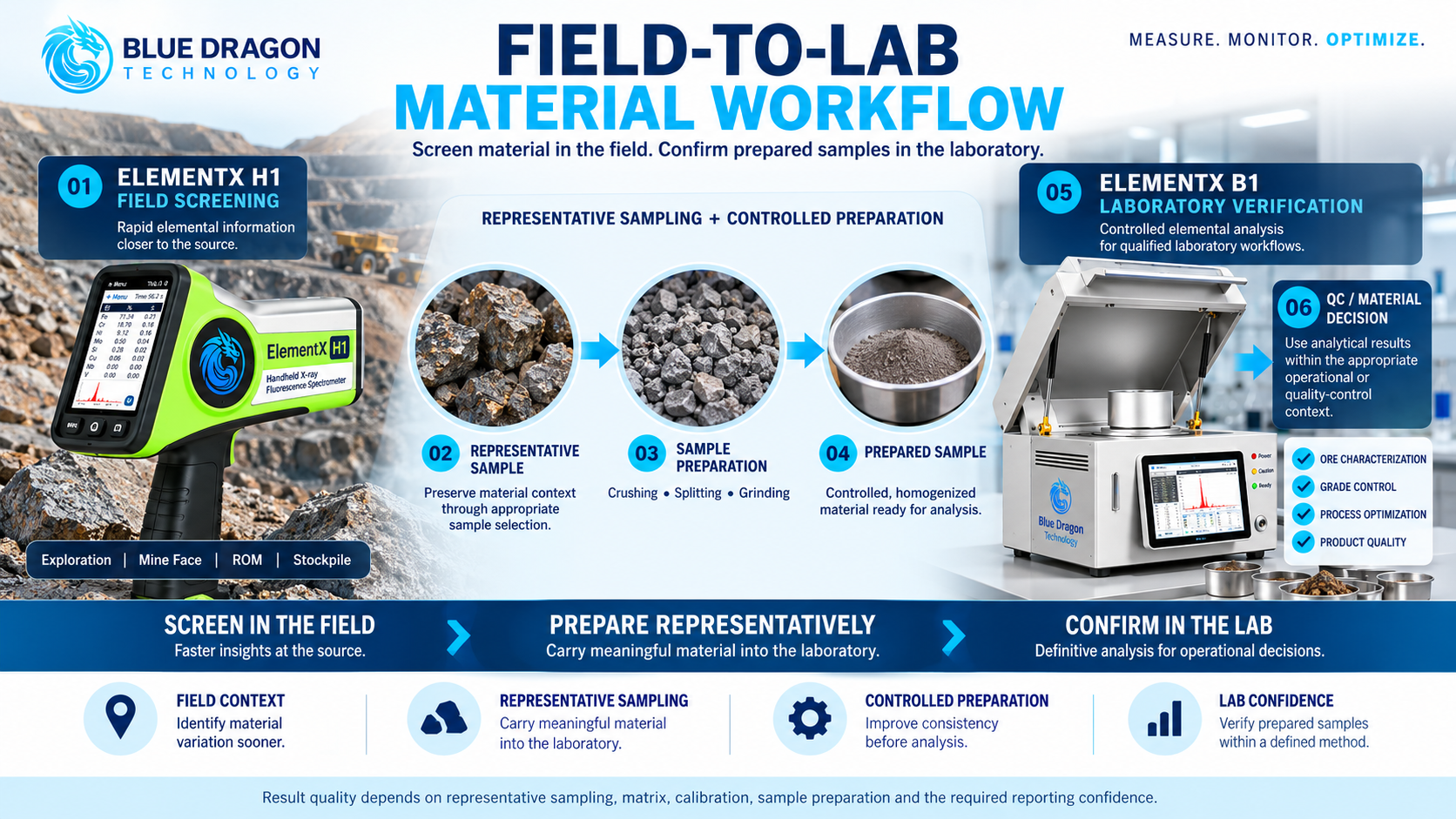
Blue Dragon field-to-lab mining material workflow showing ElementX H1 field XRF screening, representative sampling, sample preparation and ElementX B1 laboratory verification.

A field-to-laboratory workflow can combine rapid screening with representative sampling, controlled sample preparation and prepared-sample elemental verification.

From Field Screening to Laboratory Verification

Field and laboratory measurements should not be considered competing approaches. They answer different questions and can form part of the same material-information workflow.

A typical sequence may involve:

  1. Field screening to identify variation and prioritize material
  2. Representative sampling to preserve the context of the material being evaluated
  3. Sample preparation through suitable crushing, splitting, grinding or homogenization
  4. Laboratory analysis of the prepared sample under controlled conditions
  5. Decision or QC action using the result within the appropriate analytical and operational context

The quality of the final result depends on more than the analyzer itself. Representative sampling, sample preparation, matrix effects, calibration and the required reporting confidence all influence analytical performance.

Laboratory Ore and Concentrate Analysis

As material moves from the mine into laboratory and quality-control workflows, measurement becomes more controlled.

Prepared-sample elemental analysis can support comparison and verification of qualified ores, concentrates, processed mineral products, metals and other materials where the installed analytical method is suitable.

The Blue Dragon ElementX B1 provides a benchtop XRF platform for prepared-sample elemental analysis.

Potential laboratory workflows can include:

  • Prepared-sample elemental verification
  • Ore and concentrate quality control
  • Comparison of production batches or material lots
  • Controlled analysis within defined preparation and calibration procedures
  • Support for operational or reporting decisions where the analytical method is qualified

Critical Minerals and Battery Materials

Critical-mineral and battery-material projects can require measurement at several points between geological exploration and processed-material quality control.

Field screening can help identify elemental variation and guide sample selection. Laboratory analysis can then be applied to prepared materials within a defined analytical method.

Potential material streams can include:

  • Exploration samples and mineralized material
  • Ores and concentrates
  • Intermediate products
  • Battery-material feedstocks
  • Processed materials requiring elemental comparison or QC

Suitability should be reviewed according to the target elements, concentration range, matrix, sample preparation and installed calibration. Light-element and battery-material applications should be evaluated individually rather than assumed to be equivalent across all materials.
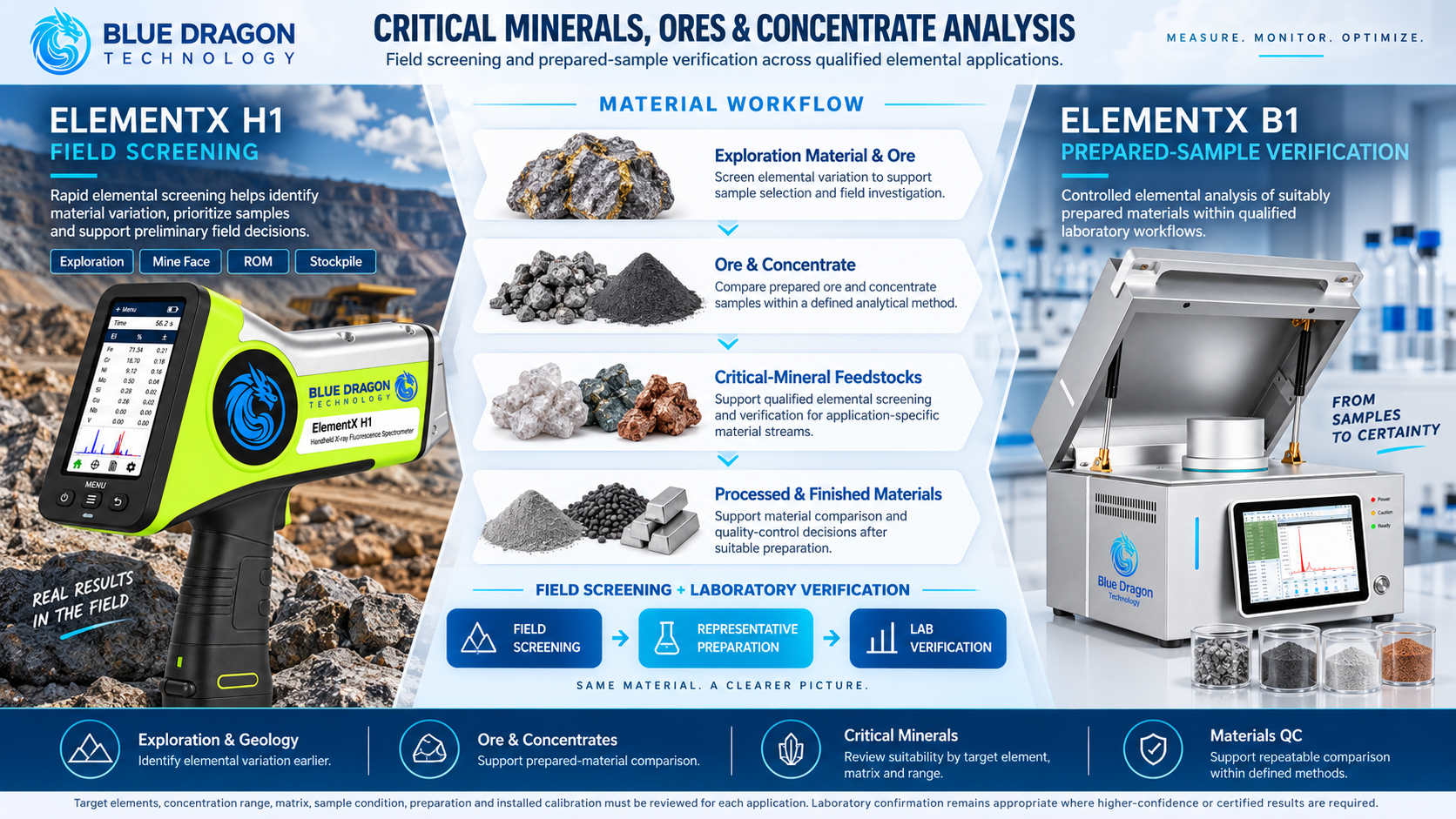
Blue Dragon ElementX H1 handheld XRF and ElementX B1 benchtop XRF for field screening and prepared-sample analysis of critical minerals, ores and concentrates.

Field and laboratory XRF can support different stages of qualified critical-mineral and materials workflows, from screening geological material to prepared-sample comparison and quality control.

Metals, Alloys and Materials Quality Control

Material measurement continues after mineral processing. Metals, alloys and other processed materials may require elemental comparison as part of incoming inspection, production control or finished-material quality workflows.

For suitable materials and qualified analytical methods, a benchtop XRF workflow can support:

  • Incoming material QC against an approved reference or specification
  • Material comparison by evaluating elemental differences between suitable samples
  • Batch consistency through controlled comparison of production lots
  • Finished-material QC before release or further processing

Instrument suitability depends on the target elements, matrix, concentration range, sample form, surface condition, preparation, installed calibration and required reporting confidence. Where alloy-grade identification is required, the method should be specifically qualified for the material system involved.

Water Monitoring in Mining and Mineral Processing

Water moves through many different parts of mining and mineral-processing operations. Depending on the site, measurement requirements can arise in process-water circuits, reclaim systems, treatment and clarification, mine-water management, wastewater systems and discharge points.

Different analytical parameters answer different questions, so the technology should be selected according to the condition the operator actually needs to observe.

Turbidity Monitoring

Turbidity provides optical information related to suspended or scattering material in water. Changes in turbidity can be relevant to circulating process water, clarification, reclaim-water systems, treatment processes and qualified wastewater or discharge applications.

The Blue Dragon C620TUR provides continuous turbidity measurement for suitable water applications.

Total Organic Carbon Analysis

Total organic carbon, or TOC, provides a different view of water condition by measuring carbon associated with organic material in a suitable sample.

The Blue Dragon C680 laboratory TOC analyzer supports controlled laboratory measurement of qualified mine-water, process-water, reclaim-water and industrial-water samples.

Oil-in-Water Monitoring

Hydrocarbon contamination can create another monitoring requirement in suitable mining and industrial-water systems. Potential applications can include process water, reclaim water, wastewater, discharge locations and leak or contamination-watch points.

The Blue Dragon C610OIW online oil-in-water analyzer provides continuous oil-in-water measurement for qualified applications where changing hydrocarbon conditions need to be monitored over time.

Water-analysis suitability depends on factors such as expected concentration range, particle characteristics, oil type, emulsification, turbidity, fouling, sample presentation, cleaning requirements, calibration and the required reporting objective.
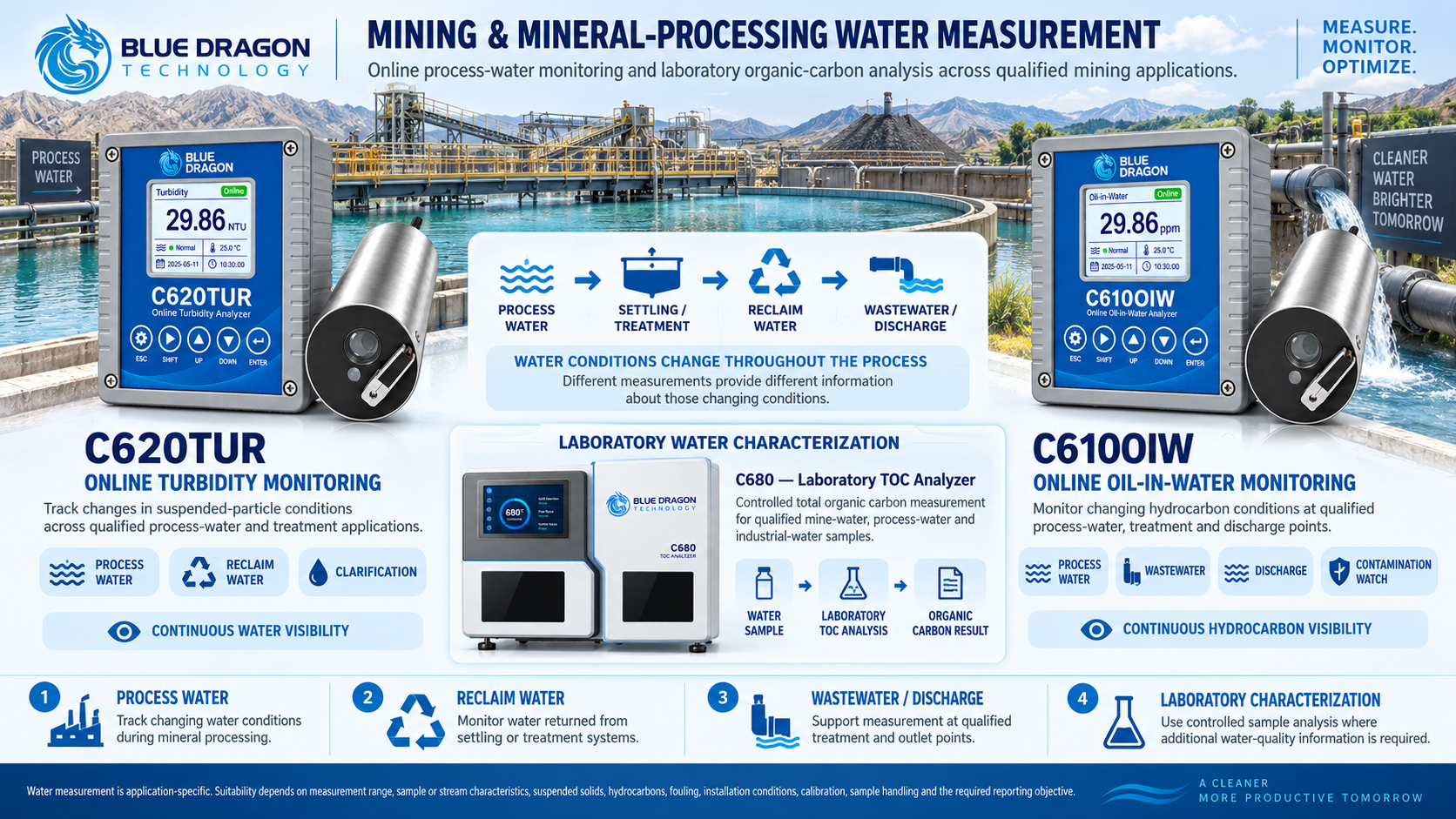
Blue Dragon Technology mining and mineral-processing water measurement solutions showing C620TUR turbidity, C610OIW oil-in-water and C680 laboratory TOC analysis across process, reclaim and wastewater applications.

Different water measurements provide different forms of process visibility across mining and mineral-processing water systems, from suspended-material trends to organic carbon and hydrocarbon contamination.

Metallurgical Process Measurement

Once material reaches metallurgical or downstream processing, measurement requirements expand beyond elemental composition and water analysis.

Process instrumentation can provide additional visibility into qualified total sulfur, temperature and gas-flow applications.

These measurements should be considered within the actual process context. Stream composition, phase, pressure, temperature, expected measurement range, installation geometry, hazardous-area requirements and plant-integration requirements can all influence instrument selection.

Total Sulfur Measurement

Continuous total sulfur measurement can provide online visibility where sulfur concentration is an important process parameter. Standard documented configurations are intended for suitable liquid process streams, while gas-phase applications require confirmed project configuration.

The Blue Dragon Model 800TS online total sulfur analyzer supports continuous total sulfur measurement in qualified applications, allowing sulfur information to be incorporated into broader process monitoring and plant-data systems.

Application review should consider sulfur species, concentration range, stream composition and phase, temperature, pressure, sample conditioning, flow conditions, installation environment and calibration requirements.

Multi-Point Temperature Measurement

Temperature distribution can be important in metallurgical, thermal and utility equipment where a single measurement point does not provide enough information about conditions across the process.

The Blue Dragon BDT-MP multipoint temperature assembly supports multi-point temperature measurement in qualified process equipment, allowing operators to observe temperature profiles across selected process zones.

Potential applications can include reactor or vessel profiling, kilns, furnaces and other thermal processes, as well as temperature monitoring associated with qualified utility and heating systems.

Blue Dragon’s temperature measurement portfolio includes solutions for different industrial measurement environments and installation requirements.

Flow Measurement

Flow information can help operators understand movement, throughput and process behaviour in qualified gas and process-service applications.

The Blue Dragon FF1225-A single-path inline ultrasonic gas flow meter represents one approach within the broader Blue Dragon flow measurement portfolio.

Flow measurement is application-specific. Stream composition, phase, pressure, temperature, line size, installation conditions and the required reporting objective should be reviewed before a measurement system is selected.
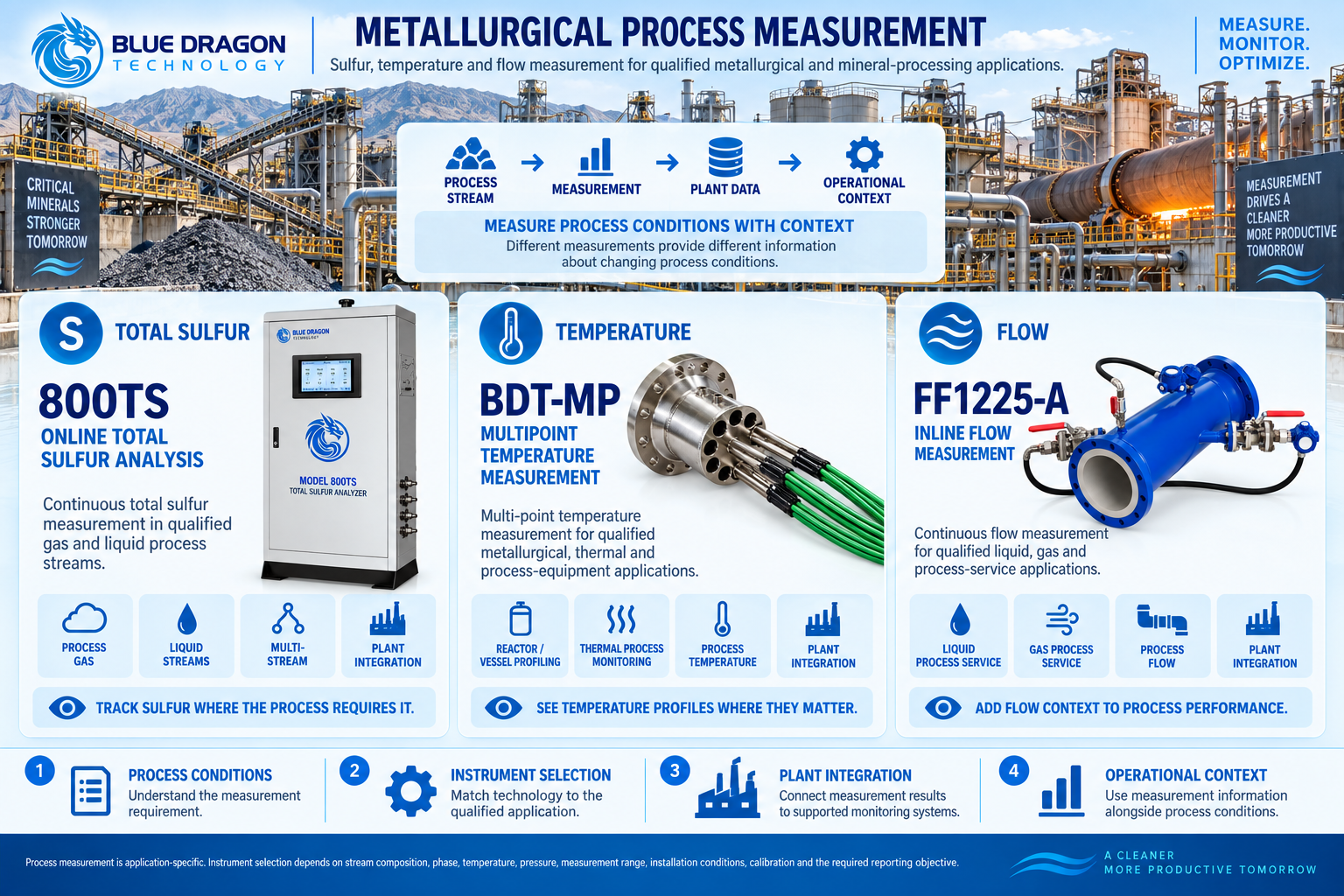
Blue Dragon metallurgical process measurement solutions featuring the Model 800TS total sulfur analyzer, BDT-MP multipoint temperature assembly and FF1225-A inline ultrasonic gas flow meter.

Representative Blue Dragon process-measurement categories for metallurgical and mineral-processing operations, combining qualified sulfur, temperature and gas-flow applications.

Mining and Materials Measurement Points and Instrumentation

The following table summarizes the major measurement areas discussed above. It is intended as an application overview rather than a universal specification for every mining or materials operation.

Application Area Measurement Need Technology Representative Blue Dragon Solution
Exploration and field geology Rapid elemental screening Handheld XRF ElementX H1
Mine face / ROM / stockpile Material-variation screening Handheld XRF ElementX H1
Laboratory / ore / concentrate QC Prepared-sample elemental analysis Benchtop XRF ElementX B1
Process / reclaim / treatment water Turbidity Online optical turbidity measurement C620TUR
Mine and industrial water Total organic carbon Laboratory TOC analysis C680
Water / wastewater hydrocarbon monitoring Oil-in-water Continuous oil-in-water analysis C610OIW
Metallurgical process streams Total sulfur Online total sulfur measurement Model 800TS
Thermal / metallurgical equipment Temperature profile Multi-point industrial temperature measurement BDT-MP / Temperature Portfolio
Qualified gas process lines Gas flow Inline flow measurement FF1225-A / Flow Portfolio
Application note: Final instrument suitability depends on the material or process characteristics, measurement range, sample or stream conditions, installation environment, calibration and the operational or reporting objective.

How to Select Instrumentation for Mining and Materials Applications

Instrument selection should begin with the application rather than with the product model.

A measurement system that performs well in one mine, laboratory or process stream may not be appropriate for another if the material, matrix, concentration, installation or process conditions are substantially different.

1. Define the Measurement Objective

Determine whether the measurement is intended for preliminary screening, laboratory verification, process monitoring, quality control, troubleshooting or formal reporting.

2. Understand the Material or Stream

Composition, matrix, physical form, particle size, moisture, oil type, suspended solids, process phase and other characteristics can affect measurement performance.

3. Establish the Required Measurement Range

The expected normal range and realistic process variation should both be considered when determining whether a measurement technology is suitable.

4. Review Sampling and Sample Preparation

Analytical performance depends strongly on whether the sample is representative of the material being evaluated and whether preparation is appropriate for the measurement method.

5. Review Process and Environmental Conditions

Temperature, pressure, dust, vibration, fouling, hazardous-area classification, available utilities and physical accessibility can all influence instrument and installation design.

6. Define Calibration and Verification Requirements

The installed method should be appropriate for the target material or process. Reference materials, calibration procedures and ongoing verification requirements should be identified before the measurement is relied upon operationally.

7. Consider Plant Integration

Where measurement data must be transferred to plant monitoring, control or reporting systems, communications, outputs and integration requirements should be established early in the project.

8. Plan for Maintenance and Support

Access, cleaning, calibration, consumables, inspection and long-term maintenance should be considered as part of instrument selection rather than after installation.
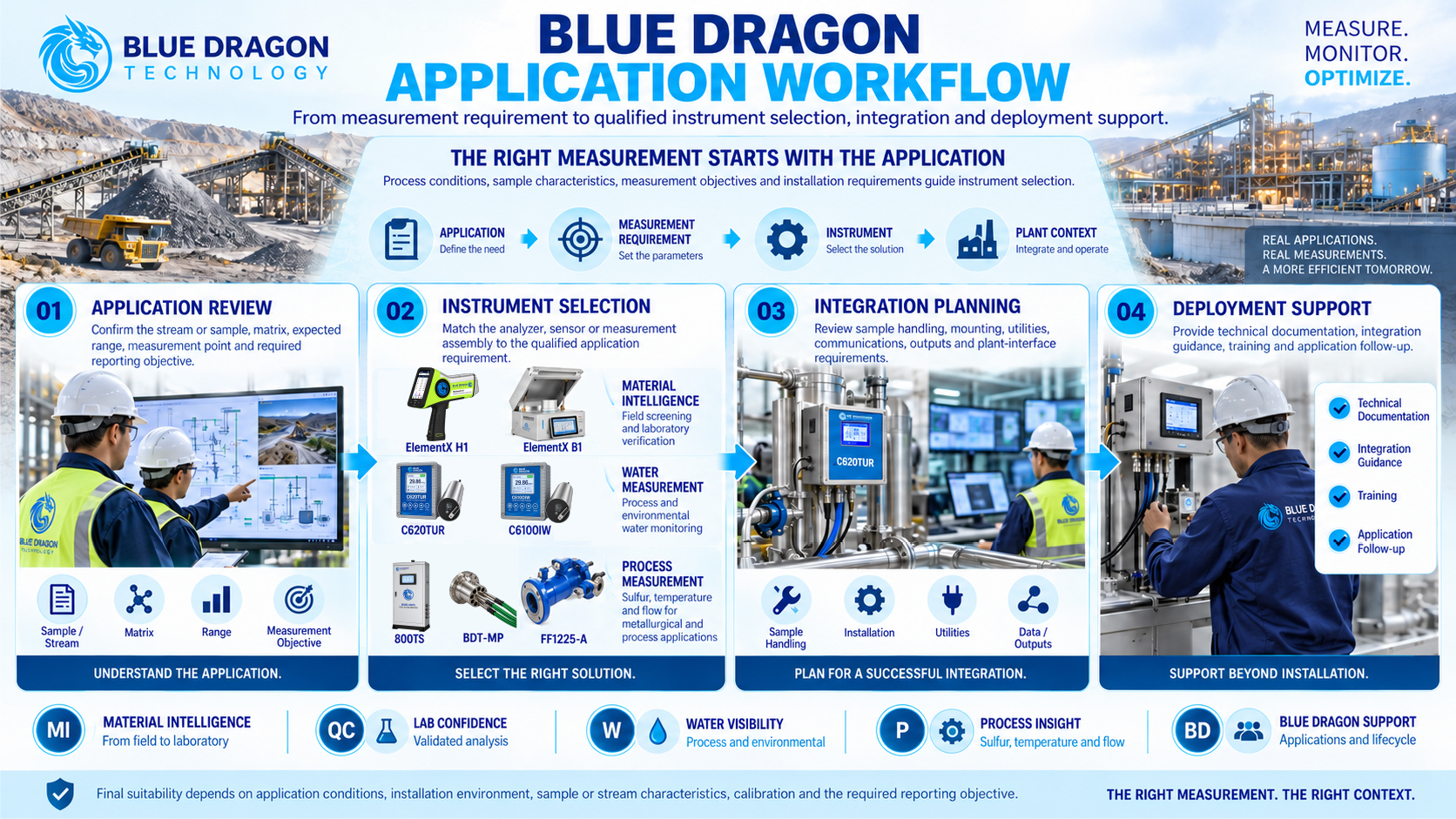
Blue Dragon Technology application workflow showing application review, instrument selection, integration planning and deployment support for mining, water and process measurement systems.

Blue Dragon’s application workflow begins with the measurement requirement and process conditions before moving into instrument selection, integration planning and deployment support.

From Individual Instruments to an Integrated Measurement Strategy

A mining operation does not become better instrumented simply by installing more analyzers. Measurement creates value when the technology is matched to a clearly defined application and the information can be used within the operating workflow.

An integrated measurement strategy can connect several different disciplines:

  • Field elemental screening to identify variation sooner
  • Prepared-sample laboratory analysis to confirm composition within controlled workflows
  • Water measurement to provide visibility into process, reclaim, treatment and wastewater systems
  • Total sulfur measurement for qualified metallurgical process streams
  • Temperature measurement to observe thermal conditions and profiles
  • Flow measurement to add movement and throughput information to process understanding

Together, these measurements can provide a broader picture of material and process conditions than any individual instrument can provide on its own.

Blue Dragon Technology supports both individual measurement applications and broader projects spanning field, laboratory, water and process instrumentation.

Frequently Asked Questions About Mining and Materials Instrumentation

What instrumentation is used in mining and mineral processing?

Mining and mineral-processing operations use different instrumentation according to the process and measurement objective. Technologies can include elemental analyzers, water-quality analyzers, temperature sensors, flow instrumentation, sulfur analyzers and many other process-measurement systems.

How is handheld XRF used in mining?

Handheld XRF can provide rapid elemental screening in exploration, field geology, mine-face, ROM and stockpile applications where the target elements, matrix, concentration range and analytical method are suitable. It is generally used as a screening technique rather than as a universal replacement for laboratory analysis.

What is the difference between field XRF and laboratory XRF?

Field XRF prioritizes portability and rapid screening close to the material source. Laboratory XRF can analyze prepared samples under more controlled conditions. The two approaches can be combined within the same field-to-laboratory workflow.

Why is representative sampling important?

An analyzer measures the sample presented to it. If that sample does not adequately represent the material or process being evaluated, even a technically accurate measurement may not represent the larger batch, stockpile or process condition.

What water parameters can be monitored in mining operations?

The required parameters depend on the water system and measurement objective. Relevant applications can include turbidity, total organic carbon, oil-in-water and many other water-quality measurements associated with process water, mine water, reclaim water, treatment, wastewater or discharge.

How should mining process instrumentation be selected?

Selection should begin with the measurement objective and actual operating conditions. Important factors can include material or stream composition, phase, measurement range, pressure, temperature, installation geometry, sample handling, calibration, environmental conditions, plant integration and maintenance requirements.

Building the Right Measurement Solution for Mining and Materials Operations

Modern mining and materials operations combine geological variability, material handling, laboratory quality control, water management and process measurement within the same production chain.

The appropriate measurement strategy therefore begins by asking four fundamental questions: what needs to be measured, where the measurement should occur, what conditions the instrument must operate under and how the resulting information will be used.

Blue Dragon Technology provides analytical and process-measurement solutions spanning handheld and benchtop XRF, turbidity monitoring, total organic carbon analysis, oil-in-water measurement, total sulfur analysis, industrial temperature measurement and flow measurement.

Individual measurement points or broader mining and materials projects can be reviewed application by application so that the instrument, calibration, sample handling, installation and integration approach match the actual operating requirement.

Discuss Your Mining & Materials Measurement Requirements

Blue Dragon Technology can support individual measurement applications or broader instrumentation requirements across exploration, mining, laboratory quality control, water systems and metallurgical processing.

Blue Dragon Technology
Measure. Monitor. Optimize.
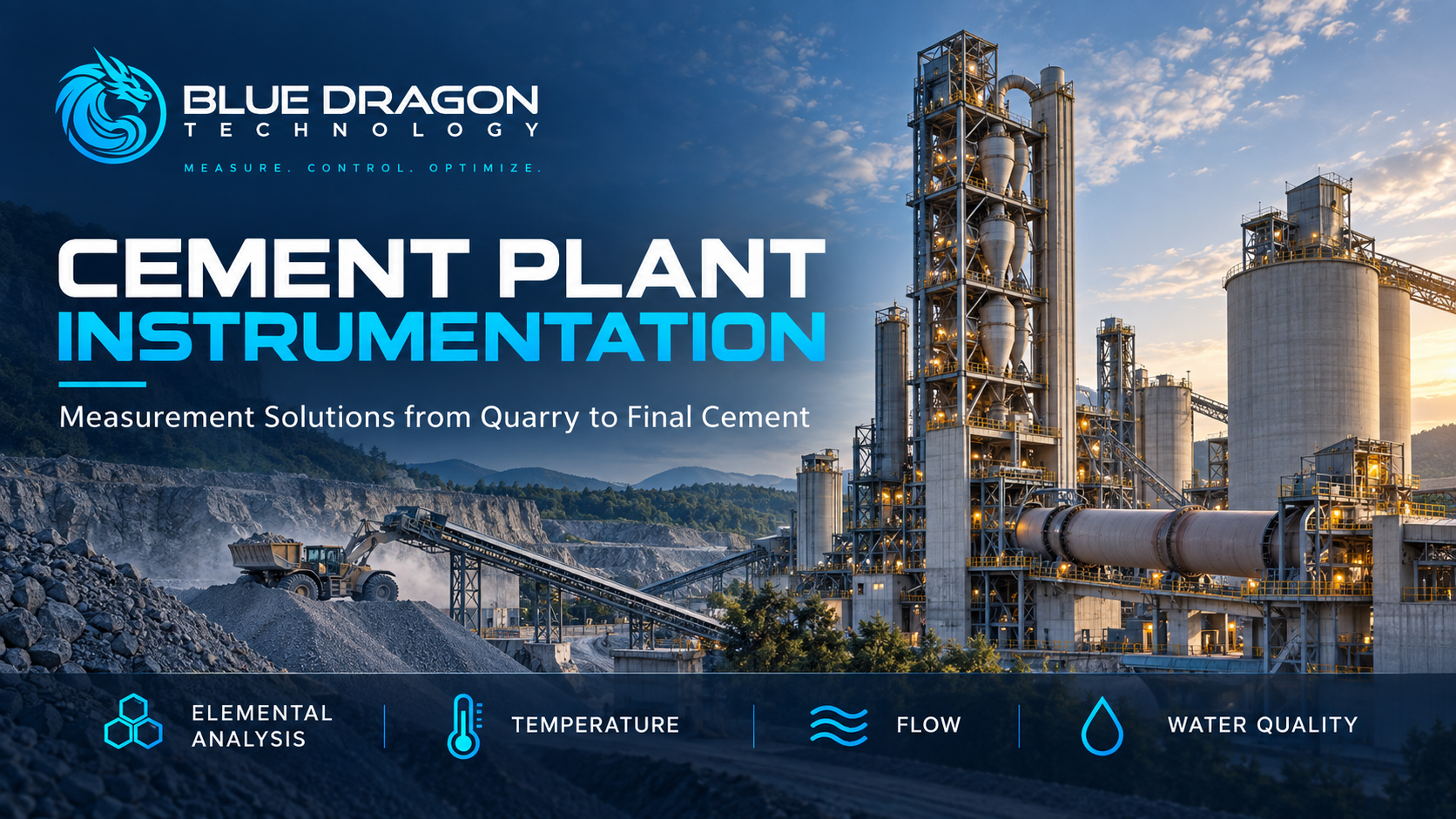
Blue Dragon Technology cement plant instrumentation solutions for process monitoring, quality control, and industrial analysis

Cement Plant Instrumentation: Measurement Solutions from Quarry to Final Cement

Cement manufacturing is a continuous process in which small variations in raw materials, thermal conditions, gas flow, product chemistry and supporting utilities can affect operating stability and final product quality.

Reliable measurement is therefore required across the plant—from the quarry and raw-material preparation stages through clinker production, cement grinding and plant utility systems.

There is no single instrument that can address every measurement point in a cement plant. Different stages require different technologies, including elemental analysis, temperature measurement, flow measurement and water-quality analysis.

An effective instrumentation strategy begins by identifying what needs to be measured, where the measurement should be made, the process conditions at that location and how the resulting data will be used.

This article examines some of the major measurement opportunities throughout cement production and the technologies that can be applied to them.

Cement Plant Measurement Solutions: Video Overview

The Blue Dragon Technology presentation below provides a process-by-process overview of measurement applications throughout cement and clinker production, from raw-material analysis through thermal processing, flow measurement and plant water systems.

The sections below expand on the measurement challenges covered in the presentation and explain how different analytical and process-measurement technologies can fit into the cement manufacturing chain.

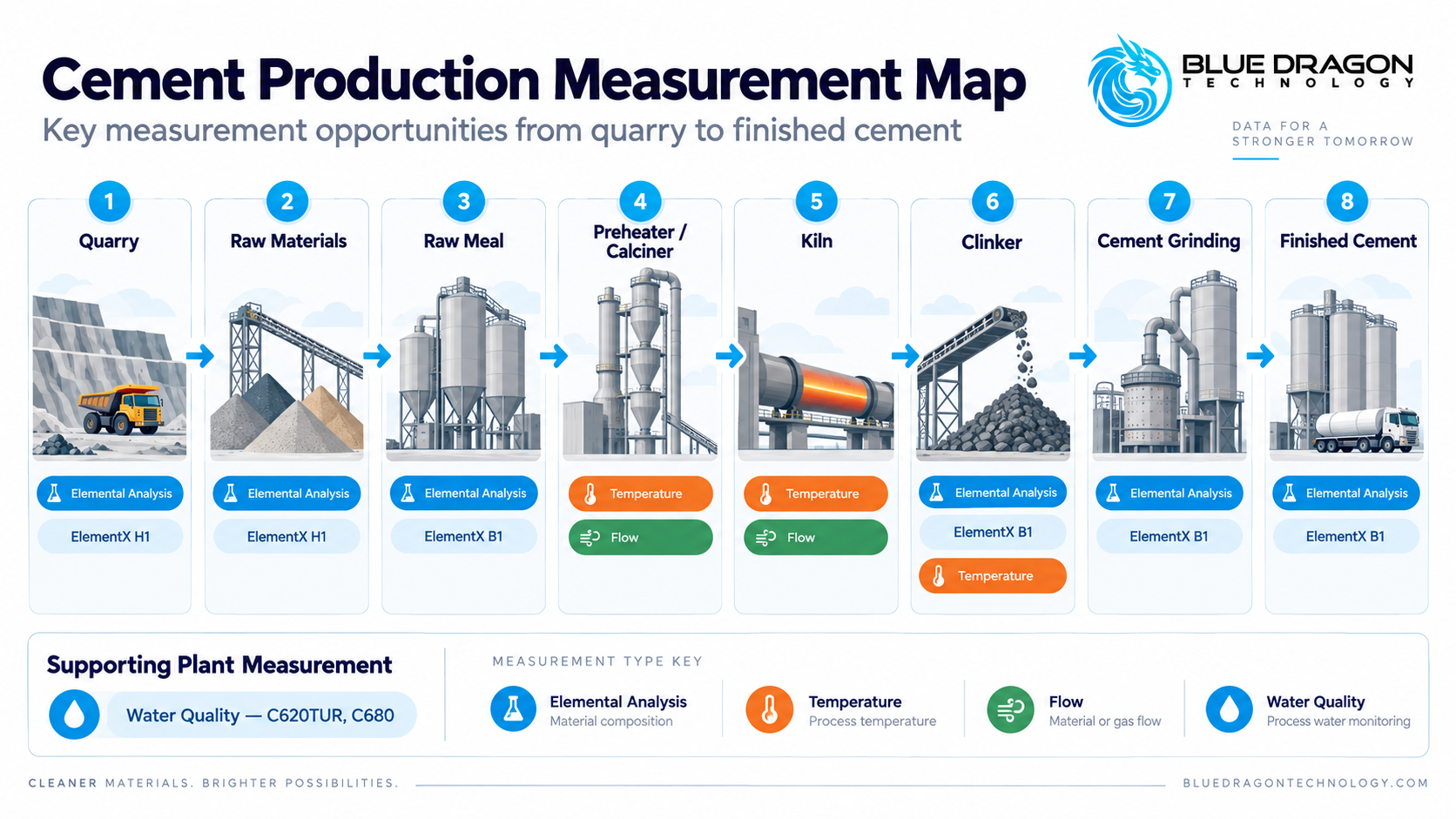
Cement production measurement map showing quarry, raw materials, raw meal, preheater and calciner, kiln, clinker, cement grinding and finished cement with elemental analysis, temperature, flow and water quality measurement points.

Key measurement opportunities across the cement production process, from quarry and raw-material analysis through clinker production, finished cement and supporting plant utilities.

Understanding the Cement Production Measurement Chain

A cement plant combines several very different operating environments within a single production process.

At the beginning of the process, the challenge is largely one of material composition. Limestone and other raw materials must be evaluated so that variations in feed chemistry can be understood and managed.

Further into the plant, raw materials are processed at elevated temperatures through preheating, calcination and clinker formation. Here, temperature measurement becomes an important part of understanding process conditions.

Air and process-gas movement introduce another measurement requirement. Flow conditions can affect combustion, heat transfer and process operation, while the hot and dusty environment can make measurement technically demanding.

Elsewhere in the facility, laboratory analysis, plant water, wastewater and utility systems introduce additional analytical requirements.

For this reason, cement plant instrumentation is best considered as an interconnected measurement architecture rather than as a collection of unrelated instruments.

Raw-Material Analysis in Cement Production

The composition of raw materials establishes the chemical foundation of cement production. Limestone normally provides the principal calcium-bearing component, while other materials contribute silicon, aluminium, iron and additional constituents required by the process.

Natural deposits are not perfectly uniform. Composition can change between quarry areas, extraction zones, stockpiles and incoming material sources. Rapid access to elemental information can therefore help plant personnel understand material variability before material moves deeper into the production process.

Using XRF for Raw-Material Screening

X-ray fluorescence spectroscopy, or XRF, is widely used for elemental analysis because it can identify and quantify multiple elements without requiring destructive chemical digestion for every measurement.

For field-oriented applications, handheld XRF can provide rapid elemental information directly at the point of inspection. This can be useful for applications such as:

  • Quarry and geological screening
  • Raw-material identification
  • Comparison of material from different extraction areas
  • Incoming material verification
  • Stockpile screening
  • Rapid investigation of unexpected material variation

The Blue Dragon ElementX H1 handheld XRF spectrometer provides a portable approach to non-destructive elemental analysis where measurements need to be taken directly in the field or at the material location.

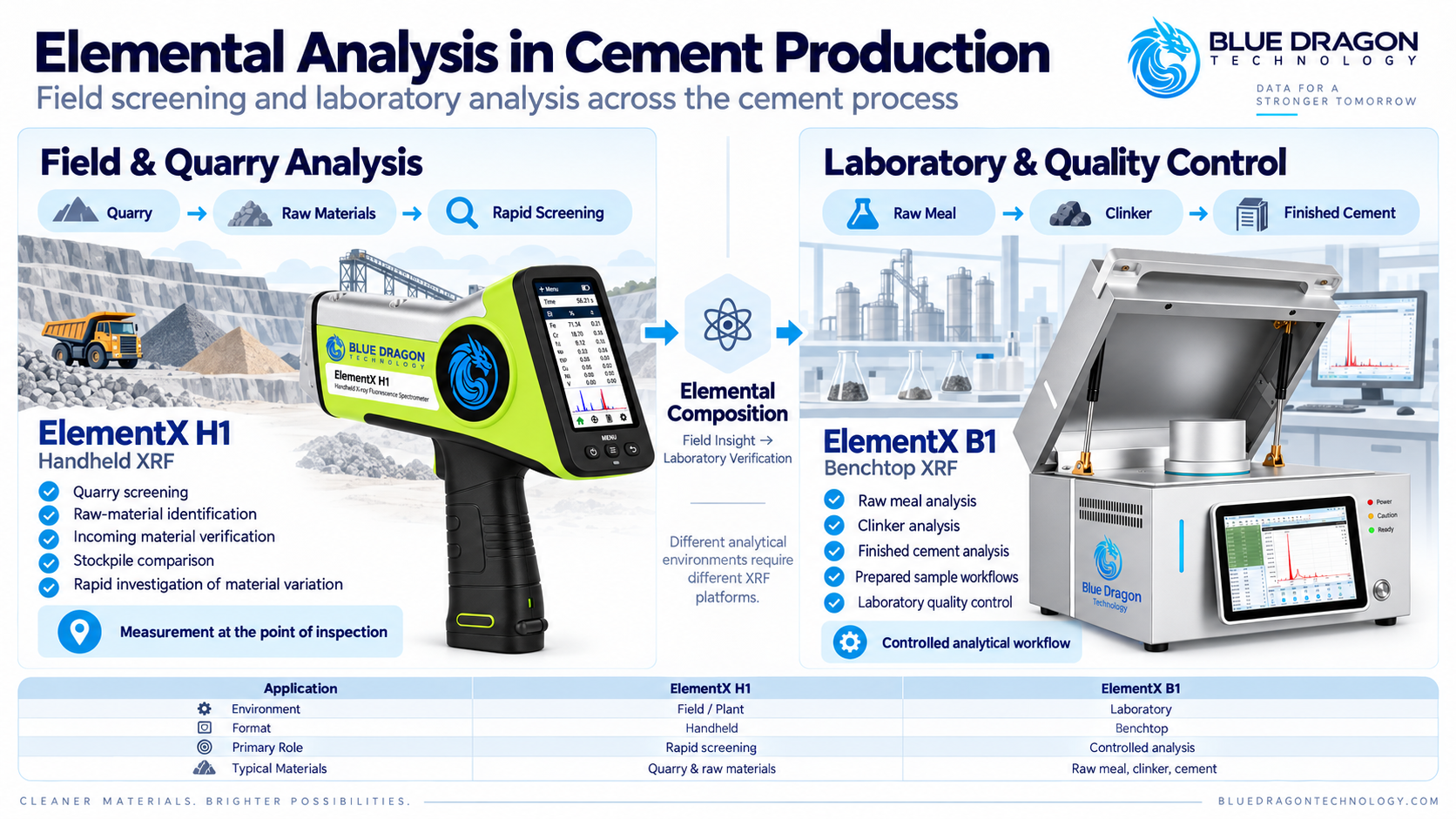
Blue Dragon ElementX H1 handheld XRF for quarry and raw-material screening alongside the ElementX B1 benchtop XRF for laboratory analysis of raw meal, clinker and finished cement.

Handheld and benchtop XRF platforms support different elemental-analysis requirements across cement production, from quarry and raw-material screening to laboratory analysis of raw meal, clinker and finished cement.

Elemental Analysis of Raw Meal, Clinker and Finished Cement

As material progresses through the plant, the purpose of elemental analysis changes.

At the quarry, the objective may be rapid screening and identification of variation. Within a laboratory or quality-control environment, measurements may instead be used to characterize prepared samples, compare production materials and support established plant quality procedures.

Common sample types can include:

  • Raw materials
  • Corrective materials
  • Raw meal
  • Clinker
  • Intermediate materials
  • Finished cement

The Blue Dragon ElementX B1 provides a laboratory-oriented XRF platform for elemental analysis applications where a benchtop configuration is preferable.

It is important to distinguish elemental analysis from other forms of material characterization. XRF provides elemental composition information; other analytical techniques may be required where the objective is to determine mineralogical phases, physical properties or other characteristics that are not directly measured by XRF.

Instrument selection should therefore begin with the analytical question the plant needs to answer rather than simply with the sample type.

Temperature Measurement in Cement Production

Cement manufacturing includes some of the most demanding thermal processes found in industrial production. Temperature changes substantially as material progresses through preheating, calcination, kiln processing and clinker cooling.

Reliable temperature information can support operators in understanding process conditions, identifying abnormal behaviour and maintaining visibility across thermal equipment.

Potential measurement locations can include areas associated with:

  • Raw-material heating
  • Preheater systems
  • Calcination
  • Kiln operation
  • Process-gas temperatures
  • Clinker handling and cooling
  • Associated ducts and process equipment

Why Temperature Measurement Can Be Challenging

Selecting a temperature sensor for a cement application requires more than choosing a suitable nominal temperature range.

The measurement point may also expose the sensor or assembly to:

  • High process temperatures
  • Abrasive dust
  • Mechanical vibration
  • Changing gas velocities
  • Thermal cycling
  • Long insertion requirements
  • Restricted maintenance access

The correct sensor, protection assembly and installation method therefore depend on the specific measurement location and operating conditions.

Blue Dragon’s industrial temperature measurement portfolio includes solutions designed for different process environments and installation requirements. Application review is particularly important where temperature, abrasion, process pressure or mechanical exposure is significant.

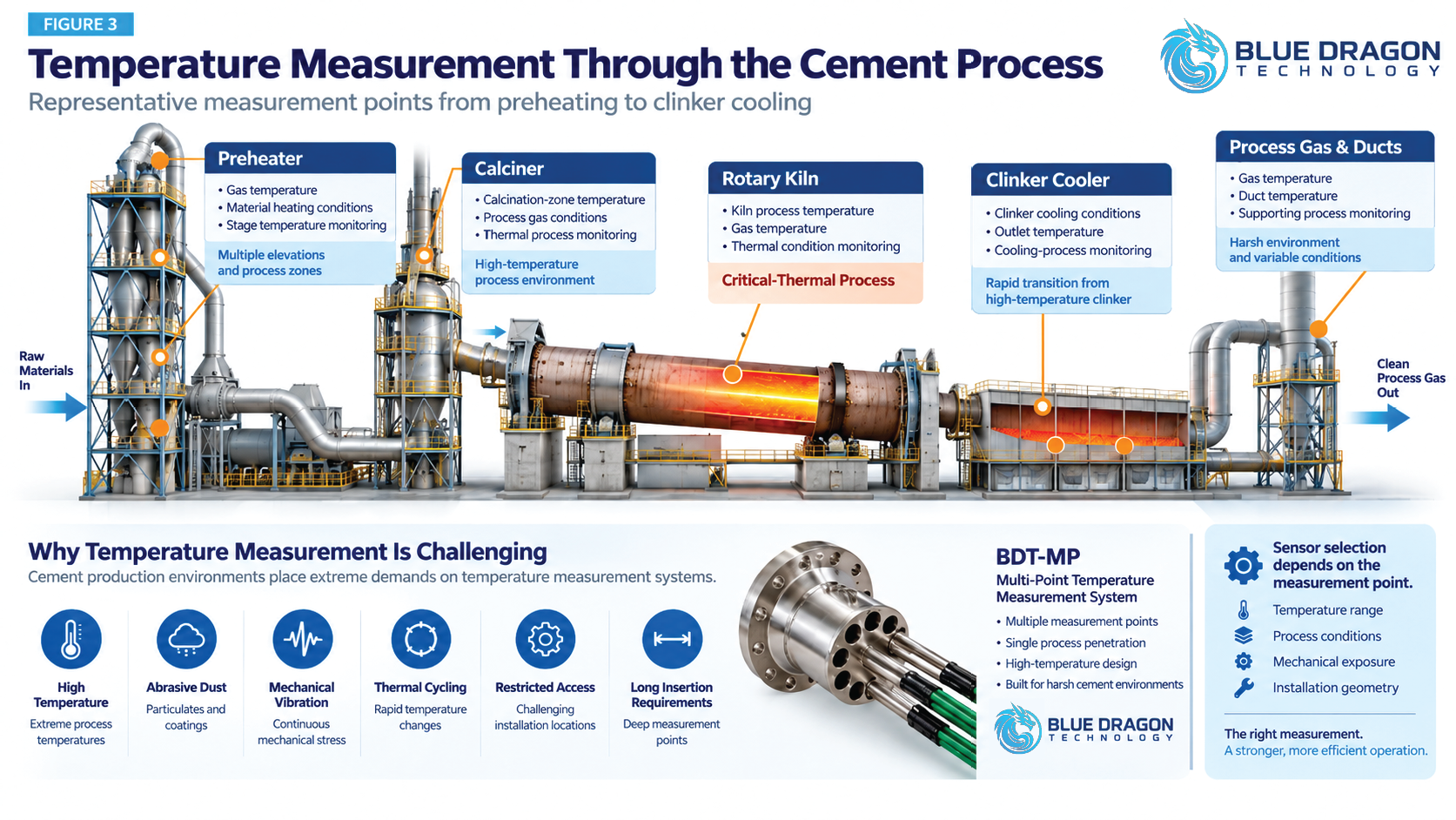
Cement process temperature measurement infographic showing the preheater, calciner, rotary kiln, clinker cooler and process gas ducts with representative temperature measurement points and the Blue Dragon BDT-MP multi-point temperature system.

Representative temperature measurement points across the cement thermal process, from preheating and calcination through rotary-kiln operation, clinker cooling and associated process-gas systems.

Flow Measurement in Cement Plant Gas and Air Systems

Gas and air movement is another important part of cement production. Depending on the process configuration, measurement may be required in air, gas or duct systems associated with combustion, process control, ventilation or material processing.

These applications can be challenging because measurement conditions may include combinations of:

  • Elevated temperatures
  • High dust loading
  • Large duct dimensions
  • Non-uniform velocity profiles
  • Abrasive particulate matter
  • Variable process conditions

An instrument that performs well in a clean utility-gas application may therefore not be appropriate for a hot, particulate-laden process stream.

Application-Specific Flow Measurement

The measurement objective should first be defined. The plant may need to determine velocity, volumetric flow, mass flow or simply monitor changes in process behaviour. Installation geometry and available straight-run distances may also influence technology selection.

The Blue Dragon FF1225-XT flow measurement platform is one of the technologies available within the Blue Dragon flow portfolio for industrial applications requiring process-flow measurement.

For cement applications, the process conditions should be reviewed before final instrument selection so that the proposed measurement method is appropriate for the actual gas composition, temperature, particulate loading, duct geometry and expected flow range.

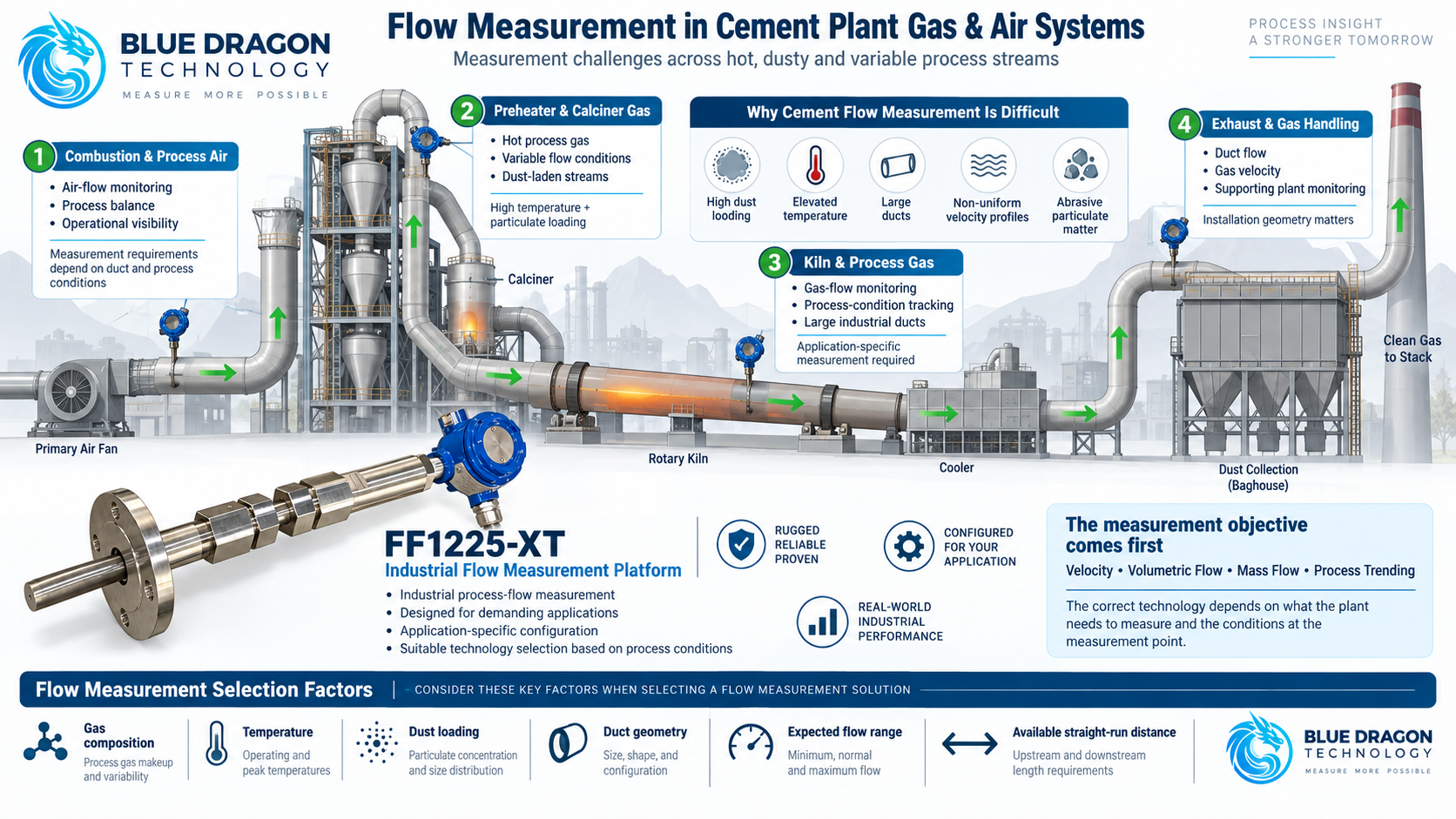
Cement plant flow measurement infographic showing representative process air and gas measurement points across preheater, calciner, kiln, cooler and exhaust systems with the Blue Dragon FF1225-XT industrial flow measurement platform.

Representative flow-measurement applications across cement-plant process air and gas systems, where temperature, dust loading, duct geometry and changing velocity profiles can influence technology selection.

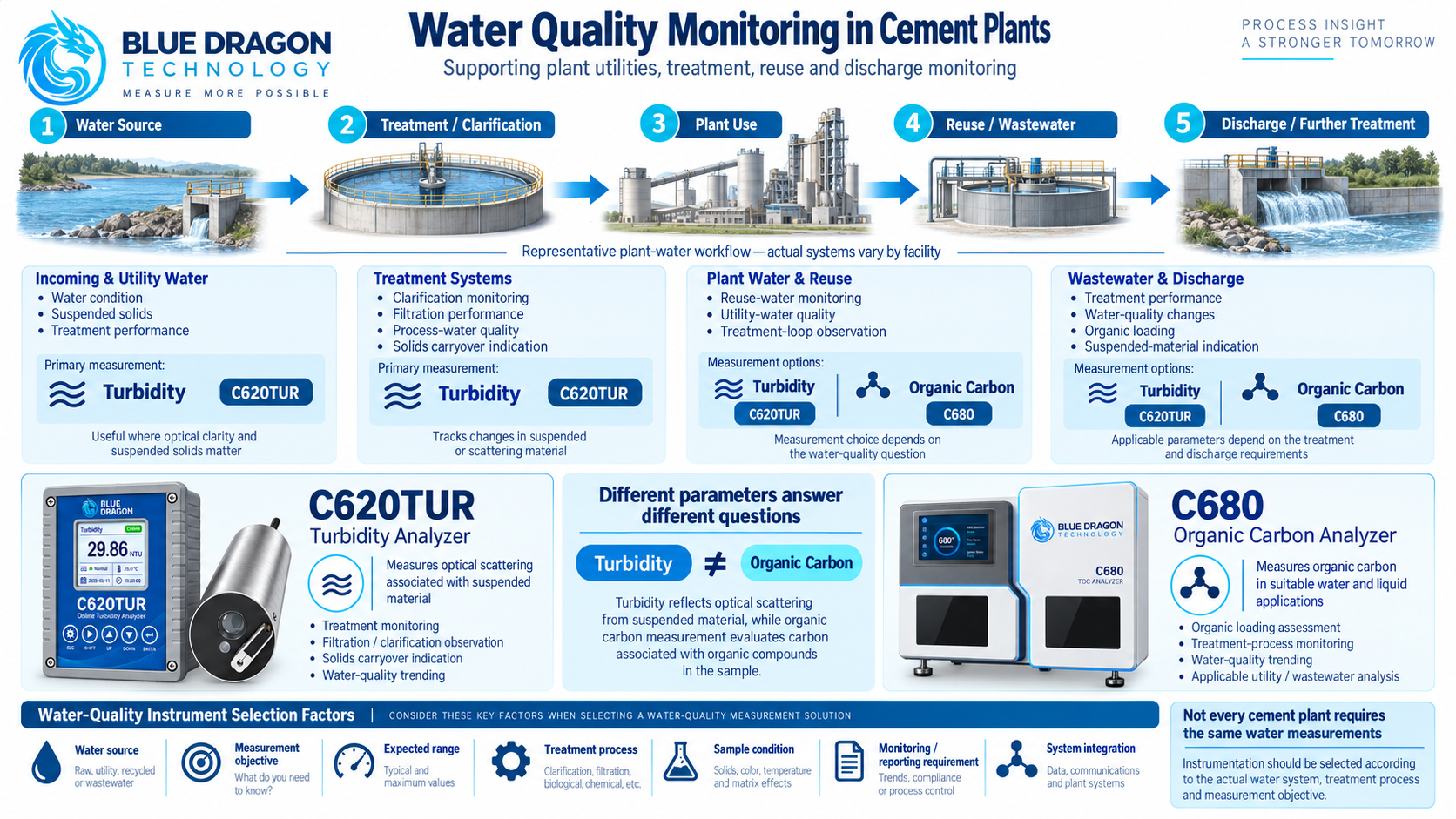
Water Quality Monitoring in Cement Plants

Although cement production is primarily associated with solid materials and high-temperature processing, water and wastewater systems remain important parts of many plant operations.

The exact water systems vary from one facility to another, but measurement requirements can arise in areas such as plant utilities, process water, treatment systems, discharge monitoring and water reuse.

Two parameters that may be relevant in appropriate applications are turbidity and organic carbon.

Turbidity Measurement

Turbidity provides information about the presence of suspended or optically scattering material in water. Monitoring turbidity can help operators observe changes in water condition, treatment performance or solids carryover where those factors are relevant to the plant’s water system.

The Blue Dragon C620TUR is designed for turbidity measurement in water applications.

Organic Carbon Measurement

Organic carbon analysis provides a different type of information. Rather than measuring suspended solids, it is used to assess carbon associated with organic material in the sample.

The Blue Dragon C680 provides organic carbon analysis for suitable water and liquid applications.

Not every cement plant will require both measurements. Water-quality instrumentation should be selected according to the actual water source, treatment process, discharge requirements and measurement objective.

Cement plant water-quality monitoring infographic showing water source, treatment and clarification, plant use, reuse and wastewater, and discharge applications with Blue Dragon C620TUR turbidity and C680 organic carbon analyzers.

Representative water-quality monitoring applications in cement plants, showing how turbidity and organic carbon measurements can support utility water, treatment, reuse and wastewater systems.

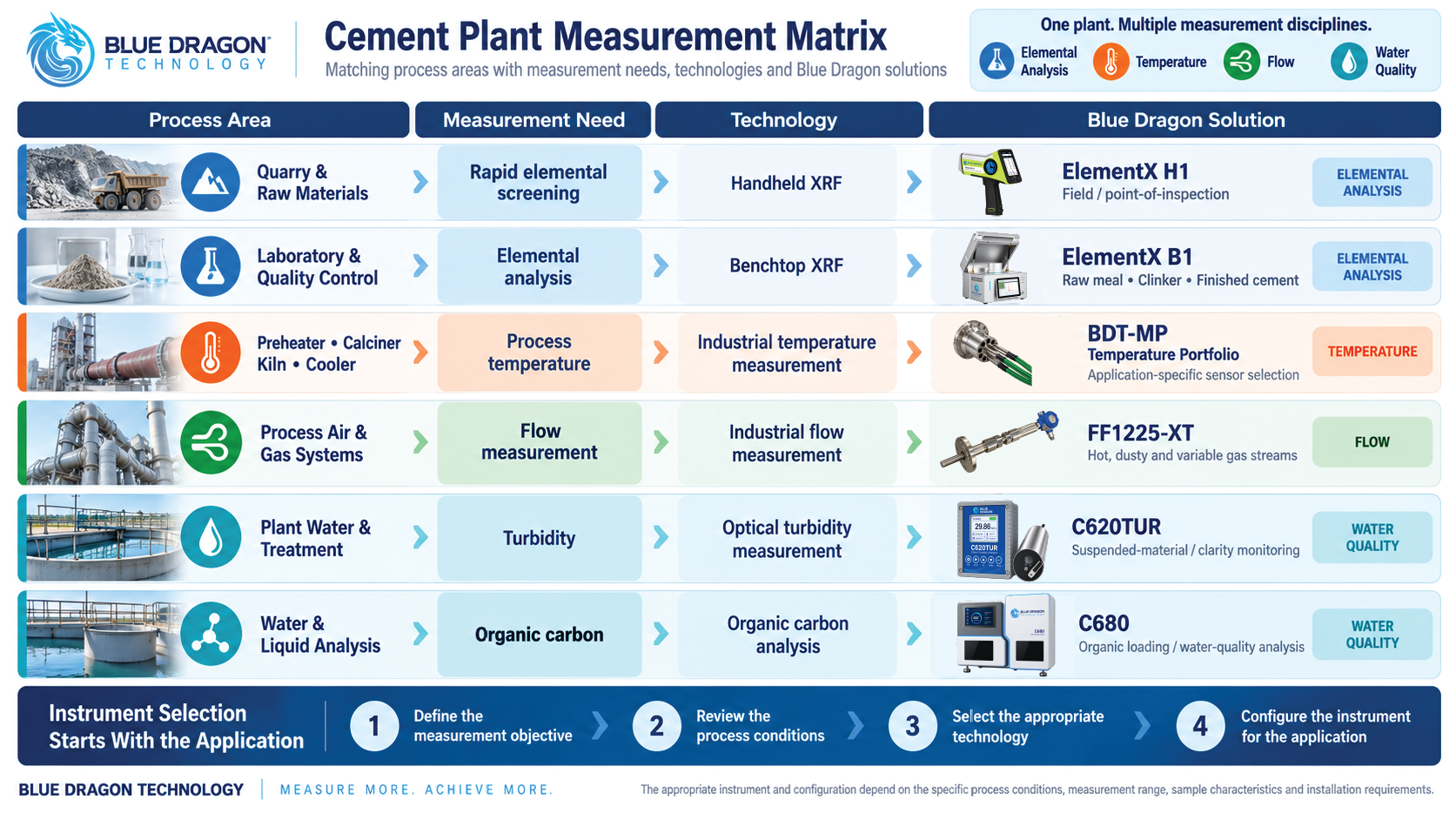
Cement Plant Measurement Points and Instrumentation

The following table summarizes several of the measurement categories discussed above. It is intended as an application overview rather than a universal instrument specification for every cement plant.

Process Area Measurement Need Technology Blue Dragon Solution
Quarry and raw materials Rapid elemental screening Handheld XRF ElementX H1
Laboratory and quality control Elemental analysis Benchtop XRF ElementX B1
Thermal process Process temperature Industrial temperature measurement Blue Dragon Temperature Portfolio
Process air and gas systems Flow measurement Industrial flow measurement FF1225-XT / Blue Dragon Flow Portfolio
Plant water systems Turbidity Optical turbidity measurement C620TUR
Water and liquid analysis Organic carbon Organic carbon analysis C680
Application note: The most appropriate configuration depends on the process conditions, measurement range, installation environment and required analytical or operational outcome.

Cement plant measurement matrix linking quarry and raw materials, laboratory quality control, thermal process, process air and gas, and water systems to XRF, temperature, flow, turbidity and organic carbon measurement technologies with Blue Dragon solutions.

Cement plant measurement matrix matching major process areas with measurement needs, technologies and representative Blue Dragon solutions across elemental analysis, temperature, flow and water-quality applications.

How to Select Instrumentation for a Cement Plant

Instrumentation should be selected around the application rather than simply around the parameter being measured.

Two plants may both require temperature measurement, for example, but the correct solution can differ substantially if one measurement point is in a relatively protected area while another is exposed to extreme heat, abrasive dust and vibration.

The same principle applies to analytical and flow instrumentation.

Before selecting an instrument, the following factors should normally be considered:

1. Measurement Objective

Define what the measurement is expected to accomplish. Screening, quality control, process monitoring, regulatory reporting and troubleshooting can require different levels of performance and different measurement approaches.

2. Expected Measurement Range

The instrument should be appropriate for both normal operating conditions and the range of variation that may realistically occur.

3. Sample or Process Characteristics

Material composition, physical form, moisture, dust loading, gas composition and other process characteristics can influence measurement performance.

4. Temperature and Environmental Conditions

Ambient and process temperature, humidity, dust, vibration and exposure conditions should be considered when determining installation suitability.

5. Installation Geometry

Flow instruments and inserted sensors can be particularly sensitive to location, available access and process geometry.

6. Calibration and Verification

Analytical instruments must be configured and calibrated for the intended application. Appropriate reference materials, verification procedures and quality-control practices may also be required depending on how the measurement will be used.

7. Maintenance and Accessibility

A measurement point that is technically ideal but extremely difficult to inspect or maintain may create operational problems over the life of the installation.

8. Data and System Integration

Where measurement data must be transferred to a control, monitoring or reporting system, communication and integration requirements should be defined before final instrument selection.

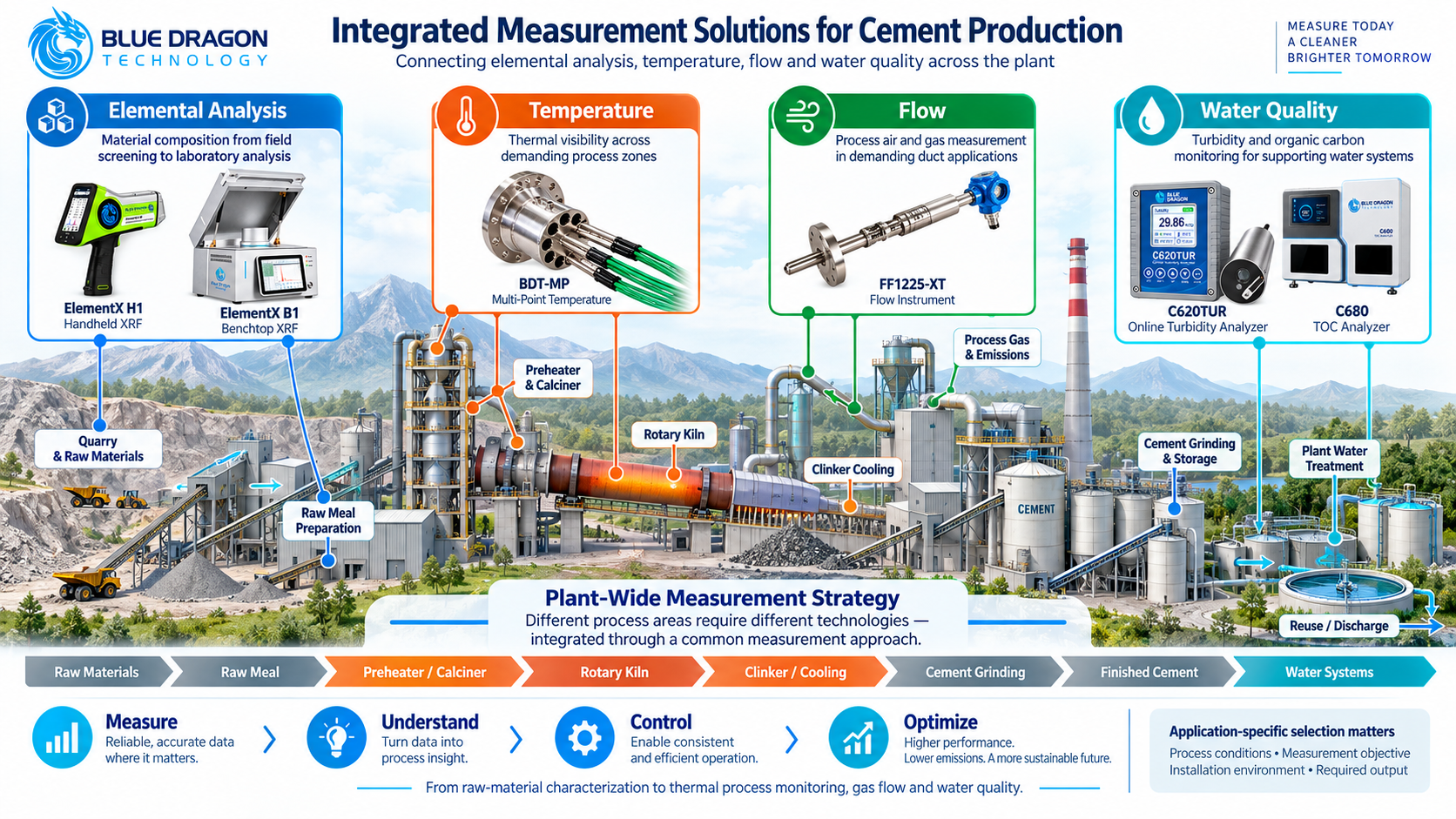
From Individual Instruments to a Plant-Wide Measurement Strategy

The most effective instrumentation strategy is not necessarily the one with the greatest number of measurement points. It is the one that provides useful information at the locations where measurement can improve understanding of the process.

In cement production, that can mean combining several different measurement disciplines:

  • Elemental analysis to understand material composition
  • Temperature measurement to observe thermal process conditions
  • Flow measurement to understand the movement of process air and gases
  • Water-quality analysis where plant utility, treatment or discharge systems require monitoring

Together, these measurements can provide a broader picture of plant conditions than any single instrument can provide independently.

Blue Dragon Technology develops analytical and process-measurement solutions across these measurement categories, allowing individual applications or broader plant requirements to be evaluated within a common instrumentation portfolio.

Integrated cement plant measurement infographic showing Blue Dragon elemental analysis, temperature, flow and water-quality solutions across quarry, raw-material preparation, preheater, kiln, clinker cooling, cement grinding and plant water systems.

Integrated Blue Dragon measurement solutions across cement production, combining elemental analysis, temperature, flow and water-quality instrumentation from raw materials through thermal processing and supporting plant systems.

Frequently Asked Questions About Cement Plant Instrumentation

What instrumentation is used in a cement plant?

Cement plants use many types of instrumentation depending on the process configuration. Common measurement categories include elemental and chemical analysis, temperature, pressure, level, flow, gas analysis, emissions monitoring and water-quality measurement. The appropriate technologies depend on the individual process and measurement objective.

Where is XRF used in cement manufacturing?

XRF can be used for elemental analysis of materials associated with cement production, including quarry materials, raw materials, raw meal, clinker and finished cement. Handheld XRF can support rapid field screening, while laboratory-oriented XRF systems can be used where prepared samples and controlled analytical workflows are preferred.

Why is elemental analysis important in cement production?

Cement manufacture depends on the chemical composition of the materials entering and moving through the process. Elemental analysis helps characterize those materials and identify variations that may be relevant to raw-material selection, process control and quality-control procedures.

Where is temperature measured in a cement plant?

Temperature may be measured at numerous points associated with preheating, calcination, kiln operation, process gases, clinker cooling and other thermal equipment. The correct sensor and installation depend on the temperature range and the mechanical and environmental conditions at the measurement location.

Why is flow measurement challenging in cement plants?

Some cement flow applications involve hot gases, high dust concentrations, large ducts, abrasive particles or non-uniform flow profiles. These conditions can influence both technology selection and installation design, so the process environment should be reviewed before an instrument is specified.

How should instrumentation for a cement plant be selected?

Selection should begin with the measurement objective and process conditions. Important factors include the required range, accuracy, material or gas characteristics, temperature, dust, installation geometry, calibration requirements, maintenance access and system-integration requirements.

Building the Right Measurement Solution for Cement Production

Cement production brings together raw-material chemistry, high-temperature processing, gas and air movement, quality control and supporting utility systems. Each area creates a different measurement challenge.

Rather than approaching these applications as isolated instrument purchases, plants, engineering companies and system integrators can evaluate measurement requirements according to the complete process: what must be measured, where the measurement should occur, how difficult the process conditions are and what decisions will be made from the resulting data.

Blue Dragon Technology provides analytical and process-measurement instruments for applications across cement and clinker production, including XRF elemental analysis, industrial temperature measurement, flow measurement, turbidity monitoring and organic carbon analysis.

Our team can review individual measurement points or broader project requirements to help determine an appropriate instrumentation approach for the specific application and operating conditions.

Discuss Your Cement Plant Measurement Requirements

Blue Dragon Technology can support individual measurement applications or broader instrumentation requirements across cement and clinker production.

Blue Dragon Technology
Measure. Control. Optimize.

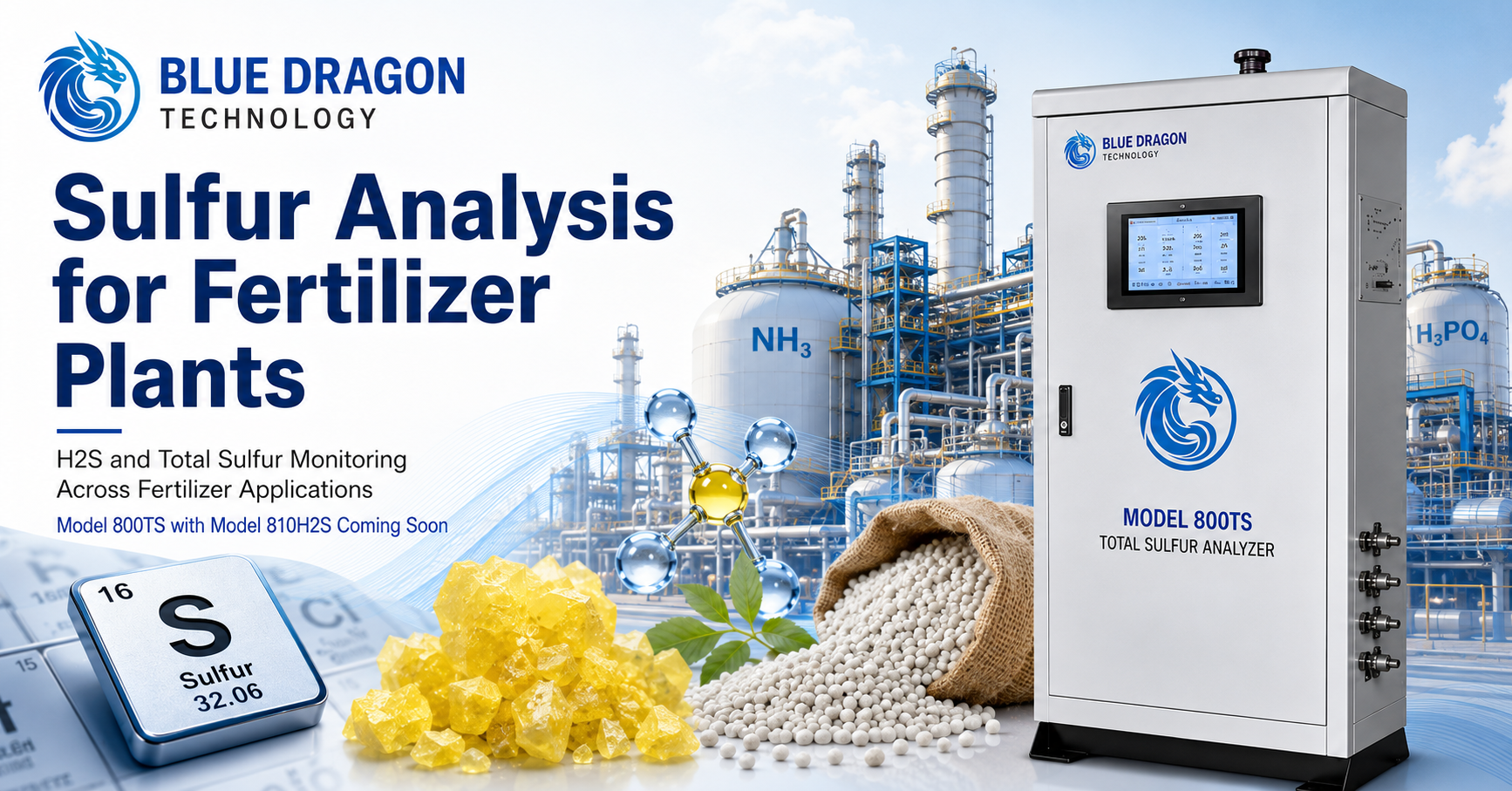
Blue Dragon Model 800TS total sulfur analyzer with fertilizer plant, fertilizer granules, sulfur crystals, and sulfur periodic table element.

Sulfur Analysis for Fertilizer Plants: H₂S and Total Sulfur Monitoring

Fertilizer production depends on tightly controlled chemical processes involving ammonia, urea, phosphate rock, sulfuric acid, ammonium sulfate, natural gas feedstocks, scrubbing systems, and emission-control equipment. Across these operations, sulfur compounds can appear in gas streams, liquid streams, vents, scrubbers, process condensates, wastewater, and product-related streams.

Hydrogen sulfide, H2S, is one of the most important sulfur compounds to monitor because it is toxic, corrosive, odorous, and environmentally significant. However, fertilizer plants often need more than single-compound H2S measurement. They may also need total sulfur analysis to understand the broader sulfur burden across process streams.

The Blue Dragon Technology Model 800TS Online Total Sulfur Analyzer provides continuous total sulfur measurement for gas and liquid applications. For fertilizer companies that require a complete sulfur-monitoring strategy, Blue Dragon Technology is also preparing the Model 810H2S Online Hydrogen Sulfide Analyzer, with a total sulfur option coming soon.

Quick Overview

Fertilizer plants can benefit from continuous sulfur analysis at multiple points in the production process, including feed gas treatment, acid gas handling, phosphate processing, sulfuric acid systems, ammonium sulfate production, scrubbers, vents, and wastewater treatment.

  • Key concern: H2S and other sulfur compounds can affect safety, corrosion, odor control, emissions, catalyst performance, and process quality.
  • Core measurement need: Continuous online sulfur data for both process control and compliance support.
  • Model 800TS: Online total sulfur analyzer for gas and liquid streams using catalytic combustion and UV fluorescence detection.
  • Model 810H2S: Coming soon as an online hydrogen sulfide analyzer, with a total sulfur option planned.
  • Typical fertilizer applications: Ammonia, urea, phosphate fertilizer, ammonium sulfate, sulfuric acid, gas treatment, scrubber monitoring, and environmental systems.

Why Sulfur Analysis Matters in Fertilizer Production

Fertilizer plants operate at the intersection of chemical manufacturing, environmental management, and process safety. Sulfur compounds are often present because many fertilizer processes rely on sulfur-containing raw materials, sulfuric acid, natural gas, acid gas treatment, or sulfur-bearing by-products.

In some locations, sulfur is part of the intended production chemistry. In others, it is an impurity that must be removed, treated, monitored, or controlled. This makes sulfur analysis important not only for product quality, but also for equipment protection, odor management, safety programs, and environmental compliance.

Periodic laboratory testing remains valuable, but it may not provide the real-time visibility needed for fast-changing process conditions. Continuous online sulfur analysis helps plant operators detect changes earlier, respond faster, and maintain more stable operation.

H2S and Total Sulfur: Understanding the Difference

H2S measurement and total sulfur measurement are related, but they are not the same. H2S analysis focuses specifically on hydrogen sulfide. Total sulfur analysis measures the combined sulfur content from multiple sulfur species in the sample.

In fertilizer plants, this distinction is important because sulfur may appear in several forms depending on the feedstock, process chemistry, temperature, pressure, oxidation state, and treatment method.

H2S Measurement

Used when the plant needs to monitor hydrogen sulfide specifically, especially in gas streams, vents, acid gas systems, safety-related points, odor-control points, or treated gas quality.

Total Sulfur Measurement

Used when the plant needs to measure the total sulfur burden across all sulfur species, including H2S, mercaptans, sulfides, disulfides, COS, CS2, and other sulfur-containing compounds.

For this reason, many fertilizer companies benefit from a combined sulfur-monitoring approach: targeted H2S measurement where hydrogen sulfide is the primary concern, and total sulfur measurement where the full sulfur profile is more important.

Where Sulfur Compounds Appear in Fertilizer Plants

Ammonia Plants

Ammonia production often begins with natural gas or another hydrocarbon feedstock. These feedstocks may contain sulfur compounds that must be removed before reforming and synthesis. Sulfur contamination can damage catalysts and reduce process efficiency, making sulfur monitoring important in feed gas treatment, desulfurization systems, and treated gas streams.

Urea Plants

Urea production is closely connected to ammonia and carbon dioxide systems. While urea synthesis itself is not usually considered a sulfur-driven process, upstream feedstock treatment, process condensates, utility systems, vents, and wastewater treatment may still require sulfur-related monitoring depending on the plant configuration.

Phosphate Fertilizer Plants

Phosphate fertilizer production often uses sulfuric acid to react with phosphate rock. Depending on raw material composition and process conditions, sulfur-containing gases or odorous compounds may appear in vents, scrubbers, reaction areas, granulation systems, and off-gas treatment units.

Sulfuric Acid Plants

Sulfuric acid production is central to many fertilizer complexes, especially phosphate fertilizer operations. Monitoring sulfur-related streams can support process control, conversion efficiency, emission control, and operational stability.

Ammonium Sulfate Plants

Ammonium sulfate production may involve sulfuric acid, ammonia, crystallization systems, scrubbers, and by-product recovery streams. Sulfur monitoring can support process optimization, odor control, product quality, and wastewater management.

Scrubbers, Vents, and Wastewater Systems

Many fertilizer plants rely on scrubbers and treatment systems to manage emissions and odorous compounds. H2S and other sulfur compounds may be present in vent gas, scrubber outlet gas, condensates, wastewater treatment areas, and recovered process streams.

Common Sulfur Species Relevant to Fertilizer Companies

Fertilizer plants may encounter a wide range of sulfur compounds. The exact species depend on the feedstock, acid system, gas-treatment process, scrubbing chemistry, and plant design.

Sulfur Species Why It Matters
Hydrogen sulfide, H2S Toxic, corrosive, odorous, and important for safety, environmental, and gas-treatment applications.
Carbonyl sulfide, COS Can appear in gas streams and may require hydrolysis or treatment depending on process requirements.
Carbon disulfide, CS2 Relevant in some sulfur-bearing gas and chemical process streams.
Mercaptans Strong odor compounds that may appear in hydrocarbon or gas-related streams.
Sulfides and disulfides Can contribute to corrosion, odor, and total sulfur loading.
Sulfur oxides Important for combustion, acid production, emission-control, and sulfuric acid-related processes.

Because sulfur can appear in several forms, total sulfur analysis is often useful when the plant needs a complete picture of sulfur content rather than only a single-compound reading.

Key Measurement Points in Fertilizer Plants

Feed Gas and Treated Gas

Monitoring sulfur in natural gas or treated gas helps protect catalysts and verify the performance of desulfurization systems.

Acid Gas and Process Vents

H2S and sulfur-containing gases may be present in acid gas systems, vents, and off-gas streams requiring continuous monitoring.

Scrubber Inlet and Outlet Streams

Measuring sulfur before and after scrubbing helps operators evaluate removal efficiency and adjust treatment systems.

Process Condensates and Liquids

Liquid sulfur analysis can help monitor contamination, process stability, wastewater loading, and treatment requirements.

Sulfuric Acid and Phosphate Systems

Sulfur-related monitoring can support acid production, phosphate rock reaction systems, off-gas control, and emission-management programs.

Wastewater and Treatment Units

Sulfur compounds in wastewater systems can create odor, corrosion, and treatment challenges, especially when process streams vary.

Operational Benefits of Continuous Sulfur Analysis

For fertilizer companies, sulfur analysis is not only a compliance function. It is also a process-control and risk-reduction tool. Continuous monitoring can help plant teams move from reactive sampling to proactive control.

  • Worker and plant safety: Continuous monitoring helps identify sulfur-related hazards earlier.
  • Odor control: H2S and mercaptans can create strong odor issues even at low concentrations.
  • Corrosion management: Sulfur compounds can contribute to corrosion in process equipment, piping, and treatment systems.
  • Catalyst protection: Sulfur contamination can reduce catalyst performance in ammonia and gas-treatment processes.
  • Scrubber optimization: Online data helps operators understand whether scrubbing systems are performing effectively.
  • Environmental reporting support: Consistent sulfur data can support internal documentation and permit-related monitoring programs.
  • Process stability: Real-time sulfur data helps operators detect feedstock changes, process upsets, and treatment inefficiencies.

Blue Dragon Model 800TS for Fertilizer Plant Sulfur Analysis

The Blue Dragon Technology Model 800TS Online Total Sulfur Analyzer is designed for continuous total sulfur measurement in both gas and liquid streams. This makes it highly relevant for fertilizer plants that need sulfur data across more than one process area or sample type.

The Model 800TS uses catalytic combustion to convert sulfur compounds into sulfur dioxide, followed by ultraviolet fluorescence detection. This approach allows the analyzer to report total sulfur content from a broad range of sulfur species, rather than measuring only one compound.

In fertilizer applications, the Model 800TS can support process monitoring, feedstock control, gas-treatment verification, liquid-stream analysis, scrubber optimization, and environmental-system monitoring.

How the Model 800TS Works

  1. Sample conditioning: The gas or liquid sample is prepared for stable online analysis based on the application requirements.
  2. Catalytic combustion: Sulfur-containing compounds are converted into sulfur dioxide.
  3. UV fluorescence detection: The generated sulfur dioxide is measured using ultraviolet fluorescence.
  4. Total sulfur calculation: The analyzer converts the detector signal into a total sulfur concentration.
  5. Plant integration: Results can be used for process control, alarms, data logging, reporting, and plant-monitoring systems.

Key Features of the Model 800TS

Gas and Liquid Analysis

Supports total sulfur measurement in both gas and liquid sample streams, allowing one analyzer platform to address multiple fertilizer-plant applications.

UV Fluorescence Detection

Provides precise total sulfur measurement after sulfur compounds are converted into sulfur dioxide.

Catalytic Combustion

Converts different sulfur compounds into a measurable form, enabling total sulfur analysis across complex sample matrices.

Multi-Stream Monitoring

Supports up to six sample streams with automatic switching, making it useful for plants with multiple sulfur-monitoring points.

Low-Level Detection

Designed for demanding applications requiring sulfur measurement down to 100 ppb.

Industrial Integration

Designed for continuous online operation with outputs suitable for plant monitoring, control systems, alarms, and data logging.

Typical Fertilizer Applications for the Model 800TS

Plant Area How Total Sulfur Analysis Helps
Natural Gas Feed Treatment Verifies sulfur removal before reforming or downstream processing.
Ammonia Production Supports catalyst protection and feedstock quality control.
Phosphate Fertilizer Monitors sulfur-related streams in acid reaction, off-gas, and scrubbing systems.
Sulfuric Acid Systems Supports process control and sulfur-related monitoring in acid production and handling.
Scrubber Systems Helps evaluate sulfur-removal performance across inlet and outlet streams.
Wastewater and Liquid Streams Provides total sulfur data for liquids, condensates, and treatment-related streams.

Coming Soon: Blue Dragon Model 810H2S Online Hydrogen Sulfide Analyzer

For applications where hydrogen sulfide is the primary measurement target, Blue Dragon Technology is preparing the Model 810H2S Online Hydrogen Sulfide Analyzer. This analyzer is being developed for continuous H2S monitoring in industrial gas applications and will also be available with a total sulfur option.

The Model 810H2S will be especially relevant for fertilizer plants that need targeted H2S monitoring in gas streams, vents, acid gas systems, scrubber outlets, odor-control points, or environmental-monitoring locations.

Planned Role of the Model 810H2S

  • Continuous online H2S monitoring for industrial gas applications
  • Useful for safety, odor control, gas-treatment verification, and emissions-related monitoring
  • Total sulfur option planned for applications requiring broader sulfur measurement capability
  • Designed to complement the Model 800TS in fertilizer and chemical plant sulfur-monitoring programs

Together, the Model 800TS and the upcoming Model 810H2S will allow fertilizer companies to select the correct sulfur-analysis approach for each application: total sulfur monitoring for broad sulfur control, and targeted H2S monitoring where hydrogen sulfide is the specific concern.

Choosing the Right Blue Dragon Analyzer for Fertilizer Applications

Measurement Need Recommended Analyzer Reason
Total sulfur in gas streams Model 800TS Measures the combined sulfur content from multiple sulfur compounds.
Total sulfur in liquid streams Model 800TS Supports liquid total sulfur measurement for process liquids, condensates, and treatment streams.
Multiple sulfur-monitoring points Model 800TS Supports up to six streams with automatic switching.
Targeted H2S gas monitoring Model 810H2S, coming soon Designed for applications where hydrogen sulfide is the primary measurement target.
H2S monitoring with total sulfur flexibility Model 810H2S with TS option, coming soon Planned for users who need H2S monitoring with broader sulfur-analysis capability.

Why Fertilizer Companies Should Consider Online Sulfur Analysis

Fertilizer plants often operate large, continuous processes where small changes in feedstock quality, gas composition, scrubber performance, or acid-system behavior can create downstream effects. Online sulfur analysis gives operators the visibility needed to respond before issues become larger operational problems.

  • Earlier detection of process upsets: Continuous sulfur data helps identify changes that may be missed between manual samples.
  • Improved control of treatment systems: Scrubbers, gas-treatment units, and wastewater systems can be adjusted based on real process conditions.
  • Reduced risk of off-spec operation: Online analysis helps maintain process consistency and product-related quality control.
  • Better documentation: Continuous data supports internal reporting, maintenance review, environmental programs, and operational decision-making.
  • Integrated plant monitoring: Analyzer outputs can support alarms, trend analysis, process dashboards, and control-room visibility.

Blue Dragon Technology Support for Fertilizer and Chemical Plants

Blue Dragon Technology supplies process-measurement and analytical instrumentation for industrial customers in fertilizer, chemical, oil & gas, petrochemical, LNG, environmental, and manufacturing sectors.

For fertilizer companies, Blue Dragon Technology can support analyzer selection, application review, sample-point planning, configuration discussions, commissioning support, and after-sales service. The goal is to provide a sulfur-analysis solution that fits the real operating conditions of the plant, not only the analyzer specification sheet.

  • Application review: Identify whether the plant needs total sulfur, H2S-specific monitoring, or both.
  • Sample-point planning: Review gas, liquid, vent, scrubber, and process-stream monitoring requirements.
  • Analyzer selection: Match the Model 800TS or upcoming Model 810H2S to the correct process application.
  • Integration support: Support plant data requirements, alarms, reporting, and control-system connection needs.
  • After-sales service: Provide continued support for operation, maintenance, calibration, and spare parts planning.

Discuss Sulfur Analysis for Your Fertilizer Plant

Whether your facility needs total sulfur analysis, H2S monitoring, scrubber-performance verification, feed gas treatment control, or liquid-stream sulfur measurement, Blue Dragon Technology can help review the application and recommend a suitable analyzer configuration.

Product Page:

Model 800TS Online Total Sulfur Analyzer

Website:

bluedragontechnology.com

Email:

contact@bluedragontechnology.com

Frequently Asked Questions

Why do fertilizer plants need sulfur analysis?

Fertilizer plants may encounter sulfur compounds in feed gas, acid systems, scrubbers, vents, process condensates, liquid streams, wastewater, and emission-control systems. Sulfur analysis helps support safety, corrosion control, odor management, catalyst protection, process stability, and environmental monitoring.

Is H2S the same as total sulfur?

No. H2S is one specific sulfur compound. Total sulfur analysis measures the combined sulfur content from multiple sulfur species. Fertilizer plants may need H2S-specific monitoring, total sulfur analysis, or both depending on the application.

Can the Model 800TS measure H2S?

The Model 800TS is a total sulfur analyzer. It can include sulfur from H2S as part of the total sulfur result after conversion and detection, but it is not positioned as a selective H2S-only analyzer. For targeted H2S monitoring, Blue Dragon Technology is preparing the Model 810H2S.

Can the Model 800TS measure both gas and liquid samples?

Yes. The Model 800TS is designed for total sulfur measurement in both gas and liquid applications, depending on the sample-conditioning and system configuration required for the process.

How many sample streams can the Model 800TS monitor?

The Model 800TS can support up to six sample streams with automatic switching, making it suitable for fertilizer plants that need to monitor multiple process points.

What is the upcoming Model 810H2S?

The Model 810H2S is Blue Dragon Technology’s upcoming online hydrogen sulfide analyzer. It is being developed for continuous H2S monitoring in industrial gas applications, with a total sulfur option planned.

Which analyzer should a fertilizer company choose?

If the facility needs total sulfur measurement across gas or liquid streams, the Model 800TS is the primary choice. If the facility needs targeted H2S monitoring in gas streams, the upcoming Model 810H2S may be the better fit. Some plants may benefit from both analyzers depending on the number and type of sulfur-monitoring points.

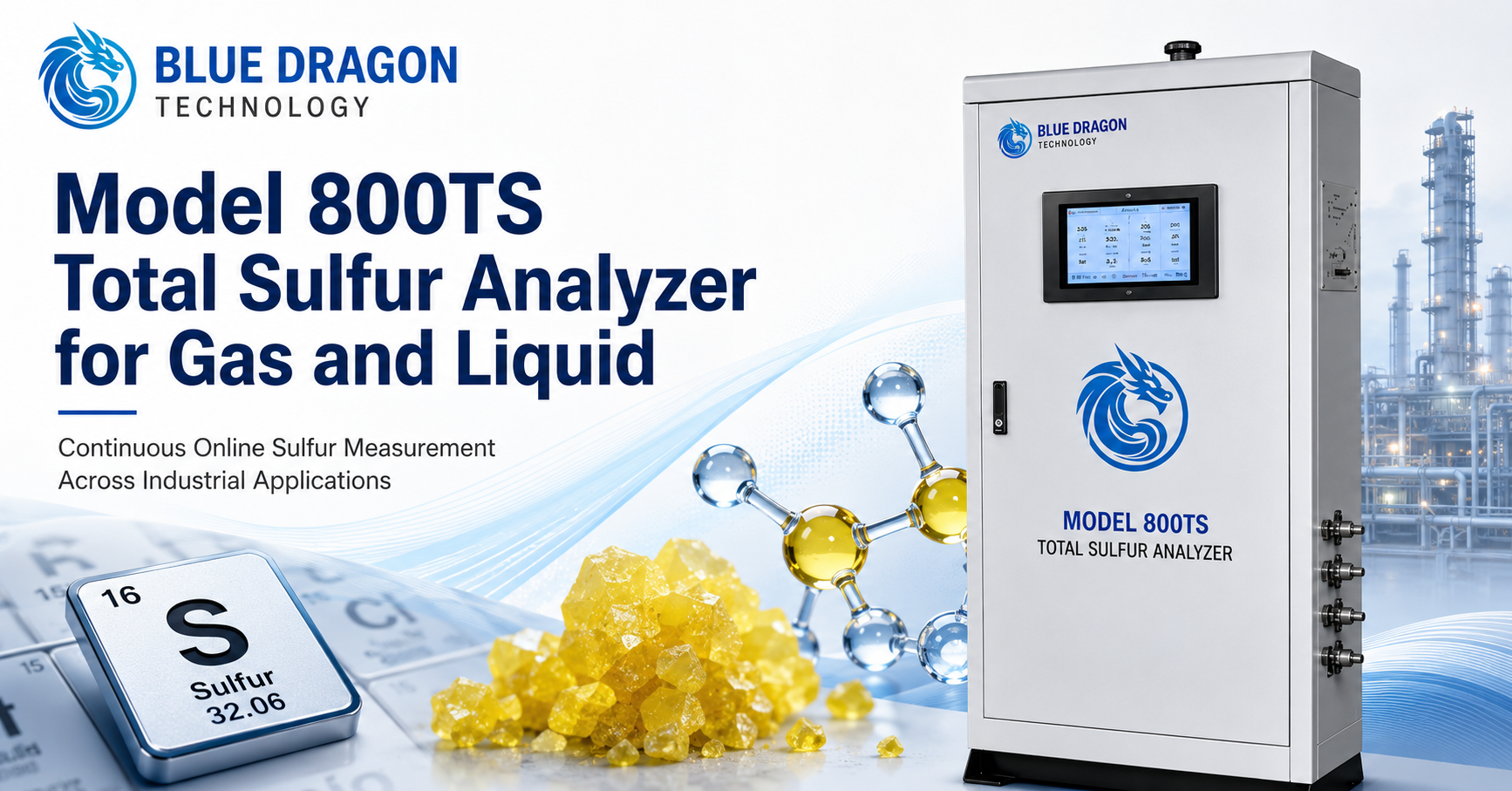
Blue Dragon Technology Model 800TS total sulfur analyzer with sulfur crystals and sulfur periodic table element for gas and liquid sulfur measurement.

Blue Dragon Technology Model 800TS Online Total Sulfur Analyzer for Gas and Liquid Applications

Sulfur measurement is a critical part of modern industrial process control. From refineries and LNG plants to petrochemical, fertilizer, gas-processing, and environmental monitoring applications, accurate total sulfur analysis helps operators protect catalysts, meet product specifications, reduce emissions, and maintain safe, reliable plant operation.

The Blue Dragon Technology Model 800TS Online Total Sulfur Analyzer is designed for continuous, real-time sulfur measurement in both gas and liquid samples. Using ultraviolet fluorescence detection and high-efficiency catalytic combustion, the Model 800TS provides dependable sulfur data for demanding industrial environments.

Quick Overview

The Model 800TS is a continuous online total sulfur analyzer for gas and liquid applications. It is built for industrial users who require accurate sulfur monitoring across process streams, feedstocks, finished products, and compliance-related applications.

  • Measurement principle: Catalytic combustion with ultraviolet fluorescence detection
  • Applications: Gas and liquid total sulfur analysis
  • Stream capability: Up to six sample streams with automatic switching
  • Detection capability: Suitable for low-level sulfur monitoring, with detection down to 100 ppb
  • Compliance support: ASTM D5453, ASTM D6667, ISO 20846, and GB/T 34100
  • Typical industries: Oil & gas, refining, LNG, petrochemicals, fertilizer, coal chemical, environmental, and process R&D

Why Sulfur Measurement Matters

Sulfur appears in many industrial feedstocks and process streams, including crude oil, natural gas, refinery intermediates, fuels, chemical solvents, hydrocarbon gases, condensates, petrochemical feedstocks, and process by-products. Even when present at low concentrations, sulfur compounds can create major operational and commercial challenges.

In refineries, sulfur affects product quality, emissions compliance, catalyst performance, corrosion risk, and downstream processing efficiency. In gas and LNG operations, sulfur compounds can damage equipment, interfere with purification systems, and create safety concerns. In petrochemical and fertilizer plants, sulfur can influence catalyst life, reaction efficiency, product purity, and environmental performance.

Continuous online sulfur analysis gives operators a faster and more actionable view of their process than periodic laboratory testing alone. Instead of waiting for manual sampling and lab results, plant teams can see sulfur changes in near real time and respond before process deviations become costly.

Common Sulfur Compounds in Industrial Streams

Industrial sulfur is rarely present in only one simple form. Depending on the process, sulfur may appear as inorganic sulfur, organic sulfur compounds, reduced sulfur species, or oxidized sulfur compounds. A total sulfur analyzer is valuable because it measures the overall sulfur content rather than only one individual compound.

Reduced Sulfur Species

  • Hydrogen sulfide, H₂S
  • Mercaptans
  • Sulfides
  • Disulfides

Organic and Oxidized Sulfur

  • Thiophenes
  • Benzothiophenes
  • Dibenzothiophenes
  • Sulfur oxides formed during combustion

Because sulfur compounds vary widely by process and matrix, total sulfur measurement is often preferred for process monitoring, quality control, and compliance support.

Sulfur in Industrial Reactions and Processes

Combustion of Fossil Fuels

When coal, crude-derived fuels, diesel, fuel oil, or other sulfur-containing materials are burned, sulfur compounds can oxidize into sulfur dioxide and sulfur trioxide. These emissions contribute to air-quality concerns, acid rain formation, and regulatory compliance requirements. Accurate sulfur measurement helps operators manage emissions and control the quality of fuel inputs.

Hydrodesulfurization in Refineries

Refineries use hydrodesulfurization to remove sulfur from fuels and feedstocks. In this process, organic sulfur compounds react with hydrogen over a catalyst and are converted into hydrogen sulfide, which can then be removed. Online sulfur analysis supports this process by monitoring feed quality, treatment performance, and finished-product sulfur levels.

Gas Sweetening and LNG Processing

Natural gas, refinery gas, and LNG-related process streams must be carefully monitored for sulfur compounds. Sulfur contamination can impact gas quality, damage downstream equipment, affect liquefaction processes, and create safety and environmental concerns. Continuous sulfur analysis helps operators verify gas treatment performance and maintain product specifications.

Petrochemical Production

Petrochemical plants often depend on sensitive catalysts and tightly controlled feedstock quality. Sulfur contamination can reduce catalyst activity, shorten catalyst life, and negatively affect product yield. Monitoring total sulfur in feedstocks and intermediate streams helps protect plant performance.

Fertilizer and Chemical Manufacturing

Fertilizer and chemical plants may encounter sulfur in feed gases, process intermediates, solvents, combustion systems, and environmental streams. Online sulfur measurement helps operators control impurities, maintain process stability, and support emission-management programs.

Metal Smelting, Mining, and Sulfur Recovery

Smelting and roasting of sulfide ores can release sulfur-containing gases that require capture, treatment, or conversion. In sulfur recovery and tail-gas treatment applications, sulfur measurement is important for process optimization, environmental control, and recovery efficiency.

Where Total Sulfur Is Measured

Oil & Gas

Sulfur analysis supports crude quality assessment, gas sweetening, sour-gas processing, condensate monitoring, pipeline quality, and downstream treatment control.

Refining

Refineries monitor sulfur in feedstocks, intermediate streams, fuel blending components, finished products, and hydrodesulfurization units.

LNG and Gas Processing

LNG plants and gas processors use sulfur data to protect equipment, verify treatment systems, and maintain gas quality before liquefaction or distribution.

Petrochemicals

Petrochemical complexes monitor sulfur to protect catalysts, maintain feedstock quality, and improve process stability across sensitive reaction systems.

Fertilizer Plants

Fertilizer producers may require sulfur monitoring in gas streams, combustion systems, acid-gas treatment, feedstock preparation, and environmental compliance points.

Environmental Monitoring

Sulfur measurement supports air-emission control, flue-gas treatment, sulfur recovery, and environmental reporting applications.

Emerging Applications for Sulfur Analysis

As industrial processes evolve, sulfur measurement is becoming increasingly important beyond conventional refining and fuel applications. New feedstocks, new catalysts, and stricter environmental expectations all increase the need for reliable low-level sulfur monitoring.

  • Biofuels and renewable diesel: Biomass-derived feedstocks can vary significantly in sulfur content, requiring close process monitoring.
  • Green and blue hydrogen: Sulfur contaminants can poison catalysts and affect purification systems.
  • E-fuels and power-to-X: Synthetic fuel and ammonia processes require clean inputs to preserve catalyst performance.
  • Carbon capture and solvent regeneration: Sulfur contamination can affect solvent performance, corrosion, and process efficiency.
  • Battery and solar-grade chemicals: High-purity chemical production may require trace sulfur control in solvents, reagents, and recycled streams.
  • Circular economy and waste-to-energy: Variable waste-derived feedstocks often require sulfur monitoring to control emissions and equipment damage.

Introducing the Blue Dragon Technology Model 800TS Online Total Sulfur Analyzer

The Model 800TS Online Total Sulfur Analyzer is engineered for continuous total sulfur measurement in both gas and liquid samples. It is designed for industrial applications where sulfur data must be accurate, repeatable, and available in real time.

The analyzer uses catalytic combustion to convert sulfur compounds into sulfur dioxide, followed by ultraviolet fluorescence detection. This method is widely used for total sulfur analysis because it provides strong sensitivity, broad applicability, and dependable performance across different sample types.

For plants that need to monitor more than one process point, the Model 800TS supports automatic multi-stream switching for up to six channels. This allows a single analyzer system to monitor multiple gas or liquid streams while reducing the need for multiple standalone instruments.

How the Model 800TS Works

  1. Sample introduction: The gas or liquid sample is introduced into the analyzer through the configured sample-handling system.
  2. Catalytic combustion: Sulfur compounds are converted into sulfur dioxide through high-efficiency combustion.
  3. UV fluorescence detection: The generated sulfur dioxide is measured using ultraviolet fluorescence.
  4. Signal processing: The analyzer converts the detector response into total sulfur concentration data.
  5. Output and integration: Results are displayed locally and can be integrated into plant control, reporting, or data-acquisition systems.

Key Features of the Model 800TS

UV Fluorescence Detection

Provides precise and repeatable total sulfur measurement for industrial gas and liquid applications.

Catalytic Combustion Technology

Converts sulfur compounds into sulfur dioxide for reliable total sulfur detection.

Gas and Liquid Compatibility

Suitable for a wide range of hydrocarbon, process, and industrial sample matrices.

Up to Six Sample Streams

Automatic stream switching allows multiple process points to be monitored from one analyzer platform.

Low-Level Sulfur Detection

Designed for demanding applications requiring sulfur measurement down to 100 ppb.

Compliance-Oriented Design

Supports sulfur analysis requirements aligned with ASTM D5453, ASTM D6667, ISO 20846, and GB/T 34100.

Benefits for Industrial Operators

  • Real-time process visibility: Continuous online analysis helps operators detect sulfur changes quickly.
  • Improved product quality: Supports tighter control of feedstocks, intermediates, and finished products.
  • Better catalyst protection: Helps identify sulfur contamination before it damages sensitive catalyst systems.
  • Reduced laboratory dependency: Complements laboratory testing by providing faster online sulfur data.
  • Lower operating risk: Helps prevent off-spec production, corrosion issues, emissions problems, and unplanned downtime.
  • Multi-stream efficiency: One analyzer can monitor multiple process streams with automatic switching.
  • Regulatory confidence: Provides consistent sulfur data for compliance, reporting, and process documentation.

Typical Applications for the Model 800TS

Industry Typical Measurement Points
Refineries Feedstocks, fuels, hydrocarbon streams, blending components, desulfurization units
Oil & Gas Natural gas, condensate, sour gas, treated gas, pipeline-quality gas
LNG Feed gas, treated gas, gas purification systems, pre-liquefaction monitoring
Petrochemicals Olefin feedstocks, aromatics, solvents, process intermediates, catalyst-protection points
Fertilizer and Chemicals Feed gases, acid gas systems, process streams, combustion and emission-related streams
Environmental Monitoring Emission-control systems, sulfur recovery, flue-gas treatment, compliance-related monitoring

Why Choose Blue Dragon Technology?

Blue Dragon Technology supplies advanced analytical instruments and process-measurement solutions for industrial customers across oil & gas, petrochemical, environmental, laboratory, and manufacturing sectors. Our focus is practical: reliable instruments, clear technical support, and solutions that fit real plant operating conditions.

The Model 800TS reflects this approach. It is not simply a laboratory-style sulfur analyzer placed in a process environment. It is designed as an online industrial analyzer for continuous operation, multi-stream monitoring, and integration into process-control workflows.

  • Industrial focus: Built for demanding process environments, not only laboratory use.
  • Application flexibility: Supports both gas and liquid total sulfur measurement.
  • Technical support: Blue Dragon Technology supports customers with product selection, application review, commissioning, and after-sales service.
  • Regional reach: Blue Dragon Technology serves customers through its international business structure and partner network.

Request Information on the Model 800TS

To learn more about the Blue Dragon Technology Model 800TS Online Total Sulfur Analyzer, request a quotation, or discuss your application with our technical team, please visit the product page or contact us directly.

Product Page:

Model 800TS Online Total Sulfur Analyzer

Website:

bluedragontechnology.com

Email:

contact@bluedragontechnology.com

Frequently Asked Questions

What does a total sulfur analyzer measure?

A total sulfur analyzer measures the overall sulfur content in a sample, rather than only one specific sulfur compound. This is useful when the sample may contain multiple sulfur species such as hydrogen sulfide, mercaptans, sulfides, thiophenes, and other organic sulfur compounds.

Can the Model 800TS measure both gas and liquid samples?

Yes. The Model 800TS is designed for total sulfur measurement in both gas and liquid applications, depending on the required sample-conditioning and system configuration.

How many sample streams can the Model 800TS monitor?

The Model 800TS can support up to six sample streams with automatic switching, making it suitable for plants that need to monitor multiple process points from one analyzer system.

What industries use online total sulfur analyzers?

Online total sulfur analyzers are commonly used in oil & gas, refining, LNG, petrochemical, fertilizer, chemical, coal chemical, sulfur recovery, environmental monitoring, and process research applications.

Why use online sulfur analysis instead of only laboratory testing?

Laboratory testing remains important, but it usually provides delayed results. Online sulfur analysis gives operators continuous process visibility, allowing faster response to process changes, contamination events, and product-quality deviations.