Contact for Availability Project-specific availability subject to MESIT technical review and nuclear qualification requirements
Temperature Measurement Series
BDT-NIC

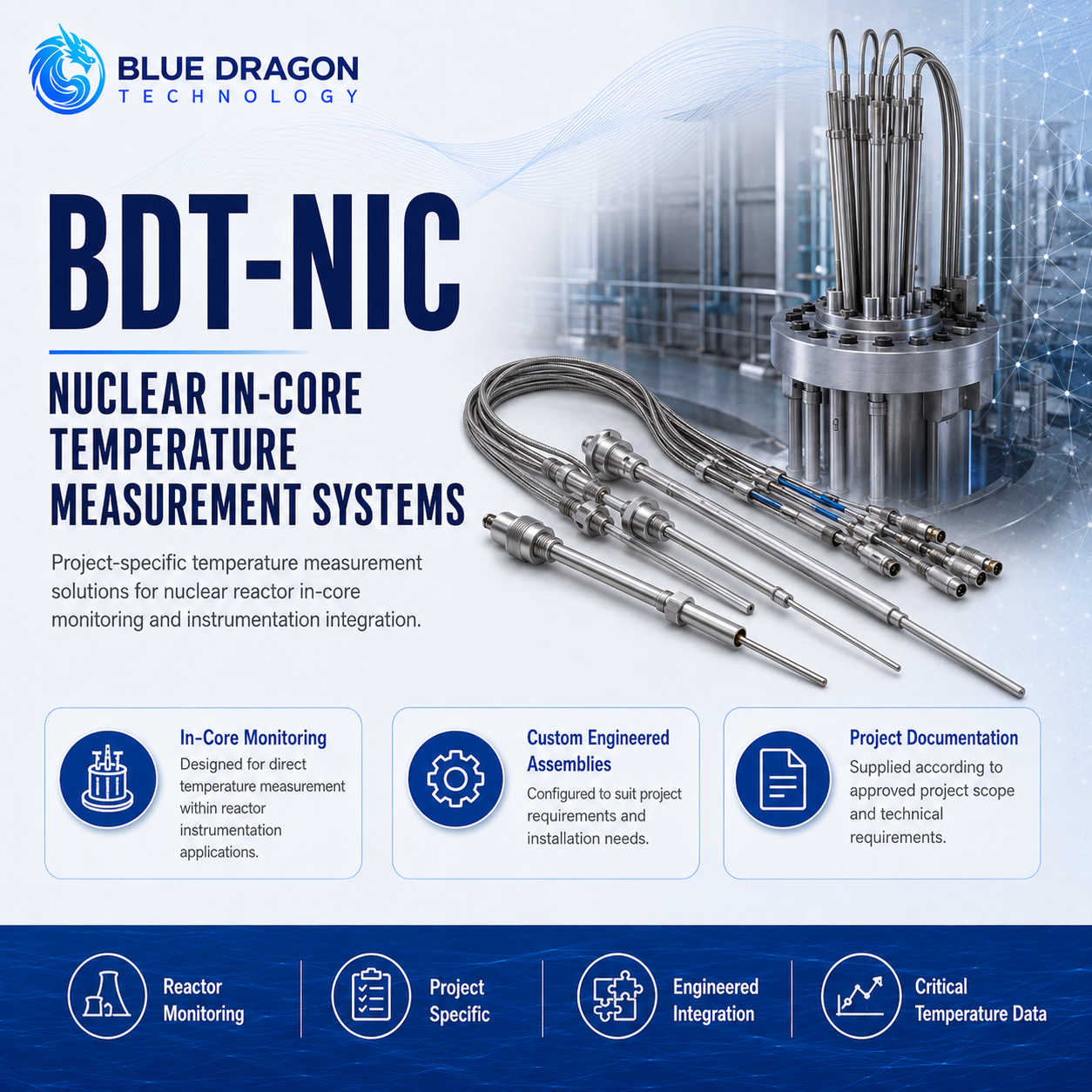
BDT-NIC Nuclear In-Core Temperature Measurement Systems

Project-engineered nuclear in-core thermocouple systems for plant-specific reactor temperature measurement and monitoring applications.

Brand: Blue Dragon Technology Manufactured by: MESIT, Italy Supply & support: Blue Dragon Technology
Product Overview

Purpose-built measurement, clearly presented.

The BDT-NIC is a project-specific nuclear in-core temperature measurement product family based on MESIT’s capability in nuclear in-core thermocouples. It is intended for nuclear power plant and research applications requiring temperature measurement at defined reactor or associated system locations.

Every configuration must be defined against the plant design, safety classification, operating environment, materials, measurement locations, routing, termination, testing, documentation, quality-assurance, and jurisdictional requirements. This product page does not imply one universal design, approval, certification, qualification, or suitability for every nuclear installation.

Distinctive Capabilities

  • Project-engineered nuclear in-core temperature measurement
  • Plant-specific sensing locations, routing, and terminations
  • Application-specific materials and mechanical construction
  • Integration with plant instrumentation subject to approved interface requirements
  • Technical review against nuclear service and jurisdictional requirements
Performance & Technical Data

The measurement method and the values that matter.

How it measures

Measurement Principle

Thermocouple sensing points use two dissimilar conductors to generate a thermoelectric voltage corresponding to the temperature at the measuring junction. A nuclear in-core configuration may use one or multiple sensing points positioned at plant-defined locations and connected to the applicable monitoring, protection, or data-acquisition system. The sensing construction, measurement locations, materials, electrical interfaces, environmental capability, and qualification requirements must be established for the specific plant and application.

Measurement ParametersNuclear in-core or reactor-system temperature
Sensor technologyThermocouple or thermoelement; project specific
Measurement pointsSingle or multipoint according to plant design
Sensor arrangement and locationsDefined by the approved reactor or instrumentation design
Thermocouple typeTo be confirmed for each project
Temperature rangeTo be confirmed for each project

Complete Technical Data

Materials and construction
Defined by nuclear service and qualification requirements
Radiation and environmental qualification
To be confirmed for the project
Safety classification
Defined by the plant, application, and jurisdiction
Mechanical and electrical interfaces
To be confirmed from approved plant documentation
Testing and documentation
Defined through the approved project quality plan
Applicable standards and certifications
No universal claim; project-specific confirmation required
Availability
Contact for Availability
Industrial Use

Applications and industries.

Typical Applications

Nuclear reactor in-core temperature measurementNuclear power plant temperature instrumentationResearch-reactor and nuclear test-facility temperature measurementMultipoint reactor temperature profilingProject-specific nuclear process temperature measurementNuclear instrumentation replacement or modernization subject to qualification reviewNuclear In-Core Temperature Measurement

Industries Served

Academic & Research LaboratoriesIndustrial LaboratoriesNuclear PowerPower GenerationResearch & Industrial Laboratories
Engineering & Integration

Built for specification, installation, and long-term operation.

Every BDT-NIC system requires plant-specific engineering of the sensing arrangement, materials, environmental capability, interfaces, documentation, testing, quality controls, installation, and regulatory compliance.

ServiceNuclear in-core or reactor temperature measurement
ConfigurationPlant-specific single-point or multipoint system
QualificationDefined by the project, safety classification, and jurisdiction
DocumentationApproved project quality, inspection, and test requirements

Sensor Construction

  • Project EngineeredSensor count, sensing locations, thermocouple construction, materials, protection, routing, connectors, terminations, and interfaces are defined from the plant requirements.
  • Project EngineeredMechanical and electrical configurations must correspond to the approved reactor instrumentation and safety-classification documentation.
  • Application DependentRedundancy, channel separation, signal conditioning, penetration arrangements, replacement strategy, and monitoring-system architecture require plant-specific review.

Materials & Junction Design

  • StandardNo extracted process sample is required; the sensing junctions measure temperature at their installed reactor or system locations.
  • Project EngineeredThe mechanical, thermal, electrical, and environmental interfaces are defined by the approved plant design.
  • Application DependentExposure to pressure, radiation, temperature, chemical environment, vibration, seismic loading, electrical interference, and accident conditions must be evaluated where applicable.

Mounting & Installation

  • Project EngineeredInstallation procedures, access, handling, routing, supports, penetrations, terminations, cleanliness controls, inspection stages, and acceptance criteria are defined by the plant and project quality requirements.
  • Application DependentInstallation may require nuclear-qualified personnel, controlled procedures, traceable materials, dedicated tooling, hold points, and independent verification.
  • Project EngineeredUtility requirements for transmitters, signal conditioning, isolation, monitoring, and data acquisition are defined by the selected plant interface.

Signal & Termination

Note: Communication protocol, transmitter type, output signal, and safety-system compatibility can only be provided after project review.

  • Project EngineeredSensor signals, channel identification, polarity, isolation, cabling, shielding, grounding, signal conditioning, and terminal arrangements must match the approved plant instrumentation design.
  • Application DependentIntegration with monitoring, protection, control, data-acquisition, or diagnostic systems is determined by the plant safety classification and functional requirements.

Calibration & Quality

  • Project EngineeredCalibration methods, calibration points, reference standards, traceability, acceptance criteria, inspections, material records, manufacturing records, and test documentation are defined by the approved quality plan.
  • Application DependentQualification testing may address environmental, radiation, vibration, seismic, electrical, mechanical, thermal, aging, or accident-condition requirements where specified.

Maintenance & Replacement

  • Project EngineeredInspection, surveillance, calibration verification, replacement, storage, handling, and spare-parts requirements are defined by the plant maintenance and quality programs.
  • Application DependentServiceability and replacement depend on the installed location, access restrictions, radiation conditions, plant operating state, and approved work procedures.
  • Project EngineeredAny repair, refurbishment, or substitution must preserve the approved configuration and follow the applicable plant change-control process.

Process & Application Considerations

  • StandardNuclear applications require formal plant-specific engineering and regulatory review; no universal suitability is implied.
  • Project EngineeredSafety classification, qualification basis, materials, traceability, testing, documentation, and acceptance criteria must be defined before manufacture.
  • Application DependentRadiation exposure, pressure, temperature, vibration, seismic loading, electrical isolation, accident conditions, aging, contamination controls, and jurisdictional requirements may apply.
Application Review

Application Engineering Notes

The current source confirms only that nuclear in-core thermocouples are part of MESIT’s thermoelement portfolio and that nuclear power plants are an application area. It does not support a specific reactor design, nuclear safety class, qualification standard, operating range, radiation tolerance, seismic capability, pressure rating, material specification, certification, or project reference.

Before this page is published, MESIT should provide an approved nuclear capability statement covering the available configurations, applicable codes or standards, quality-assurance system, manufacturing controls, material traceability, inspection and test capabilities, qualification limits, documentation package, territorial availability, and any project references that may be used publicly.

Application Engineering

Discuss your measurement application.

Share the sample, measurement range, operating conditions, project location, and timeline. Blue Dragon Technology will review the application and recommend the appropriate configuration.