
Analytical Instrumentation for Critical Industrial Measurements
Blue Dragon Technology
Blue Dragon Technology fertilizer and chemical plant measurement solutions for process control, gas quality, utilities, and laboratory verification.

Fertilizer & Chemical Plant Instrumentation: Measurement Solutions from Feed Gas to Finished Product

Fertilizer and chemical plants bring together several very different measurement environments within a single production complex. Feed-gas quality, sulfur, trace moisture, fired-equipment temperature, reactor temperature profiles, gas flow, raw-material composition, product quality and supporting water systems can all influence plant reliability and production decisions.

These requirements extend from natural-gas and feed preparation through reforming, synthesis and reaction, and continue into ammonia, urea, phosphate, DAP, NPK, laboratory quality control, plant utilities and wastewater systems.

There is no single analyzer or sensor that can address all of these measurement points. Effective fertilizer and chemical plant instrumentation instead requires a coordinated combination of gas analysis, moisture measurement, temperature measurement, ultrasonic gas flow, elemental analysis and water-quality instrumentation.

The central principle is simple: the instrument should be selected around the actual application—not around the model name alone. Stream chemistry, sample phase, pressure, temperature, materials, installation conditions, hazardous-area requirements and the decision the measurement must support all influence the correct configuration.

This article examines the major measurement opportunities across fertilizer and chemical production and explains how different Blue Dragon technologies can be applied from feed gas to finished product.

Fertilizer & Chemical Plant Measurement Solutions: Video Overview

The Blue Dragon Technology presentation below provides a visual overview of measurement applications across fertilizer and chemical plants, including feed-gas verification, sulfur and moisture measurement, reformer and reactor temperature monitoring, raw-material analysis, gas flow, utilities, water quality and laboratory verification.

The sections below expand on the measurement challenges introduced in the presentation and explain how the technologies fit into the process in greater technical detail.
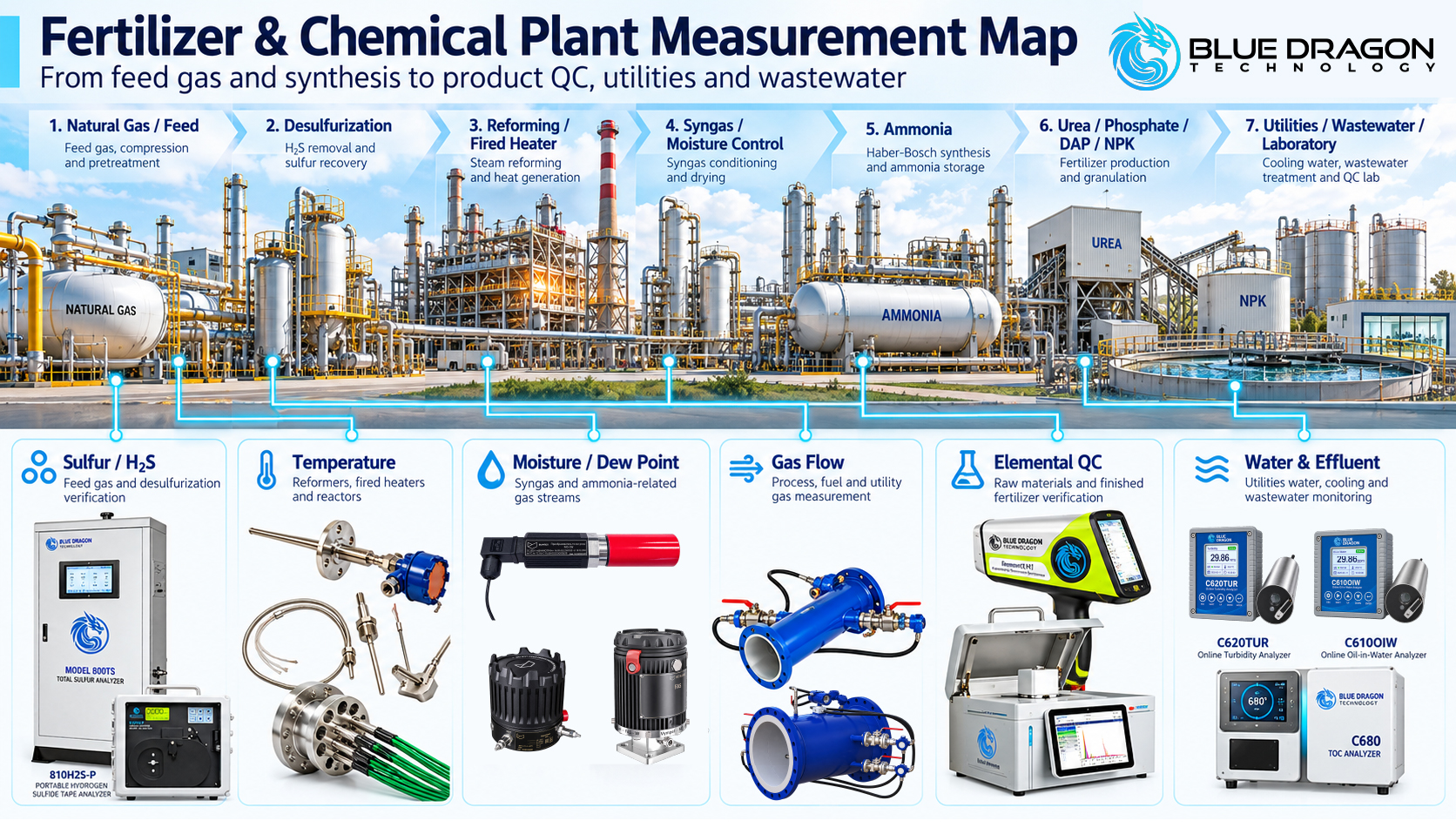
Blue Dragon fertilizer and chemical plant measurement map showing gas quality, temperature, moisture, flow, elemental QC and water monitoring across the plant.

Figure 1. A plant-wide measurement map showing where Blue Dragon instrumentation supports gas treatment, synthesis, reaction, product quality, utilities and water monitoring.

Understanding the Fertilizer & Chemical Plant Measurement Chain

A fertilizer plant is not one measurement environment. It is a sequence of processes in which the physical form of the material, the process chemistry and the operating objective can change significantly from one unit to the next.

At the front of an ammonia or urea process, the principal concern may be the quality of the incoming gas. Sulfur compounds and moisture can be important because downstream treatment, catalysts and process equipment may depend on suitably conditioned gas.

Further into the plant, reformers, fired heaters, reactors, columns and vessels create different measurement requirements. Here, external tube-wall temperature, internal temperature distribution and gas-flow behaviour may become important to plant personnel.

Phosphate, DAP and NPK production introduce another set of questions involving raw-material composition, formulation, granulation, intermediate materials and final-product verification.

Meanwhile, cooling water, process water, scrubbers, wastewater systems and plant laboratories introduce water-quality and analytical requirements that are technically separate from the main synthesis process but remain important to plant operation.

The result is best understood as an integrated measurement architecture covering gas quality, moisture, thermal conditions, flow, elemental quality control and water systems.

Feed Gas, Hydrogen Sulfide & Total Sulfur Measurement

Sulfur measurement can be relevant at several points in fertilizer and chemical processing, particularly where gas quality, catalyst protection, gas treatment or downstream process requirements depend on sulfur control.

Instrument selection should begin by identifying the sulfur species that must be measured, the sample phase, expected concentration range, stream pressure and temperature, sample-conditioning requirements and the intended use of the result.

Hydrogen Sulfide Measurement

For selective hydrogen-sulfide measurement, Blue Dragon’s sulfur-analysis portfolio includes several configurations intended for different operating requirements.

  • Model 810H2S is the online H₂S tape-analyzer configuration for continuous selective H₂S monitoring in qualified gas applications.
  • Model 810H2S-P provides portable H₂S measurement for field verification, commissioning, temporary monitoring and troubleshooting in appropriate general-purpose locations.
  • Model 810H2S-TS combines direct H₂S measurement with a separate Total Sulfur measurement path using a heated hydrogen-conversion section.

The appropriate configuration depends on whether the objective is continuous process monitoring, combined H₂S and Total Sulfur analysis, or portable verification. Final range, stream composition, sample conditioning, utilities, hazardous-area requirements and current product availability should be confirmed during application review. Availability varies by model; refer to the linked product page for the current release status.

Total Sulfur Measurement

Total sulfur answers a different analytical question from selective H₂S measurement. It is used where the plant needs to understand sulfur across the compounds converted and detected by the selected analytical method.

The Blue Dragon Model 800TS Online Total Sulfur Analyzer uses high-temperature catalytic combustion and ultraviolet fluorescence detection. The documented standard configuration is oriented toward suitable light-hydrocarbon liquid samples; gas-phase use and any fertilizer-plant application require specific confirmation of the sample and sample-handling arrangement.

Application note: H₂S, Total Sulfur and other sulfur measurements are not interchangeable. Define the target sulfur measurement, sample phase, composition, range, pressure, temperature and process objective before selecting the analyzer.

Trace Moisture & Dew-Point Measurement in Process Gas

Moisture and dew-point measurement can support gas-quality monitoring across syngas, ammonia gas and other qualified process-gas streams. The objective may be to verify dryer performance, observe moisture breakthrough, reduce condensation risk or provide greater visibility into gas condition before sensitive downstream equipment.

Blue Dragon provides several different moisture technologies because no single measurement principle is ideal for every gas composition, range or installation.

Gas composition is particularly important in moisture measurement. Reactive components, free liquids, aerosols, pressure reduction, sample-line condition and background moisture can influence both technology selection and measurement performance.

For this reason, a trace-moisture application review should establish the complete gas composition, pressure, temperature, expected range, sample-conditioning arrangement and verification method before configuration.
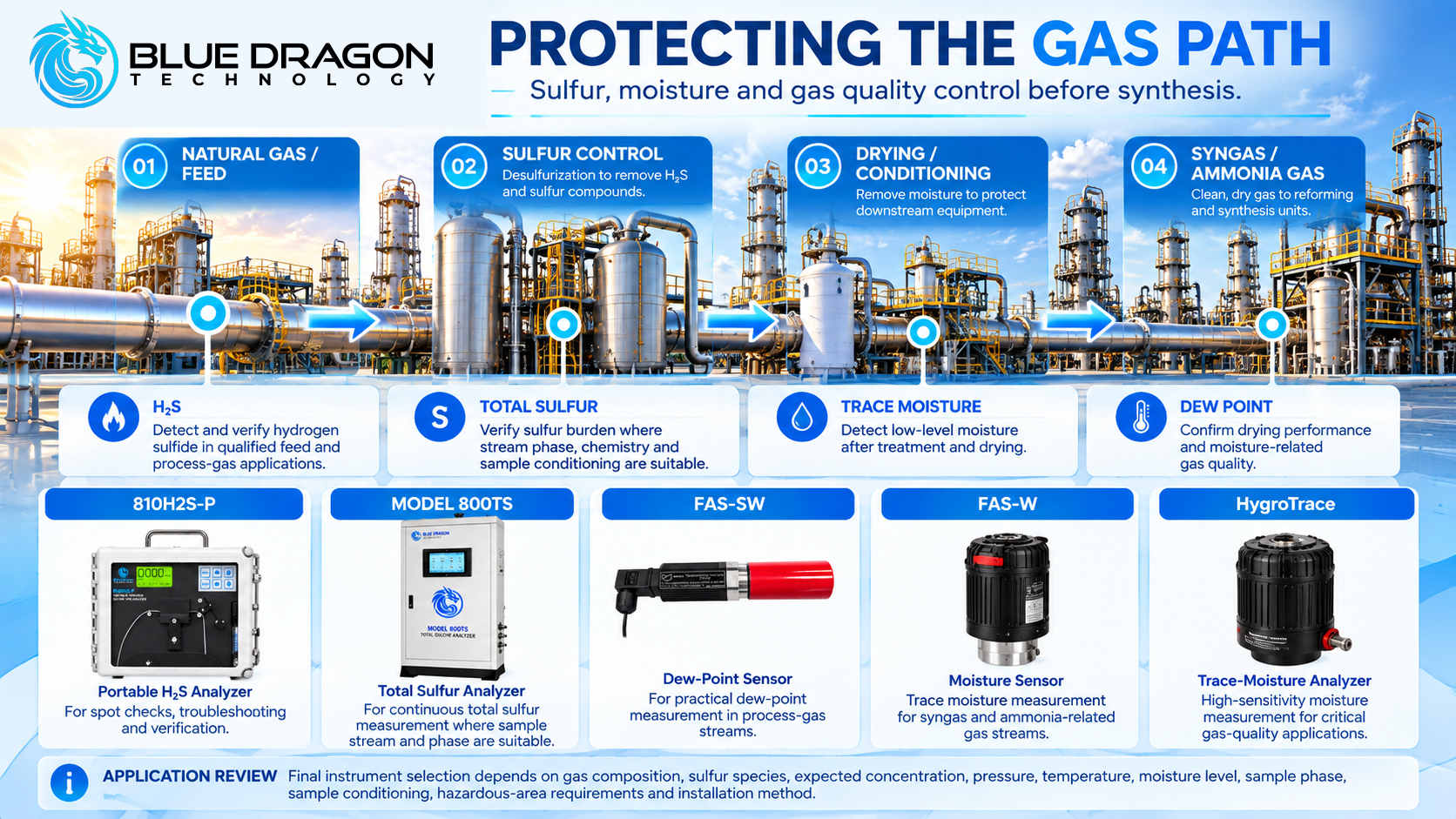
Fertilizer plant gas path showing sulfur, H2S, trace moisture and dew-point measurement before and through synthesis processes.

Figure 2. Protecting the gas path with sulfur, H₂S, trace-moisture and dew-point measurement for qualified process-gas streams.

Temperature Measurement in Reformers, Fired Heaters & Reactors

Thermal measurement requirements in fertilizer and chemical plants can be divided into at least two very different problems: measuring the external temperature of fired-equipment tubes and measuring temperature distribution at multiple internal locations within reactors or vessels.

Those two objectives require different sensor architectures.

Primary Reformer & Fired-Heater Tube-Skin Temperature

Primary reformers and fired heaters operate in demanding thermal environments where local tube-wall temperature can provide important information about operating behaviour and equipment condition.

The Blue Dragon BDT-SKIN Tube-Skin Thermocouples are engineered for direct external tube-wall temperature measurement. The complete assembly must account for tube geometry, operating temperature, attachment method, shielding, thermal expansion, routing and termination.

Representative tube-skin temperature information can support:

  • Identification of localized overheating
  • Comparison of temperature behaviour across critical tubes
  • Thermal-performance investigation
  • Maintenance and inspection planning
  • Long-term equipment-condition trending

Tube-skin thermocouples are engineered assemblies rather than generic surface sensors. Plant drawings, tube dimensions, material, monitored locations, design temperature and installation requirements should be reviewed before manufacture.

Multi-Point Reactor Temperature Profiling

Reactor measurement presents a different challenge. A single temperature point may not show how temperature varies through the depth or height of the process vessel.

The Blue Dragon BDT-MP Multipoint Temperature Assembly can be engineered with multiple thermocouple or RTD sensing points positioned at defined elevations or depths inside reactors, columns, vessels and other process equipment.

In urea and other chemical-reactor applications, multi-point measurement can help operators understand temperature distribution rather than relying on one isolated value.

The final assembly depends on vessel drawings, nozzle geometry, insertion length, sensing locations, materials, process pressure and temperature, mechanical support and termination requirements.
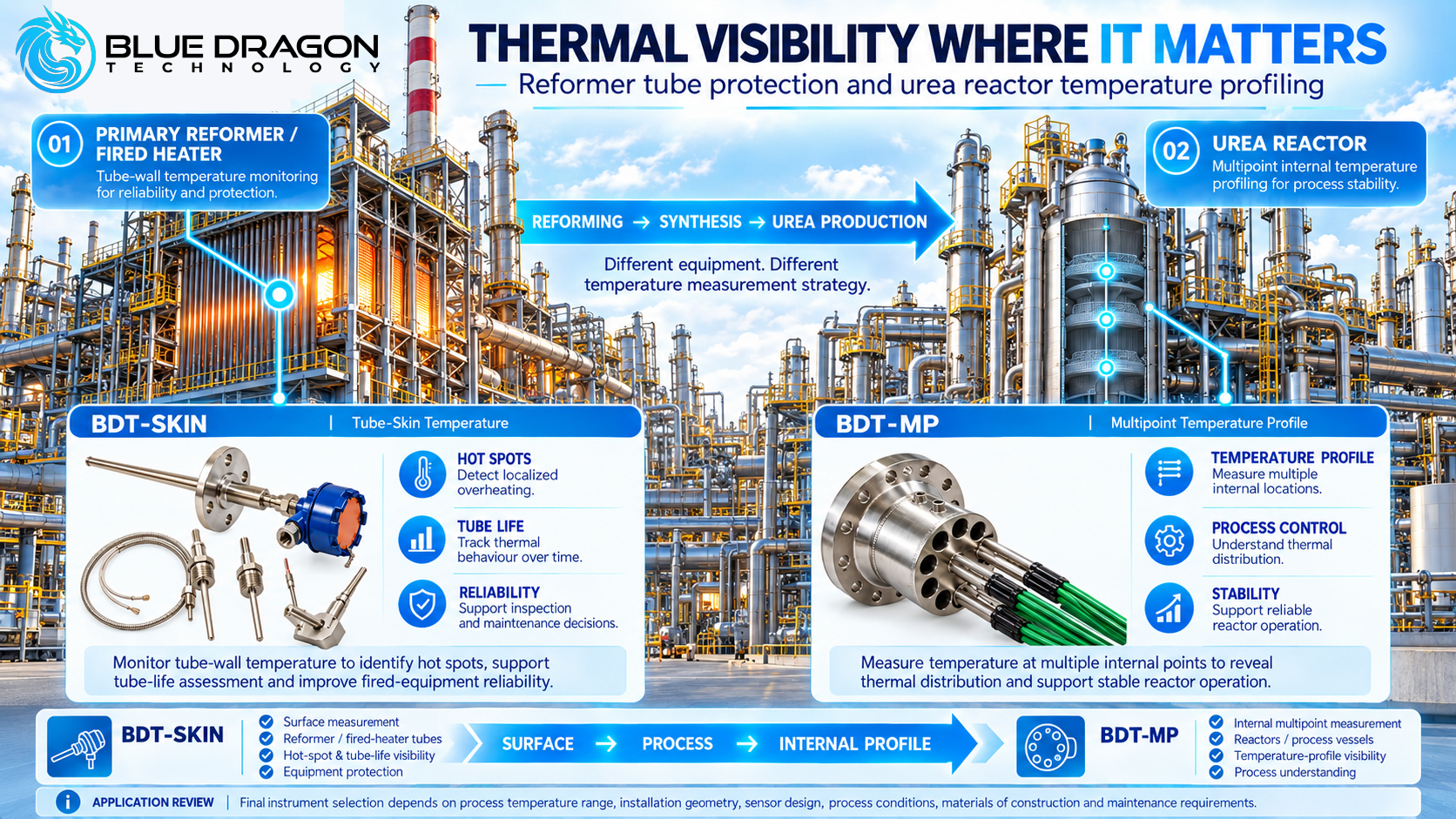
Blue Dragon BDT-SKIN and BDT-MP temperature measurement solutions for fired-heater tube monitoring and multi-point urea reactor profiling.

Figure 3. Thermal visibility where it matters: BDT-SKIN supports tube-wall temperature monitoring, while BDT-MP provides multi-point reactor temperature profiling.

The Ammonia & Urea Measurement Workflow

Viewed as one production chain, ammonia and urea manufacture can involve several measurement disciplines operating at different stages of the process.

Feed and treatment stages may require sulfur or H₂S verification where gas composition affects treatment or downstream equipment.

Primary reforming and fired equipment can require tube-wall temperature monitoring using engineered tube-skin assemblies.

Syngas and gas-conditioning stages may require moisture or dew-point measurement to understand drying performance and gas condition.

Process-gas networks may require qualified ultrasonic flow measurement where the line geometry, gas composition and required performance support that technology.

Urea reactors and related vessels may benefit from multi-point internal temperature profiling where temperature distribution is important to plant operation.

Utilities and wastewater systems introduce separate measurements including turbidity, oil-in-water and laboratory organic-carbon analysis.

These measurements do not need to come from one instrument family. Their value comes from being selected and applied as one coordinated plant measurement strategy.

Phosphate Rock, Raw Materials & Fertilizer Quality Control

Phosphate, DAP and NPK production introduce a measurement problem centred on material composition. Incoming rock, additives, intermediate materials and finished fertilizer may all require analytical verification depending on the plant’s quality-control procedures.

X-ray fluorescence spectroscopy, or XRF, provides elemental information and can be used at different stages of this workflow.

Rapid Field & Receiving Inspection

The Blue Dragon ElementX H1 Handheld XRF Spectrometer provides a portable approach to elemental screening where measurements need to be taken at receiving, storage, stockpile or other field-oriented locations.

Potential applications include screening of phosphate rock, additives and other incoming materials, subject to the installed analytical mode, calibration, sample matrix and required elements.

Laboratory Elemental Verification

The Blue Dragon ElementX B1 Vacuum Benchtop XRF Spectrometer provides a laboratory-oriented EDXRF platform for controlled elemental-analysis workflows.

The H1 and B1 therefore serve complementary roles. A plant may use rapid handheld measurements for screening and material triage while using a benchtop system for prepared samples and more structured laboratory verification.

Quantitative XRF performance depends on the sample matrix, preparation method, installed calibration and suitable reference materials. Instrument selection should therefore begin with the analytical question the plant needs to answer rather than simply the sample name.

DAP & NPK Production

For DAP and NPK production, elemental analysis can support incoming-material evaluation, formulation checks and finished-product quality-control workflows. Temperature measurement may also be relevant at selected process points where thermal conditions influence operation, but the sensor design must be matched to the actual equipment rather than assumed from the process name alone.
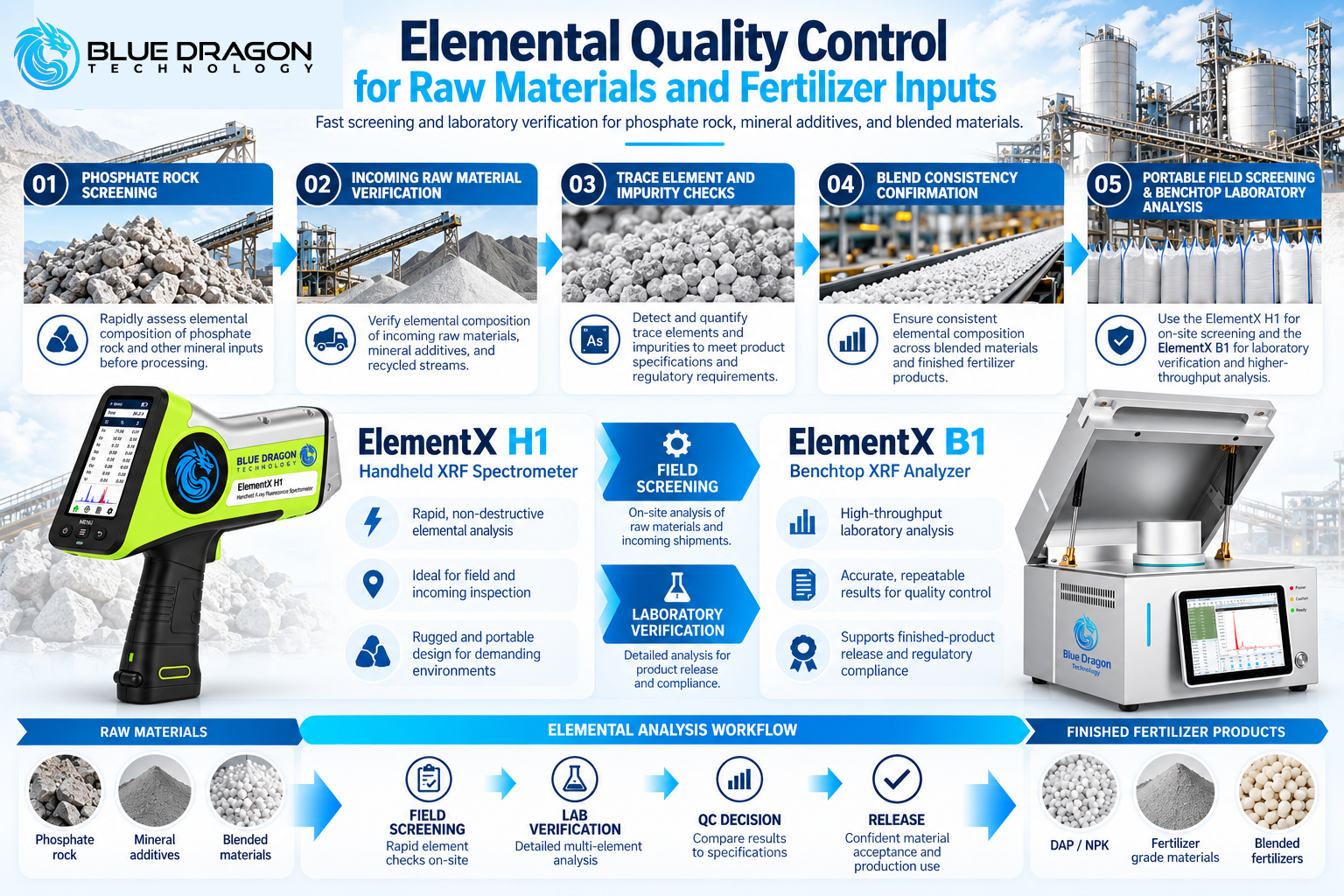
Blue Dragon ElementX H1 handheld XRF and ElementX B1 benchtop analyzer supporting elemental quality control from phosphate rock to finished fertilizer.

Figure 4. From phosphate rock to finished fertilizer: ElementX H1 provides rapid screening while ElementX B1 supports structured laboratory verification.

Phosphoric Acid, Sulfuric Acid & Reactor-Area Measurement

Acid-production and reactor areas require especially careful application review because process chemistry, corrosion, temperature and material compatibility can substantially change the measurement approach.

Potential measurement requirements can include:

  • Multi-point reactor or vessel temperature
  • Qualified gas-flow measurement
  • Utility-water and cooling-water monitoring
  • Turbidity or solids-related water trends
  • Oil contamination in appropriate water streams
  • Laboratory TOC analysis of suitable water samples

The process stream itself and the surrounding utility systems should be treated separately. A water-quality instrument appropriate for cooling or wastewater service should not be assumed to be compatible with concentrated acid or another aggressive process stream.

Important sulfur-application distinction: The Model 800RS sulfur-ratio analyzer is intended for Claus sulfur-recovery-unit tail-gas H₂S/SO₂ ratio applications. It should not be positioned as a general sulfuric-acid-production analyzer. Sulfuric-acid plant service and Claus SRU tail-gas service are different applications and require separate qualification.

Process, Fuel, Vent & Utility Gas Flow Measurement

Gas movement is another important measurement category across fertilizer and chemical plants. Depending on the process configuration, flow measurement may be required in fuel gas, process gas, vent gas, natural gas or other plant gas services.

Blue Dragon’s ultrasonic gas-flow portfolio includes inline and insertion configurations for different gas-flow applications.

Representative options include the Lauris FF1225-A Single-Path Inline Ultrasonic Gas Flow Meter and the Lauris FF2225-A Dual-Path Inline Ultrasonic Gas Flow Meter.

The appropriate flow-meter architecture cannot be selected from gas type alone. Important factors include:

  • Pipe diameter and schedule
  • Gas composition and density
  • Normal, minimum and maximum velocity
  • Pressure and temperature
  • Available straight-run distance
  • Liquid carryover or contamination
  • Required measurement uncertainty
  • Installation and transducer-access requirements
  • Hazardous-area classification and project certification

A process-gas flow application review should therefore be completed before the final meter geometry and configuration are selected.

Process Water, Cooling Water & Wastewater Monitoring

Water systems cross many areas of fertilizer and chemical plants. The exact arrangement varies by facility, but measurement requirements may arise in process water, cooling circuits, scrubbers, treatment systems, wastewater and discharge-related monitoring.

Different water-quality problems require different measurement principles. Turbidity, oil contamination and organic carbon should not be treated as interchangeable parameters.

Turbidity Monitoring

Turbidity provides an optical indication of suspended and scattering material in water. The Blue Dragon C620TUR Online Turbidity Analyzer is designed for continuous industrial water applications including process water, treatment systems, utility water and wastewater where the range and matrix are appropriate.

Measurement location, bubbles, particle characteristics, fouling, immersion conditions and calibration or verification practice can all influence turbidity performance.

Oil-in-Water Monitoring

Oil contamination represents a different water-quality problem. The Blue Dragon C610OIW Online Oil-in-Water Analyzer uses UV fluorescence for continuous oil-related trending in qualified industrial water streams.

Potential applications may include cooling-water contamination investigation, industrial wastewater and other water systems where the oil type, measurement range and sample characteristics are compatible with the sensing method.

Laboratory Total Organic Carbon Analysis

Total organic carbon provides another view of water condition by measuring carbon associated with organic material using the selected analytical method.

The Blue Dragon Model C680 High-Temperature Combustion TOC Analyzer is a laboratory instrument for TOC, TC, IC and NPOC analysis in suitable water samples using high-temperature catalytic combustion and NDIR detection.

The standard C680 configuration uses manual microsyringe injection, so it should be considered an offline laboratory analytical platform rather than an online continuous process analyzer.
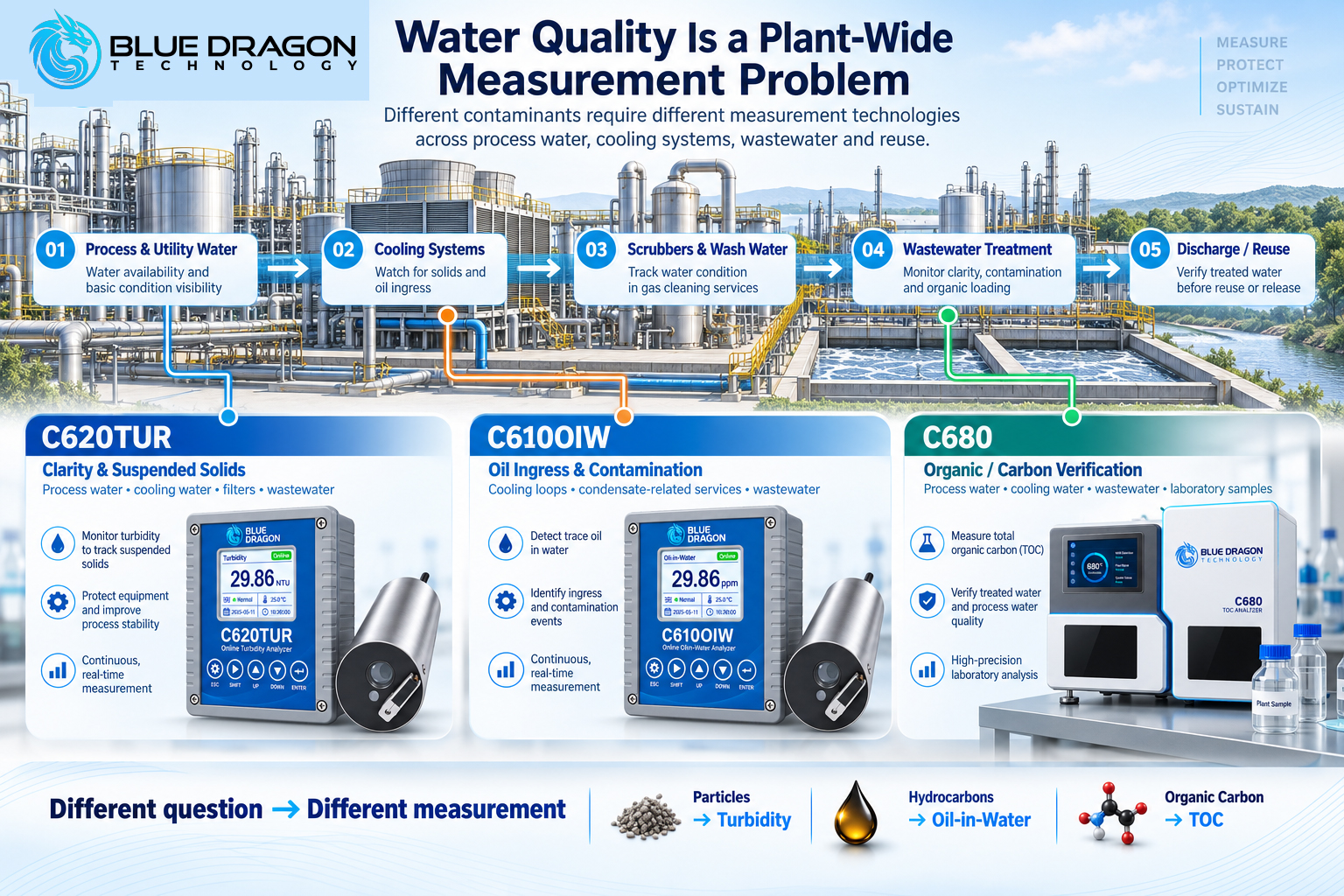
Blue Dragon C620TUR, C610OIW and C680 analyzers for turbidity, oil-in-water and TOC monitoring across plant water and wastewater systems.

Figure 5. Water quality is a plant-wide measurement problem, spanning process water, cooling systems and wastewater through turbidity, oil-in-water and TOC monitoring.

Matching Measurement Requirements to Plant Areas

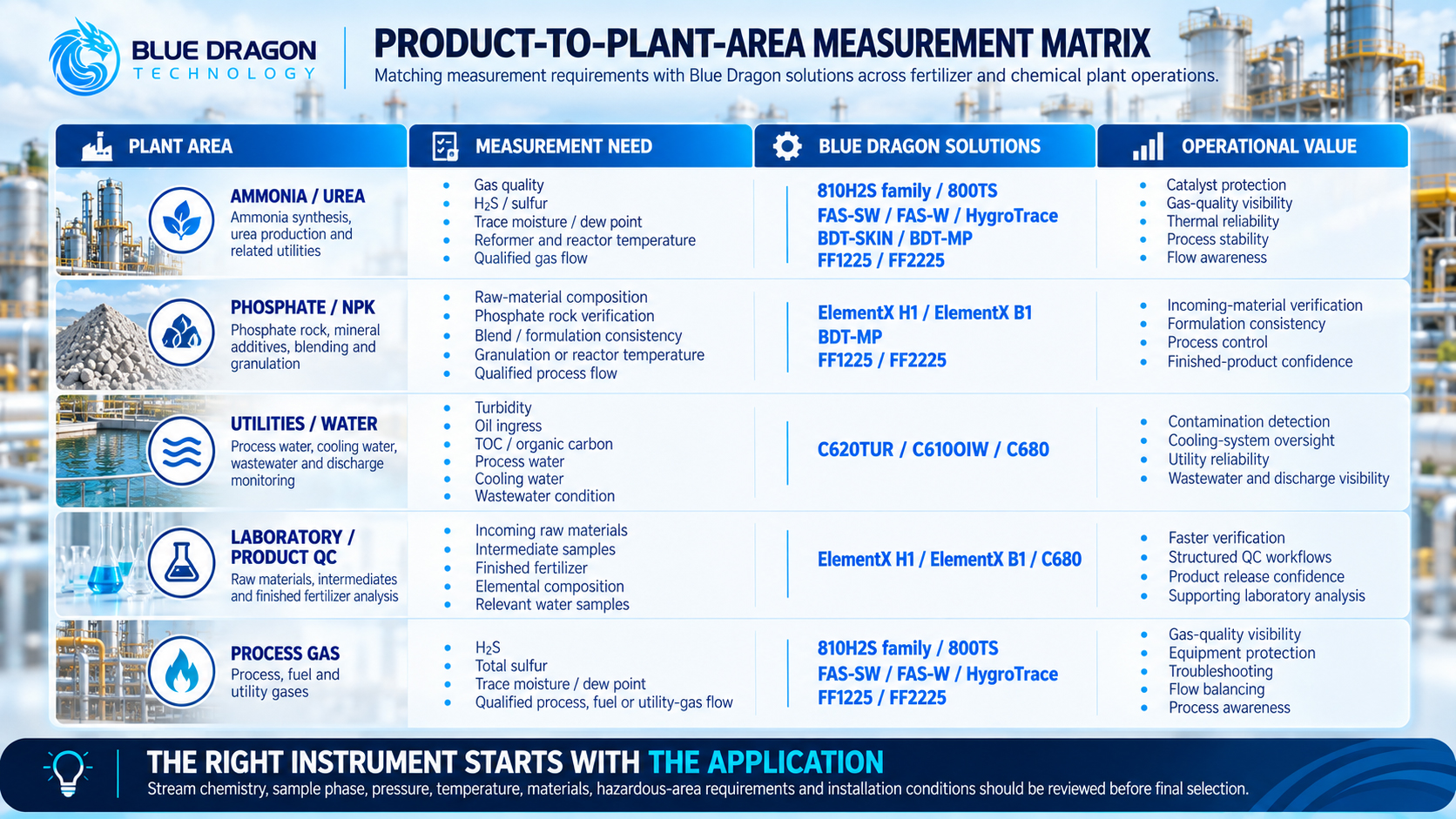
The following table summarizes representative measurement requirements across the plant. It is intended as an application map rather than a universal specification. Final suitability depends on the actual process, range, chemistry, installation and project requirements.

Plant Area Measurement Need Measurement Technology Representative Blue Dragon Solutions
Ammonia / Urea Gas quality, sulfur, moisture, reformer temperature, reactor temperature and qualified gas flow H₂S / sulfur analysis, moisture and dew point, tube-skin temperature, multipoint temperature, ultrasonic gas flow 810H2S-P,
FAS-SW,
FAS-W,
HygroTrace,
BDT-SKIN,
BDT-MP
Phosphate / DAP / NPK Raw-material composition, incoming inspection, laboratory verification and finished-product QC Handheld and benchtop XRF; application-specific process temperature measurement ElementX H1,
ElementX B1,
BDT-MP where the equipment and application justify multipoint profiling
Utilities / Water Turbidity, oil contamination, water treatment and laboratory organic-carbon analysis Optical turbidity, UV-fluorescence oil-in-water, high-temperature combustion TOC C620TUR,
C610OIW,
C680
Laboratory / Product QC Incoming material, intermediate and final-product elemental analysis; relevant water-sample analysis XRF elemental analysis and laboratory TOC analysis ElementX H1,
ElementX B1,
C680
Process Gas H₂S, sulfur, moisture, dew point and qualified gas flow Tape-based H₂S, total sulfur, chilled-mirror / transmitter / coulometric moisture, ultrasonic gas flow 810H2S,
810H2S-TS,
FAS-SW,
HygroTrace,
Blue Dragon Flow Portfolio
Application note: Product-to-plant relationships identify potentially relevant technologies. They do not replace application engineering. Sample composition, phase, range, process conditions, installation, certification and required performance can change the correct solution.

Matrix connecting fertilizer and chemical plant areas with Blue Dragon gas quality, temperature, flow, elemental QC and water measurement solutions.

Figure 6. Product-to-plant-area measurement matrix showing how instrumentation is matched to ammonia and urea, phosphate and NPK, utilities, laboratory QC and process-gas applications.

Technical Qualification: Why Application Review Comes First

Industrial instrumentation should be selected around the process conditions and measurement objective rather than only around the parameter name.

Two streams may both require H₂S measurement, for example, while differing substantially in pressure, moisture, composition, required range, hazardous-area classification and sample-system design. The same principle applies to temperature, flow, elemental analysis and water-quality instrumentation.

Before final instrument selection, the following areas should normally be reviewed.

1. Gas or Process Composition

Define the target species, major stream components, possible interferents, concentration range and any reactive, corrosive or contaminating components that may affect the measurement system.

2. Sample Matrix & Phase

Confirm whether the sample is a gas, liquid, water, solid, powder or prepared laboratory sample. Free liquids, particulates, moisture, aerosols and sample preparation can materially change measurement performance.

3. Pressure & Temperature

Normal, minimum, maximum, startup and upset conditions should be considered. Pressure reduction, cooling, heat tracing or other conditioning may be necessary depending on the technology.

4. Materials & Corrosion

Wetted-material compatibility is essential in chemical service. Acids, chlorides, sulfur compounds, solvents and other aggressive components must be reviewed against the proposed sensor, sample system and process interface.

5. Hazardous-Area Requirements

Area classification, required electrical approvals, installation method, purge requirements and project certification should be defined before final configuration.

6. Calibration, Verification & Maintenance

The plant should define how the measurement will be calibrated or verified, which standards or comparison methods are required, how frequently maintenance can be performed and how the instrument will be accessed safely.

7. Installation Geometry & Process Interface

Line size, nozzles, insertion depth, straight runs, vessel geometry, mounting orientation, sensor routing and available maintenance access can be decisive—particularly for flow meters and inserted temperature assemblies.

8. Data, Outputs & Control-System Integration

Required analogue outputs, digital communications, alarms, historian data, control-system tags and ownership of any process action should be defined as part of the instrumentation scope.

Blue Dragon provides a dedicated application-engineering review for projects where the measurement point, sample, configuration or project requirements need to be qualified before quotation.

Building a Coordinated Fertilizer & Chemical Plant Measurement Package

A coordinated instrumentation package does not need to begin as a full-plant project. Plants can start with one defined measurement problem and expand the scope where additional measurements provide useful process, quality or reliability information.

Gas Quality Package

A gas-quality scope can combine H₂S or Total Sulfur measurement with moisture and dew-point monitoring for qualified feed, fuel, syngas or process-gas streams. The exact analyzer combination depends on the stream chemistry and measurement objective.

Reactor & Heater Package

BDT-SKIN and BDT-MP address two complementary temperature problems: external tube-wall monitoring on fired equipment and internal multi-point temperature profiling within reactors, columns and vessels.

Raw Material & Laboratory QC Package

ElementX H1 and ElementX B1 can provide a field-to-laboratory elemental-analysis workflow, while laboratory TOC measurement can be added where suitable plant-water or wastewater samples require carbon analysis.

Utilities & Water Package

C620TUR, C610OIW and C680 address different water-quality questions across continuous turbidity, oil-related contamination monitoring and laboratory carbon analysis.

Full Plant Measurement Package

For larger projects, gas quality, temperature, flow, elemental QC and water-quality instrumentation can be evaluated together. The objective is not to install every available instrument, but to coordinate the measurements that address the plant’s actual process and quality requirements.
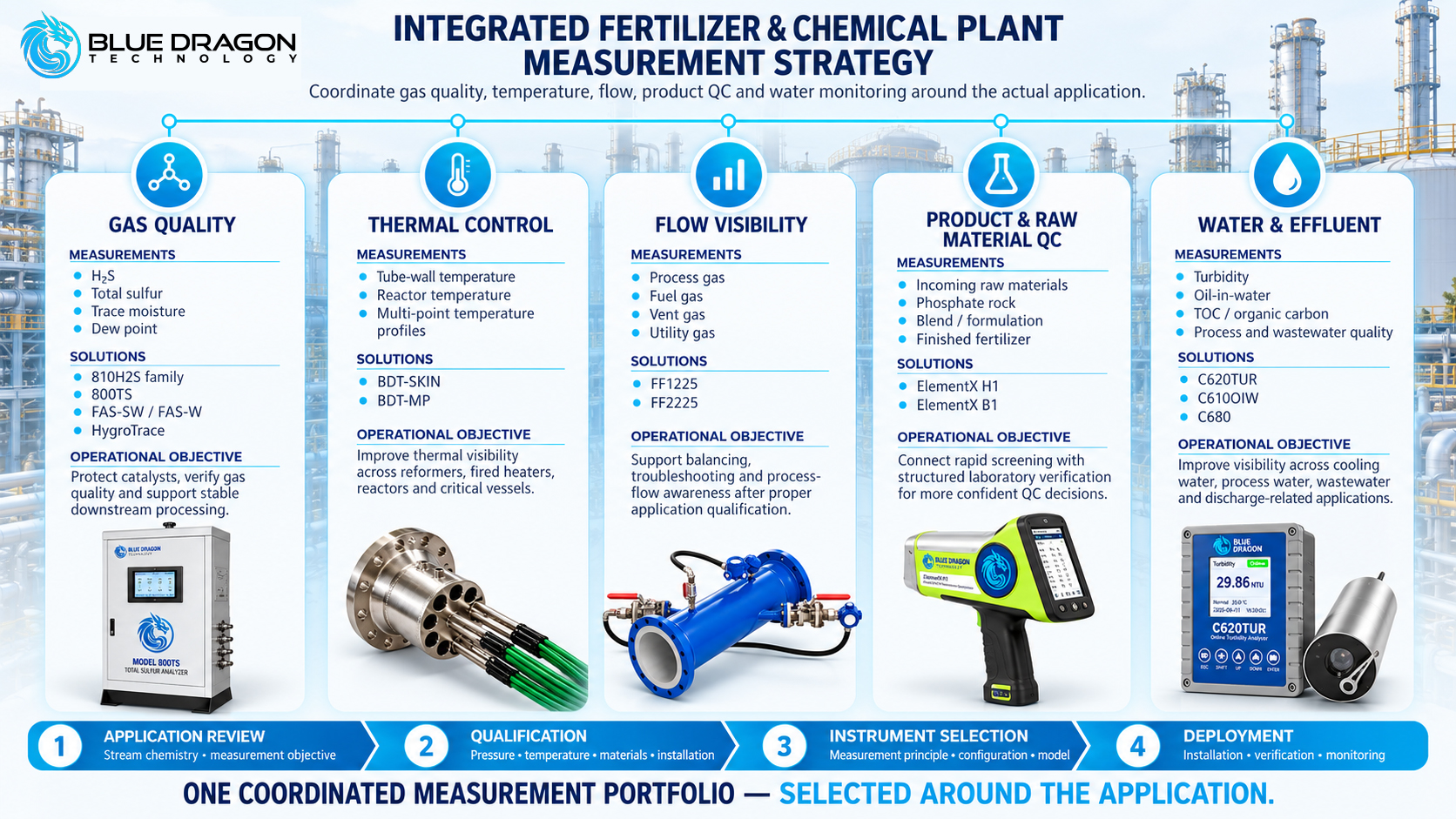
Integrated Blue Dragon measurement strategy covering gas quality, thermal control, flow, product QC and water monitoring from application review through deployment.

Figure 7. An integrated measurement strategy coordinating gas quality, temperature, flow, product and raw-material QC, and water monitoring around the actual application.

Information to Provide Before Instrument Selection or Quotation

Providing a small amount of application information at the beginning of a project can significantly improve instrument selection and reduce unnecessary clarification later.

Where available, provide:

  • Process or plant area
  • Measurement objective
  • Gas, liquid, water, solid or sample type
  • Complete or representative composition
  • Normal and maximum measurement range
  • Process pressure and temperature
  • Line, vessel or installation dimensions
  • Wetted-material or corrosion requirements
  • Hazardous-area classification
  • Required signals or communication protocol
  • Calibration or reference-method requirements
  • Project location and schedule

A complete specification is not necessary for an initial discussion. Blue Dragon can use the available information to identify missing qualification points and determine the appropriate technical next step.

Frequently Asked Questions About Fertilizer & Chemical Plant Instrumentation

Which measurements are commonly required in fertilizer and chemical plants?

Requirements depend on the plant and process, but relevant measurement categories can include sulfur and H₂S, trace moisture and dew point, reactor and fired-equipment temperature, process-gas flow, elemental composition, turbidity, oil-in-water and organic carbon. The correct priorities depend on the process and decisions the data must support.

How can H₂S and sulfur be monitored in fertilizer-plant gas streams?

Selective H₂S and Total Sulfur are different measurements. Blue Dragon provides tape-based H₂S configurations, combined H₂S / Total Sulfur configurations and total-sulfur analysis platforms. Stream composition, phase, range, pressure, temperature, sample conditioning and measurement objective must be reviewed before selection.

How is moisture measured in syngas or ammonia-related process gas?

Possible technologies include dew-point transmitters, chilled-mirror analyzers and coulometric ultra-trace moisture measurement. The most suitable principle depends on gas composition, pressure, moisture range, contaminants, sample conditioning, required response and verification method.

What is the difference between tube-skin and multipoint temperature measurement?

Tube-skin thermocouples measure external tube-wall temperature at defined points on fired equipment. Multipoint assemblies measure temperature at several internal elevations or depths inside reactors, columns or vessels. They solve different thermal-measurement problems and require different mechanical designs.

How can phosphate rock and finished fertilizer be analyzed?

XRF can support elemental analysis of phosphate rock, additives, prepared samples and finished fertilizer where the elements, matrix, calibration and sample preparation are suitable. Handheld XRF supports rapid field screening, while benchtop XRF supports controlled laboratory workflows.

Which measurements can be used in fertilizer-plant water systems?

Depending on the water system, measurements can include turbidity for solids-related optical trends, oil-in-water for hydrocarbon contamination and laboratory TOC analysis for organic-carbon evaluation. Each parameter answers a different analytical question.

Can the Model 800RS be used as a sulfuric-acid-production analyzer?

The Model 800RS is intended for H₂S / SO₂ ratio and air-demand monitoring in Claus sulfur-recovery-unit tail gas. That application is different from normal sulfuric-acid-production service and should not be treated as interchangeable without a separate technical review.

Why is an application review required before instrument selection?

Industrial measurements depend on more than the parameter name. Composition, sample phase, range, pressure, temperature, materials, installation geometry, hazardous-area requirements, calibration, maintenance and data integration can all change which technology and configuration are appropriate.

From Feed Gas to Finished Fertilizer

Fertilizer and chemical production combines gas treatment, synthesis, high-temperature equipment, reactors, raw materials, product-quality workflows and supporting utility systems. Each area creates a different measurement challenge.

The strongest instrumentation strategy is therefore not necessarily the one with the greatest number of instruments. It is the one that places the right measurement at the right process point and provides information that can support an operating, quality or maintenance decision.

That can mean combining:

  • Gas-quality measurement for H₂S, sulfur, moisture and dew point
  • Temperature measurement for reformer tubes, fired equipment, reactors and vessels
  • Ultrasonic gas-flow measurement for suitable process, fuel, vent and utility-gas services
  • Elemental analysis for raw-material and finished-product quality control
  • Water-quality instrumentation for turbidity, oil contamination and organic-carbon analysis

Together, these measurements provide a broader view of the process than any one instrument can provide independently.

Blue Dragon Technology supports individual measurement points and coordinated instrumentation requirements across fertilizer and chemical processing, from feed-gas verification through synthesis, reactors, product QC, utilities and wastewater.

Discuss Your Fertilizer & Chemical Plant Measurement Requirements

Blue Dragon Technology can review individual measurement points or broader plant instrumentation requirements across gas quality, sulfur, moisture, temperature, flow, raw-material and product QC, water quality and laboratory analysis.

For the most useful application review, provide the process or stream, measurement objective, expected range, composition or matrix, pressure, temperature, installation conditions, hazardous-area requirements and project schedule where available.

Discuss Your Application
Request a Quote
Contact Blue Dragon

Blue Dragon Technology
Measure. Monitor. Optimize.
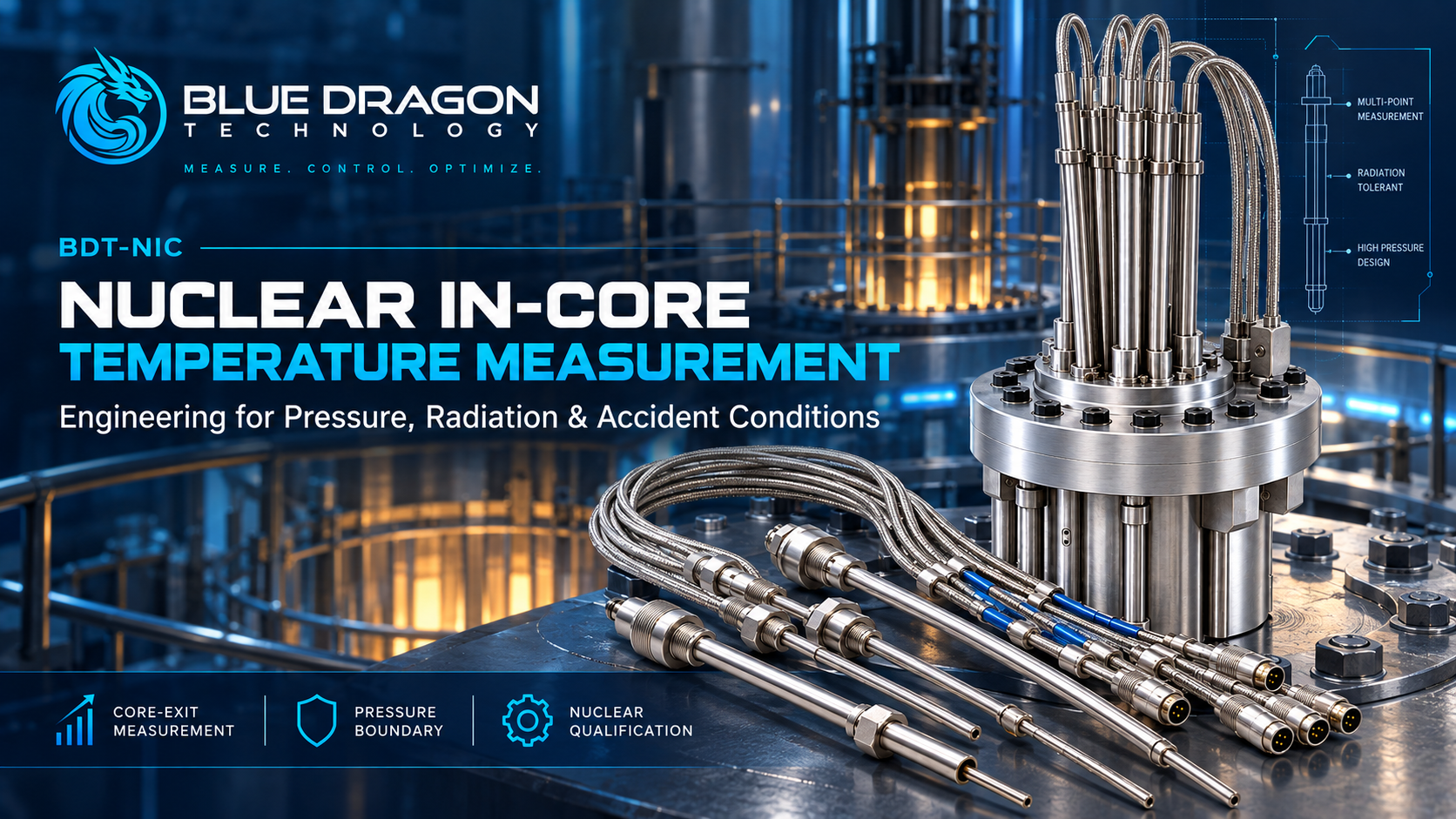
Blue Dragon Technology BDT-NIC nuclear in-core temperature measurement system with mineral-insulated thermocouple assemblies for core-exit measurement, pressure-boundary applications and nuclear qualification.

Core-Exit Temperature Measurement in Nuclear Reactors: Engineering Thermocouples for Pressure, Radiation and Accident Conditions

A thermocouple is one of the most established temperature-sensing technologies in industry. Its operating principle is straightforward: two dissimilar conductors generate a thermoelectric voltage related to the temperature difference between the measuring junction and the reference junction.

Inside or immediately above a nuclear reactor core, however, the measurement problem is no longer defined by the thermocouple alone. The sensing element may need to operate alongside reactor pressure, neutron and gamma radiation, mechanical loads, long cable runs, reactor-specific penetrations, safety-class requirements and plant instrumentation interfaces.

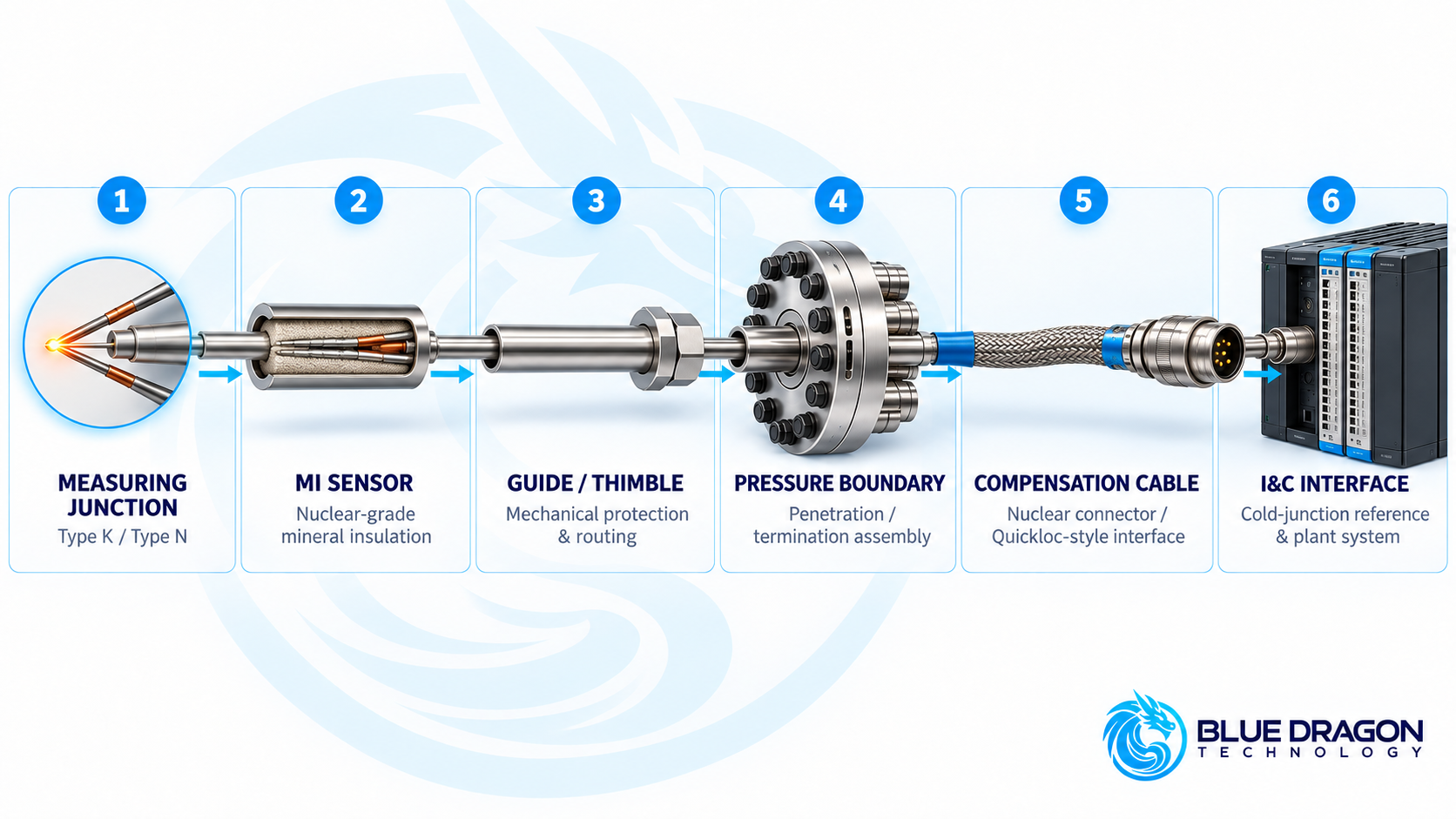
The relevant engineering object is therefore the complete temperature-measurement chain: from the measuring junction and mineral-insulated sensor through the guide, pressure boundary and compensation cable to the plant instrumentation and control system.

This article examines how nuclear core-exit and in-core temperature measurement systems are engineered around temperature capability, accuracy, response time, radiation environment, pressure containment, materials, service life and environmental qualification—and why these parameters must ultimately be defined for the specific reactor and measurement function. Blue Dragon addresses these project-specific applications through its BDT-NIC Nuclear In-Core Temperature Measurement Systems.

From Hot Junction to Plant I&C: The Complete Measurement Chain

A nuclear temperature measurement does not stop at the hot junction. The signal must travel through a mechanically and electrically controlled path before it becomes useful information inside the plant instrumentation system.

A representative measurement chain can include:

  • Measuring junction — the thermoelectric sensing point
  • Mineral-insulated thermocouple — providing compact, protected signal conductors inside a metallic sheath
  • Guide or thimble — routing and mechanically protecting the sensing assembly
  • Engineered pressure boundary — separating reactor/process pressure from the instrumentation side
  • Compensation cable and termination — carrying the thermocouple signal beyond the penetration
  • Plant I&C interface — including the appropriate cold-junction reference and measurement electronics

Representative nuclear core-exit temperature measurement chain showing the thermocouple junction, mineral-insulated sensor, guide or thimble, pressure boundary, compensation cable and plant I&C interface.

Representative nuclear temperature measurement chain extending from the sensing junction through the mineral-insulated assembly, mechanical guide and engineered pressure boundary to the compensation cable and plant I&C interface.

Mineral-Insulated Construction

Mineral-insulated, or MI, thermocouples place the thermoelement conductors inside a metallic sheath surrounded by compacted electrical insulation. This construction provides a small cross-section while mechanically protecting the conductors and maintaining electrical insulation along the sensor length.

For nuclear core-exit applications, Type K is an established reference thermocouple configuration, while Type N can be considered where required by the project. Depending on the design and qualification basis, sheath materials can include Inconel 600, 316 stainless steel or 304L stainless steel, with mineral insulation such as MgO or Al₂O₃.

Grounded and ungrounded junction arrangements can also be engineered according to the required electrical isolation, response and plant interface.

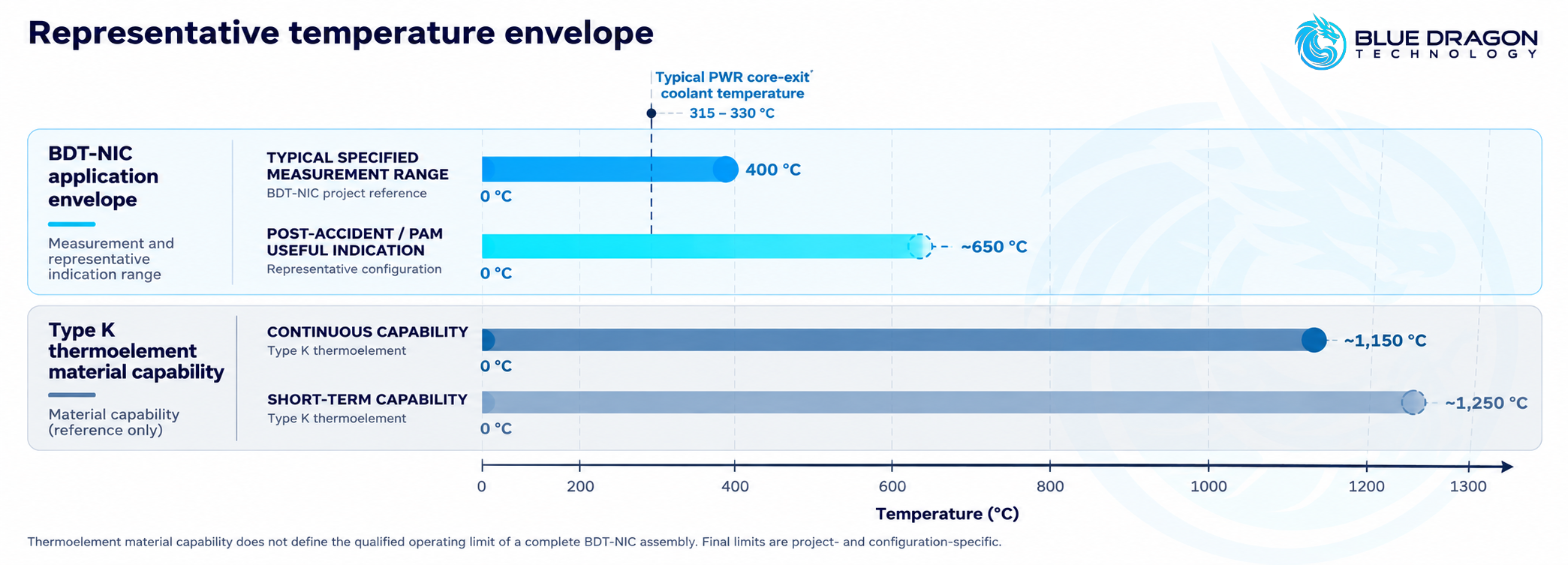
Temperature Capability Is Not the Same as Qualified Operating Range

One of the most important distinctions in nuclear temperature instrumentation is the difference between the temperature capability of the thermoelectric materials and the qualified operating range of the complete installed assembly.

For representative nuclear-grade Type K core-exit configurations, several different temperature ranges may be relevant:

  • Typical PWR core-exit coolant environment: approximately 315–330 °C
  • Typical specified measurement range: 0 to +400 °C, extendable according to calibration and configuration
  • Representative post-accident / PAM indication: useful indication through approximately 650 °C for applicable configurations
  • Type K thermoelement continuous capability: up to approximately 1,150 °C
  • Type K short-term thermoelement capability: approximately 1,250 °C

Representative BDT-NIC temperature envelope showing typical 0 to 400 °C measurement range, approximately 315 to 330 °C PWR core-exit coolant temperature, post-accident indication around 650 °C, and Type K thermoelement capability.

Normal measurement range, representative post-accident indication and thermoelement material capability describe different engineering limits and should not be treated as interchangeable.

The thermoelement material may therefore tolerate a substantially higher temperature than the complete installed system is specified or qualified to measure.

The actual assembly limit depends on factors such as sheath alloy, sheath diameter, mineral insulation, mechanical geometry, pressure-boundary arrangement, cable and termination design, calibration and the required measurement mission.

Engineering distinction: The Seebeck pair alone does not define the qualified operating temperature of a nuclear thermocouple assembly. Final limits belong to the complete, project-specific measurement system.

Accuracy and Response Are System Properties

Reference Type K Performance

For a Type K Class 1 thermocouple, a representative reference tolerance is approximately ±1.5 °C to 375 °C, followed by approximately ±0.4% of reading over the applicable higher-temperature range.

The uncertainty of the complete installed chain is different from the tolerance of the thermocouple element alone. Around a representative PWR core-exit temperature of approximately 325 °C, a complete nuclear measurement chain may typically be around ±2 to ±2.5 °C, depending on the configuration.

Response Time Changes After Installation

A small-diameter mineral-insulated element can achieve a representative t50 response of approximately two seconds. Once that element is incorporated into an engineered reactor assembly, however, the surrounding finger, guide, sheath, mechanical protection and thermal coupling influence how quickly the final system responds.

Installed core-exit or IITA-type configurations may therefore respond over several seconds to tens of seconds, depending on the mechanical design.

This illustrates another recurring principle in nuclear instrumentation: performance must be evaluated at the system level, not simply from the properties of the bare sensing element.

Radiation Duty Depends on Where the Sensor Is Located

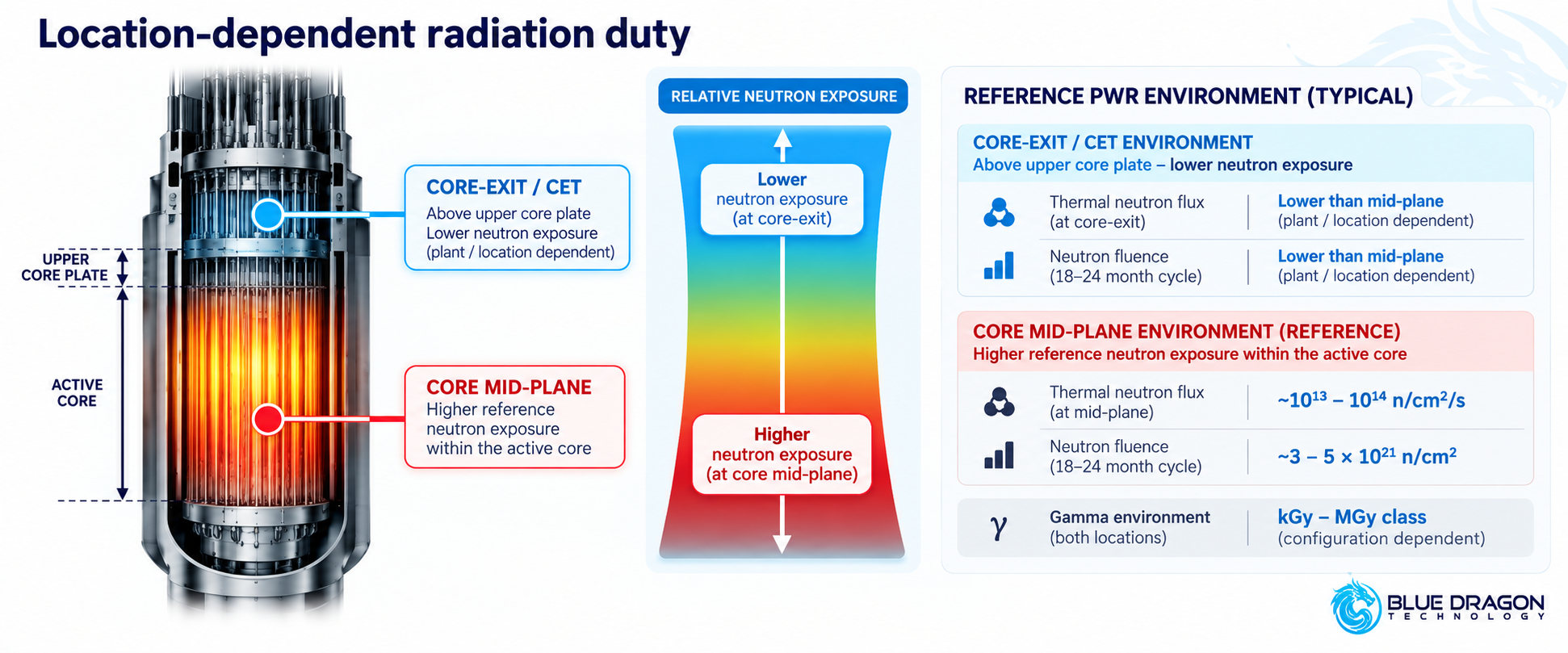
The term “in-core” can easily suggest that every sensor experiences the peak neutron environment inside the active core. In practice, radiation duty depends strongly on the actual measurement location.

Core-exit thermocouples are positioned above the upper core plate rather than at the core mid-plane. Their neutron exposure is therefore different from the higher reference neutron environment within the active core, although gamma exposure remains a significant qualification consideration.

For context, representative PWR mid-plane conditions can be of the order of:

  • Thermal neutron flux: approximately 1013–1014 n/cm²/s
  • Thermal fluence per 18–24 month cycle: approximately 3–5 × 10²¹ n/cm²
  • Core-exit neutron exposure: lower than the core mid-plane and dependent on plant and sensor location
  • Gamma environment: potentially kGy–MGy class, depending on the configuration and location

Conceptual comparison of neutron and gamma radiation environments at the reactor core mid-plane and core-exit thermocouple location.

Core-exit thermocouples operate in a different neutron environment from the core mid-plane, while gamma exposure remains an important project-specific qualification consideration.

Radiation Influences More Than Immediate Survivability

Long-term exposure can influence thermoelectric stability, measurement drift, insulation performance, sheath condition and other components within the measurement chain.

This is why a generic neutron-flux or gamma-dose number should not be treated as a universal thermocouple rating. The relevant radiation duty has to be established at the actual sensor location and assessed within the applicable plant environmental-qualification basis.

The Thermocouple Is Not the Reactor Pressure Boundary

Pressure is another area where the distinction between the sensor and the measurement system becomes important.

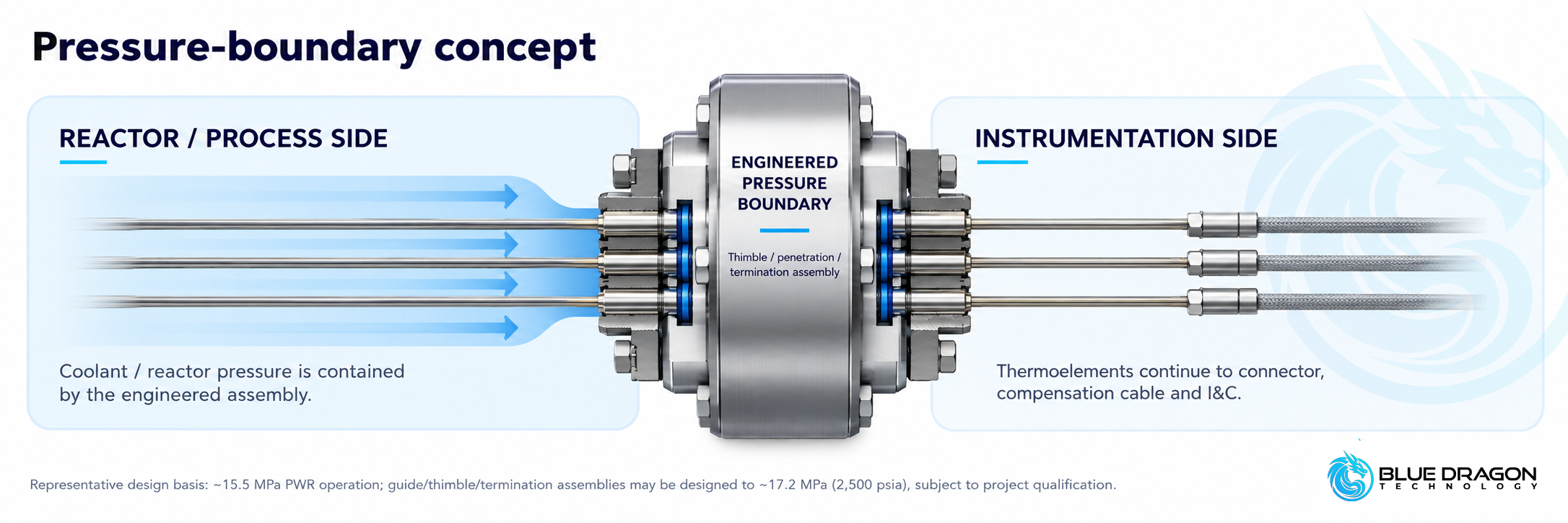
A large pressurized-water reactor can operate at reactor coolant system pressures around 15.5 MPa. Representative engineered IITA, guide or Quickloc-style pressure-boundary arrangements can be designed around approximately 17.2 MPa / 2,500 psia at 343 °C / 650 °F, subject to the actual project requirements.

The thermoelement itself is not the reactor coolant pressure boundary.

Pressure containment is provided by the engineered mechanical architecture around the sensing path, such as the thimble, guide, penetration, termination assembly and welded pressure-retaining components.

Conceptual nuclear thermocouple pressure-boundary arrangement showing reactor-side pressure contained by an engineered thimble, guide or termination assembly while the thermocouple signal continues to plant instrumentation.

The thermocouple provides the measurement path while reactor or process pressure is contained by the engineered guide, penetration or termination assembly.

Pressure Integrity Becomes Part of Instrument Qualification

Depending on the design and purchase specification, pressure-boundary verification can include all-welded construction, hydrostatic pressure testing, helium leak testing, weld inspection and other integrity checks.

The result is not simply a thermocouple capable of sensing temperature. It is a temperature-measurement system engineered to coexist with the mechanical boundary of the reactor installation.

Mechanical Design Is Reactor-Specific

The sensing element itself may be only a few millimetres in diameter, while the complete measurement path can extend through reactor internals, the vessel head, penetrations and cable routing over substantial distances.

Representative nuclear MI configurations can include:

  • MI sheath outside diameter: approximately 1.0–3.2 mm
  • Compact combined configurations: commonly around 1.0–1.6 mm
  • Overall length: engineered to the routing and potentially extending tens of metres
  • Sheath materials: Inconel 600, 316 stainless steel or 304L stainless steel
  • Junction arrangement: grounded or ungrounded depending on the measurement and isolation requirement

Final diameter and length are determined by the instrument-tube or thimble geometry, reactor internals, penetration arrangement, connector interface and routing to the plant instrumentation system.

Different Measurement Functions Produce Different Architectures

A project-engineered platform such as BDT-NIC can take different forms according to what the plant needs to measure.

  • Single core-exit temperature measurement for an individual monitoring location
  • Multipoint assemblies where several measurement locations are required within an engineered arrangement
  • Shared in-core instrumentation where temperature and neutron instrumentation occupy the same mechanical instrumentation space
  • Post-accident monitoring configurations engineered for the applicable safety and accident-monitoring function

These are configuration families rather than universally interchangeable products. Reactor design, sensor location, mechanical interfaces, electrical separation and qualification requirements determine the final architecture.

Core-Exit Temperature Measurement Has a Specific Plant Function

Core-exit thermocouples should not automatically be treated as interchangeable with every other reactor temperature measurement.

Depending on the plant architecture and safety basis, core-exit temperature information can support functions such as:

  • Core-exit temperature monitoring
  • Radial temperature mapping
  • Temperature or enthalpy-related monitoring
  • Post-accident indication where required by the plant design

These functions are different from temperature measurements performed elsewhere in the reactor coolant system and should not automatically be equated with loop RTD measurements used within reactor-protection calculations.

Service Life Is a Qualification Question, Not a Catalogue Number

It is tempting to ask for a single lifetime value for a nuclear thermocouple. In practice, qualified life depends on the specific environment and complete assembly.

Core-exit Type K configurations can support multi-cycle service and may remain usable for substantially longer periods when sheath and insulation integrity are maintained. That does not create a universal product-life value.

Important lifetime drivers can include:

  • Accumulated neutron fluence and gamma exposure, which can influence long-term thermoelectric stability
  • Sheath integrity, which protects the internal insulation system
  • Moisture ingress and insulation resistance, including the potential for virtual-junction effects
  • Thermal cycling across normal and transient operating conditions
  • Static and dynamic mechanical loads
  • Vibration and seismic duty
  • Connector and termination condition
Application note: Qualified life is established for the specific supplied configuration and environmental-qualification basis. It should not be interpreted as a universal warranty period for a thermocouple type.

Qualification Is Part of the Measurement System

Nuclear temperature instrumentation is not defined solely by nominal temperature range, accuracy and dimensions. Qualification and documentation can become part of the system specification itself.

Depending on the reactor, jurisdiction, safety classification and purchase specification, applicable standards or frameworks may include:

  • IEC 60737
  • IEC 62651
  • IEC 60584
  • IEEE 323
  • IEEE 344
  • IEEE 384
  • Regulatory Guide 1.97 for applicable post-accident monitoring functions
  • RCC-E / K1 requirements where applicable
  • 10 CFR 50 Appendix B and/or ISO 19443 where contractually required within the quality-assurance or supply-chain basis

The presence of these frameworks in an engineering discussion does not mean that every nuclear temperature assembly is automatically certified to every listed requirement. Applicability and qualification evidence have to be established against the actual plant and project scope.

Qualification Can Extend Beyond the Sensor

Depending on the project, qualification and documentation activities can include:

  • Environmental and functional testing
  • Thermal operating-mode verification
  • Pressure and leak-integrity testing
  • Radiation and ageing assessment
  • Static and dynamic mechanical analysis
  • Vibration and seismic qualification
  • Electrical isolation and separation requirements
  • Material and manufacturing traceability
  • Calibration, inspection and test documentation
  • Final project data-book documentation

Representative Nuclear Temperature Measurement Data

The following values summarize several of the representative engineering references discussed above. They are intended to illustrate the scale and engineering context of nuclear core-exit temperature measurement rather than provide a universal specification for BDT-NIC.

Engineering Parameter Representative Reference Engineering Context
Typical specified measurement range 0 to +400 °C Extendable according to calibration and project configuration.
Type K continuous thermoelement capability Up to ~1,150 °C Material capability; not the qualified operating limit of the complete assembly.
Typical large-PWR RCS operating pressure ~15.5 MPa Reference plant environment; actual reactor values govern.
Representative pressure-boundary design basis ~17.2 MPa / 2,500 psia Representative guide / thimble / termination basis; project specific.
Type K Class 1 reference tolerance ±1.5 °C to 375 °C, then ±0.4% Thermocouple reference tolerance; complete-chain accuracy is configuration dependent.
MI sheath OD Typically ~1.0–3.2 mm Final dimensions depend on instrument tube, thimble and mechanical interfaces.
Important: These values are representative engineering references and do not constitute the qualified specification of a particular BDT-NIC configuration. Final values are established against the reactor design, sensor location, safety classification, operating environment, environmental qualification and approved project documentation.

Why Nuclear Temperature Measurement Becomes Project Engineering

The underlying thermocouple technology may be mature, but the nuclear application is not generic.

Before a core-exit or in-core temperature measurement configuration can be finalized, the engineering team typically needs to understand:

  1. Reactor / NSSS type and plant architecture
  2. Measurement function — CET, multipoint, shared in-core instrumentation or PAM
  3. Number and location of measurement points
  4. Mechanical interfaces — including available thimble, instrument-tube and penetration information
  5. Temperature and pressure environment under normal, maximum and applicable accident conditions
  6. Radiation environment — neutron flux/fluence and gamma dose at the actual sensor location
  7. Required accuracy, allowable drift and response time
  8. Grounded or ungrounded junction requirements
  9. Safety classification and qualification basis
  10. Electrical and I&C interfaces
  11. Cable length, connector and termination requirements
  12. Quantity, documentation requirements and delivery schedule

That information allows the sensing element, materials, dimensions, interfaces, qualification scope and project documentation to be defined as one controlled system.

The thermocouple technology may be standardized. The nuclear application engineering is not.

BDT-NIC Nuclear In-Core Temperature Measurement Systems

The Blue Dragon BDT-NIC Nuclear In-Core Temperature Measurement Systems provide a project-engineered platform for nuclear temperature measurement applications requiring reactor-specific configuration and qualification.

Potential configurations include:

  • Core-exit temperature measurement
  • Multipoint nuclear temperature measurement
  • Shared in-core instrumentation arrangements
  • Applicable post-accident / PAM temperature measurement

The final BDT-NIC configuration is established against the reactor architecture, measurement location, operating environment, pressure-boundary interface, safety classification, required measurement performance, plant I&C system and applicable qualification basis.

For deeper engineering information, the BDT-NIC Technical & Application Engineering Guide — Rev. 1.0 provides representative temperature, accuracy, response, radiation, pressure, mechanical, material, qualification and project-definition information and is available through the BDT-NIC product page.

Frequently Asked Questions About Nuclear In-Core Temperature Measurement

What is a core-exit thermocouple?

A core-exit thermocouple measures temperature at a plant-defined location near the reactor-core outlet. Depending on reactor design, the resulting information can support core-exit temperature monitoring, temperature distribution assessment and applicable post-accident monitoring functions.

Why are mineral-insulated thermocouples used in nuclear applications?

Mineral-insulated construction provides compact thermoelement conductors inside a metallic sheath with electrically insulating mineral material. It allows the sensing path to be mechanically protected and configured for demanding temperature, routing and qualification requirements.

Is the maximum Type K temperature the operating limit of the complete sensor?

No. Thermoelement material capability is only one limit. The qualified operating range of the complete system also depends on sheath material, diameter, insulation, mechanical geometry, pressure-boundary arrangement, terminations, calibration and the required measurement mission.

Does a core-exit thermocouple experience peak core neutron flux?

Not necessarily. Core-exit thermocouples are located above the upper core plate rather than at the core mid-plane. Their neutron exposure is therefore different from the higher reference environment in the active core, while gamma radiation can remain significant.

Is the thermocouple itself the reactor pressure boundary?

No. The thermocouple provides the temperature-measurement path. Reactor/process pressure is contained by the engineered thimble, guide, penetration, termination or other pressure-retaining assembly surrounding the sensor route.

How is a BDT-NIC configuration selected?

Selection begins with the reactor architecture and measurement function, followed by the required temperature and pressure environment, radiation duty, accuracy, response time, mechanical interfaces, safety classification, qualification basis, electrical interface and project schedule. BDT-NIC project information and technical documentation are available here.

From a Simple Sensor Principle to a Qualified Nuclear Measurement System

The thermoelectric principle behind a Type K thermocouple is simple. Nuclear core-exit and in-core temperature measurement is not.

Temperature capability must be separated from complete-assembly qualification. Radiation exposure must be evaluated at the actual measurement location. Reactor pressure has to be contained by an engineered boundary. Accuracy and response have to be considered across the installed chain. Materials, mechanical interfaces, service life, electrical isolation, seismic requirements and documentation all become part of the final measurement system.

That is why nuclear temperature measurement is ultimately an application-engineering and qualification problem rather than a catalogue-sensor selection problem.

The BDT-NIC Nuclear In-Core Temperature Measurement Systems are structured around that project-specific approach, allowing the thermocouple technology, mechanical architecture, interfaces and qualification scope to be defined against the requirements of the individual reactor application.

Discuss Your Nuclear Temperature Measurement Application

Blue Dragon Technology can begin with a preliminary engineering review using high-level application information.

Useful inputs include the reactor / NSSS type, measurement function, number of instrumented locations, operating and design temperature and pressure, radiation environment, required measurement performance, applicable qualification basis, available mechanical interface information and project schedule.

This information can be used to define the appropriate BDT-NIC configuration, interface requirements, qualification and documentation scope, and the next technical and commercial steps.

Explore BDT-NIC Nuclear In-Core Temperature Measurement Systems

Blue Dragon Technology
Measure. Monitor. Optimize.
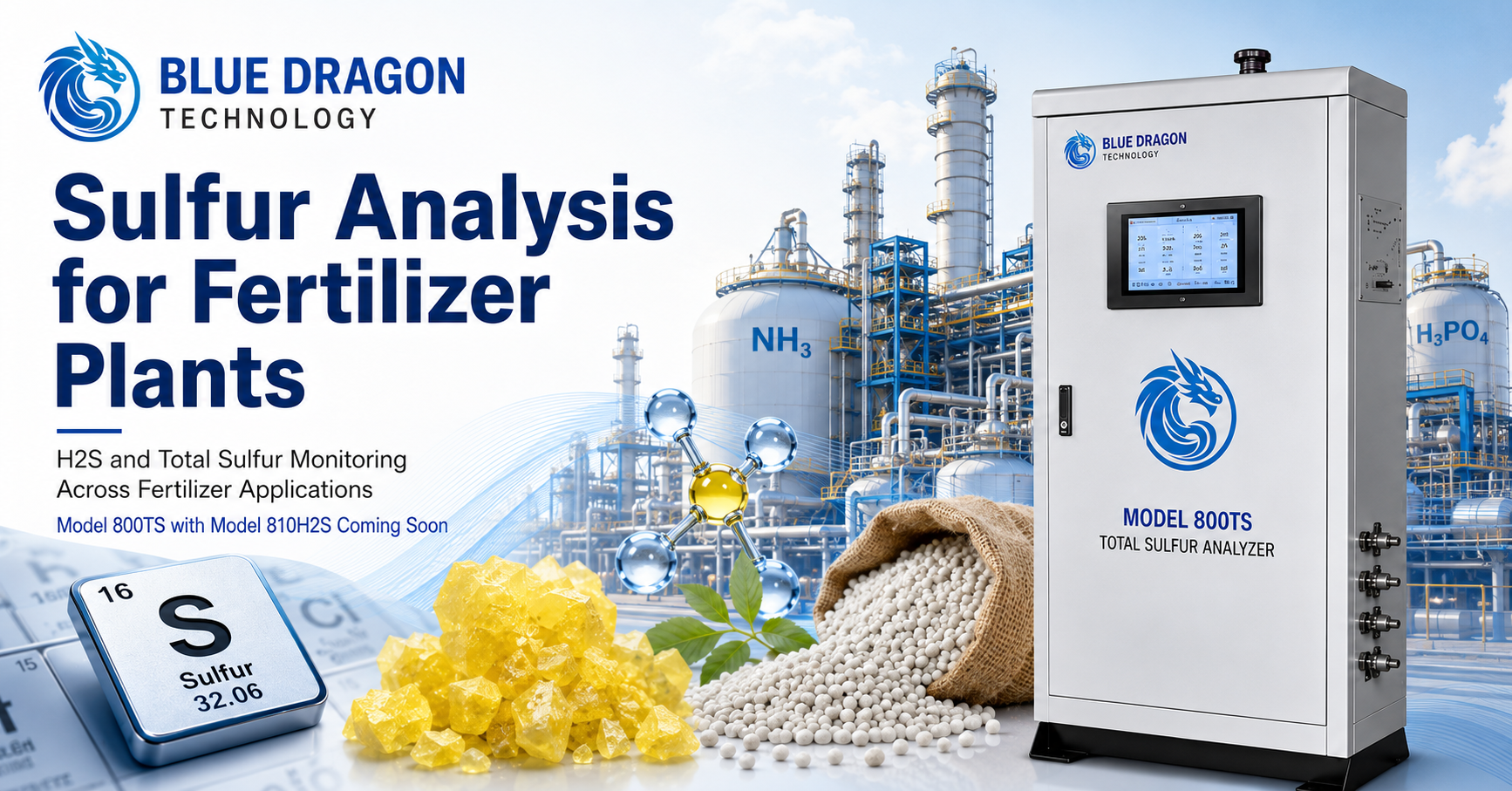
Blue Dragon Model 800TS total sulfur analyzer with fertilizer plant, fertilizer granules, sulfur crystals, and sulfur periodic table element.

Sulfur Analysis for Fertilizer Plants: H₂S and Total Sulfur Monitoring

Fertilizer production depends on tightly controlled chemical processes involving ammonia, urea, phosphate rock, sulfuric acid, ammonium sulfate, natural gas feedstocks, scrubbing systems, and emission-control equipment. Across these operations, sulfur compounds can appear in gas streams, liquid streams, vents, scrubbers, process condensates, wastewater, and product-related streams.

Hydrogen sulfide, H2S, is one of the most important sulfur compounds to monitor because it is toxic, corrosive, odorous, and environmentally significant. However, fertilizer plants often need more than single-compound H2S measurement. They may also need total sulfur analysis to understand the broader sulfur burden across process streams.

The Blue Dragon Technology Model 800TS Online Total Sulfur Analyzer provides continuous total sulfur measurement for gas and liquid applications. For fertilizer companies that require a complete sulfur-monitoring strategy, Blue Dragon Technology is also preparing the Model 810H2S Online Hydrogen Sulfide Analyzer, with a total sulfur option coming soon.

Quick Overview

Fertilizer plants can benefit from continuous sulfur analysis at multiple points in the production process, including feed gas treatment, acid gas handling, phosphate processing, sulfuric acid systems, ammonium sulfate production, scrubbers, vents, and wastewater treatment.

  • Key concern: H2S and other sulfur compounds can affect safety, corrosion, odor control, emissions, catalyst performance, and process quality.
  • Core measurement need: Continuous online sulfur data for both process control and compliance support.
  • Model 800TS: Online total sulfur analyzer for gas and liquid streams using catalytic combustion and UV fluorescence detection.
  • Model 810H2S: Coming soon as an online hydrogen sulfide analyzer, with a total sulfur option planned.
  • Typical fertilizer applications: Ammonia, urea, phosphate fertilizer, ammonium sulfate, sulfuric acid, gas treatment, scrubber monitoring, and environmental systems.

Why Sulfur Analysis Matters in Fertilizer Production

Fertilizer plants operate at the intersection of chemical manufacturing, environmental management, and process safety. Sulfur compounds are often present because many fertilizer processes rely on sulfur-containing raw materials, sulfuric acid, natural gas, acid gas treatment, or sulfur-bearing by-products.

In some locations, sulfur is part of the intended production chemistry. In others, it is an impurity that must be removed, treated, monitored, or controlled. This makes sulfur analysis important not only for product quality, but also for equipment protection, odor management, safety programs, and environmental compliance.

Periodic laboratory testing remains valuable, but it may not provide the real-time visibility needed for fast-changing process conditions. Continuous online sulfur analysis helps plant operators detect changes earlier, respond faster, and maintain more stable operation.

H2S and Total Sulfur: Understanding the Difference

H2S measurement and total sulfur measurement are related, but they are not the same. H2S analysis focuses specifically on hydrogen sulfide. Total sulfur analysis measures the combined sulfur content from multiple sulfur species in the sample.

In fertilizer plants, this distinction is important because sulfur may appear in several forms depending on the feedstock, process chemistry, temperature, pressure, oxidation state, and treatment method.

H2S Measurement

Used when the plant needs to monitor hydrogen sulfide specifically, especially in gas streams, vents, acid gas systems, safety-related points, odor-control points, or treated gas quality.

Total Sulfur Measurement

Used when the plant needs to measure the total sulfur burden across all sulfur species, including H2S, mercaptans, sulfides, disulfides, COS, CS2, and other sulfur-containing compounds.

For this reason, many fertilizer companies benefit from a combined sulfur-monitoring approach: targeted H2S measurement where hydrogen sulfide is the primary concern, and total sulfur measurement where the full sulfur profile is more important.

Where Sulfur Compounds Appear in Fertilizer Plants

Ammonia Plants

Ammonia production often begins with natural gas or another hydrocarbon feedstock. These feedstocks may contain sulfur compounds that must be removed before reforming and synthesis. Sulfur contamination can damage catalysts and reduce process efficiency, making sulfur monitoring important in feed gas treatment, desulfurization systems, and treated gas streams.

Urea Plants

Urea production is closely connected to ammonia and carbon dioxide systems. While urea synthesis itself is not usually considered a sulfur-driven process, upstream feedstock treatment, process condensates, utility systems, vents, and wastewater treatment may still require sulfur-related monitoring depending on the plant configuration.

Phosphate Fertilizer Plants

Phosphate fertilizer production often uses sulfuric acid to react with phosphate rock. Depending on raw material composition and process conditions, sulfur-containing gases or odorous compounds may appear in vents, scrubbers, reaction areas, granulation systems, and off-gas treatment units.

Sulfuric Acid Plants

Sulfuric acid production is central to many fertilizer complexes, especially phosphate fertilizer operations. Monitoring sulfur-related streams can support process control, conversion efficiency, emission control, and operational stability.

Ammonium Sulfate Plants

Ammonium sulfate production may involve sulfuric acid, ammonia, crystallization systems, scrubbers, and by-product recovery streams. Sulfur monitoring can support process optimization, odor control, product quality, and wastewater management.

Scrubbers, Vents, and Wastewater Systems

Many fertilizer plants rely on scrubbers and treatment systems to manage emissions and odorous compounds. H2S and other sulfur compounds may be present in vent gas, scrubber outlet gas, condensates, wastewater treatment areas, and recovered process streams.

Common Sulfur Species Relevant to Fertilizer Companies

Fertilizer plants may encounter a wide range of sulfur compounds. The exact species depend on the feedstock, acid system, gas-treatment process, scrubbing chemistry, and plant design.

Sulfur Species Why It Matters
Hydrogen sulfide, H2S Toxic, corrosive, odorous, and important for safety, environmental, and gas-treatment applications.
Carbonyl sulfide, COS Can appear in gas streams and may require hydrolysis or treatment depending on process requirements.
Carbon disulfide, CS2 Relevant in some sulfur-bearing gas and chemical process streams.
Mercaptans Strong odor compounds that may appear in hydrocarbon or gas-related streams.
Sulfides and disulfides Can contribute to corrosion, odor, and total sulfur loading.
Sulfur oxides Important for combustion, acid production, emission-control, and sulfuric acid-related processes.

Because sulfur can appear in several forms, total sulfur analysis is often useful when the plant needs a complete picture of sulfur content rather than only a single-compound reading.

Key Measurement Points in Fertilizer Plants

Feed Gas and Treated Gas

Monitoring sulfur in natural gas or treated gas helps protect catalysts and verify the performance of desulfurization systems.

Acid Gas and Process Vents

H2S and sulfur-containing gases may be present in acid gas systems, vents, and off-gas streams requiring continuous monitoring.

Scrubber Inlet and Outlet Streams

Measuring sulfur before and after scrubbing helps operators evaluate removal efficiency and adjust treatment systems.

Process Condensates and Liquids

Liquid sulfur analysis can help monitor contamination, process stability, wastewater loading, and treatment requirements.

Sulfuric Acid and Phosphate Systems

Sulfur-related monitoring can support acid production, phosphate rock reaction systems, off-gas control, and emission-management programs.

Wastewater and Treatment Units

Sulfur compounds in wastewater systems can create odor, corrosion, and treatment challenges, especially when process streams vary.

Operational Benefits of Continuous Sulfur Analysis

For fertilizer companies, sulfur analysis is not only a compliance function. It is also a process-control and risk-reduction tool. Continuous monitoring can help plant teams move from reactive sampling to proactive control.

  • Worker and plant safety: Continuous monitoring helps identify sulfur-related hazards earlier.
  • Odor control: H2S and mercaptans can create strong odor issues even at low concentrations.
  • Corrosion management: Sulfur compounds can contribute to corrosion in process equipment, piping, and treatment systems.
  • Catalyst protection: Sulfur contamination can reduce catalyst performance in ammonia and gas-treatment processes.
  • Scrubber optimization: Online data helps operators understand whether scrubbing systems are performing effectively.
  • Environmental reporting support: Consistent sulfur data can support internal documentation and permit-related monitoring programs.
  • Process stability: Real-time sulfur data helps operators detect feedstock changes, process upsets, and treatment inefficiencies.

Blue Dragon Model 800TS for Fertilizer Plant Sulfur Analysis

The Blue Dragon Technology Model 800TS Online Total Sulfur Analyzer is designed for continuous total sulfur measurement in both gas and liquid streams. This makes it highly relevant for fertilizer plants that need sulfur data across more than one process area or sample type.

The Model 800TS uses catalytic combustion to convert sulfur compounds into sulfur dioxide, followed by ultraviolet fluorescence detection. This approach allows the analyzer to report total sulfur content from a broad range of sulfur species, rather than measuring only one compound.

In fertilizer applications, the Model 800TS can support process monitoring, feedstock control, gas-treatment verification, liquid-stream analysis, scrubber optimization, and environmental-system monitoring.

How the Model 800TS Works

  1. Sample conditioning: The gas or liquid sample is prepared for stable online analysis based on the application requirements.
  2. Catalytic combustion: Sulfur-containing compounds are converted into sulfur dioxide.
  3. UV fluorescence detection: The generated sulfur dioxide is measured using ultraviolet fluorescence.
  4. Total sulfur calculation: The analyzer converts the detector signal into a total sulfur concentration.
  5. Plant integration: Results can be used for process control, alarms, data logging, reporting, and plant-monitoring systems.

Key Features of the Model 800TS

Gas and Liquid Analysis

Supports total sulfur measurement in both gas and liquid sample streams, allowing one analyzer platform to address multiple fertilizer-plant applications.

UV Fluorescence Detection

Provides precise total sulfur measurement after sulfur compounds are converted into sulfur dioxide.

Catalytic Combustion

Converts different sulfur compounds into a measurable form, enabling total sulfur analysis across complex sample matrices.

Multi-Stream Monitoring

Supports up to six sample streams with automatic switching, making it useful for plants with multiple sulfur-monitoring points.

Low-Level Detection

Designed for demanding applications requiring sulfur measurement down to 100 ppb.

Industrial Integration

Designed for continuous online operation with outputs suitable for plant monitoring, control systems, alarms, and data logging.

Typical Fertilizer Applications for the Model 800TS

Plant Area How Total Sulfur Analysis Helps
Natural Gas Feed Treatment Verifies sulfur removal before reforming or downstream processing.
Ammonia Production Supports catalyst protection and feedstock quality control.
Phosphate Fertilizer Monitors sulfur-related streams in acid reaction, off-gas, and scrubbing systems.
Sulfuric Acid Systems Supports process control and sulfur-related monitoring in acid production and handling.
Scrubber Systems Helps evaluate sulfur-removal performance across inlet and outlet streams.
Wastewater and Liquid Streams Provides total sulfur data for liquids, condensates, and treatment-related streams.

Coming Soon: Blue Dragon Model 810H2S Online Hydrogen Sulfide Analyzer

For applications where hydrogen sulfide is the primary measurement target, Blue Dragon Technology is preparing the Model 810H2S Online Hydrogen Sulfide Analyzer. This analyzer is being developed for continuous H2S monitoring in industrial gas applications and will also be available with a total sulfur option.

The Model 810H2S will be especially relevant for fertilizer plants that need targeted H2S monitoring in gas streams, vents, acid gas systems, scrubber outlets, odor-control points, or environmental-monitoring locations.

Planned Role of the Model 810H2S

  • Continuous online H2S monitoring for industrial gas applications
  • Useful for safety, odor control, gas-treatment verification, and emissions-related monitoring
  • Total sulfur option planned for applications requiring broader sulfur measurement capability
  • Designed to complement the Model 800TS in fertilizer and chemical plant sulfur-monitoring programs

Together, the Model 800TS and the upcoming Model 810H2S will allow fertilizer companies to select the correct sulfur-analysis approach for each application: total sulfur monitoring for broad sulfur control, and targeted H2S monitoring where hydrogen sulfide is the specific concern.

Choosing the Right Blue Dragon Analyzer for Fertilizer Applications

Measurement Need Recommended Analyzer Reason
Total sulfur in gas streams Model 800TS Measures the combined sulfur content from multiple sulfur compounds.
Total sulfur in liquid streams Model 800TS Supports liquid total sulfur measurement for process liquids, condensates, and treatment streams.
Multiple sulfur-monitoring points Model 800TS Supports up to six streams with automatic switching.
Targeted H2S gas monitoring Model 810H2S, coming soon Designed for applications where hydrogen sulfide is the primary measurement target.
H2S monitoring with total sulfur flexibility Model 810H2S with TS option, coming soon Planned for users who need H2S monitoring with broader sulfur-analysis capability.

Why Fertilizer Companies Should Consider Online Sulfur Analysis

Fertilizer plants often operate large, continuous processes where small changes in feedstock quality, gas composition, scrubber performance, or acid-system behavior can create downstream effects. Online sulfur analysis gives operators the visibility needed to respond before issues become larger operational problems.

  • Earlier detection of process upsets: Continuous sulfur data helps identify changes that may be missed between manual samples.
  • Improved control of treatment systems: Scrubbers, gas-treatment units, and wastewater systems can be adjusted based on real process conditions.
  • Reduced risk of off-spec operation: Online analysis helps maintain process consistency and product-related quality control.
  • Better documentation: Continuous data supports internal reporting, maintenance review, environmental programs, and operational decision-making.
  • Integrated plant monitoring: Analyzer outputs can support alarms, trend analysis, process dashboards, and control-room visibility.

Blue Dragon Technology Support for Fertilizer and Chemical Plants

Blue Dragon Technology supplies process-measurement and analytical instrumentation for industrial customers in fertilizer, chemical, oil & gas, petrochemical, LNG, environmental, and manufacturing sectors.

For fertilizer companies, Blue Dragon Technology can support analyzer selection, application review, sample-point planning, configuration discussions, commissioning support, and after-sales service. The goal is to provide a sulfur-analysis solution that fits the real operating conditions of the plant, not only the analyzer specification sheet.

  • Application review: Identify whether the plant needs total sulfur, H2S-specific monitoring, or both.
  • Sample-point planning: Review gas, liquid, vent, scrubber, and process-stream monitoring requirements.
  • Analyzer selection: Match the Model 800TS or upcoming Model 810H2S to the correct process application.
  • Integration support: Support plant data requirements, alarms, reporting, and control-system connection needs.
  • After-sales service: Provide continued support for operation, maintenance, calibration, and spare parts planning.

Discuss Sulfur Analysis for Your Fertilizer Plant

Whether your facility needs total sulfur analysis, H2S monitoring, scrubber-performance verification, feed gas treatment control, or liquid-stream sulfur measurement, Blue Dragon Technology can help review the application and recommend a suitable analyzer configuration.

Product Page:

Model 800TS Online Total Sulfur Analyzer

Website:

bluedragontechnology.com

Email:

contact@bluedragontechnology.com

Frequently Asked Questions

Why do fertilizer plants need sulfur analysis?

Fertilizer plants may encounter sulfur compounds in feed gas, acid systems, scrubbers, vents, process condensates, liquid streams, wastewater, and emission-control systems. Sulfur analysis helps support safety, corrosion control, odor management, catalyst protection, process stability, and environmental monitoring.

Is H2S the same as total sulfur?

No. H2S is one specific sulfur compound. Total sulfur analysis measures the combined sulfur content from multiple sulfur species. Fertilizer plants may need H2S-specific monitoring, total sulfur analysis, or both depending on the application.

Can the Model 800TS measure H2S?

The Model 800TS is a total sulfur analyzer. It can include sulfur from H2S as part of the total sulfur result after conversion and detection, but it is not positioned as a selective H2S-only analyzer. For targeted H2S monitoring, Blue Dragon Technology is preparing the Model 810H2S.

Can the Model 800TS measure both gas and liquid samples?

Yes. The Model 800TS is designed for total sulfur measurement in both gas and liquid applications, depending on the sample-conditioning and system configuration required for the process.

How many sample streams can the Model 800TS monitor?

The Model 800TS can support up to six sample streams with automatic switching, making it suitable for fertilizer plants that need to monitor multiple process points.

What is the upcoming Model 810H2S?

The Model 810H2S is Blue Dragon Technology’s upcoming online hydrogen sulfide analyzer. It is being developed for continuous H2S monitoring in industrial gas applications, with a total sulfur option planned.

Which analyzer should a fertilizer company choose?

If the facility needs total sulfur measurement across gas or liquid streams, the Model 800TS is the primary choice. If the facility needs targeted H2S monitoring in gas streams, the upcoming Model 810H2S may be the better fit. Some plants may benefit from both analyzers depending on the number and type of sulfur-monitoring points.

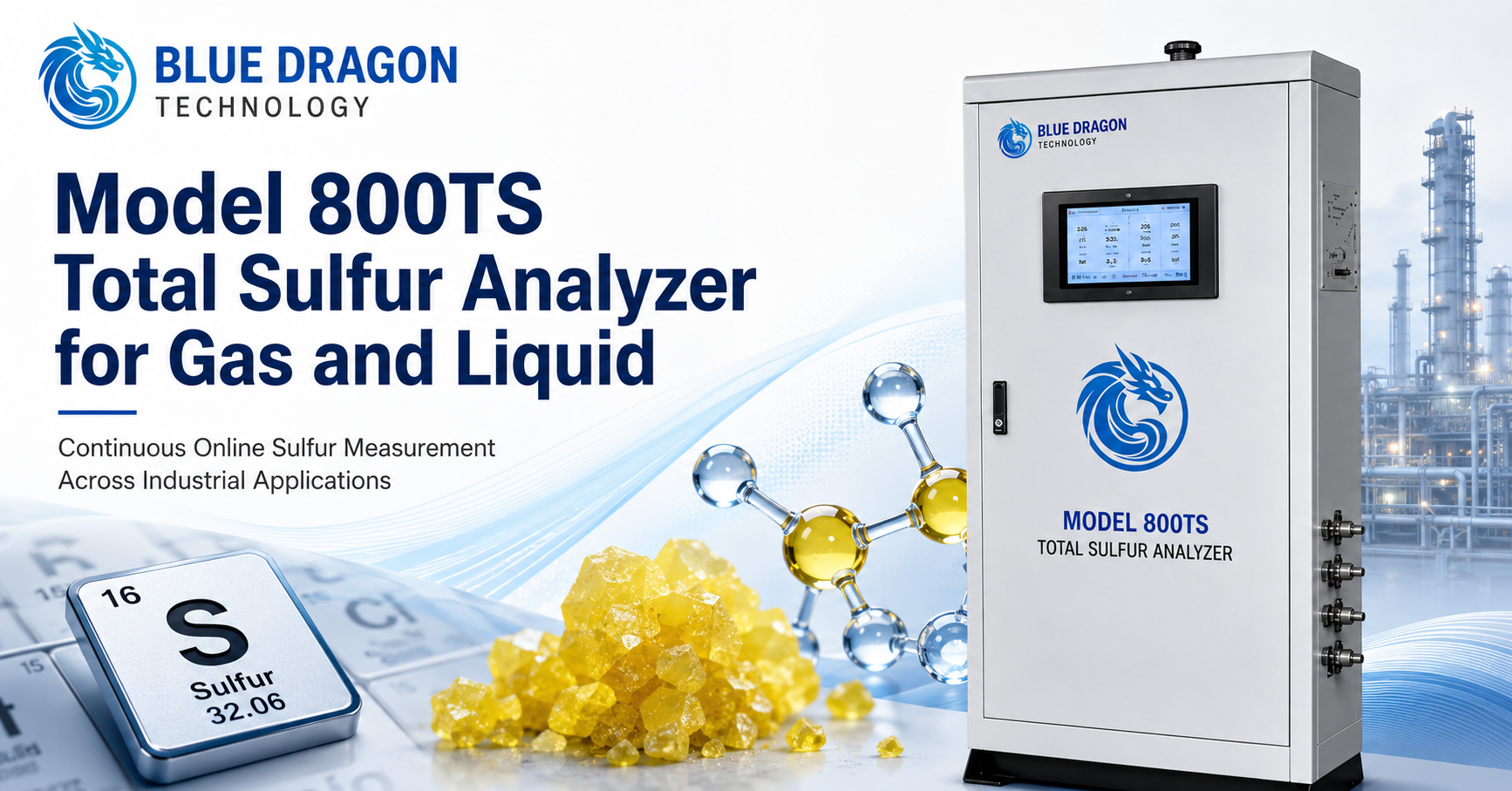
Blue Dragon Technology Model 800TS total sulfur analyzer with sulfur crystals and sulfur periodic table element for gas and liquid sulfur measurement.

Blue Dragon Technology Model 800TS Online Total Sulfur Analyzer for Gas and Liquid Applications

Sulfur measurement is a critical part of modern industrial process control. From refineries and LNG plants to petrochemical, fertilizer, gas-processing, and environmental monitoring applications, accurate total sulfur analysis helps operators protect catalysts, meet product specifications, reduce emissions, and maintain safe, reliable plant operation.

The Blue Dragon Technology Model 800TS Online Total Sulfur Analyzer is designed for continuous, real-time sulfur measurement in both gas and liquid samples. Using ultraviolet fluorescence detection and high-efficiency catalytic combustion, the Model 800TS provides dependable sulfur data for demanding industrial environments.

Quick Overview

The Model 800TS is a continuous online total sulfur analyzer for gas and liquid applications. It is built for industrial users who require accurate sulfur monitoring across process streams, feedstocks, finished products, and compliance-related applications.

  • Measurement principle: Catalytic combustion with ultraviolet fluorescence detection
  • Applications: Gas and liquid total sulfur analysis
  • Stream capability: Up to six sample streams with automatic switching
  • Detection capability: Suitable for low-level sulfur monitoring, with detection down to 100 ppb
  • Compliance support: ASTM D5453, ASTM D6667, ISO 20846, and GB/T 34100
  • Typical industries: Oil & gas, refining, LNG, petrochemicals, fertilizer, coal chemical, environmental, and process R&D

Why Sulfur Measurement Matters

Sulfur appears in many industrial feedstocks and process streams, including crude oil, natural gas, refinery intermediates, fuels, chemical solvents, hydrocarbon gases, condensates, petrochemical feedstocks, and process by-products. Even when present at low concentrations, sulfur compounds can create major operational and commercial challenges.

In refineries, sulfur affects product quality, emissions compliance, catalyst performance, corrosion risk, and downstream processing efficiency. In gas and LNG operations, sulfur compounds can damage equipment, interfere with purification systems, and create safety concerns. In petrochemical and fertilizer plants, sulfur can influence catalyst life, reaction efficiency, product purity, and environmental performance.

Continuous online sulfur analysis gives operators a faster and more actionable view of their process than periodic laboratory testing alone. Instead of waiting for manual sampling and lab results, plant teams can see sulfur changes in near real time and respond before process deviations become costly.

Common Sulfur Compounds in Industrial Streams

Industrial sulfur is rarely present in only one simple form. Depending on the process, sulfur may appear as inorganic sulfur, organic sulfur compounds, reduced sulfur species, or oxidized sulfur compounds. A total sulfur analyzer is valuable because it measures the overall sulfur content rather than only one individual compound.

Reduced Sulfur Species

  • Hydrogen sulfide, H₂S
  • Mercaptans
  • Sulfides
  • Disulfides

Organic and Oxidized Sulfur

  • Thiophenes
  • Benzothiophenes
  • Dibenzothiophenes
  • Sulfur oxides formed during combustion

Because sulfur compounds vary widely by process and matrix, total sulfur measurement is often preferred for process monitoring, quality control, and compliance support.

Sulfur in Industrial Reactions and Processes

Combustion of Fossil Fuels

When coal, crude-derived fuels, diesel, fuel oil, or other sulfur-containing materials are burned, sulfur compounds can oxidize into sulfur dioxide and sulfur trioxide. These emissions contribute to air-quality concerns, acid rain formation, and regulatory compliance requirements. Accurate sulfur measurement helps operators manage emissions and control the quality of fuel inputs.

Hydrodesulfurization in Refineries

Refineries use hydrodesulfurization to remove sulfur from fuels and feedstocks. In this process, organic sulfur compounds react with hydrogen over a catalyst and are converted into hydrogen sulfide, which can then be removed. Online sulfur analysis supports this process by monitoring feed quality, treatment performance, and finished-product sulfur levels.

Gas Sweetening and LNG Processing

Natural gas, refinery gas, and LNG-related process streams must be carefully monitored for sulfur compounds. Sulfur contamination can impact gas quality, damage downstream equipment, affect liquefaction processes, and create safety and environmental concerns. Continuous sulfur analysis helps operators verify gas treatment performance and maintain product specifications.

Petrochemical Production

Petrochemical plants often depend on sensitive catalysts and tightly controlled feedstock quality. Sulfur contamination can reduce catalyst activity, shorten catalyst life, and negatively affect product yield. Monitoring total sulfur in feedstocks and intermediate streams helps protect plant performance.

Fertilizer and Chemical Manufacturing

Fertilizer and chemical plants may encounter sulfur in feed gases, process intermediates, solvents, combustion systems, and environmental streams. Online sulfur measurement helps operators control impurities, maintain process stability, and support emission-management programs.

Metal Smelting, Mining, and Sulfur Recovery

Smelting and roasting of sulfide ores can release sulfur-containing gases that require capture, treatment, or conversion. In sulfur recovery and tail-gas treatment applications, sulfur measurement is important for process optimization, environmental control, and recovery efficiency.

Where Total Sulfur Is Measured

Oil & Gas

Sulfur analysis supports crude quality assessment, gas sweetening, sour-gas processing, condensate monitoring, pipeline quality, and downstream treatment control.

Refining

Refineries monitor sulfur in feedstocks, intermediate streams, fuel blending components, finished products, and hydrodesulfurization units.

LNG and Gas Processing

LNG plants and gas processors use sulfur data to protect equipment, verify treatment systems, and maintain gas quality before liquefaction or distribution.

Petrochemicals

Petrochemical complexes monitor sulfur to protect catalysts, maintain feedstock quality, and improve process stability across sensitive reaction systems.

Fertilizer Plants

Fertilizer producers may require sulfur monitoring in gas streams, combustion systems, acid-gas treatment, feedstock preparation, and environmental compliance points.

Environmental Monitoring

Sulfur measurement supports air-emission control, flue-gas treatment, sulfur recovery, and environmental reporting applications.

Emerging Applications for Sulfur Analysis

As industrial processes evolve, sulfur measurement is becoming increasingly important beyond conventional refining and fuel applications. New feedstocks, new catalysts, and stricter environmental expectations all increase the need for reliable low-level sulfur monitoring.

  • Biofuels and renewable diesel: Biomass-derived feedstocks can vary significantly in sulfur content, requiring close process monitoring.
  • Green and blue hydrogen: Sulfur contaminants can poison catalysts and affect purification systems.
  • E-fuels and power-to-X: Synthetic fuel and ammonia processes require clean inputs to preserve catalyst performance.
  • Carbon capture and solvent regeneration: Sulfur contamination can affect solvent performance, corrosion, and process efficiency.
  • Battery and solar-grade chemicals: High-purity chemical production may require trace sulfur control in solvents, reagents, and recycled streams.
  • Circular economy and waste-to-energy: Variable waste-derived feedstocks often require sulfur monitoring to control emissions and equipment damage.

Introducing the Blue Dragon Technology Model 800TS Online Total Sulfur Analyzer

The Model 800TS Online Total Sulfur Analyzer is engineered for continuous total sulfur measurement in both gas and liquid samples. It is designed for industrial applications where sulfur data must be accurate, repeatable, and available in real time.

The analyzer uses catalytic combustion to convert sulfur compounds into sulfur dioxide, followed by ultraviolet fluorescence detection. This method is widely used for total sulfur analysis because it provides strong sensitivity, broad applicability, and dependable performance across different sample types.

For plants that need to monitor more than one process point, the Model 800TS supports automatic multi-stream switching for up to six channels. This allows a single analyzer system to monitor multiple gas or liquid streams while reducing the need for multiple standalone instruments.

How the Model 800TS Works

  1. Sample introduction: The gas or liquid sample is introduced into the analyzer through the configured sample-handling system.
  2. Catalytic combustion: Sulfur compounds are converted into sulfur dioxide through high-efficiency combustion.
  3. UV fluorescence detection: The generated sulfur dioxide is measured using ultraviolet fluorescence.
  4. Signal processing: The analyzer converts the detector response into total sulfur concentration data.
  5. Output and integration: Results are displayed locally and can be integrated into plant control, reporting, or data-acquisition systems.

Key Features of the Model 800TS

UV Fluorescence Detection

Provides precise and repeatable total sulfur measurement for industrial gas and liquid applications.

Catalytic Combustion Technology

Converts sulfur compounds into sulfur dioxide for reliable total sulfur detection.

Gas and Liquid Compatibility

Suitable for a wide range of hydrocarbon, process, and industrial sample matrices.

Up to Six Sample Streams

Automatic stream switching allows multiple process points to be monitored from one analyzer platform.

Low-Level Sulfur Detection

Designed for demanding applications requiring sulfur measurement down to 100 ppb.

Compliance-Oriented Design

Supports sulfur analysis requirements aligned with ASTM D5453, ASTM D6667, ISO 20846, and GB/T 34100.

Benefits for Industrial Operators

  • Real-time process visibility: Continuous online analysis helps operators detect sulfur changes quickly.
  • Improved product quality: Supports tighter control of feedstocks, intermediates, and finished products.
  • Better catalyst protection: Helps identify sulfur contamination before it damages sensitive catalyst systems.
  • Reduced laboratory dependency: Complements laboratory testing by providing faster online sulfur data.
  • Lower operating risk: Helps prevent off-spec production, corrosion issues, emissions problems, and unplanned downtime.
  • Multi-stream efficiency: One analyzer can monitor multiple process streams with automatic switching.
  • Regulatory confidence: Provides consistent sulfur data for compliance, reporting, and process documentation.

Typical Applications for the Model 800TS

Industry Typical Measurement Points
Refineries Feedstocks, fuels, hydrocarbon streams, blending components, desulfurization units
Oil & Gas Natural gas, condensate, sour gas, treated gas, pipeline-quality gas
LNG Feed gas, treated gas, gas purification systems, pre-liquefaction monitoring
Petrochemicals Olefin feedstocks, aromatics, solvents, process intermediates, catalyst-protection points
Fertilizer and Chemicals Feed gases, acid gas systems, process streams, combustion and emission-related streams
Environmental Monitoring Emission-control systems, sulfur recovery, flue-gas treatment, compliance-related monitoring

Why Choose Blue Dragon Technology?

Blue Dragon Technology supplies advanced analytical instruments and process-measurement solutions for industrial customers across oil & gas, petrochemical, environmental, laboratory, and manufacturing sectors. Our focus is practical: reliable instruments, clear technical support, and solutions that fit real plant operating conditions.

The Model 800TS reflects this approach. It is not simply a laboratory-style sulfur analyzer placed in a process environment. It is designed as an online industrial analyzer for continuous operation, multi-stream monitoring, and integration into process-control workflows.

  • Industrial focus: Built for demanding process environments, not only laboratory use.
  • Application flexibility: Supports both gas and liquid total sulfur measurement.
  • Technical support: Blue Dragon Technology supports customers with product selection, application review, commissioning, and after-sales service.
  • Regional reach: Blue Dragon Technology serves customers through its international business structure and partner network.

Request Information on the Model 800TS

To learn more about the Blue Dragon Technology Model 800TS Online Total Sulfur Analyzer, request a quotation, or discuss your application with our technical team, please visit the product page or contact us directly.

Product Page:

Model 800TS Online Total Sulfur Analyzer

Website:

bluedragontechnology.com

Email:

contact@bluedragontechnology.com

Frequently Asked Questions

What does a total sulfur analyzer measure?

A total sulfur analyzer measures the overall sulfur content in a sample, rather than only one specific sulfur compound. This is useful when the sample may contain multiple sulfur species such as hydrogen sulfide, mercaptans, sulfides, thiophenes, and other organic sulfur compounds.

Can the Model 800TS measure both gas and liquid samples?

Yes. The Model 800TS is designed for total sulfur measurement in both gas and liquid applications, depending on the required sample-conditioning and system configuration.

How many sample streams can the Model 800TS monitor?

The Model 800TS can support up to six sample streams with automatic switching, making it suitable for plants that need to monitor multiple process points from one analyzer system.

What industries use online total sulfur analyzers?

Online total sulfur analyzers are commonly used in oil & gas, refining, LNG, petrochemical, fertilizer, chemical, coal chemical, sulfur recovery, environmental monitoring, and process research applications.

Why use online sulfur analysis instead of only laboratory testing?

Laboratory testing remains important, but it usually provides delayed results. Online sulfur analysis gives operators continuous process visibility, allowing faster response to process changes, contamination events, and product-quality deviations.