Available Available for application review and quotation
Water Quality & Organic Carbon Series
Model C680

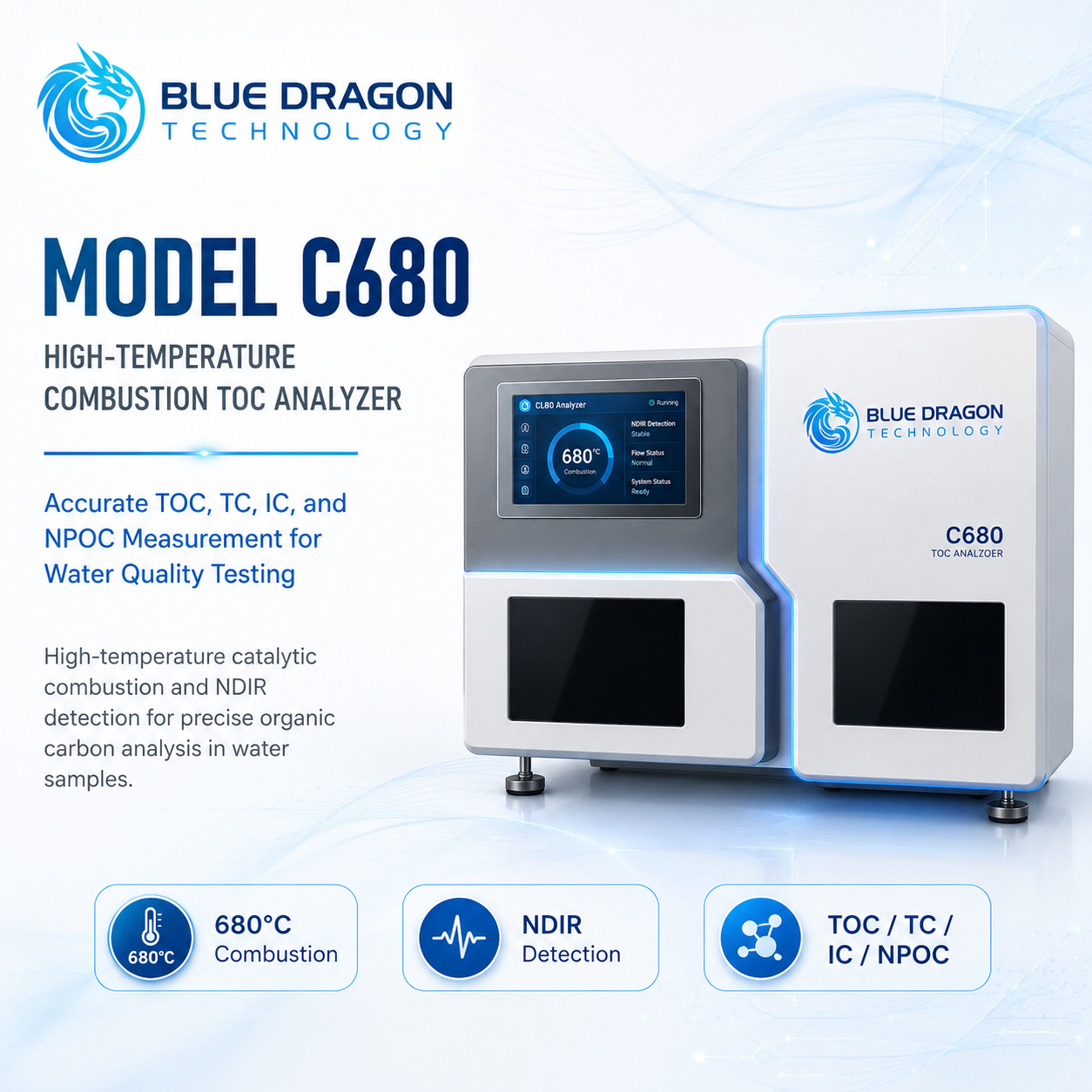
Model C680 High-Temperature Combustion TOC Analyzer

High-temperature catalytic combustion with NDIR detection for TOC, TC, IC, and NPOC analysis across diverse water matrices.

Brand: Blue Dragon Technology Supply & support: Blue Dragon Technology
Product Overview

Purpose-built measurement, clearly presented.

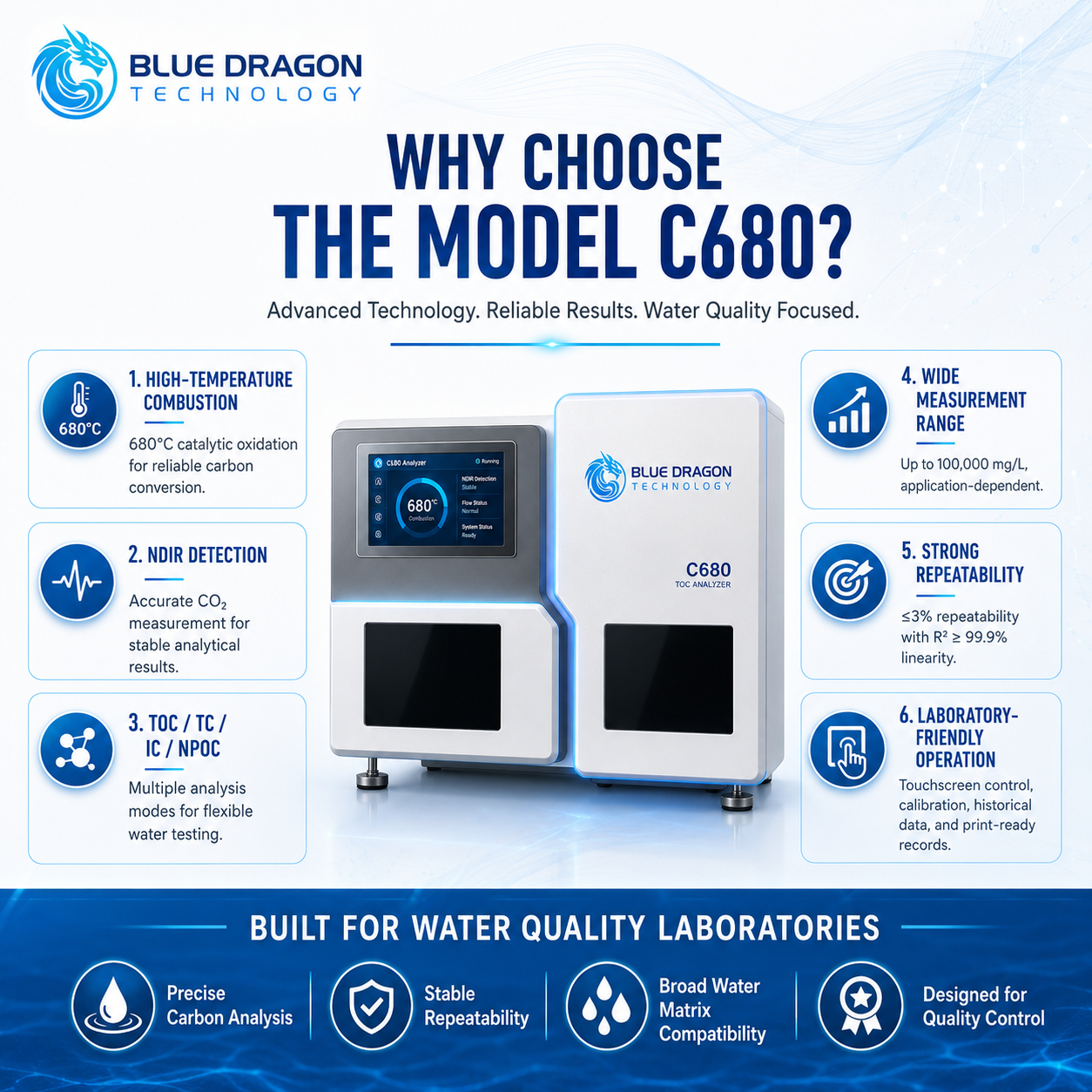
The Model C680 is a laboratory total organic carbon analyzer for purified water, drinking water, surface water, process water, and wastewater. It combines high-temperature catalytic combustion with NDIR carbon-dioxide detection and supports TOC, TC, IC, and NPOC methods.

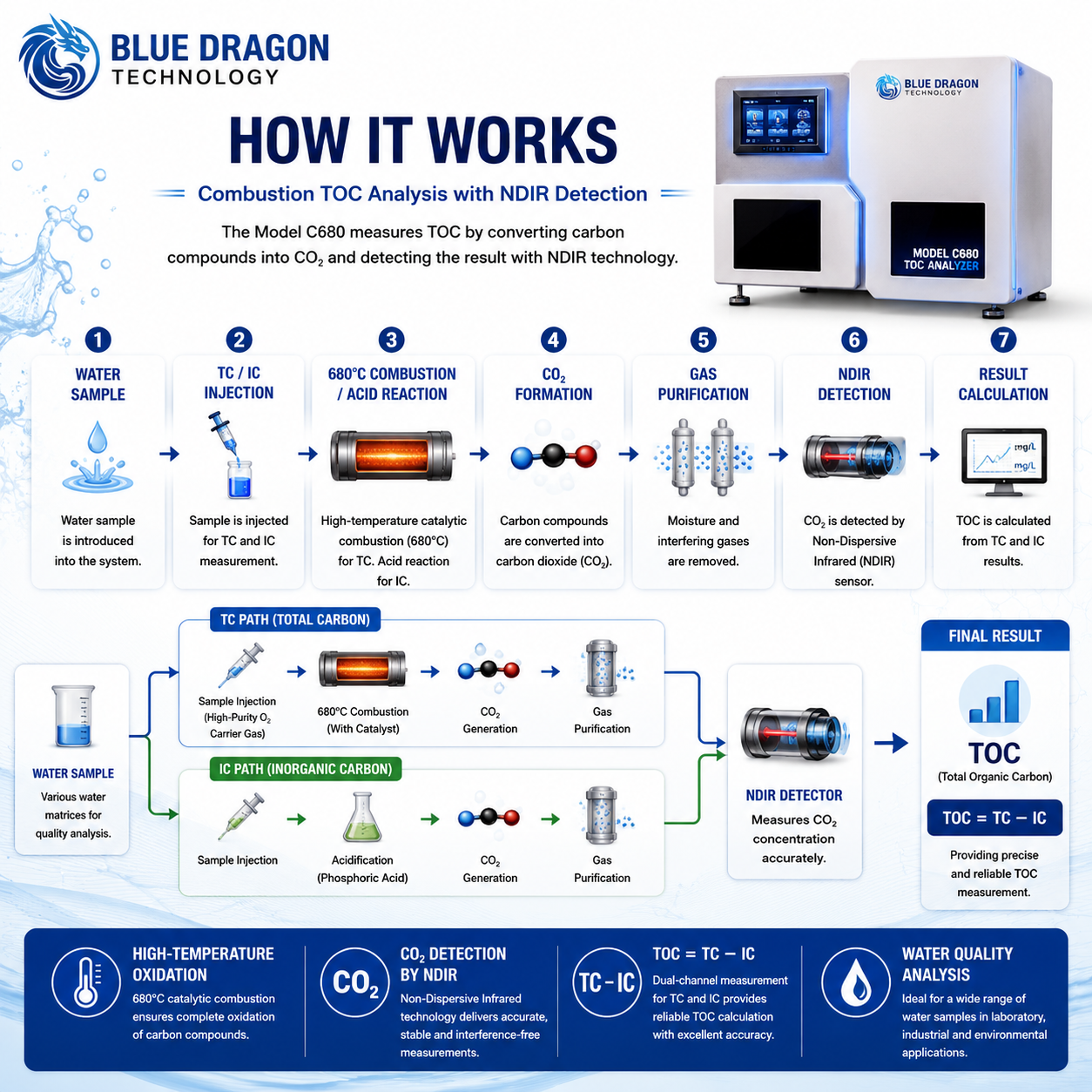
The documented configuration uses manual microsyringe injection. TC and IC are measured through separate reaction paths, allowing automatic calculation of TOC as TC minus IC, while NPOC uses acidification and purging to remove inorganic carbon before analysis.

Distinctive Capabilities

  • Four selectable carbon-analysis workflows within one laboratory platform
  • Broad water-matrix coverage from high-purity water to industrial wastewater
  • Integrated touchscreen operation, calibration, testing, and historical-data functions
  • Configurable injection volume and method parameters for application development
Performance & Technical Data

The measurement method and the values that matter.

How it measures

Measurement Principle

For TC analysis, a measured water sample is injected into a catalyst-filled combustion tube operating at 680 °C or above, converting organic and inorganic carbon to carbon dioxide. For IC analysis, the sample is acidified in a separate low-temperature reaction path so inorganic carbon is released as carbon dioxide. High-purity oxygen carries the carbon dioxide to an NDIR detector. TOC is calculated as TC minus IC; NPOC is measured after acidification and purge removal of inorganic carbon.

Detection Limit≤0.5 mg/L under HJ 501-2009 conditions
Repeatability≤3%
Analysis Time4–10 minutes
Measurement ParametersTOC, TC, IC, and NPOC

Complete Technical Data

Sample Phase
Liquid water samples
Sample introduction
Manual microsyringe injection
Injection volume
10–500 µL
Oxidation principle
High-temperature catalytic combustion
Combustion furnace range
680–1000 °C
Detection Principle
Non-dispersive infrared (NDIR) carbon-dioxide detection
Published measurement range
0–100,000 mg/L; method and matrix dependent
TC indication error
±0.1% full scale or ±5%, whichever is greater
IC indication error
±0.1% full scale or ±4%, whichever is greater
Linearity
R² ≥99.9%
Ambient temperature
10–40 °C
Relative humidity
10–85%
Power Supply
220–240 VAC, 50 Hz
Heating power
Approximately 1200 W during furnace heating
Carrier gas
High-purity oxygen, ≥99.99%
Reagent
0.1 mol/L phosphoric acid for IC and NPOC workflows
Availability
Available
Industrial Use

Applications and industries.

Typical Applications

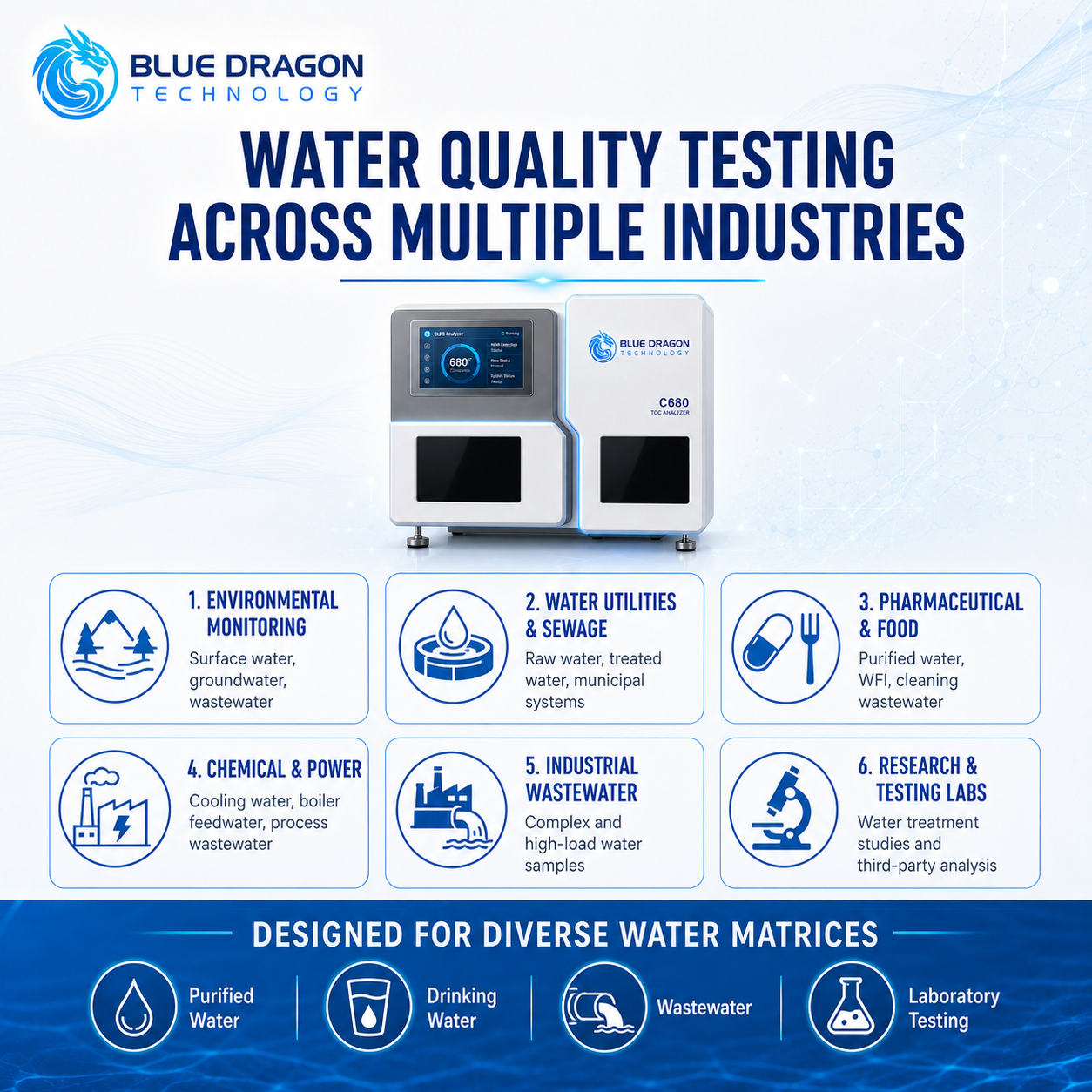
Purified water, ultrapure water, and water for injectionDrinking water, source water, groundwater, and surface waterMunicipal sewage, reclaimed water, and industrial wastewaterBoiler feedwater, cooling water, process water, and plant effluentPharmaceutical, food, chemical, power, environmental, and research laboratoriesHigh-Purity Water TOC MonitoringTotal Organic Carbon Measurement

Industries Served

Chemical ProcessingEnvironmental Monitoring & ComplianceFertilizers & ChemicalsFood & BeveragePetrochemicalsPharmaceuticalPower GenerationPulp & PaperRefiningResearch & Industrial LaboratoriesWater & Wastewater
Engineering & Integration

Built for specification, installation, and long-term operation.

Practical laboratory requirements for sample introduction, oxygen and reagent supply, method calibration, matrix management, consumables, and safe operation.

Sample introductionManual microsyringe injection, 10–500 µL
Carbon workflowSeparate TC and IC paths with TOC calculation and NPOC purge mode
Required services220–240 VAC, high-purity oxygen, CO₂-free water, and phosphoric acid
InstallationIndoor laboratory, 10–40 °C, with at least 20 cm clearance

System Configuration

The instrument combines a high-temperature TC combustion path, an acidification-based IC path, NDIR detection, liquid handling, a touchscreen controller, and stored test and calibration functions.

  • StandardHigh-temperature catalytic combustion furnace and catalyst tube
  • StandardSeparate low-temperature IC reaction path with automatic acid addition
  • StandardNDIR carbon-dioxide detector and integrated calculation of TOC from TC and IC
  • StandardTouchscreen access to testing, calibration, time settings, and historical data
  • Application DependentMethod configuration for TOC, TC, IC, or NPOC
  • Application DependentMeasurement range, injection volume, furnace setpoint, acid dose, purge time, dilution, and calibration method must be configured for the sample matrix

Sensor & Sample Interface

Representative injection and clean fluid paths are essential for reliable carbon analysis.

  • StandardManual injection with a microsyringe over a documented 10–500 µL range
  • StandardCO₂-free ultrapure water with TOC no greater than 0.1 mg/L is used for standards and rinsing
  • Standard0.1 mol/L phosphoric acid supports IC release and NPOC pretreatment
  • Application DependentInsoluble particles can block the microsampler and should be removed or managed before injection
  • Application DependentHigh-salinity samples should normally be diluted to protect the catalyst and maintain performance
  • Application DependentStrongly acidic or alkaline samples are not suitable without specialist review

Installation & Utilities

The C680 is an indoor laboratory instrument requiring a stable bench, clear ventilation space, grounded power, high-purity oxygen, and safe reagent and waste placement.

  • StandardLevel laboratory bench capable of supporting at least 25 kg
  • StandardAt least 20 cm clearance behind and on both sides for heat dissipation and service
  • Standard220–240 VAC, 50 Hz with verified protective grounding
  • StandardHigh-purity oxygen supply of at least 99.99% with an appropriate regulator
  • StandardWaste bottle and acid-reagent bottle positioned at their designated connections

Controller & Communications

The integrated interface manages methods, test execution, calibration, time settings, and result history locally.

  • StandardTouchscreen control of testing and calibration workflows
  • StandardHistorical-data storage and review through the instrument interface
  • StandardMethod settings for sample type, injection, acidification, and purge operations
  • Application DependentExternal data integration and report-export functions are governed by the delivered software build and order documentation

Calibration & Quality Control

Calibration and quality control must use suitable standards, clean reagents, stable furnace and detector conditions, and a method appropriate to the water matrix.

  • StandardAllow the furnace and detector to preheat and stabilize before calibration or testing
  • StandardPrepare standards with CO₂-free ultrapure water and controlled reagents
  • StandardCalibration workflows are available through the integrated interface
  • StandardCalibrate after replacing major consumables or when quality-control checks indicate drift
  • Application DependentInjection volume, range, dilution, acid amount, purge time, and standard levels must match the method
  • Application DependentValidate performance for the intended matrix before compliance-critical use

Cleaning & Maintenance

Routine service protects the microsampler, catalyst, gas path, pump tubing, filters, seals, and analytical baseline.

  • StandardFlush the sample introduction system and lines after testing
  • StandardClean the microsampler promptly when insoluble particles are present
  • StandardInspect reagents, gas tightness, combustion tube, catalyst, filters, seals, quartz wool, and pump tubing
  • Application DependentCombustion tube and catalyst replacement is typically 12–24 months or about 2,000 tests
  • Application DependentFilters, high-temperature gaskets, and quartz wool are typically replaced every 3–6 months
  • StandardRecalibrate after consumable replacement or maintenance affecting the analytical path

Interferences & Application Considerations

The instrument combines a hot combustion furnace, high-purity oxygen, mains power, acid reagent, fragile quartz parts, and laboratory samples.

  • StandardDisconnect power before maintenance and allow the furnace to cool before servicing the combustion tube or catalyst
  • StandardKeep oxygen cylinders away from ignition sources and use an approved pressure regulator
  • StandardHandle phosphoric acid and samples using appropriate laboratory PPE and procedures
  • Application DependentStrongly acidic, strongly alkaline, high-salinity, high-solids, or unusual matrices require suitability review
  • Application DependentReported range and performance are method- and matrix-dependent and must be verified for the intended use
Application Review

Application Engineering Notes

Configurable measurement range

The C680 platform supports configurations up to 100,000 mg/L. The validated working range, injection volume, calibration standards, dilution strategy, and quality-control plan should be selected for the sample matrix and reporting objective.

Sample introduction

The standard C680 uses manual microsyringe injection over a documented 10–500 µL range and does not include an automated autosampler. Any automated sample-introduction configuration must be separately documented and included in the approved scope.

Matrix and method control

Insoluble particles, high salinity, strong acidity or alkalinity, reagent contamination, and poor oxygen quality can affect reliability and consumable life. Method validation and representative quality-control samples are essential for dependable results.

Project Delivery

Project Integration & Support Scope

Blue Dragon reviews the measurement objective, interfaces, documentation, commissioning, and lifecycle requirements as part of project configuration. The scope below identifies the principal items to confirm before order placement.

Measurement Objective
Laboratory measurement of TOC, TC, IC, and NPOC in water, wastewater, environmental samples, and approved process-water matrices using high-temperature catalytic combustion and NDIR detection.
Signal Outputs
Results, methods, calibration functions, and historical records are managed through the local touchscreen. Any external report export or data interface is governed by the delivered software build and order documentation.
Data Integration
The standard workflow is standalone laboratory operation with local method setup, testing, calibration, and result history. LIMS, network, or report-export integration should be treated as configuration dependent unless documented for the delivered system.
Alarms & Diagnostics
The local interface provides operating status and diagnostic information for the analytical workflow. Exact external alarm, fault-output, and report functions depend on the delivered software and ordered configuration.
Documentation
The project package may include the product sheet, operating manual, method and sample-preparation guidance, calibration information, reagent and consumable requirements, and project-specific laboratory documentation.
Commissioning Support
Commissioning can include bench and ventilation review, grounded power, high-purity oxygen connection, reagent and waste setup, leak checks, furnace and detector stabilization, method configuration, calibration verification, and user training.
Lifecycle Support
Lifecycle support covers the microsyringe and fluid paths, catalyst and combustion tube, membrane and filters, seals, quartz wool, pump tubing, calibration, troubleshooting, spare parts, repairs, and long-term technical assistance.
Product Media

See the instrument platform.

Product video and platform overview.

Technical Resources

Product Documents

Product Sheet first, followed by the Brochure, Manual, and any additional technical documents.

Application Engineering

Discuss your measurement application.

Share the sample, measurement range, operating conditions, project location, and timeline. Blue Dragon Technology will review the application and recommend the appropriate configuration.