Available Available for application review and quotation
Sulfur Analysis Series
810H2S-P

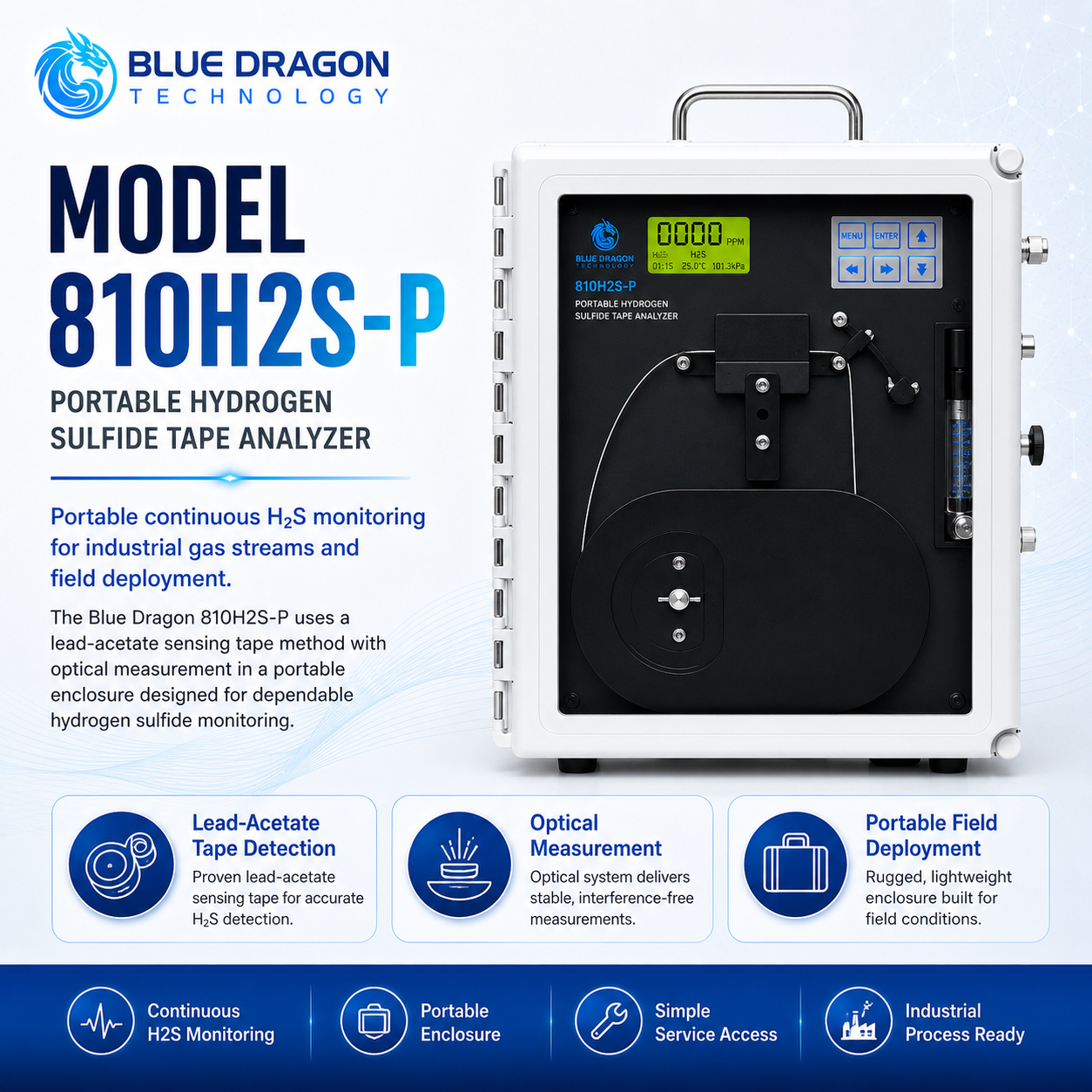
Model 810H2S-P Portable Hydrogen Sulfide Tape Analyzer

Portable selective hydrogen sulfide measurement from ppb to ppm using lead-acetate sensing tape and optical detection.

Brand: Blue Dragon Technology Supply & support: Blue Dragon Technology
Product Overview

Purpose-built measurement, clearly presented.

The Blue Dragon 810H2S-P is a portable industrial hydrogen sulfide analyzer that uses lead-acetate sensing tape and optical detection for selective H₂S measurement. It is designed for field verification, temporary monitoring, process troubleshooting, commissioning, and sheltered laboratory or pilot-unit work.

A pressure-fed gas sample passes through the analyzer flow-control and membrane-humidification system before contacting a fresh section of sensing tape. The optical detector measures the tape response and displays the hydrogen sulfide concentration locally, with optional analogue, alarm, and digital communication functions depending on the delivered configuration.

The portable model is intended for general-purpose non-hazardous areas. It is not a personal safety monitor, and the analyzer vent must discharge safely to atmosphere without backpressure.

Distinctive Capabilities

  • Local display, keypad, flow indication, alarms, and diagnostics
  • Compact serviceable tape deck for routine sensing-tape replacement
Performance & Technical Data

The measurement method and the values that matter.

How it measures

Measurement Principle

A controlled gas sample is conditioned by a 5% acetic-acid membrane humidifier and directed across lead-acetate sensing tape in the detector block. Hydrogen sulfide darkens the treated tape, and the optical measurement system converts the tape response into a concentration reading. The tape advances automatically to provide a fresh measurement area according to the configured interval.

Accuracy±2% of full scale
Analysis Time1 second
Measurement ParametersHydrogen sulfide (H₂S)
Measurement PrincipleLead-acetate sensing tape with optical photometric detection
Sample PhaseGas
Measurement rangesConfigurable, order-specific ppb-to-ppm full-scale ranges

Complete Technical Data

Resolution
1 ppb
Linearity
Linear response
Calibration
Single-point manual calibration; automatic and timed functions configuration dependent
Sample flow
0.3 SCFH typical
Sample inlet pressure
10–15 psig typical; adjust to approximately 9 psig at the analyzer
Sample connections
1/8-inch sample inlet and 1/4-inch analyzer vent
Vent requirement
Discharge safely to atmosphere with no backpressure
Humidification
5% acetic-acid membrane humidification
Power Supply
AC or DC operation; optional battery depending on configuration
Outputs and options
Optional isolated 4–20 mA, alarms, RS-485/Modbus, range, and data functions
Weight
Approximately 10 lb (4.5 kg)
Area classification
Portable version for general-purpose non-hazardous areas
Availability
Available for application review and quotation
Industrial Use

Applications and industries.

Typical Applications

Portable H₂S verification in natural gas sweetening and treatmentRefinery fuel-gas and sulfur-bearing process-gas troubleshootingLNG feed-gas, terminal, storage, and gas-handling checksSulfur recovery and gas-treating process verificationPetrochemical and chemical process-gas spot monitoringHydrogen, synthesis-gas, biogas, and renewable-gas quality investigationsPipeline, midstream, commissioning, and field-service checksSheltered laboratory, pilot-unit, and method-verification work

Industries Served

Academic & Research LaboratoriesBiogas & Renewable GasChemical ProcessingFuels, Terminals & MarineHydrogen & SyngasIndustrial LaboratoriesNatural Gas & LNGOil & Gas ProductionPetrochemicalPipelines & MidstreamRefineriesSulfur Recovery & Gas Treating
Engineering & Integration

Built for specification, installation, and long-term operation.

Application engineering covers the pressure-fed sample interface, flow and pressure regulation, humidifier condition, atmospheric vent routing, selected measuring range, output options, certified calibration gas, consumables, and safe use in a sheltered general-purpose location.

Sample interfacePressure-fed gas, 10–15 psig typical inlet, approximately 9 psig at analyzer
Measurement flow0.3 SCFH typical with atmospheric vent and no backpressure
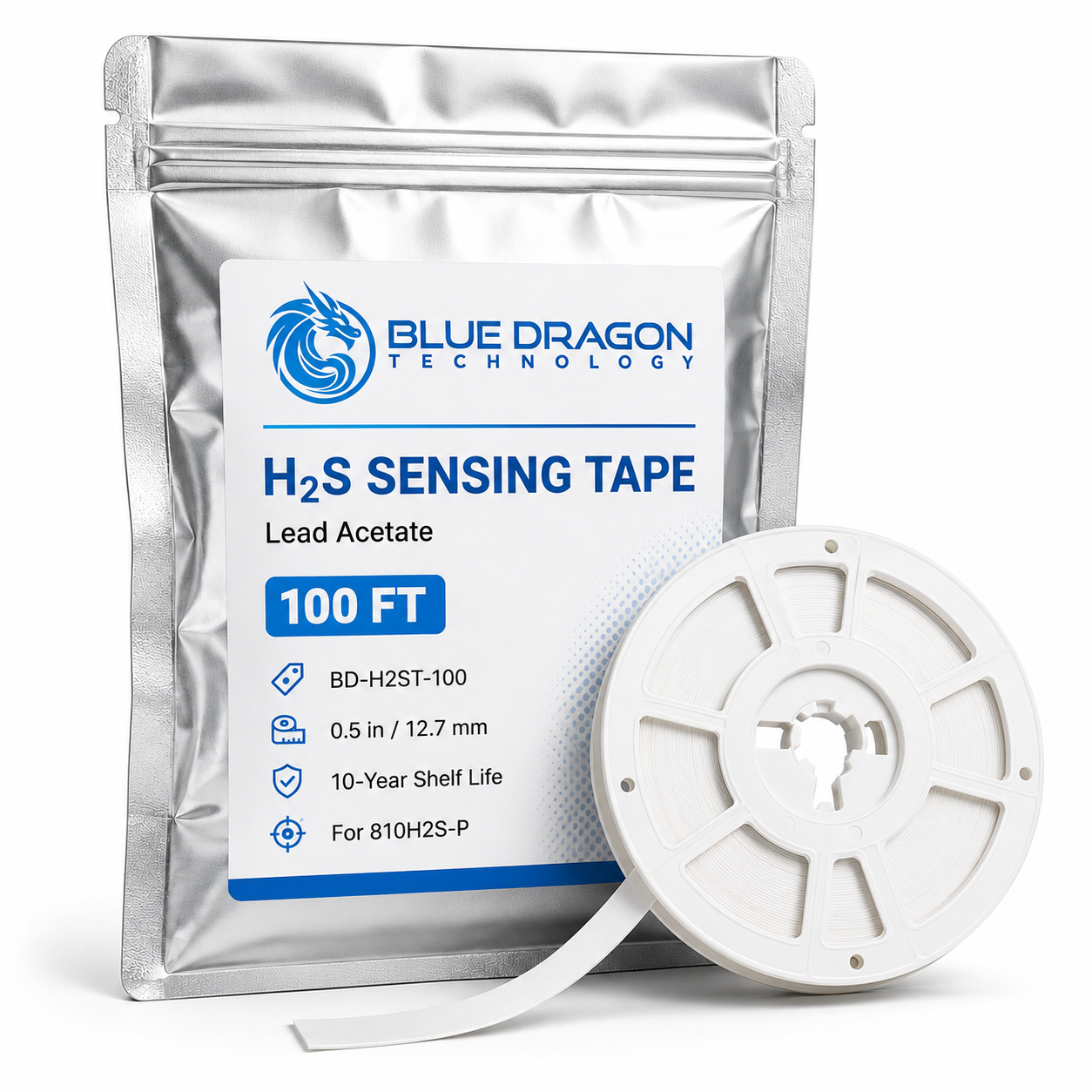
Routine consumablesLead-acetate sensing tape and 5% acetic-acid humidifier solution
Installation environmentPortable general-purpose non-hazardous sheltered use

System Configuration

The 810H2S-P is a self-contained portable tape-analyzer platform. The delivered configuration should be confirmed against the order and serial-number-specific documentation.

  • StandardPortable enclosure, handle, display, keypad, tape transport, detector and pressure block, capstan and pinch roller, manual flow indication, humidifier, and external sample and vent connections
  • StandardFactory-configured full-scale range and single-point calibration parameters
  • OptionalBattery, internal pump, outputs, alarms, communications, logging, additional ranges, automatic calibration, and enhanced sample-conditioning accessories
  • Application DependentPressure regulator, filter or separator, moisture removal, sample tubing, transport case, and field connection package
  • StandardPortable analyzer enclosure with carrying handle, display, keypad, sensing-tape deck, optical detector, manual flow indication, and membrane humidifier
  • StandardOne configured full-scale measurement range and factory calibration for the ordered application

Sample Handling

Stable performance requires a clean representative gas sample at controlled pressure and flow.

  • StandardConnect the pressure-fed sample to the designated 1/8-inch sample inlet using compatible tubing
  • StandardSupply 10–15 psig typical and adjust the analyzer inlet to approximately 9 psig
  • StandardSet sample flow to approximately 0.3 SCFH
  • StandardRoute the analyzer vent to a safe atmospheric location with no backpressure
  • StandardMaintain the humidifier with the specified 5% acetic-acid solution and do not overfill it
  • OptionalUse an appropriate regulator, particulate filter, separator, or liquids-removal system

Installation & Utilities

The portable analyzer must be operated upright in a stable, dry, sheltered general-purpose location.

  • StandardVerify that the location is non-hazardous and suitable for the delivered electrical configuration
  • StandardPlace the analyzer where the display, tape deck, flowmeter, fill cap, breather cap, and connections remain accessible
  • StandardConnect only the approved AC or DC supply and verify protective grounding where applicable
  • StandardKeep the atmospheric vent short, unrestricted, and free of valves or pressurized headers
  • StandardKeep the enclosure protected from rain, washdown, corrosive spray, excessive dust, vibration, and direct process heat
  • Application DependentLocal electrical requirements, external battery charging, sample conditioning, safe vent destination, and transport restraints

Integration & Communications

Local display and keypad functions are standard. External interfaces depend on the ordered option package.

  • StandardLocal concentration, status, alarm, calibration, setup, and diagnostic screens
  • OptionalIsolated 4–20 mA concentration output and configurable alarm contacts
  • OptionalRS-485/Modbus communications and data-logging or remote-software functions
  • OptionalAdditional range, stream, output, and automatic-calibration controls
  • Application DependentSignal scaling, alarm setpoints, Modbus mode, channel, slave address, baud rate, cable routing, grounding, and control-system integration

Calibration & Quality Control

Calibration and quality checks must use certified hydrogen sulfide standards and the delivered range configuration.

  • StandardSingle-point manual span calibration using an appropriate certified H₂S calibration gas
  • StandardVerify regulator, sample path, entered span value, calibration valve position, completion status, and return to online service
  • StandardRun LED calibration on clean white tape after sensing-tape replacement or when required by diagnostics
  • StandardRecord calibration date, gas concentration, cylinder identification, regulator, field-reference value, and result
  • OptionalAutomatic or timed calibration functions where installed and enabled
  • Application DependentCalibration frequency, zero-gas requirement, acceptance limits, traceability, and site quality-control records

Maintenance & Service

Routine maintenance centers on sensing tape, humidifier solution, sample filtration, tubing, and functional checks.

  • StandardReplace the sensing tape when depleted, damaged, contaminated, or indicated by the analyzer
  • StandardThread the tape from supply hub through the guide, detector, capstan and pinch roller to the take-up hub, remove slack, close the pressure block, and complete LED calibration
  • StandardInspect the sample filter approximately monthly and clean or backflush the porous-metal element as required
  • StandardCheck humidifier level and condition, fill and breather caps, flow indication, sample tubing, vent tubing, and fittings
  • StandardConfirm tape advance, display operation, alarms, and calibration status after maintenance
  • Application DependentTape replacement frequency may range from approximately four weeks to three months depending on interval and service

Safety & Application Considerations

Hydrogen sulfide is toxic and potentially fatal. Installation, calibration, venting, and maintenance must follow the site's gas-safety and permit procedures.

  • StandardConfirm the portable unit is used only in a general-purpose non-hazardous area
  • StandardIsolate the sample and verify a safe condition before loosening fittings, opening sample components, or servicing the humidifier
  • StandardVent sample and calibration gas to a designated safe atmospheric location with no backpressure
  • StandardUse certified regulators, compatible tubing, suitable personal protective equipment, and approved gas-detection practices
  • StandardHandle 5% acetic-acid solution according to the safety data sheet and site chemical procedures
  • StandardDo not use the 810H2S-P as a personal safety detector or substitute for fixed-area gas-detection systems
Application Review

Application Engineering Notes

Range and options: Available full-scale ranges, battery runtime, pump configuration, outputs, alarms, communications, logging, automatic calibration, and accessories are order specific and should be confirmed in the quotation and approved datasheet.

Sample source: The standard manual describes a pressure-fed sample. Direct ambient-air or unpressurized sampling requires an approved pump arrangement.

Area classification: The portable configuration is for general-purpose non-hazardous locations. It must not be represented as an explosion-proof or hazardous-area process analyzer.

Display representation: Screen wording, units, decimal places, and menu availability may vary with the delivered firmware and installed options.

Measurement role: The instrument is an industrial analytical analyzer for verification, troubleshooting, and temporary monitoring, not a handheld personal-protection monitor.

Application Engineering

Discuss your measurement application.

Share the sample, measurement range, operating conditions, project location, and timeline. Blue Dragon Technology will review the application and recommend the appropriate configuration.