
Sulfur Analysis for Fertilizer Plants: H₂S and Total Sulfur Monitoring
Fertilizer production depends on tightly controlled chemical processes involving ammonia, urea, phosphate rock, sulfuric acid, ammonium sulfate, natural gas feedstocks, scrubbing systems, and emission-control equipment. Across these operations, sulfur compounds can appear in gas streams, liquid streams, vents, scrubbers, process condensates, wastewater, and product-related streams.
Hydrogen sulfide, H2S, is one of the most important sulfur compounds to monitor because it is toxic, corrosive, odorous, and environmentally significant. However, fertilizer plants often need more than single-compound H2S measurement. They may also need total sulfur analysis to understand the broader sulfur burden across process streams.
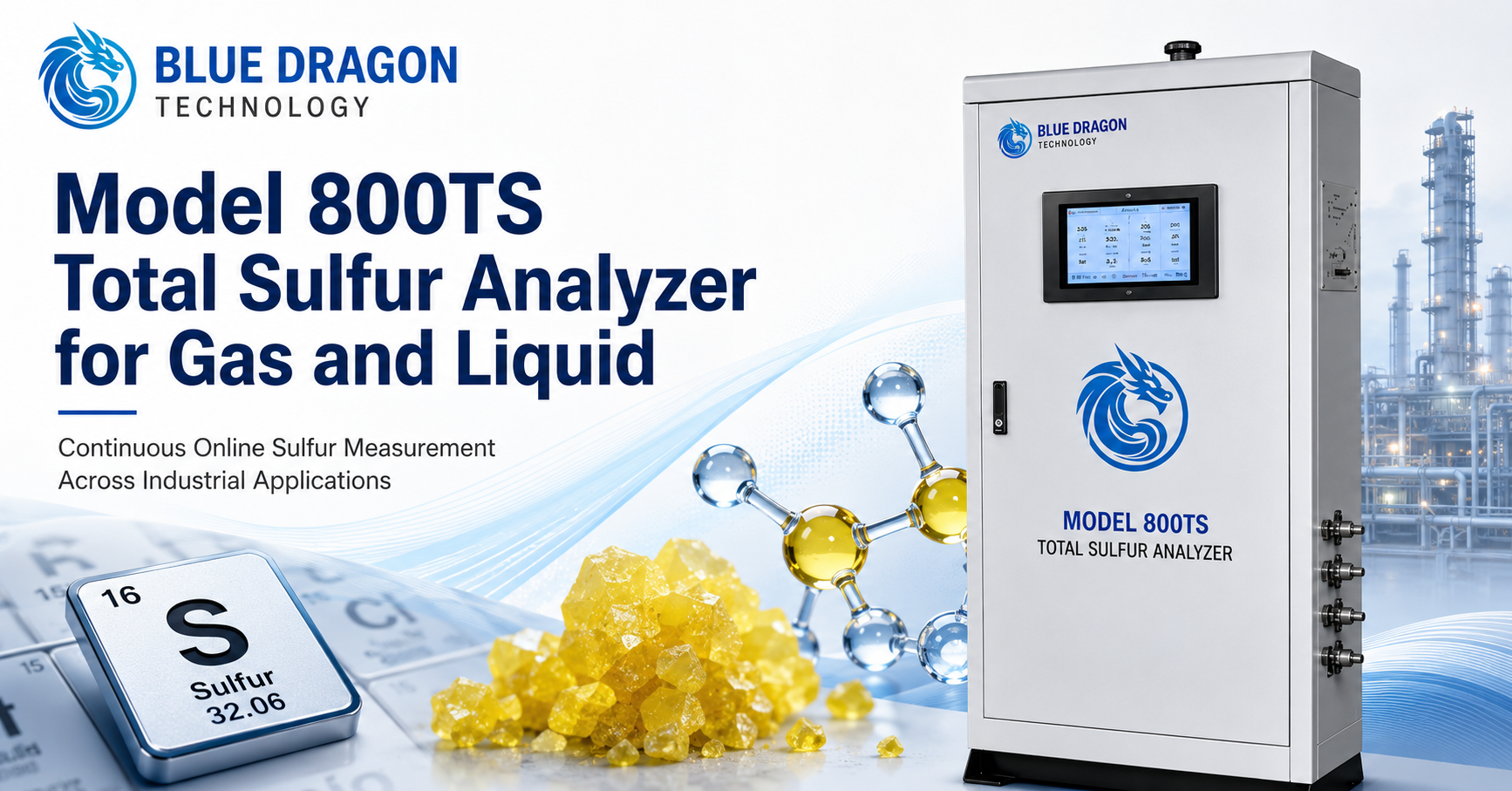
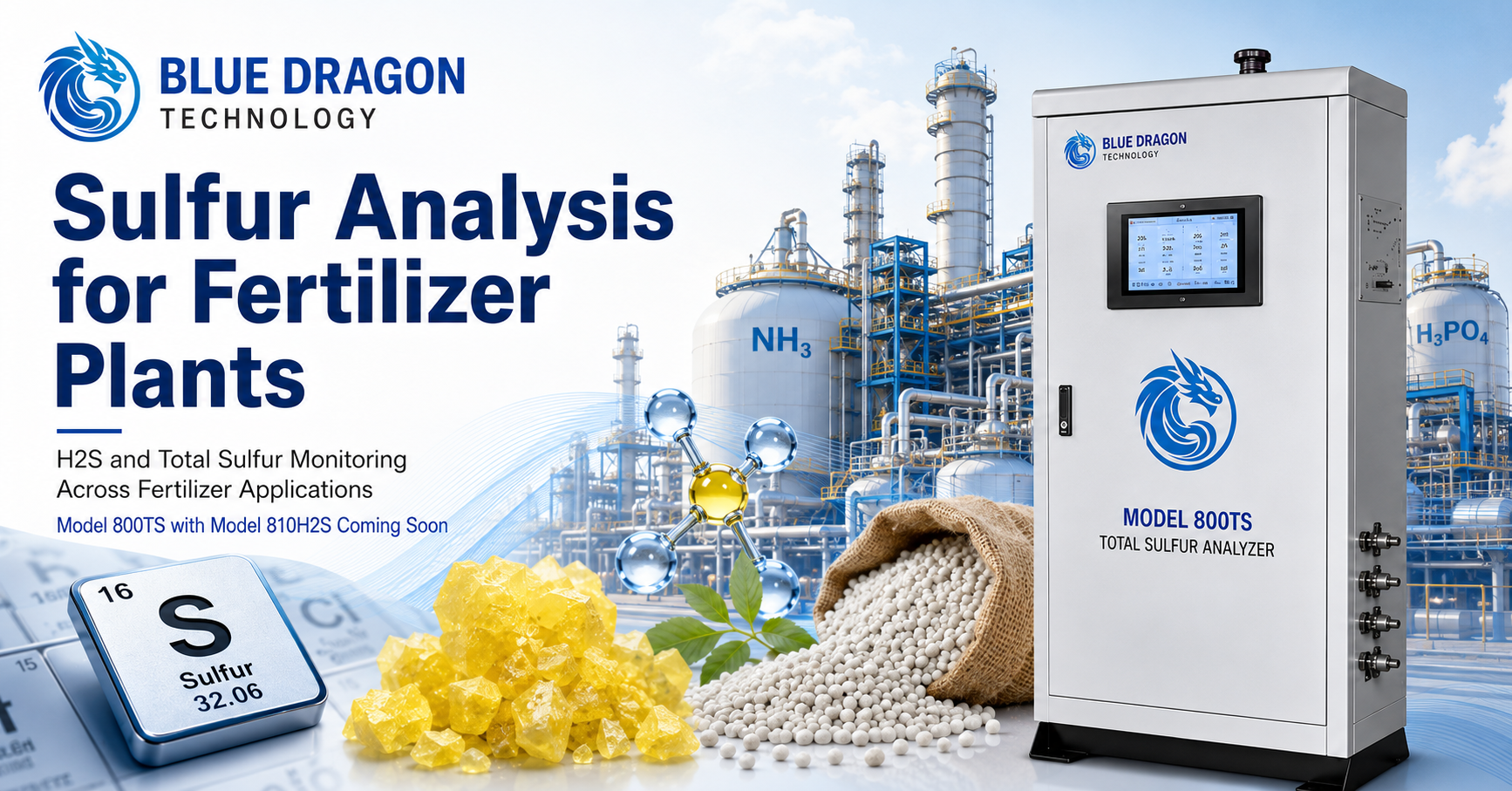
The Blue Dragon Technology Model 800TS Online Total Sulfur Analyzer provides continuous total sulfur measurement for gas and liquid applications. For fertilizer companies that require a complete sulfur-monitoring strategy, Blue Dragon Technology is also preparing the Model 810H2S Online Hydrogen Sulfide Analyzer, with a total sulfur option coming soon.
Quick Overview
Fertilizer plants can benefit from continuous sulfur analysis at multiple points in the production process, including feed gas treatment, acid gas handling, phosphate processing, sulfuric acid systems, ammonium sulfate production, scrubbers, vents, and wastewater treatment.
- Key concern: H2S and other sulfur compounds can affect safety, corrosion, odor control, emissions, catalyst performance, and process quality.
- Core measurement need: Continuous online sulfur data for both process control and compliance support.
- Model 800TS: Online total sulfur analyzer for gas and liquid streams using catalytic combustion and UV fluorescence detection.
- Model 810H2S: Coming soon as an online hydrogen sulfide analyzer, with a total sulfur option planned.
- Typical fertilizer applications: Ammonia, urea, phosphate fertilizer, ammonium sulfate, sulfuric acid, gas treatment, scrubber monitoring, and environmental systems.
Why Sulfur Analysis Matters in Fertilizer Production
Fertilizer plants operate at the intersection of chemical manufacturing, environmental management, and process safety. Sulfur compounds are often present because many fertilizer processes rely on sulfur-containing raw materials, sulfuric acid, natural gas, acid gas treatment, or sulfur-bearing by-products.
In some locations, sulfur is part of the intended production chemistry. In others, it is an impurity that must be removed, treated, monitored, or controlled. This makes sulfur analysis important not only for product quality, but also for equipment protection, odor management, safety programs, and environmental compliance.
Periodic laboratory testing remains valuable, but it may not provide the real-time visibility needed for fast-changing process conditions. Continuous online sulfur analysis helps plant operators detect changes earlier, respond faster, and maintain more stable operation.
H2S and Total Sulfur: Understanding the Difference
H2S measurement and total sulfur measurement are related, but they are not the same. H2S analysis focuses specifically on hydrogen sulfide. Total sulfur analysis measures the combined sulfur content from multiple sulfur species in the sample.
In fertilizer plants, this distinction is important because sulfur may appear in several forms depending on the feedstock, process chemistry, temperature, pressure, oxidation state, and treatment method.
H2S Measurement
Used when the plant needs to monitor hydrogen sulfide specifically, especially in gas streams, vents, acid gas systems, safety-related points, odor-control points, or treated gas quality.
Total Sulfur Measurement
Used when the plant needs to measure the total sulfur burden across all sulfur species, including H2S, mercaptans, sulfides, disulfides, COS, CS2, and other sulfur-containing compounds.
For this reason, many fertilizer companies benefit from a combined sulfur-monitoring approach: targeted H2S measurement where hydrogen sulfide is the primary concern, and total sulfur measurement where the full sulfur profile is more important.
Where Sulfur Compounds Appear in Fertilizer Plants
Ammonia Plants
Ammonia production often begins with natural gas or another hydrocarbon feedstock. These feedstocks may contain sulfur compounds that must be removed before reforming and synthesis. Sulfur contamination can damage catalysts and reduce process efficiency, making sulfur monitoring important in feed gas treatment, desulfurization systems, and treated gas streams.
Urea Plants
Urea production is closely connected to ammonia and carbon dioxide systems. While urea synthesis itself is not usually considered a sulfur-driven process, upstream feedstock treatment, process condensates, utility systems, vents, and wastewater treatment may still require sulfur-related monitoring depending on the plant configuration.
Phosphate Fertilizer Plants
Phosphate fertilizer production often uses sulfuric acid to react with phosphate rock. Depending on raw material composition and process conditions, sulfur-containing gases or odorous compounds may appear in vents, scrubbers, reaction areas, granulation systems, and off-gas treatment units.
Sulfuric Acid Plants
Sulfuric acid production is central to many fertilizer complexes, especially phosphate fertilizer operations. Monitoring sulfur-related streams can support process control, conversion efficiency, emission control, and operational stability.
Ammonium Sulfate Plants
Ammonium sulfate production may involve sulfuric acid, ammonia, crystallization systems, scrubbers, and by-product recovery streams. Sulfur monitoring can support process optimization, odor control, product quality, and wastewater management.
Scrubbers, Vents, and Wastewater Systems
Many fertilizer plants rely on scrubbers and treatment systems to manage emissions and odorous compounds. H2S and other sulfur compounds may be present in vent gas, scrubber outlet gas, condensates, wastewater treatment areas, and recovered process streams.
Common Sulfur Species Relevant to Fertilizer Companies
Fertilizer plants may encounter a wide range of sulfur compounds. The exact species depend on the feedstock, acid system, gas-treatment process, scrubbing chemistry, and plant design.
| Sulfur Species | Why It Matters |
|---|---|
| Hydrogen sulfide, H2S | Toxic, corrosive, odorous, and important for safety, environmental, and gas-treatment applications. |
| Carbonyl sulfide, COS | Can appear in gas streams and may require hydrolysis or treatment depending on process requirements. |
| Carbon disulfide, CS2 | Relevant in some sulfur-bearing gas and chemical process streams. |
| Mercaptans | Strong odor compounds that may appear in hydrocarbon or gas-related streams. |
| Sulfides and disulfides | Can contribute to corrosion, odor, and total sulfur loading. |
| Sulfur oxides | Important for combustion, acid production, emission-control, and sulfuric acid-related processes. |
Because sulfur can appear in several forms, total sulfur analysis is often useful when the plant needs a complete picture of sulfur content rather than only a single-compound reading.
Key Measurement Points in Fertilizer Plants
Feed Gas and Treated Gas
Monitoring sulfur in natural gas or treated gas helps protect catalysts and verify the performance of desulfurization systems.
Acid Gas and Process Vents
H2S and sulfur-containing gases may be present in acid gas systems, vents, and off-gas streams requiring continuous monitoring.
Scrubber Inlet and Outlet Streams
Measuring sulfur before and after scrubbing helps operators evaluate removal efficiency and adjust treatment systems.
Process Condensates and Liquids
Liquid sulfur analysis can help monitor contamination, process stability, wastewater loading, and treatment requirements.
Sulfuric Acid and Phosphate Systems
Sulfur-related monitoring can support acid production, phosphate rock reaction systems, off-gas control, and emission-management programs.
Wastewater and Treatment Units
Sulfur compounds in wastewater systems can create odor, corrosion, and treatment challenges, especially when process streams vary.
Operational Benefits of Continuous Sulfur Analysis
For fertilizer companies, sulfur analysis is not only a compliance function. It is also a process-control and risk-reduction tool. Continuous monitoring can help plant teams move from reactive sampling to proactive control.
- Worker and plant safety: Continuous monitoring helps identify sulfur-related hazards earlier.
- Odor control: H2S and mercaptans can create strong odor issues even at low concentrations.
- Corrosion management: Sulfur compounds can contribute to corrosion in process equipment, piping, and treatment systems.
- Catalyst protection: Sulfur contamination can reduce catalyst performance in ammonia and gas-treatment processes.
- Scrubber optimization: Online data helps operators understand whether scrubbing systems are performing effectively.
- Environmental reporting support: Consistent sulfur data can support internal documentation and permit-related monitoring programs.
- Process stability: Real-time sulfur data helps operators detect feedstock changes, process upsets, and treatment inefficiencies.
Blue Dragon Model 800TS for Fertilizer Plant Sulfur Analysis
The Blue Dragon Technology Model 800TS Online Total Sulfur Analyzer is designed for continuous total sulfur measurement in both gas and liquid streams. This makes it highly relevant for fertilizer plants that need sulfur data across more than one process area or sample type.
The Model 800TS uses catalytic combustion to convert sulfur compounds into sulfur dioxide, followed by ultraviolet fluorescence detection. This approach allows the analyzer to report total sulfur content from a broad range of sulfur species, rather than measuring only one compound.
In fertilizer applications, the Model 800TS can support process monitoring, feedstock control, gas-treatment verification, liquid-stream analysis, scrubber optimization, and environmental-system monitoring.
How the Model 800TS Works
- Sample conditioning: The gas or liquid sample is prepared for stable online analysis based on the application requirements.
- Catalytic combustion: Sulfur-containing compounds are converted into sulfur dioxide.
- UV fluorescence detection: The generated sulfur dioxide is measured using ultraviolet fluorescence.
- Total sulfur calculation: The analyzer converts the detector signal into a total sulfur concentration.
- Plant integration: Results can be used for process control, alarms, data logging, reporting, and plant-monitoring systems.
Key Features of the Model 800TS
Gas and Liquid Analysis
Supports total sulfur measurement in both gas and liquid sample streams, allowing one analyzer platform to address multiple fertilizer-plant applications.
UV Fluorescence Detection
Provides precise total sulfur measurement after sulfur compounds are converted into sulfur dioxide.
Catalytic Combustion
Converts different sulfur compounds into a measurable form, enabling total sulfur analysis across complex sample matrices.
Multi-Stream Monitoring
Supports up to six sample streams with automatic switching, making it useful for plants with multiple sulfur-monitoring points.
Low-Level Detection
Designed for demanding applications requiring sulfur measurement down to 100 ppb.
Industrial Integration
Designed for continuous online operation with outputs suitable for plant monitoring, control systems, alarms, and data logging.
Typical Fertilizer Applications for the Model 800TS
| Plant Area | How Total Sulfur Analysis Helps |
|---|---|
| Natural Gas Feed Treatment | Verifies sulfur removal before reforming or downstream processing. |
| Ammonia Production | Supports catalyst protection and feedstock quality control. |
| Phosphate Fertilizer | Monitors sulfur-related streams in acid reaction, off-gas, and scrubbing systems. |
| Sulfuric Acid Systems | Supports process control and sulfur-related monitoring in acid production and handling. |
| Scrubber Systems | Helps evaluate sulfur-removal performance across inlet and outlet streams. |
| Wastewater and Liquid Streams | Provides total sulfur data for liquids, condensates, and treatment-related streams. |
Coming Soon: Blue Dragon Model 810H2S Online Hydrogen Sulfide Analyzer
For applications where hydrogen sulfide is the primary measurement target, Blue Dragon Technology is preparing the Model 810H2S Online Hydrogen Sulfide Analyzer. This analyzer is being developed for continuous H2S monitoring in industrial gas applications and will also be available with a total sulfur option.
The Model 810H2S will be especially relevant for fertilizer plants that need targeted H2S monitoring in gas streams, vents, acid gas systems, scrubber outlets, odor-control points, or environmental-monitoring locations.
Planned Role of the Model 810H2S
- Continuous online H2S monitoring for industrial gas applications
- Useful for safety, odor control, gas-treatment verification, and emissions-related monitoring
- Total sulfur option planned for applications requiring broader sulfur measurement capability
- Designed to complement the Model 800TS in fertilizer and chemical plant sulfur-monitoring programs
Together, the Model 800TS and the upcoming Model 810H2S will allow fertilizer companies to select the correct sulfur-analysis approach for each application: total sulfur monitoring for broad sulfur control, and targeted H2S monitoring where hydrogen sulfide is the specific concern.
Choosing the Right Blue Dragon Analyzer for Fertilizer Applications
| Measurement Need | Recommended Analyzer | Reason |
|---|---|---|
| Total sulfur in gas streams | Model 800TS | Measures the combined sulfur content from multiple sulfur compounds. |
| Total sulfur in liquid streams | Model 800TS | Supports liquid total sulfur measurement for process liquids, condensates, and treatment streams. |
| Multiple sulfur-monitoring points | Model 800TS | Supports up to six streams with automatic switching. |
| Targeted H2S gas monitoring | Model 810H2S, coming soon | Designed for applications where hydrogen sulfide is the primary measurement target. |
| H2S monitoring with total sulfur flexibility | Model 810H2S with TS option, coming soon | Planned for users who need H2S monitoring with broader sulfur-analysis capability. |
Why Fertilizer Companies Should Consider Online Sulfur Analysis
Fertilizer plants often operate large, continuous processes where small changes in feedstock quality, gas composition, scrubber performance, or acid-system behavior can create downstream effects. Online sulfur analysis gives operators the visibility needed to respond before issues become larger operational problems.
- Earlier detection of process upsets: Continuous sulfur data helps identify changes that may be missed between manual samples.
- Improved control of treatment systems: Scrubbers, gas-treatment units, and wastewater systems can be adjusted based on real process conditions.
- Reduced risk of off-spec operation: Online analysis helps maintain process consistency and product-related quality control.
- Better documentation: Continuous data supports internal reporting, maintenance review, environmental programs, and operational decision-making.
- Integrated plant monitoring: Analyzer outputs can support alarms, trend analysis, process dashboards, and control-room visibility.
Blue Dragon Technology Support for Fertilizer and Chemical Plants
Blue Dragon Technology supplies process-measurement and analytical instrumentation for industrial customers in fertilizer, chemical, oil & gas, petrochemical, LNG, environmental, and manufacturing sectors.
For fertilizer companies, Blue Dragon Technology can support analyzer selection, application review, sample-point planning, configuration discussions, commissioning support, and after-sales service. The goal is to provide a sulfur-analysis solution that fits the real operating conditions of the plant, not only the analyzer specification sheet.
- Application review: Identify whether the plant needs total sulfur, H2S-specific monitoring, or both.
- Sample-point planning: Review gas, liquid, vent, scrubber, and process-stream monitoring requirements.
- Analyzer selection: Match the Model 800TS or upcoming Model 810H2S to the correct process application.
- Integration support: Support plant data requirements, alarms, reporting, and control-system connection needs.
- After-sales service: Provide continued support for operation, maintenance, calibration, and spare parts planning.
Discuss Sulfur Analysis for Your Fertilizer Plant
Whether your facility needs total sulfur analysis, H2S monitoring, scrubber-performance verification, feed gas treatment control, or liquid-stream sulfur measurement, Blue Dragon Technology can help review the application and recommend a suitable analyzer configuration.
Product Page:
Model 800TS Online Total Sulfur Analyzer
Website:
bluedragontechnology.com
Frequently Asked Questions
Why do fertilizer plants need sulfur analysis?
Fertilizer plants may encounter sulfur compounds in feed gas, acid systems, scrubbers, vents, process condensates, liquid streams, wastewater, and emission-control systems. Sulfur analysis helps support safety, corrosion control, odor management, catalyst protection, process stability, and environmental monitoring.
Is H2S the same as total sulfur?
No. H2S is one specific sulfur compound. Total sulfur analysis measures the combined sulfur content from multiple sulfur species. Fertilizer plants may need H2S-specific monitoring, total sulfur analysis, or both depending on the application.
Can the Model 800TS measure H2S?
The Model 800TS is a total sulfur analyzer. It can include sulfur from H2S as part of the total sulfur result after conversion and detection, but it is not positioned as a selective H2S-only analyzer. For targeted H2S monitoring, Blue Dragon Technology is preparing the Model 810H2S.
Can the Model 800TS measure both gas and liquid samples?
Yes. The Model 800TS is designed for total sulfur measurement in both gas and liquid applications, depending on the sample-conditioning and system configuration required for the process.
How many sample streams can the Model 800TS monitor?
The Model 800TS can support up to six sample streams with automatic switching, making it suitable for fertilizer plants that need to monitor multiple process points.
What is the upcoming Model 810H2S?
The Model 810H2S is Blue Dragon Technology’s upcoming online hydrogen sulfide analyzer. It is being developed for continuous H2S monitoring in industrial gas applications, with a total sulfur option planned.
Which analyzer should a fertilizer company choose?
If the facility needs total sulfur measurement across gas or liquid streams, the Model 800TS is the primary choice. If the facility needs targeted H2S monitoring in gas streams, the upcoming Model 810H2S may be the better fit. Some plants may benefit from both analyzers depending on the number and type of sulfur-monitoring points.