

High-Purity Water TOC Monitoring
Measure low and controlled organic-carbon levels in purified and high-purity water systems with the method, quality controls, and documentation required by the site.

TOC monitoring for controlled water generation and distribution
High-purity water applications require careful control of background carbon, sampling, materials, calibration, verification, contamination, data review, and maintenance. The correct TOC platform depends on the water type, expected range, required response, validated method, software controls, documentation, and site quality system.
Blue Dragon Technology can review high-purity and pharmaceutical water requirements using the Model C680 where technically suitable and a dedicated pharmaceutical TOC platform under development. Final regulatory, pharmacopeial, validation, and data-integrity claims are confirmed only for the delivered configuration.
What the application needs to establish
Determine TOC in purified or high-purity water at the required range and quality-control level while protecting sample integrity and supporting the site's validated workflow.
Why the measurement matters
Water-system control
Identify organic contamination in generation, storage, and distribution systems.
Investigation
Support deviations, sanitization review, maintenance events, and process changes.
Quality workflow
Provide calibration, verification, records, and result review appropriate to the site procedure.
Process protection
Detect contamination before it affects controlled manufacturing or sensitive equipment.
Trend visibility
Establish long-term water-system behavior and response to operational events.
How the measurement is approached
The final oxidation and carbon-detection method must be selected for the required range, water type, response time, validation package, and data controls. The dedicated pharmaceutical TOC analyzer remains under development; final specifications and claims will be published before release.
Typical operating locations
- Purified-water generation systems
- High-purity and ultrapure water loops
- Pharmaceutical and biotechnology utilities
- Semiconductor and electronics water systems
- Storage and distribution return points
- Quality-control and investigation laboratories
- Utility monitoring and process-support locations
Instrument-selection considerations
- Water type and expected TOC range
- Online, at-line, or laboratory measurement role
- Sampling materials, flow, temperature, and contamination control
- Calibration, system suitability, verification, and blanks
- Response time, sanitization, cleaning, and maintenance
- User access, records, review, export, and data controls
- Validation, documentation, and site quality requirements
Where this application is used.


Petrochemicals
Measurement systems for petrochemical feedstocks, reaction processes, fired equipment, utilities, effluent, gas flow, and material quality.
Explore →
Chemical Processing
Application-focused instrumentation for Chemical Processing, covering Trace moisture, H2S and sulfur, TOC, flow, and multipoint temperature across Reactors, columns, specialty gas systems, and utilities.
Explore →
Fertilizers & Chemicals
Analytical and engineered measurement systems for feedstocks, process gases, reactors, utilities, effluent, flow, and material quality.
Explore →
Power Generation
Measurement systems for fuels, boiler and high-purity water, fired equipment, gas flow, materials, and conventional or nuclear generation.
Explore →
Water & Wastewater
Online and laboratory instruments for organic carbon, oil contamination, turbidity, treatment control, discharge, reuse, and water-quality investigation.
Explore →
Pharmaceutical
Measurement solutions for purified and high-purity water, TOC monitoring, contamination investigations, materials screening, and quality laboratories.
Explore →
Semiconductor & Electronics
Application-focused instrumentation for Semiconductor & Electronics, covering Ultra-trace gas moisture, UPW TOC, and XRF screening across UPW, specialty gases, fabrication, and incoming materials.
Explore →
Food & Beverage
Application-focused instrumentation for Food & Beverage, covering TOC, turbidity, water quality, and materials screening as applicable across Process water, wastewater, QC laboratories, and utilities.
Explore →
Pulp & Paper
Application-focused instrumentation for Pulp & Paper, covering TOC and turbidity, flow, and temperature across Process water, effluent, boilers, and recovery systems.
Explore →
Environmental Monitoring & Compliance
Application-focused instrumentation for Environmental Monitoring & Compliance, covering Oil-in-water, turbidity, TOC, emissions flow, and XRF soil screening across Wastewater discharge, emissions, contaminated land, and compliance labs.
Explore →
Research & Industrial Laboratories
Flexible analytical instruments for water, organic carbon, elemental composition, material verification, method development, and quality control.
Explore →Relevant measurement capabilities.
Explore the permanent Blue Dragon capability areas associated with this industry or application.
Water Quality & Organic Carbon Series
Online and laboratory analyzers for organic carbon, oil-in-water, turbidity, wastewater, and high-purity water measurement.
Explore series →Instruments connected to this application.
 Available
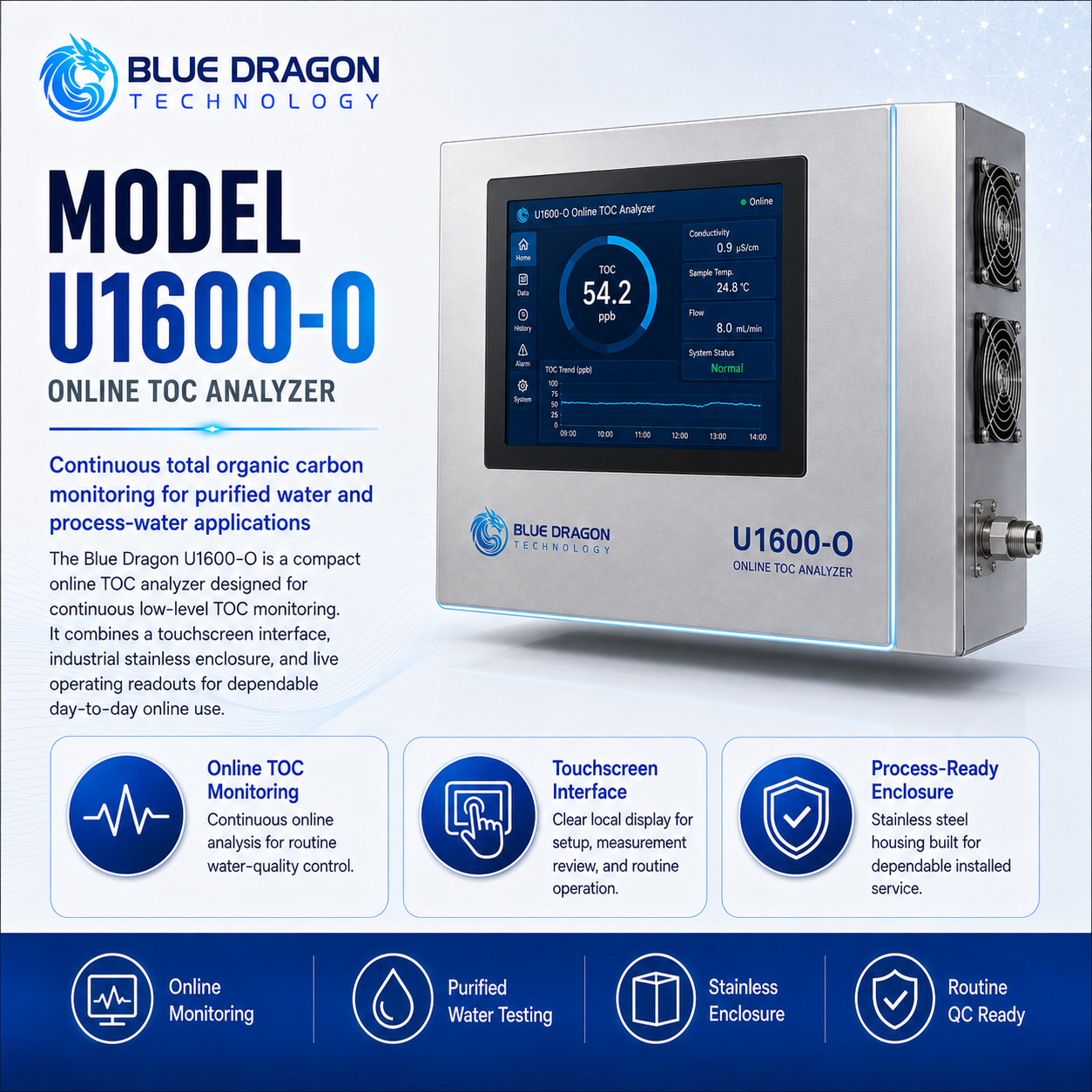
Model U1600-O Online TOC Analyzer
Wall-mounted online TOC analyzer using UV photocatalytic oxidation and differential conductivity detection for continuous or routine low-level monitoring of pharmaceutical and electronic high-purity water.
View instrument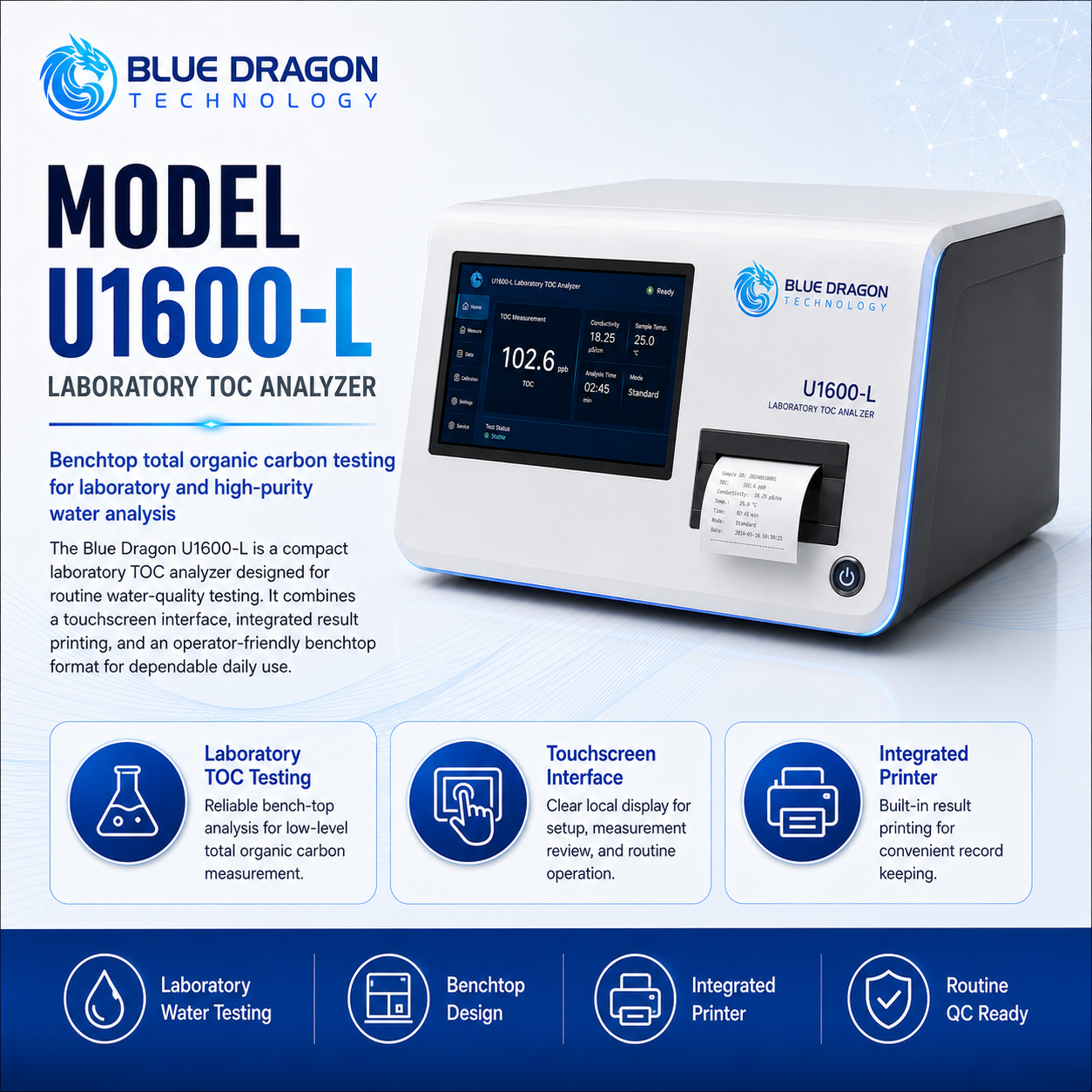 Available
Model U1600-L Laboratory TOC Analyzer
Compact benchtop laboratory TOC analyzer using UV photocatalytic oxidation and differential conductivity detection for offline low-level testing from non-pressurized sample containers.
View instrument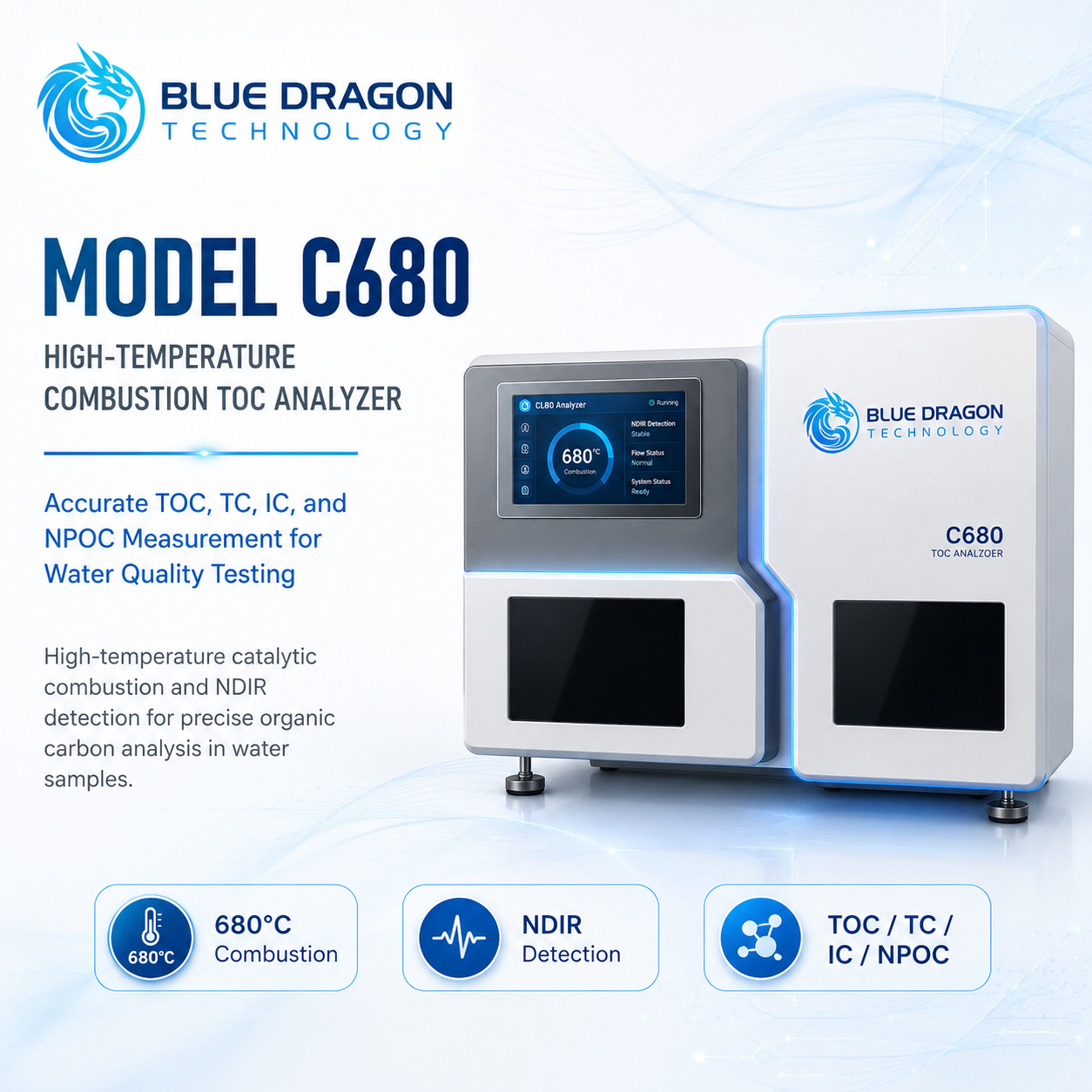 Available
Model C680 High-Temperature Combustion TOC Analyzer
Laboratory total organic carbon analyzer using 680 °C catalytic combustion, separate TC and IC reaction paths, manual microsyringe injection, and NDIR carbon-dioxide detection.
View instrumentRelated applications.
Total Organic Carbon Measurement
TOC measurement for water-quality control, contamination detection, treatment monitoring, process investigation, and laboratory analysis.
Explore →Application questions.
Is a general-purpose TOC analyzer automatically suitable for pharmaceutical water?
No. Suitability depends on range, method, system suitability, calibration, data controls, validation, documentation, maintenance, and the applicable site or pharmacopeial requirements.
What sampling issues matter at low TOC levels?
Tubing, fittings, containers, ambient contamination, flow, stagnation, temperature, cleaning, sanitization, handling, and operator technique can all affect low-level measurements.
Can the analyzer connect to a plant data system?
Potential integration depends on the delivered hardware, communications, software, network policy, data requirements, cybersecurity review, and validation responsibility.
When will the dedicated pharmaceutical TOC specifications be final?
Final range, method, software, validation, documentation, and compliance details will be published after technical verification and release approval.
Discuss your high-purity water TOC requirement.
Share the water type, expected range, sample location, required response, calibration and verification procedures, software and data needs, validation expectations, and timeline.