

Oil-in-Water Monitoring
Measure hydrocarbon-related contamination in water streams to support separation, treatment, reuse, process control, and discharge-related decisions.

Continuous visibility of hydrocarbon contamination in water
Oil-in-water monitoring is used where hydrocarbon contamination affects treatment performance, produced-water management, process-water quality, reuse, or discharge. The measurement must respond appropriately to the oil type and sample matrix while remaining practical to keep clean and calibrated.
Application review should include oil composition, droplet distribution, dissolved and dispersed fractions, suspended solids, surfactants, salinity, bubbles, temperature, fouling, sample transport, calibration basis, and the operational action triggered by the result.
What the application needs to establish
Estimate oil or hydrocarbon-related concentration in a representative water sample using a method and calibration appropriate to the oil type and matrix.
Why the measurement matters
Separation control
Evaluate oil-water separation and treatment performance.
Produced-water management
Support reinjection, reuse, further treatment, or discharge decisions.
Process protection
Identify hydrocarbon ingress into water or utility systems.
Environmental management
Provide timely information for internal control and verified discharge workflows.
Operational response
Detect changing contamination before periodic laboratory results are available.
How the measurement is approached
The Model C610OIW uses an optical fluorescence-based approach for hydrocarbon-related response. Performance depends on the oil, aromatic content, calibration basis, sample matrix, optical cleanliness, and configured measurement conditions.
Typical operating locations
- Produced-water treatment systems
- Oil-water separators and flotation systems
- Refinery and petrochemical wastewater
- Industrial process-water and drainage systems
- Treatment inlet and outlet monitoring
- Reuse and discharge-related measurement points
- Analyzer shelters and packaged bypass systems
Instrument-selection considerations
- Oil type and expected concentration range
- Dissolved, dispersed, and free-oil behavior
- Suspended solids, color, surfactants, salinity, and bubbles
- Calibration oil and correlation to the reference method
- Optical fouling, cleaning, and maintenance
- Sample pressure, temperature, flow, and transport
- Response time, alarm use, installation, and area classification
Where this application is used.


Petrochemicals
Measurement systems for petrochemical feedstocks, reaction processes, fired equipment, utilities, effluent, gas flow, and material quality.
Explore →
Chemical Processing
Application-focused instrumentation for Chemical Processing, covering Trace moisture, H2S and sulfur, TOC, flow, and multipoint temperature across Reactors, columns, specialty gas systems, and utilities.
Explore →
Fertilizers & Chemicals
Analytical and engineered measurement systems for feedstocks, process gases, reactors, utilities, effluent, flow, and material quality.
Explore →
Power Generation
Measurement systems for fuels, boiler and high-purity water, fired equipment, gas flow, materials, and conventional or nuclear generation.
Explore →
Water & Wastewater
Online and laboratory instruments for organic carbon, oil contamination, turbidity, treatment control, discharge, reuse, and water-quality investigation.
Explore →
Environmental Monitoring & Compliance
Application-focused instrumentation for Environmental Monitoring & Compliance, covering Oil-in-water, turbidity, TOC, emissions flow, and XRF soil screening across Wastewater discharge, emissions, contaminated land, and compliance labs.
Explore →Relevant measurement capabilities.
Explore the permanent Blue Dragon capability areas associated with this industry or application.
Water Quality & Organic Carbon Series
Online and laboratory analyzers for organic carbon, oil-in-water, turbidity, wastewater, and high-purity water measurement.
Explore series →Instruments connected to this application.
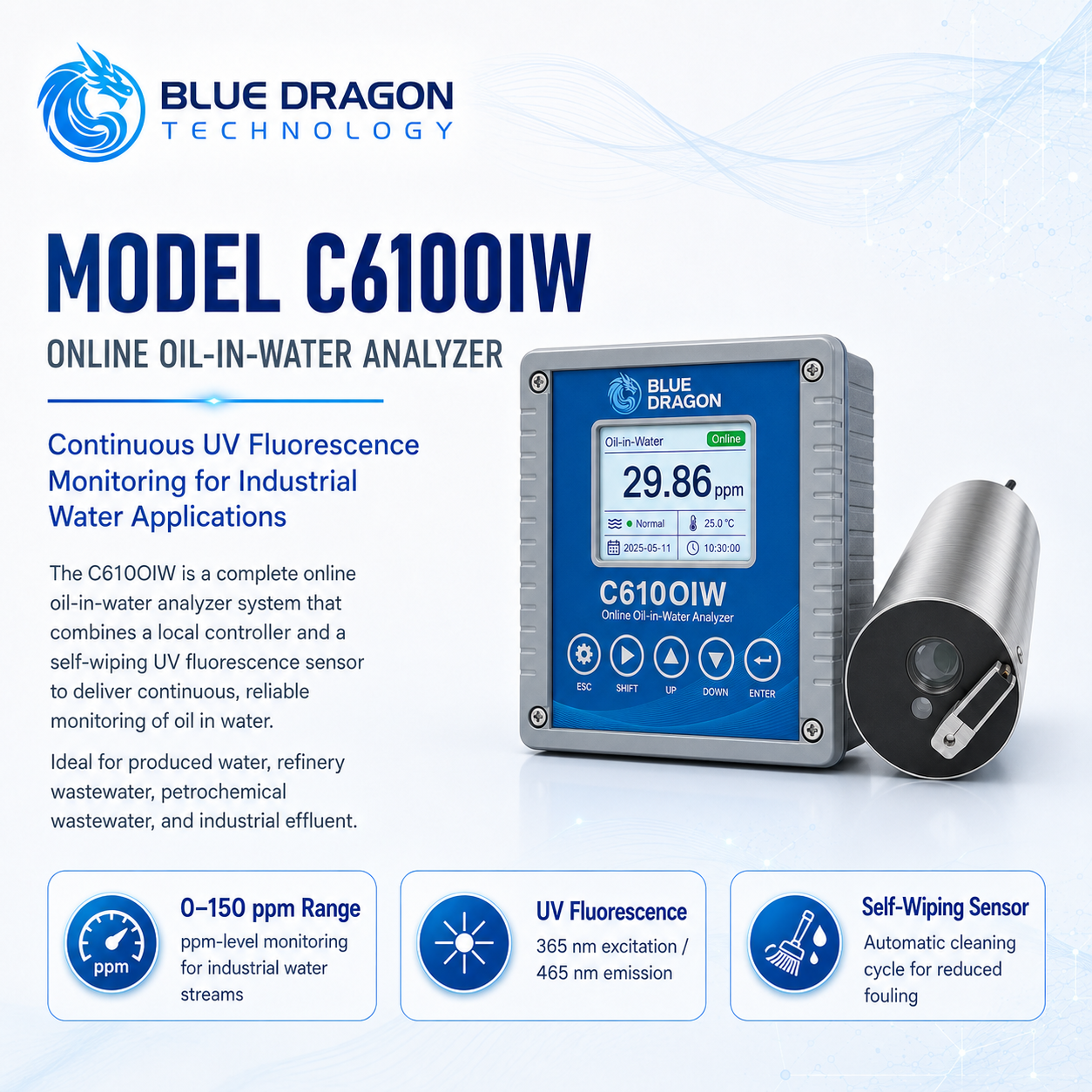 Available
Model C610OIW Online Oil-in-Water Analyzer
Online oil-in-water monitoring system for produced water, refinery and industrial wastewater, heavy-oil contamination, process trending, and alarm applications.
View instrumentRelated applications.
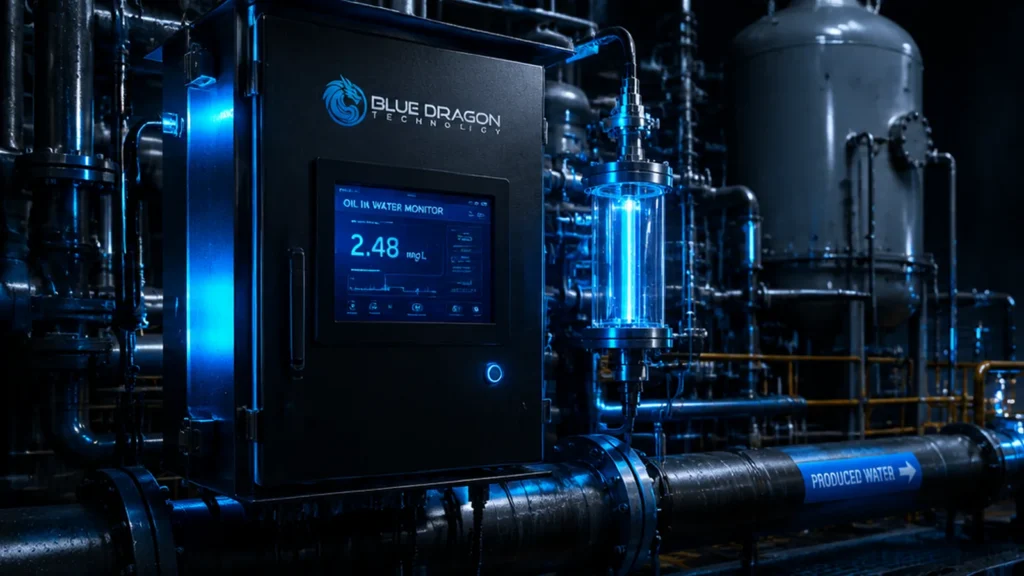
Application questions.
Does oil-in-water fluorescence respond equally to every oil?
No. Fluorescence response depends on the hydrocarbon composition, especially fluorescent aromatic components, as well as the matrix and calibration basis.
Can the result be compared directly with a laboratory method?
Correlation may be developed, but the online optical method and laboratory reference method may measure different fractions or respond differently. Representative samples and a defined correlation procedure are required.
How is fouling managed?
The installation should address sample velocity, optical cleaning, automatic or manual maintenance, access, solids, biological growth, and the expected cleaning frequency.
Can the analyzer be installed directly in the process line?
The preferred arrangement depends on pressure, temperature, flow, solids, bubbles, accessibility, and maintenance. A bypass or conditioned sample system may be more appropriate.
Discuss your oil-in-water monitoring application.
Share the water source, oil type, expected range, solids and surfactants, salinity, sample pressure and temperature, calibration basis, installation, and response-time need.