

Fertilizer & Chemical Plant Instrumentation: Measurement Solutions from Feed Gas to Finished Product
Fertilizer and chemical plants bring together several very different measurement environments within a single production complex. Feed-gas quality, sulfur, trace moisture, fired-equipment temperature, reactor temperature profiles, gas flow, raw-material composition, product quality and supporting water systems can all influence plant reliability and production decisions.
These requirements extend from natural-gas and feed preparation through reforming, synthesis and reaction, and continue into ammonia, urea, phosphate, DAP, NPK, laboratory quality control, plant utilities and wastewater systems.
There is no single analyzer or sensor that can address all of these measurement points. Effective fertilizer and chemical plant instrumentation instead requires a coordinated combination of gas analysis, moisture measurement, temperature measurement, ultrasonic gas flow, elemental analysis and water-quality instrumentation.
The central principle is simple: the instrument should be selected around the actual application—not around the model name alone. Stream chemistry, sample phase, pressure, temperature, materials, installation conditions, hazardous-area requirements and the decision the measurement must support all influence the correct configuration.
This article examines the major measurement opportunities across fertilizer and chemical production and explains how different Blue Dragon technologies can be applied from feed gas to finished product.
Fertilizer & Chemical Plant Measurement Solutions: Video Overview
The Blue Dragon Technology presentation below provides a visual overview of measurement applications across fertilizer and chemical plants, including feed-gas verification, sulfur and moisture measurement, reformer and reactor temperature monitoring, raw-material analysis, gas flow, utilities, water quality and laboratory verification.
The sections below expand on the measurement challenges introduced in the presentation and explain how the technologies fit into the process in greater technical detail.
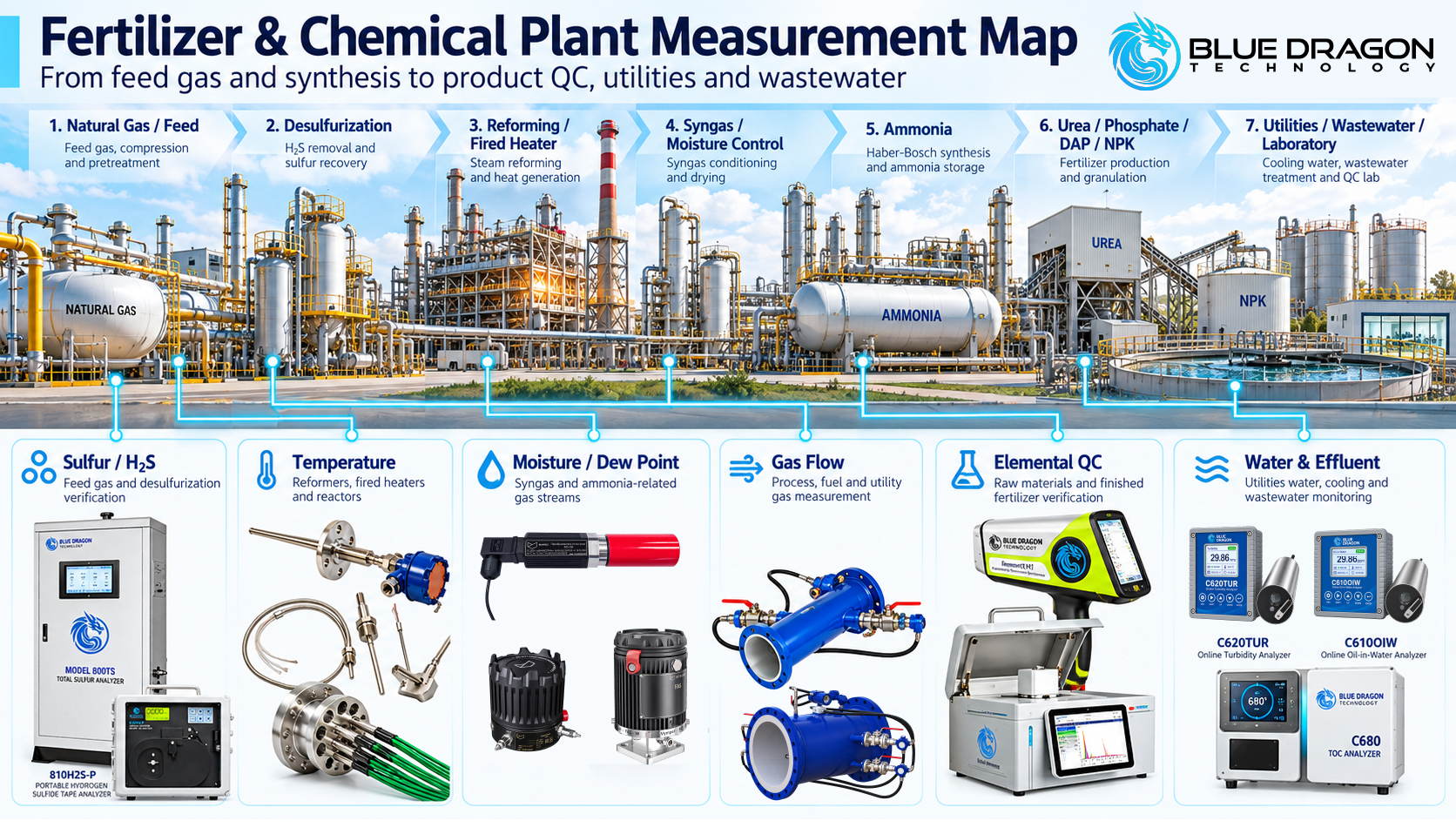
Understanding the Fertilizer & Chemical Plant Measurement Chain
A fertilizer plant is not one measurement environment. It is a sequence of processes in which the physical form of the material, the process chemistry and the operating objective can change significantly from one unit to the next.
At the front of an ammonia or urea process, the principal concern may be the quality of the incoming gas. Sulfur compounds and moisture can be important because downstream treatment, catalysts and process equipment may depend on suitably conditioned gas.
Further into the plant, reformers, fired heaters, reactors, columns and vessels create different measurement requirements. Here, external tube-wall temperature, internal temperature distribution and gas-flow behaviour may become important to plant personnel.
Phosphate, DAP and NPK production introduce another set of questions involving raw-material composition, formulation, granulation, intermediate materials and final-product verification.
Meanwhile, cooling water, process water, scrubbers, wastewater systems and plant laboratories introduce water-quality and analytical requirements that are technically separate from the main synthesis process but remain important to plant operation.
The result is best understood as an integrated measurement architecture covering gas quality, moisture, thermal conditions, flow, elemental quality control and water systems.
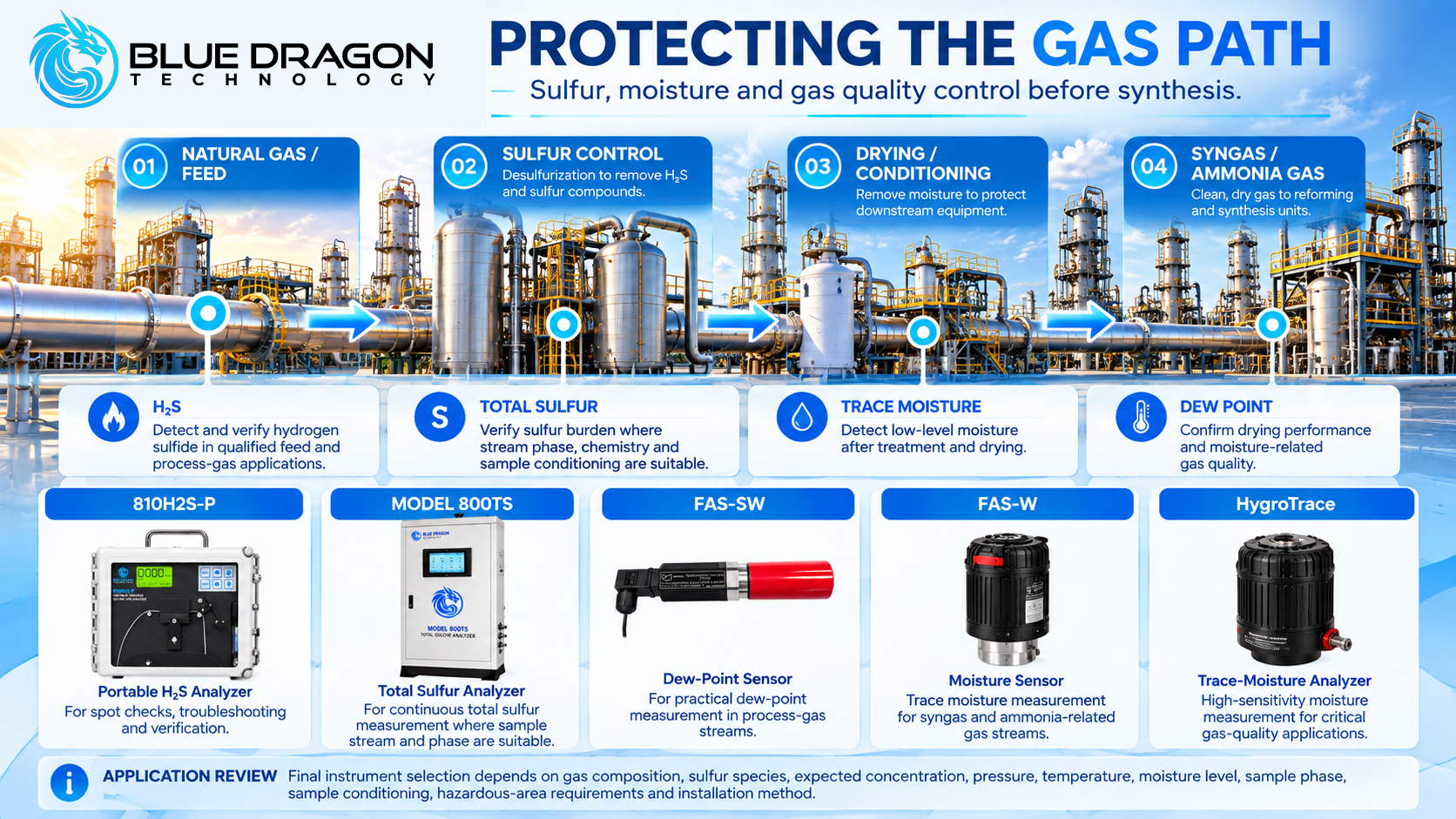
Feed Gas, Hydrogen Sulfide & Total Sulfur Measurement
Sulfur measurement can be relevant at several points in fertilizer and chemical processing, particularly where gas quality, catalyst protection, gas treatment or downstream process requirements depend on sulfur control.
Instrument selection should begin by identifying the sulfur species that must be measured, the sample phase, expected concentration range, stream pressure and temperature, sample-conditioning requirements and the intended use of the result.
Hydrogen Sulfide Measurement
For selective hydrogen-sulfide measurement, Blue Dragon’s sulfur-analysis portfolio includes several configurations intended for different operating requirements.
- Model 810H2S is the online H₂S tape-analyzer configuration for continuous selective H₂S monitoring in qualified gas applications.
- Model 810H2S-P provides portable H₂S measurement for field verification, commissioning, temporary monitoring and troubleshooting in appropriate general-purpose locations.
- Model 810H2S-TS combines direct H₂S measurement with a separate Total Sulfur measurement path using a heated hydrogen-conversion section.
The appropriate configuration depends on whether the objective is continuous process monitoring, combined H₂S and Total Sulfur analysis, or portable verification. Final range, stream composition, sample conditioning, utilities, hazardous-area requirements and current product availability should be confirmed during application review. Availability varies by model; refer to the linked product page for the current release status.
Total Sulfur Measurement
Total sulfur answers a different analytical question from selective H₂S measurement. It is used where the plant needs to understand sulfur across the compounds converted and detected by the selected analytical method.
The Blue Dragon Model 800TS Online Total Sulfur Analyzer uses high-temperature catalytic combustion and ultraviolet fluorescence detection. The documented standard configuration is oriented toward suitable light-hydrocarbon liquid samples; gas-phase use and any fertilizer-plant application require specific confirmation of the sample and sample-handling arrangement.
Trace Moisture & Dew-Point Measurement in Process Gas
Moisture and dew-point measurement can support gas-quality monitoring across syngas, ammonia gas and other qualified process-gas streams. The objective may be to verify dryer performance, observe moisture breakthrough, reduce condensation risk or provide greater visibility into gas condition before sensitive downstream equipment.
Blue Dragon provides several different moisture technologies because no single measurement principle is ideal for every gas composition, range or installation.
- FAS-SW Trace Moisture & Dew Point Transmitter provides compact continuous dew-point measurement for qualified gas applications.
- FAS-W Online Moisture & Dew Point Analyzer uses an automatic chilled-mirror approach with configurations for dew point, moisture concentration or both.
- HygroTrace Ultra-Trace Moisture Analyzer uses coulometric measurement for very low water concentrations in compatible gases.
Gas composition is particularly important in moisture measurement. Reactive components, free liquids, aerosols, pressure reduction, sample-line condition and background moisture can influence both technology selection and measurement performance.
For this reason, a trace-moisture application review should establish the complete gas composition, pressure, temperature, expected range, sample-conditioning arrangement and verification method before configuration.
Temperature Measurement in Reformers, Fired Heaters & Reactors
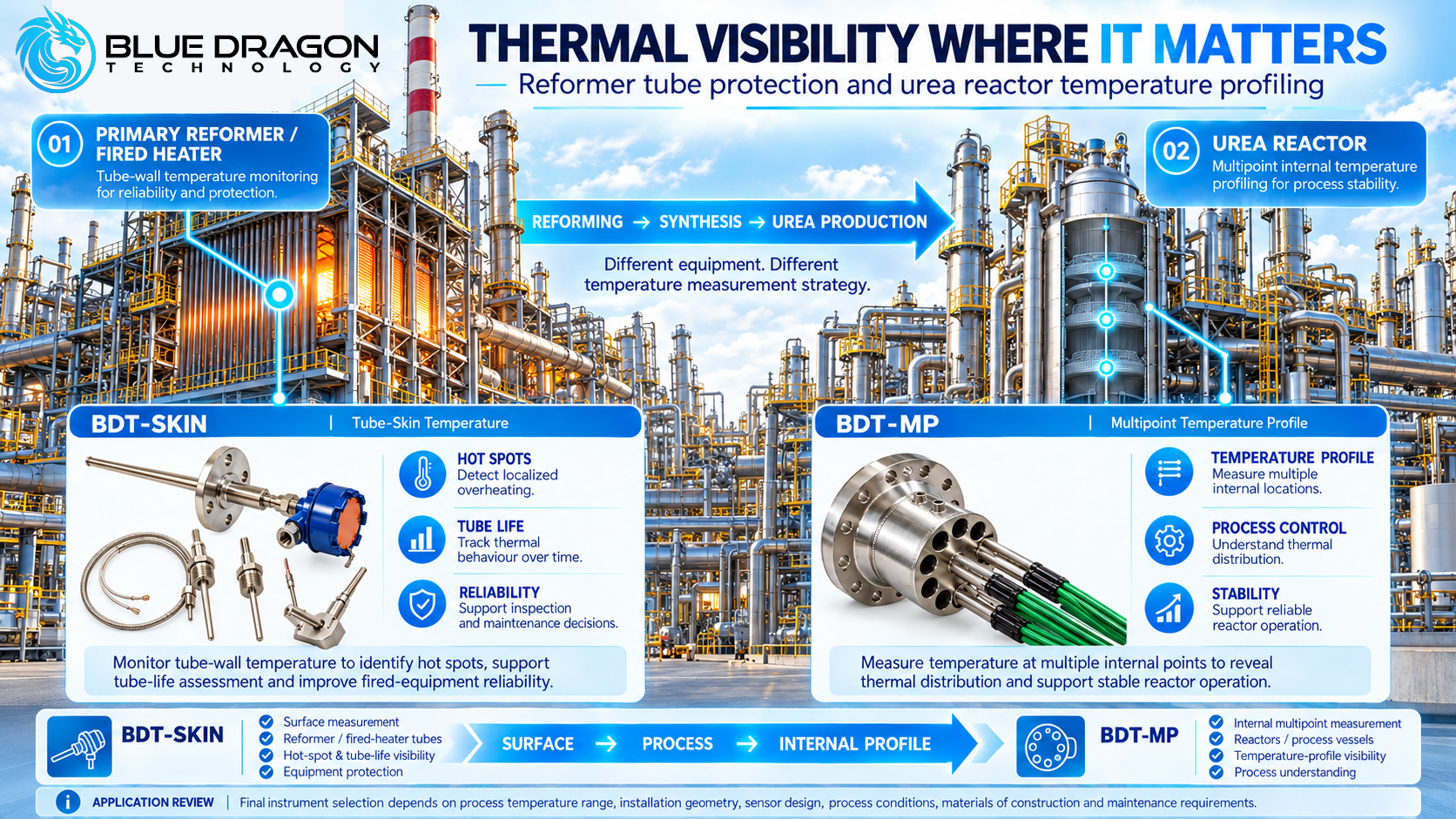
Thermal measurement requirements in fertilizer and chemical plants can be divided into at least two very different problems: measuring the external temperature of fired-equipment tubes and measuring temperature distribution at multiple internal locations within reactors or vessels.
Those two objectives require different sensor architectures.
Primary Reformer & Fired-Heater Tube-Skin Temperature
Primary reformers and fired heaters operate in demanding thermal environments where local tube-wall temperature can provide important information about operating behaviour and equipment condition.
The Blue Dragon BDT-SKIN Tube-Skin Thermocouples are engineered for direct external tube-wall temperature measurement. The complete assembly must account for tube geometry, operating temperature, attachment method, shielding, thermal expansion, routing and termination.
Representative tube-skin temperature information can support:
- Identification of localized overheating
- Comparison of temperature behaviour across critical tubes
- Thermal-performance investigation
- Maintenance and inspection planning
- Long-term equipment-condition trending
Tube-skin thermocouples are engineered assemblies rather than generic surface sensors. Plant drawings, tube dimensions, material, monitored locations, design temperature and installation requirements should be reviewed before manufacture.
Multi-Point Reactor Temperature Profiling
Reactor measurement presents a different challenge. A single temperature point may not show how temperature varies through the depth or height of the process vessel.
The Blue Dragon BDT-MP Multipoint Temperature Assembly can be engineered with multiple thermocouple or RTD sensing points positioned at defined elevations or depths inside reactors, columns, vessels and other process equipment.
In urea and other chemical-reactor applications, multi-point measurement can help operators understand temperature distribution rather than relying on one isolated value.
The final assembly depends on vessel drawings, nozzle geometry, insertion length, sensing locations, materials, process pressure and temperature, mechanical support and termination requirements.
The Ammonia & Urea Measurement Workflow
Viewed as one production chain, ammonia and urea manufacture can involve several measurement disciplines operating at different stages of the process.
Feed and treatment stages may require sulfur or H₂S verification where gas composition affects treatment or downstream equipment.
Primary reforming and fired equipment can require tube-wall temperature monitoring using engineered tube-skin assemblies.
Syngas and gas-conditioning stages may require moisture or dew-point measurement to understand drying performance and gas condition.
Process-gas networks may require qualified ultrasonic flow measurement where the line geometry, gas composition and required performance support that technology.
Urea reactors and related vessels may benefit from multi-point internal temperature profiling where temperature distribution is important to plant operation.
Utilities and wastewater systems introduce separate measurements including turbidity, oil-in-water and laboratory organic-carbon analysis.
These measurements do not need to come from one instrument family. Their value comes from being selected and applied as one coordinated plant measurement strategy.
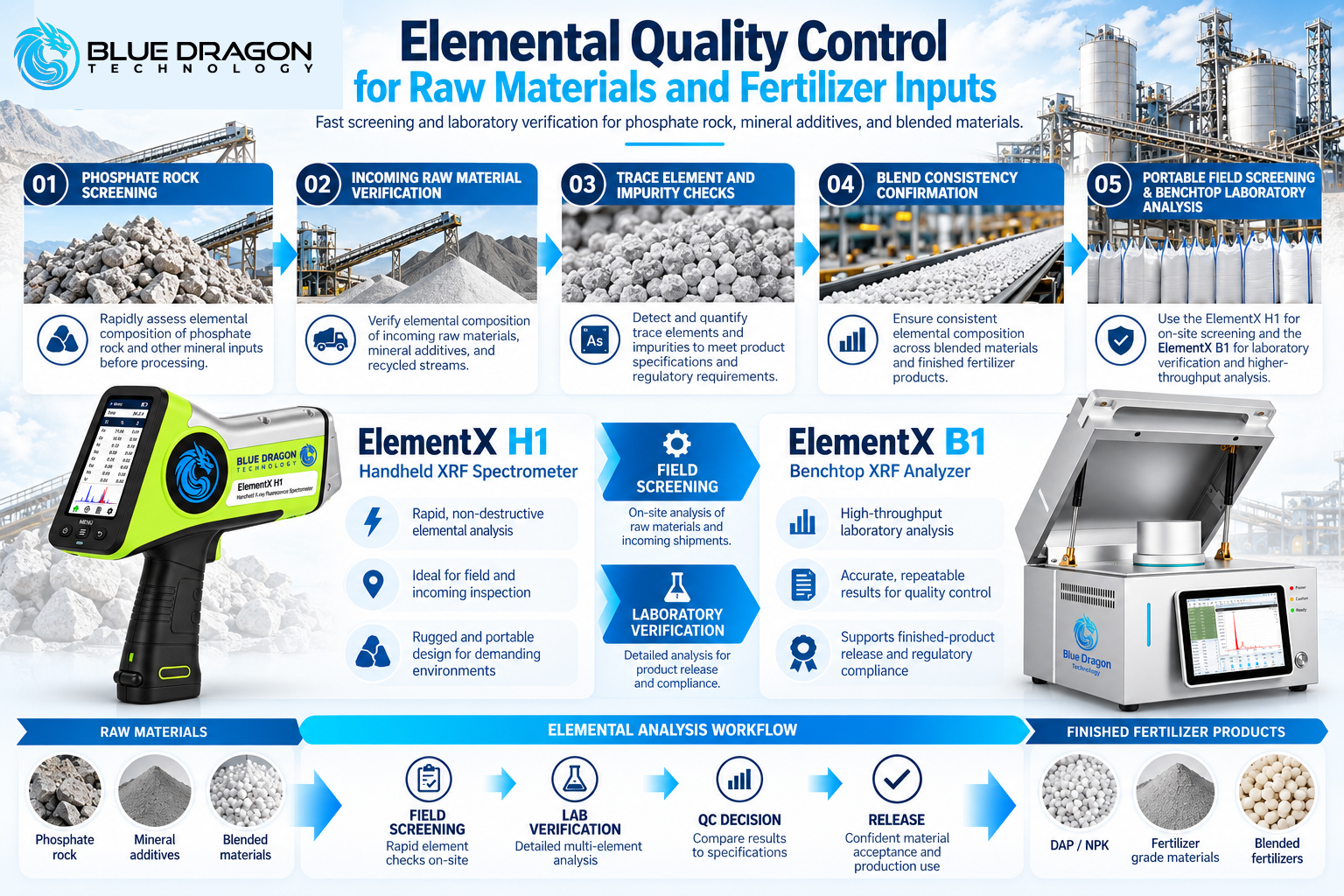
Phosphate Rock, Raw Materials & Fertilizer Quality Control
Phosphate, DAP and NPK production introduce a measurement problem centred on material composition. Incoming rock, additives, intermediate materials and finished fertilizer may all require analytical verification depending on the plant’s quality-control procedures.
X-ray fluorescence spectroscopy, or XRF, provides elemental information and can be used at different stages of this workflow.
Rapid Field & Receiving Inspection
The Blue Dragon ElementX H1 Handheld XRF Spectrometer provides a portable approach to elemental screening where measurements need to be taken at receiving, storage, stockpile or other field-oriented locations.
Potential applications include screening of phosphate rock, additives and other incoming materials, subject to the installed analytical mode, calibration, sample matrix and required elements.
Laboratory Elemental Verification
The Blue Dragon ElementX B1 Vacuum Benchtop XRF Spectrometer provides a laboratory-oriented EDXRF platform for controlled elemental-analysis workflows.
The H1 and B1 therefore serve complementary roles. A plant may use rapid handheld measurements for screening and material triage while using a benchtop system for prepared samples and more structured laboratory verification.
Quantitative XRF performance depends on the sample matrix, preparation method, installed calibration and suitable reference materials. Instrument selection should therefore begin with the analytical question the plant needs to answer rather than simply the sample name.
DAP & NPK Production
For DAP and NPK production, elemental analysis can support incoming-material evaluation, formulation checks and finished-product quality-control workflows. Temperature measurement may also be relevant at selected process points where thermal conditions influence operation, but the sensor design must be matched to the actual equipment rather than assumed from the process name alone.
Phosphoric Acid, Sulfuric Acid & Reactor-Area Measurement
Acid-production and reactor areas require especially careful application review because process chemistry, corrosion, temperature and material compatibility can substantially change the measurement approach.
Potential measurement requirements can include:
- Multi-point reactor or vessel temperature
- Qualified gas-flow measurement
- Utility-water and cooling-water monitoring
- Turbidity or solids-related water trends
- Oil contamination in appropriate water streams
- Laboratory TOC analysis of suitable water samples
The process stream itself and the surrounding utility systems should be treated separately. A water-quality instrument appropriate for cooling or wastewater service should not be assumed to be compatible with concentrated acid or another aggressive process stream.
Important sulfur-application distinction: The Model 800RS sulfur-ratio analyzer is intended for Claus sulfur-recovery-unit tail-gas H₂S/SO₂ ratio applications. It should not be positioned as a general sulfuric-acid-production analyzer. Sulfuric-acid plant service and Claus SRU tail-gas service are different applications and require separate qualification.
Process, Fuel, Vent & Utility Gas Flow Measurement
Gas movement is another important measurement category across fertilizer and chemical plants. Depending on the process configuration, flow measurement may be required in fuel gas, process gas, vent gas, natural gas or other plant gas services.
Blue Dragon’s ultrasonic gas-flow portfolio includes inline and insertion configurations for different gas-flow applications.
Representative options include the Lauris FF1225-A Single-Path Inline Ultrasonic Gas Flow Meter and the Lauris FF2225-A Dual-Path Inline Ultrasonic Gas Flow Meter.
The appropriate flow-meter architecture cannot be selected from gas type alone. Important factors include:
- Pipe diameter and schedule
- Gas composition and density
- Normal, minimum and maximum velocity
- Pressure and temperature
- Available straight-run distance
- Liquid carryover or contamination
- Required measurement uncertainty
- Installation and transducer-access requirements
- Hazardous-area classification and project certification
A process-gas flow application review should therefore be completed before the final meter geometry and configuration are selected.
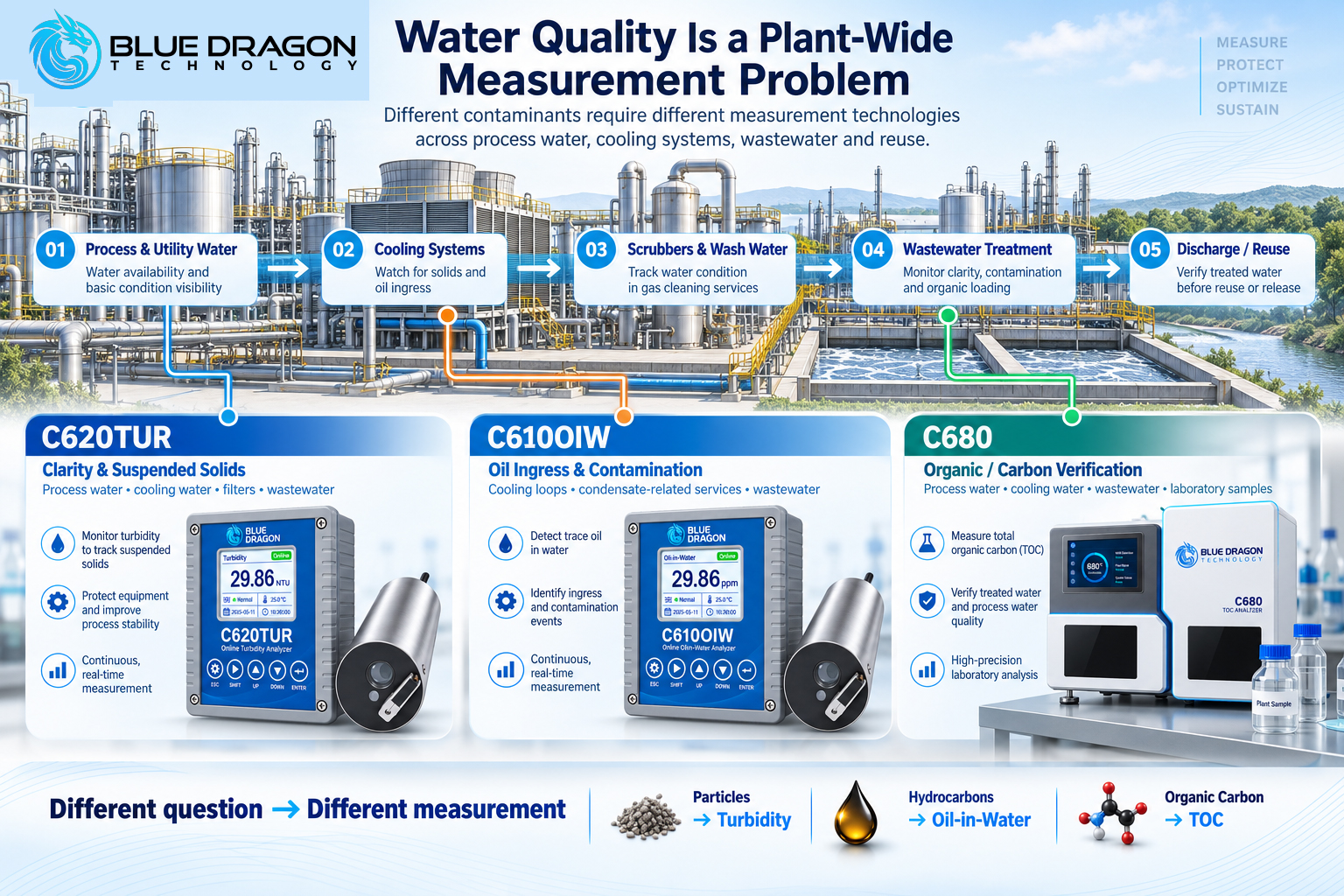
Process Water, Cooling Water & Wastewater Monitoring
Water systems cross many areas of fertilizer and chemical plants. The exact arrangement varies by facility, but measurement requirements may arise in process water, cooling circuits, scrubbers, treatment systems, wastewater and discharge-related monitoring.
Different water-quality problems require different measurement principles. Turbidity, oil contamination and organic carbon should not be treated as interchangeable parameters.
Turbidity Monitoring
Turbidity provides an optical indication of suspended and scattering material in water. The Blue Dragon C620TUR Online Turbidity Analyzer is designed for continuous industrial water applications including process water, treatment systems, utility water and wastewater where the range and matrix are appropriate.
Measurement location, bubbles, particle characteristics, fouling, immersion conditions and calibration or verification practice can all influence turbidity performance.
Oil-in-Water Monitoring
Oil contamination represents a different water-quality problem. The Blue Dragon C610OIW Online Oil-in-Water Analyzer uses UV fluorescence for continuous oil-related trending in qualified industrial water streams.
Potential applications may include cooling-water contamination investigation, industrial wastewater and other water systems where the oil type, measurement range and sample characteristics are compatible with the sensing method.
Laboratory Total Organic Carbon Analysis
Total organic carbon provides another view of water condition by measuring carbon associated with organic material using the selected analytical method.
The Blue Dragon Model C680 High-Temperature Combustion TOC Analyzer is a laboratory instrument for TOC, TC, IC and NPOC analysis in suitable water samples using high-temperature catalytic combustion and NDIR detection.
The standard C680 configuration uses manual microsyringe injection, so it should be considered an offline laboratory analytical platform rather than an online continuous process analyzer.
Matching Measurement Requirements to Plant Areas
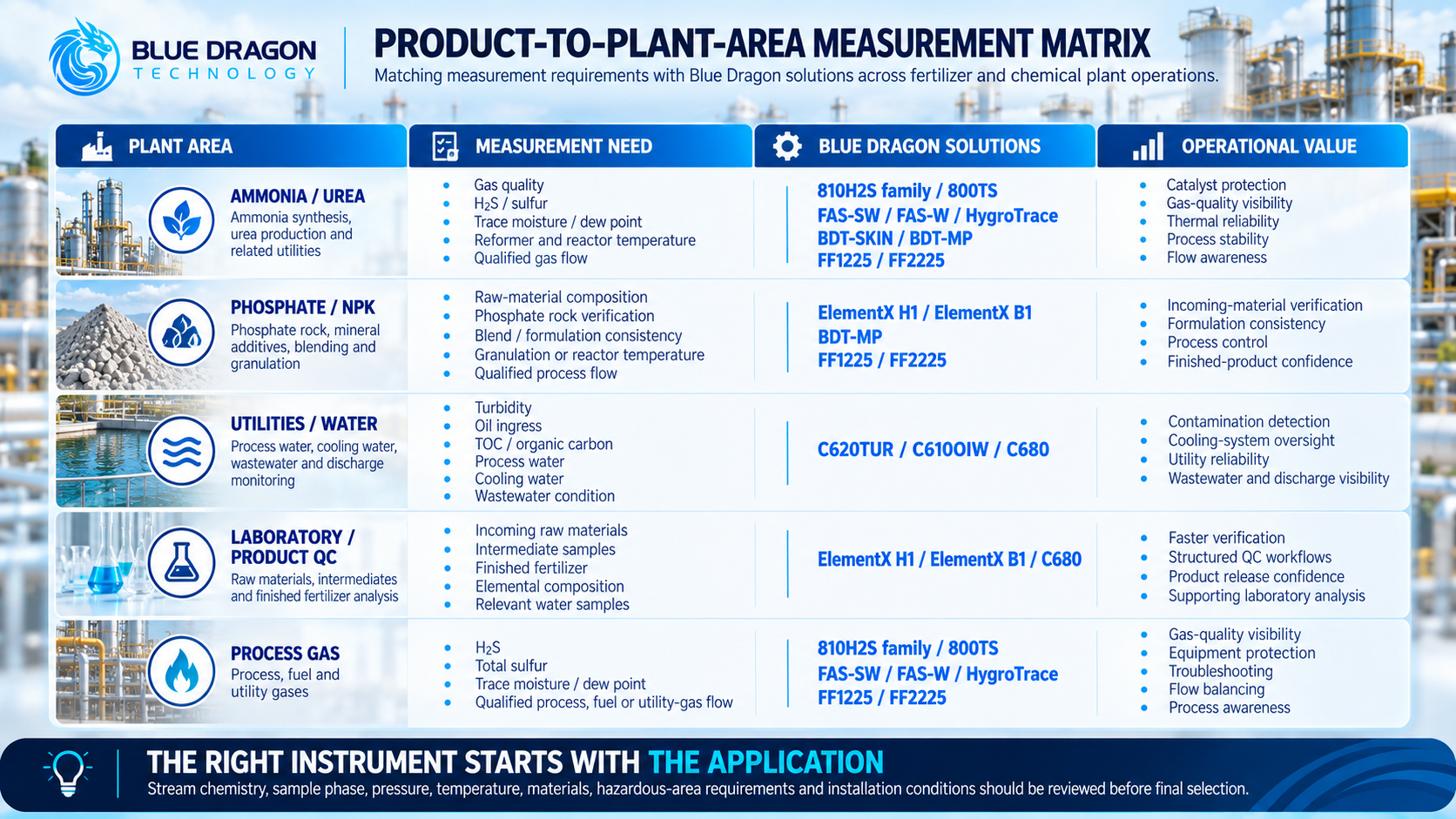
The following table summarizes representative measurement requirements across the plant. It is intended as an application map rather than a universal specification. Final suitability depends on the actual process, range, chemistry, installation and project requirements.
| Plant Area | Measurement Need | Measurement Technology | Representative Blue Dragon Solutions |
|---|---|---|---|
| Ammonia / Urea | Gas quality, sulfur, moisture, reformer temperature, reactor temperature and qualified gas flow | H₂S / sulfur analysis, moisture and dew point, tube-skin temperature, multipoint temperature, ultrasonic gas flow | 810H2S-P, FAS-SW, FAS-W, HygroTrace, BDT-SKIN, BDT-MP |
| Phosphate / DAP / NPK | Raw-material composition, incoming inspection, laboratory verification and finished-product QC | Handheld and benchtop XRF; application-specific process temperature measurement | ElementX H1, ElementX B1, BDT-MP where the equipment and application justify multipoint profiling |
| Utilities / Water | Turbidity, oil contamination, water treatment and laboratory organic-carbon analysis | Optical turbidity, UV-fluorescence oil-in-water, high-temperature combustion TOC | C620TUR, C610OIW, C680 |
| Laboratory / Product QC | Incoming material, intermediate and final-product elemental analysis; relevant water-sample analysis | XRF elemental analysis and laboratory TOC analysis | ElementX H1, ElementX B1, C680 |
| Process Gas | H₂S, sulfur, moisture, dew point and qualified gas flow | Tape-based H₂S, total sulfur, chilled-mirror / transmitter / coulometric moisture, ultrasonic gas flow | 810H2S, 810H2S-TS, FAS-SW, HygroTrace, Blue Dragon Flow Portfolio |
Technical Qualification: Why Application Review Comes First
Industrial instrumentation should be selected around the process conditions and measurement objective rather than only around the parameter name.
Two streams may both require H₂S measurement, for example, while differing substantially in pressure, moisture, composition, required range, hazardous-area classification and sample-system design. The same principle applies to temperature, flow, elemental analysis and water-quality instrumentation.
Before final instrument selection, the following areas should normally be reviewed.
1. Gas or Process Composition
Define the target species, major stream components, possible interferents, concentration range and any reactive, corrosive or contaminating components that may affect the measurement system.
2. Sample Matrix & Phase
Confirm whether the sample is a gas, liquid, water, solid, powder or prepared laboratory sample. Free liquids, particulates, moisture, aerosols and sample preparation can materially change measurement performance.
3. Pressure & Temperature
Normal, minimum, maximum, startup and upset conditions should be considered. Pressure reduction, cooling, heat tracing or other conditioning may be necessary depending on the technology.
4. Materials & Corrosion
Wetted-material compatibility is essential in chemical service. Acids, chlorides, sulfur compounds, solvents and other aggressive components must be reviewed against the proposed sensor, sample system and process interface.
5. Hazardous-Area Requirements
Area classification, required electrical approvals, installation method, purge requirements and project certification should be defined before final configuration.
6. Calibration, Verification & Maintenance
The plant should define how the measurement will be calibrated or verified, which standards or comparison methods are required, how frequently maintenance can be performed and how the instrument will be accessed safely.
7. Installation Geometry & Process Interface
Line size, nozzles, insertion depth, straight runs, vessel geometry, mounting orientation, sensor routing and available maintenance access can be decisive—particularly for flow meters and inserted temperature assemblies.
8. Data, Outputs & Control-System Integration
Required analogue outputs, digital communications, alarms, historian data, control-system tags and ownership of any process action should be defined as part of the instrumentation scope.
Blue Dragon provides a dedicated application-engineering review for projects where the measurement point, sample, configuration or project requirements need to be qualified before quotation.
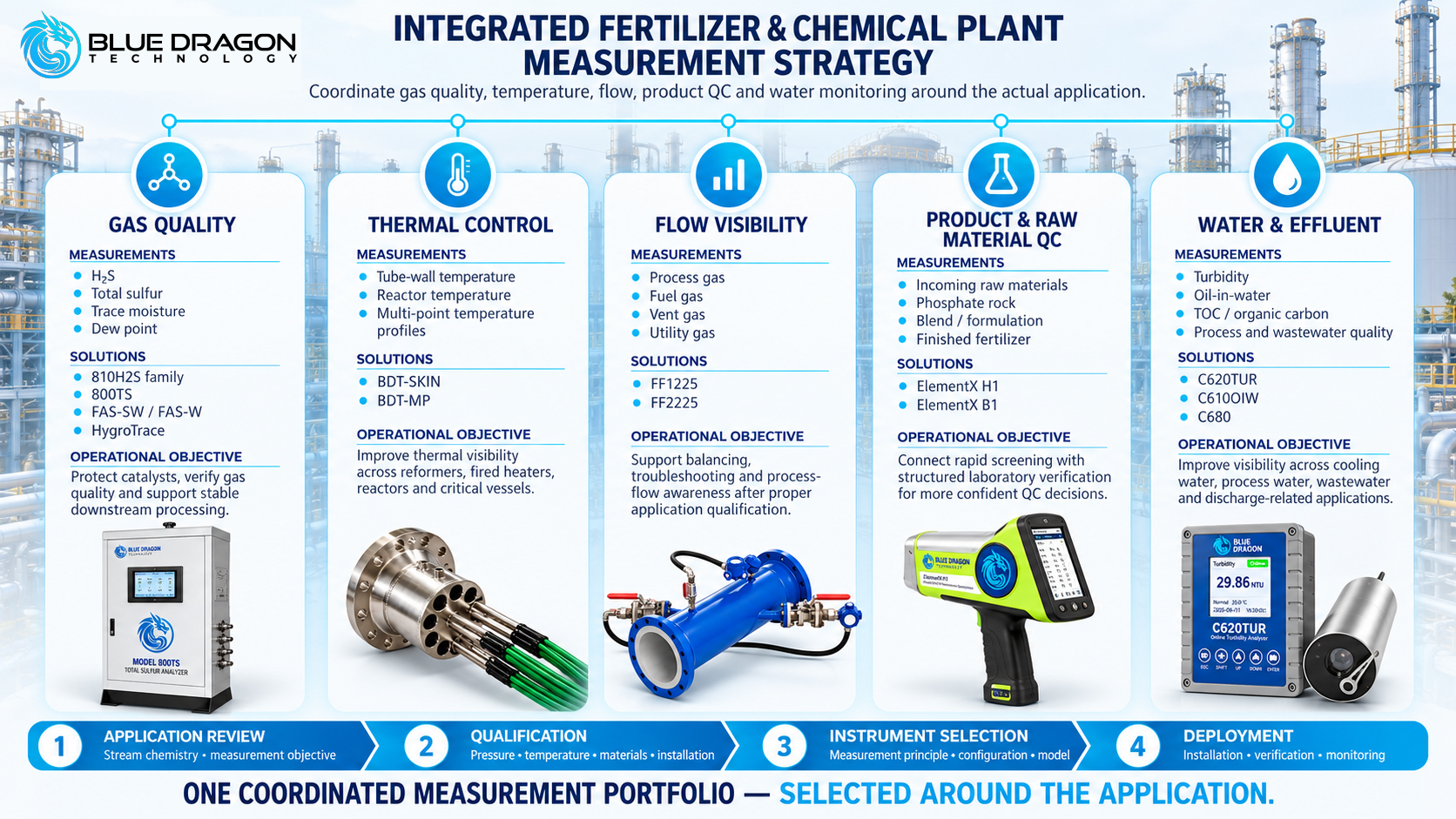
Building a Coordinated Fertilizer & Chemical Plant Measurement Package
A coordinated instrumentation package does not need to begin as a full-plant project. Plants can start with one defined measurement problem and expand the scope where additional measurements provide useful process, quality or reliability information.
Gas Quality Package
A gas-quality scope can combine H₂S or Total Sulfur measurement with moisture and dew-point monitoring for qualified feed, fuel, syngas or process-gas streams. The exact analyzer combination depends on the stream chemistry and measurement objective.
Reactor & Heater Package
BDT-SKIN and BDT-MP address two complementary temperature problems: external tube-wall monitoring on fired equipment and internal multi-point temperature profiling within reactors, columns and vessels.
Raw Material & Laboratory QC Package
ElementX H1 and ElementX B1 can provide a field-to-laboratory elemental-analysis workflow, while laboratory TOC measurement can be added where suitable plant-water or wastewater samples require carbon analysis.
Utilities & Water Package
C620TUR, C610OIW and C680 address different water-quality questions across continuous turbidity, oil-related contamination monitoring and laboratory carbon analysis.
Full Plant Measurement Package
For larger projects, gas quality, temperature, flow, elemental QC and water-quality instrumentation can be evaluated together. The objective is not to install every available instrument, but to coordinate the measurements that address the plant’s actual process and quality requirements.
Information to Provide Before Instrument Selection or Quotation
Providing a small amount of application information at the beginning of a project can significantly improve instrument selection and reduce unnecessary clarification later.
Where available, provide:
- Process or plant area
- Measurement objective
- Gas, liquid, water, solid or sample type
- Complete or representative composition
- Normal and maximum measurement range
- Process pressure and temperature
- Line, vessel or installation dimensions
- Wetted-material or corrosion requirements
- Hazardous-area classification
- Required signals or communication protocol
- Calibration or reference-method requirements
- Project location and schedule
A complete specification is not necessary for an initial discussion. Blue Dragon can use the available information to identify missing qualification points and determine the appropriate technical next step.
Frequently Asked Questions About Fertilizer & Chemical Plant Instrumentation
Which measurements are commonly required in fertilizer and chemical plants?
Requirements depend on the plant and process, but relevant measurement categories can include sulfur and H₂S, trace moisture and dew point, reactor and fired-equipment temperature, process-gas flow, elemental composition, turbidity, oil-in-water and organic carbon. The correct priorities depend on the process and decisions the data must support.
How can H₂S and sulfur be monitored in fertilizer-plant gas streams?
Selective H₂S and Total Sulfur are different measurements. Blue Dragon provides tape-based H₂S configurations, combined H₂S / Total Sulfur configurations and total-sulfur analysis platforms. Stream composition, phase, range, pressure, temperature, sample conditioning and measurement objective must be reviewed before selection.
How is moisture measured in syngas or ammonia-related process gas?
Possible technologies include dew-point transmitters, chilled-mirror analyzers and coulometric ultra-trace moisture measurement. The most suitable principle depends on gas composition, pressure, moisture range, contaminants, sample conditioning, required response and verification method.
What is the difference between tube-skin and multipoint temperature measurement?
Tube-skin thermocouples measure external tube-wall temperature at defined points on fired equipment. Multipoint assemblies measure temperature at several internal elevations or depths inside reactors, columns or vessels. They solve different thermal-measurement problems and require different mechanical designs.
How can phosphate rock and finished fertilizer be analyzed?
XRF can support elemental analysis of phosphate rock, additives, prepared samples and finished fertilizer where the elements, matrix, calibration and sample preparation are suitable. Handheld XRF supports rapid field screening, while benchtop XRF supports controlled laboratory workflows.
Which measurements can be used in fertilizer-plant water systems?
Depending on the water system, measurements can include turbidity for solids-related optical trends, oil-in-water for hydrocarbon contamination and laboratory TOC analysis for organic-carbon evaluation. Each parameter answers a different analytical question.
Can the Model 800RS be used as a sulfuric-acid-production analyzer?
The Model 800RS is intended for H₂S / SO₂ ratio and air-demand monitoring in Claus sulfur-recovery-unit tail gas. That application is different from normal sulfuric-acid-production service and should not be treated as interchangeable without a separate technical review.
Why is an application review required before instrument selection?
Industrial measurements depend on more than the parameter name. Composition, sample phase, range, pressure, temperature, materials, installation geometry, hazardous-area requirements, calibration, maintenance and data integration can all change which technology and configuration are appropriate.
From Feed Gas to Finished Fertilizer
Fertilizer and chemical production combines gas treatment, synthesis, high-temperature equipment, reactors, raw materials, product-quality workflows and supporting utility systems. Each area creates a different measurement challenge.
The strongest instrumentation strategy is therefore not necessarily the one with the greatest number of instruments. It is the one that places the right measurement at the right process point and provides information that can support an operating, quality or maintenance decision.
That can mean combining:
- Gas-quality measurement for H₂S, sulfur, moisture and dew point
- Temperature measurement for reformer tubes, fired equipment, reactors and vessels
- Ultrasonic gas-flow measurement for suitable process, fuel, vent and utility-gas services
- Elemental analysis for raw-material and finished-product quality control
- Water-quality instrumentation for turbidity, oil contamination and organic-carbon analysis
Together, these measurements provide a broader view of the process than any one instrument can provide independently.
Blue Dragon Technology supports individual measurement points and coordinated instrumentation requirements across fertilizer and chemical processing, from feed-gas verification through synthesis, reactors, product QC, utilities and wastewater.
Discuss Your Fertilizer & Chemical Plant Measurement Requirements
Blue Dragon Technology can review individual measurement points or broader plant instrumentation requirements across gas quality, sulfur, moisture, temperature, flow, raw-material and product QC, water quality and laboratory analysis.
For the most useful application review, provide the process or stream, measurement objective, expected range, composition or matrix, pressure, temperature, installation conditions, hazardous-area requirements and project schedule where available.
Discuss Your Application
Request a Quote
Contact Blue Dragon
Blue Dragon Technology
Measure. Monitor. Optimize.