

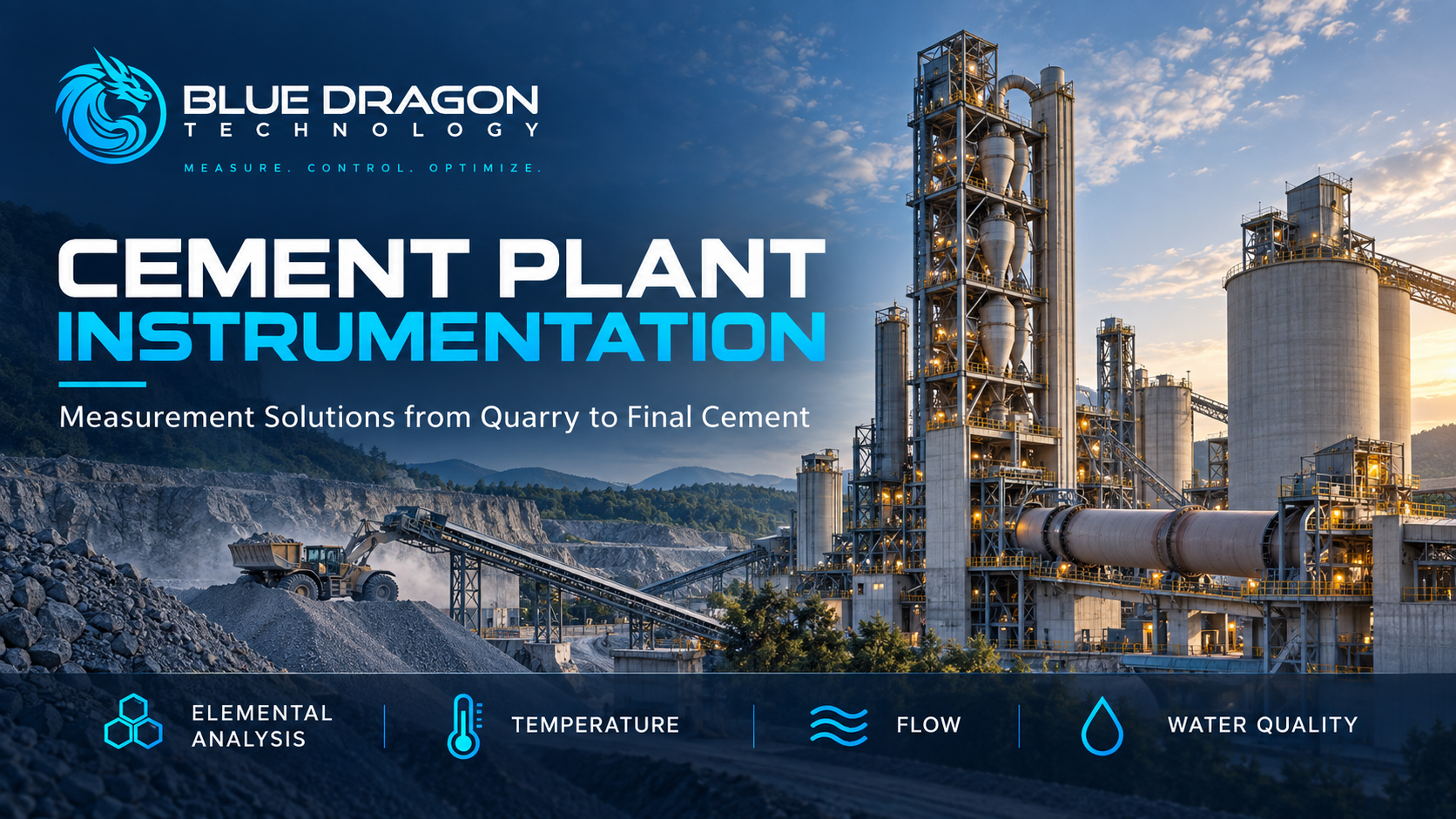
Cement Plant Instrumentation: Measurement Solutions from Quarry to Final Cement
Cement manufacturing is a continuous process in which small variations in raw materials, thermal conditions, gas flow, product chemistry and supporting utilities can affect operating stability and final product quality.
Reliable measurement is therefore required across the plant—from the quarry and raw-material preparation stages through clinker production, cement grinding and plant utility systems.
There is no single instrument that can address every measurement point in a cement plant. Different stages require different technologies, including elemental analysis, temperature measurement, flow measurement and water-quality analysis.
An effective instrumentation strategy begins by identifying what needs to be measured, where the measurement should be made, the process conditions at that location and how the resulting data will be used.
This article examines some of the major measurement opportunities throughout cement production and the technologies that can be applied to them.
Cement Plant Measurement Solutions: Video Overview
The Blue Dragon Technology presentation below provides a process-by-process overview of measurement applications throughout cement and clinker production, from raw-material analysis through thermal processing, flow measurement and plant water systems.
The sections below expand on the measurement challenges covered in the presentation and explain how different analytical and process-measurement technologies can fit into the cement manufacturing chain.
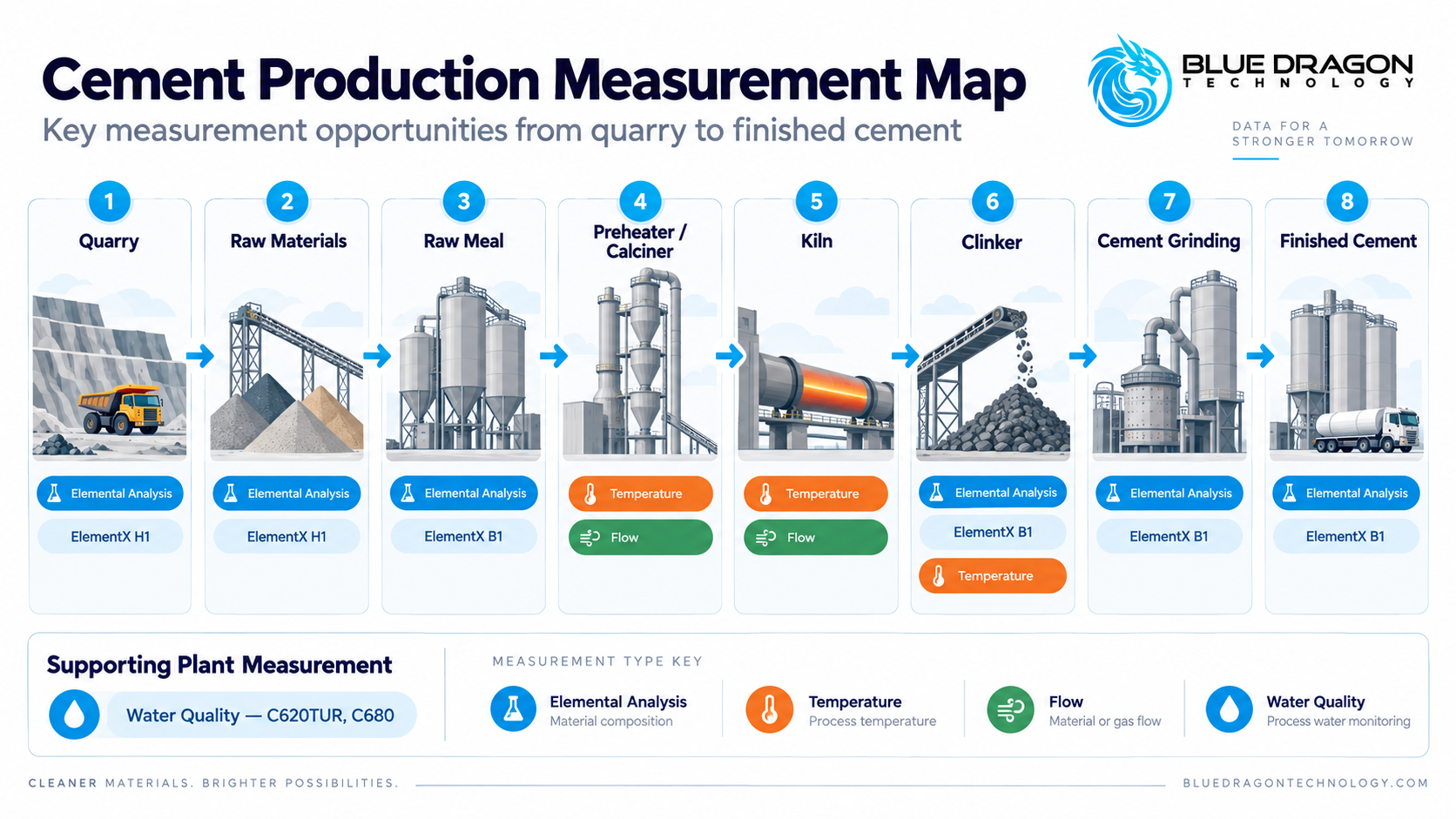
Understanding the Cement Production Measurement Chain
A cement plant combines several very different operating environments within a single production process.
At the beginning of the process, the challenge is largely one of material composition. Limestone and other raw materials must be evaluated so that variations in feed chemistry can be understood and managed.
Further into the plant, raw materials are processed at elevated temperatures through preheating, calcination and clinker formation. Here, temperature measurement becomes an important part of understanding process conditions.
Air and process-gas movement introduce another measurement requirement. Flow conditions can affect combustion, heat transfer and process operation, while the hot and dusty environment can make measurement technically demanding.
Elsewhere in the facility, laboratory analysis, plant water, wastewater and utility systems introduce additional analytical requirements.
For this reason, cement plant instrumentation is best considered as an interconnected measurement architecture rather than as a collection of unrelated instruments.
Raw-Material Analysis in Cement Production
The composition of raw materials establishes the chemical foundation of cement production. Limestone normally provides the principal calcium-bearing component, while other materials contribute silicon, aluminium, iron and additional constituents required by the process.
Natural deposits are not perfectly uniform. Composition can change between quarry areas, extraction zones, stockpiles and incoming material sources. Rapid access to elemental information can therefore help plant personnel understand material variability before material moves deeper into the production process.
Using XRF for Raw-Material Screening
X-ray fluorescence spectroscopy, or XRF, is widely used for elemental analysis because it can identify and quantify multiple elements without requiring destructive chemical digestion for every measurement.
For field-oriented applications, handheld XRF can provide rapid elemental information directly at the point of inspection. This can be useful for applications such as:
- Quarry and geological screening
- Raw-material identification
- Comparison of material from different extraction areas
- Incoming material verification
- Stockpile screening
- Rapid investigation of unexpected material variation
The Blue Dragon ElementX H1 handheld XRF spectrometer provides a portable approach to non-destructive elemental analysis where measurements need to be taken directly in the field or at the material location.
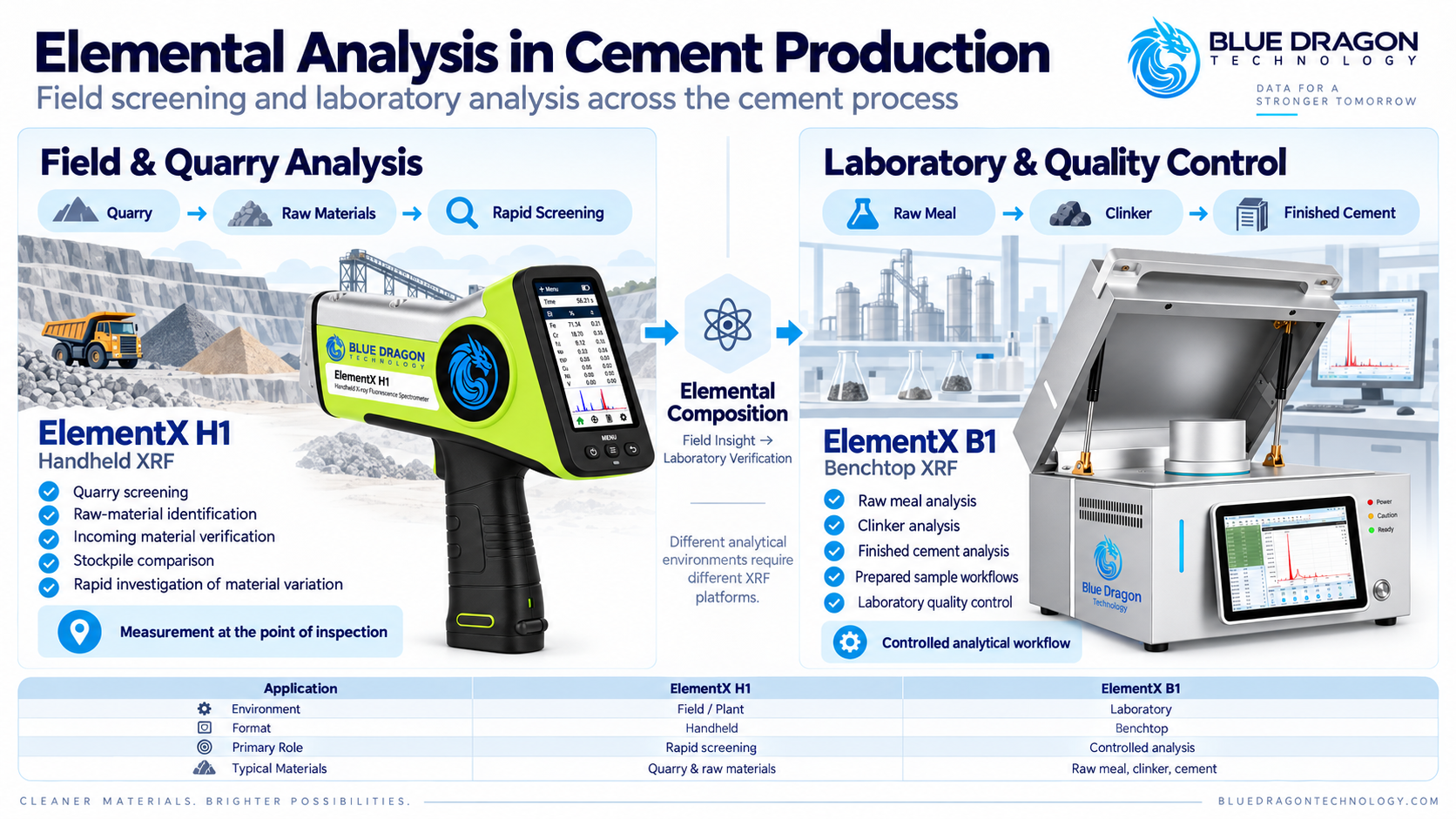
Elemental Analysis of Raw Meal, Clinker and Finished Cement
As material progresses through the plant, the purpose of elemental analysis changes.
At the quarry, the objective may be rapid screening and identification of variation. Within a laboratory or quality-control environment, measurements may instead be used to characterize prepared samples, compare production materials and support established plant quality procedures.
Common sample types can include:
- Raw materials
- Corrective materials
- Raw meal
- Clinker
- Intermediate materials
- Finished cement
The Blue Dragon ElementX B1 provides a laboratory-oriented XRF platform for elemental analysis applications where a benchtop configuration is preferable.
It is important to distinguish elemental analysis from other forms of material characterization. XRF provides elemental composition information; other analytical techniques may be required where the objective is to determine mineralogical phases, physical properties or other characteristics that are not directly measured by XRF.
Instrument selection should therefore begin with the analytical question the plant needs to answer rather than simply with the sample type.
Temperature Measurement in Cement Production
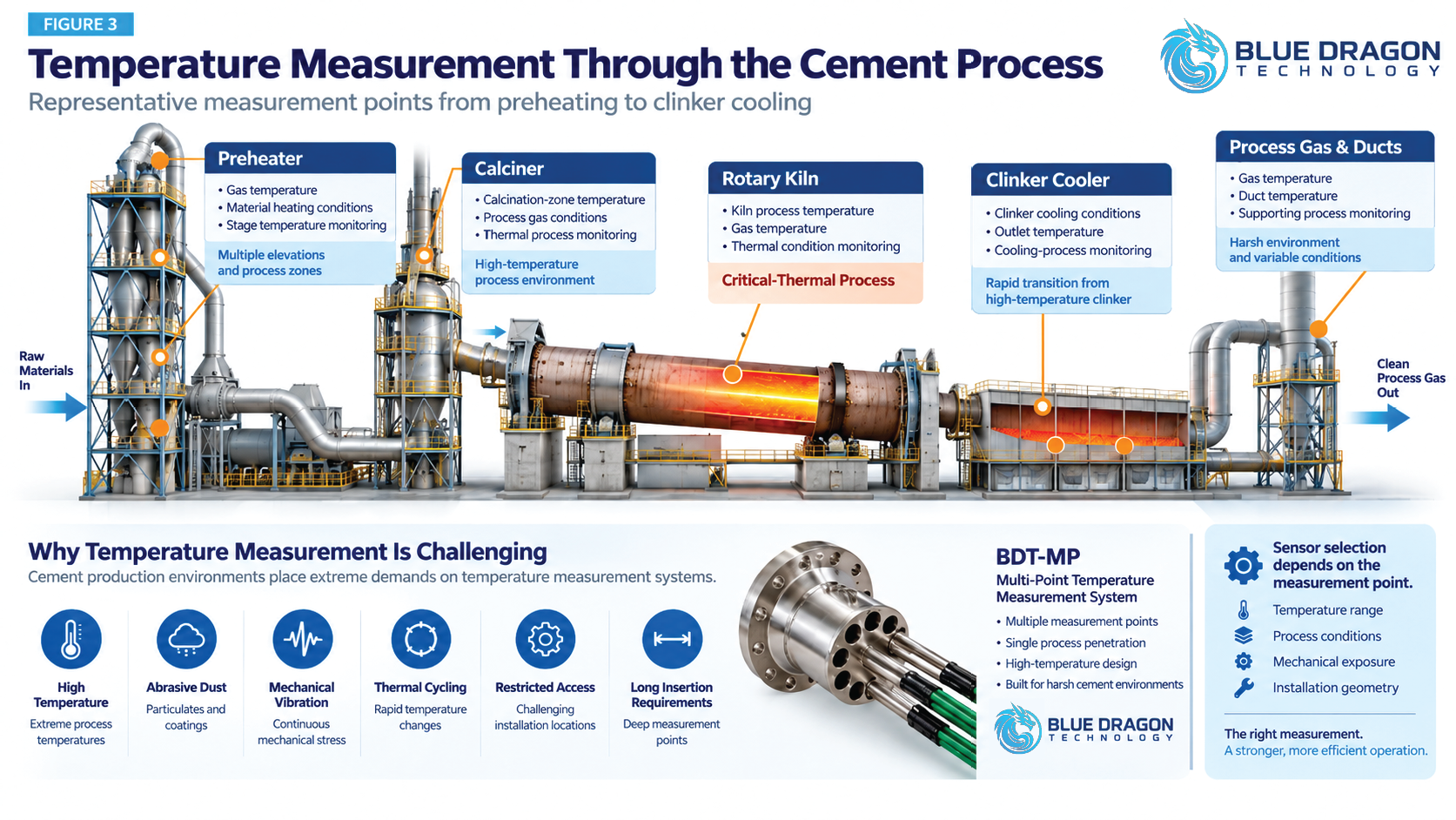
Cement manufacturing includes some of the most demanding thermal processes found in industrial production. Temperature changes substantially as material progresses through preheating, calcination, kiln processing and clinker cooling.
Reliable temperature information can support operators in understanding process conditions, identifying abnormal behaviour and maintaining visibility across thermal equipment.
Potential measurement locations can include areas associated with:
- Raw-material heating
- Preheater systems
- Calcination
- Kiln operation
- Process-gas temperatures
- Clinker handling and cooling
- Associated ducts and process equipment
Why Temperature Measurement Can Be Challenging
Selecting a temperature sensor for a cement application requires more than choosing a suitable nominal temperature range.
The measurement point may also expose the sensor or assembly to:
- High process temperatures
- Abrasive dust
- Mechanical vibration
- Changing gas velocities
- Thermal cycling
- Long insertion requirements
- Restricted maintenance access
The correct sensor, protection assembly and installation method therefore depend on the specific measurement location and operating conditions.
Blue Dragon’s industrial temperature measurement portfolio includes solutions designed for different process environments and installation requirements. Application review is particularly important where temperature, abrasion, process pressure or mechanical exposure is significant.
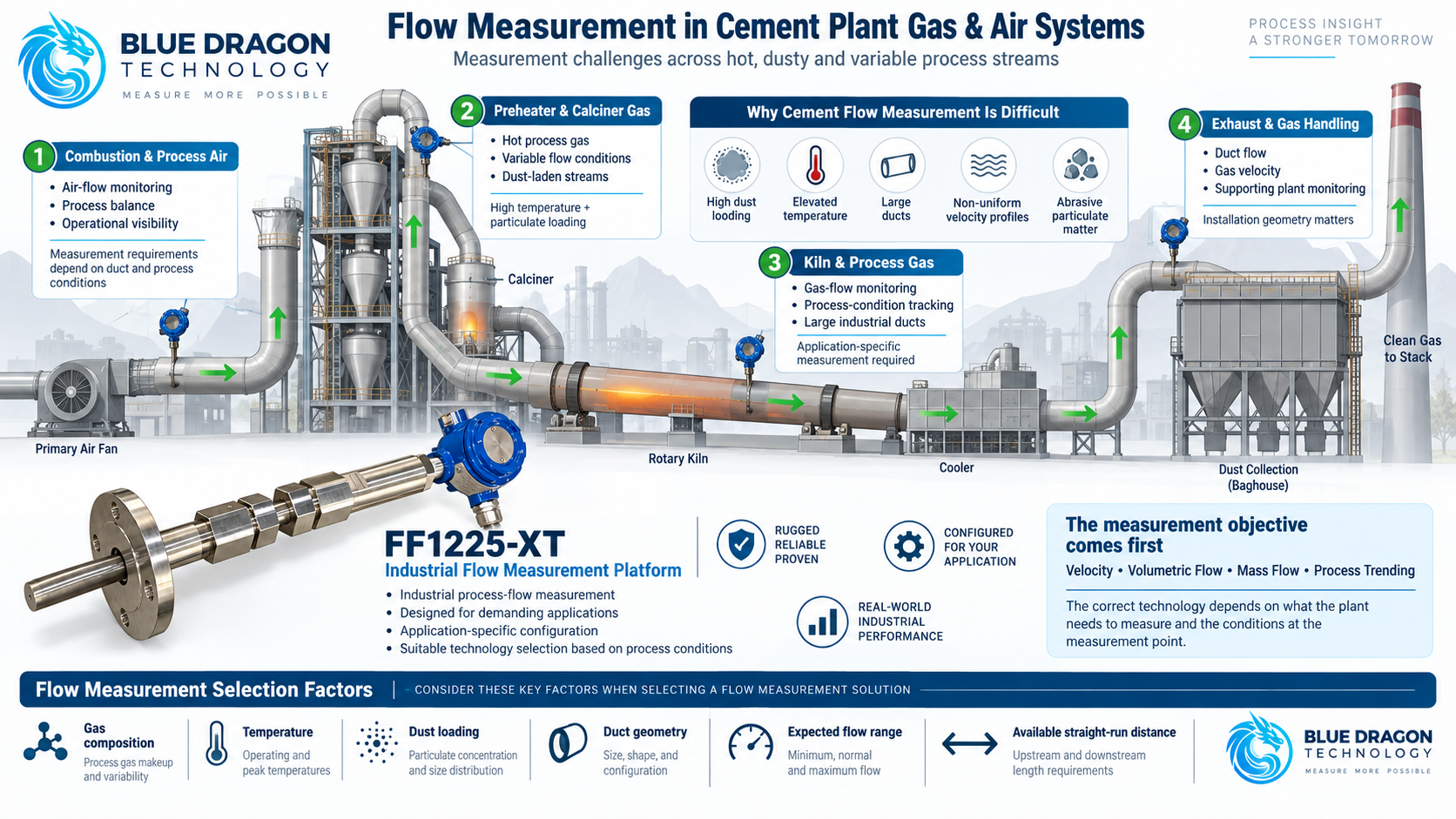
Flow Measurement in Cement Plant Gas and Air Systems
Gas and air movement is another important part of cement production. Depending on the process configuration, measurement may be required in air, gas or duct systems associated with combustion, process control, ventilation or material processing.
These applications can be challenging because measurement conditions may include combinations of:
- Elevated temperatures
- High dust loading
- Large duct dimensions
- Non-uniform velocity profiles
- Abrasive particulate matter
- Variable process conditions
An instrument that performs well in a clean utility-gas application may therefore not be appropriate for a hot, particulate-laden process stream.
Application-Specific Flow Measurement
The measurement objective should first be defined. The plant may need to determine velocity, volumetric flow, mass flow or simply monitor changes in process behaviour. Installation geometry and available straight-run distances may also influence technology selection.
The Blue Dragon FF1225-XT flow measurement platform is one of the technologies available within the Blue Dragon flow portfolio for industrial applications requiring process-flow measurement.
For cement applications, the process conditions should be reviewed before final instrument selection so that the proposed measurement method is appropriate for the actual gas composition, temperature, particulate loading, duct geometry and expected flow range.
Water Quality Monitoring in Cement Plants
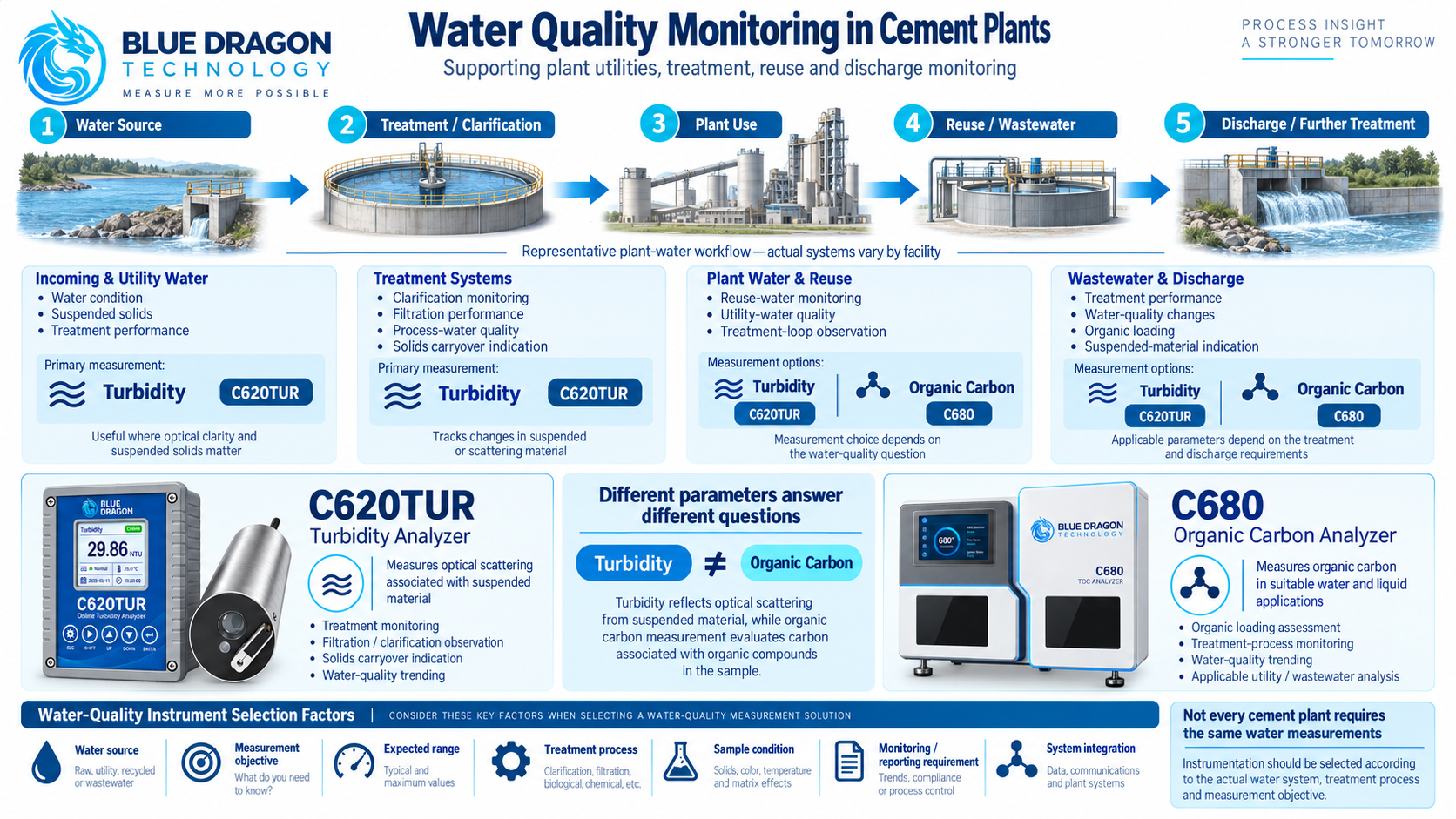
Although cement production is primarily associated with solid materials and high-temperature processing, water and wastewater systems remain important parts of many plant operations.
The exact water systems vary from one facility to another, but measurement requirements can arise in areas such as plant utilities, process water, treatment systems, discharge monitoring and water reuse.
Two parameters that may be relevant in appropriate applications are turbidity and organic carbon.
Turbidity Measurement
Turbidity provides information about the presence of suspended or optically scattering material in water. Monitoring turbidity can help operators observe changes in water condition, treatment performance or solids carryover where those factors are relevant to the plant’s water system.
The Blue Dragon C620TUR is designed for turbidity measurement in water applications.
Organic Carbon Measurement
Organic carbon analysis provides a different type of information. Rather than measuring suspended solids, it is used to assess carbon associated with organic material in the sample.
The Blue Dragon C680 provides organic carbon analysis for suitable water and liquid applications.
Not every cement plant will require both measurements. Water-quality instrumentation should be selected according to the actual water source, treatment process, discharge requirements and measurement objective.
Cement Plant Measurement Points and Instrumentation
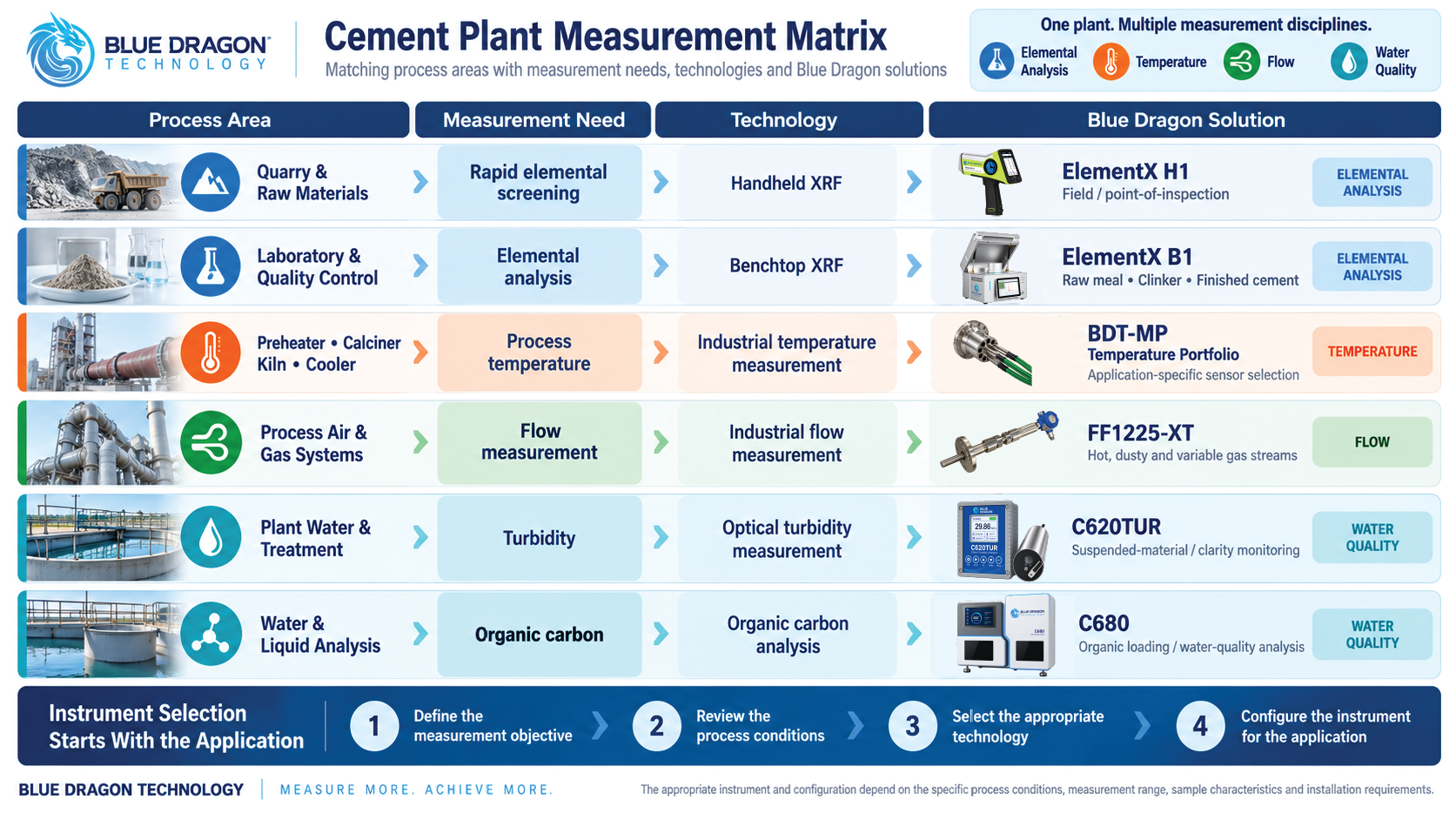
The following table summarizes several of the measurement categories discussed above. It is intended as an application overview rather than a universal instrument specification for every cement plant.
| Process Area | Measurement Need | Technology | Blue Dragon Solution |
|---|---|---|---|
| Quarry and raw materials | Rapid elemental screening | Handheld XRF | ElementX H1 |
| Laboratory and quality control | Elemental analysis | Benchtop XRF | ElementX B1 |
| Thermal process | Process temperature | Industrial temperature measurement | Blue Dragon Temperature Portfolio |
| Process air and gas systems | Flow measurement | Industrial flow measurement | FF1225-XT / Blue Dragon Flow Portfolio |
| Plant water systems | Turbidity | Optical turbidity measurement | C620TUR |
| Water and liquid analysis | Organic carbon | Organic carbon analysis | C680 |
How to Select Instrumentation for a Cement Plant
Instrumentation should be selected around the application rather than simply around the parameter being measured.
Two plants may both require temperature measurement, for example, but the correct solution can differ substantially if one measurement point is in a relatively protected area while another is exposed to extreme heat, abrasive dust and vibration.
The same principle applies to analytical and flow instrumentation.
Before selecting an instrument, the following factors should normally be considered:
1. Measurement Objective
Define what the measurement is expected to accomplish. Screening, quality control, process monitoring, regulatory reporting and troubleshooting can require different levels of performance and different measurement approaches.
2. Expected Measurement Range
The instrument should be appropriate for both normal operating conditions and the range of variation that may realistically occur.
3. Sample or Process Characteristics
Material composition, physical form, moisture, dust loading, gas composition and other process characteristics can influence measurement performance.
4. Temperature and Environmental Conditions
Ambient and process temperature, humidity, dust, vibration and exposure conditions should be considered when determining installation suitability.
5. Installation Geometry
Flow instruments and inserted sensors can be particularly sensitive to location, available access and process geometry.
6. Calibration and Verification
Analytical instruments must be configured and calibrated for the intended application. Appropriate reference materials, verification procedures and quality-control practices may also be required depending on how the measurement will be used.
7. Maintenance and Accessibility
A measurement point that is technically ideal but extremely difficult to inspect or maintain may create operational problems over the life of the installation.
8. Data and System Integration
Where measurement data must be transferred to a control, monitoring or reporting system, communication and integration requirements should be defined before final instrument selection.
From Individual Instruments to a Plant-Wide Measurement Strategy
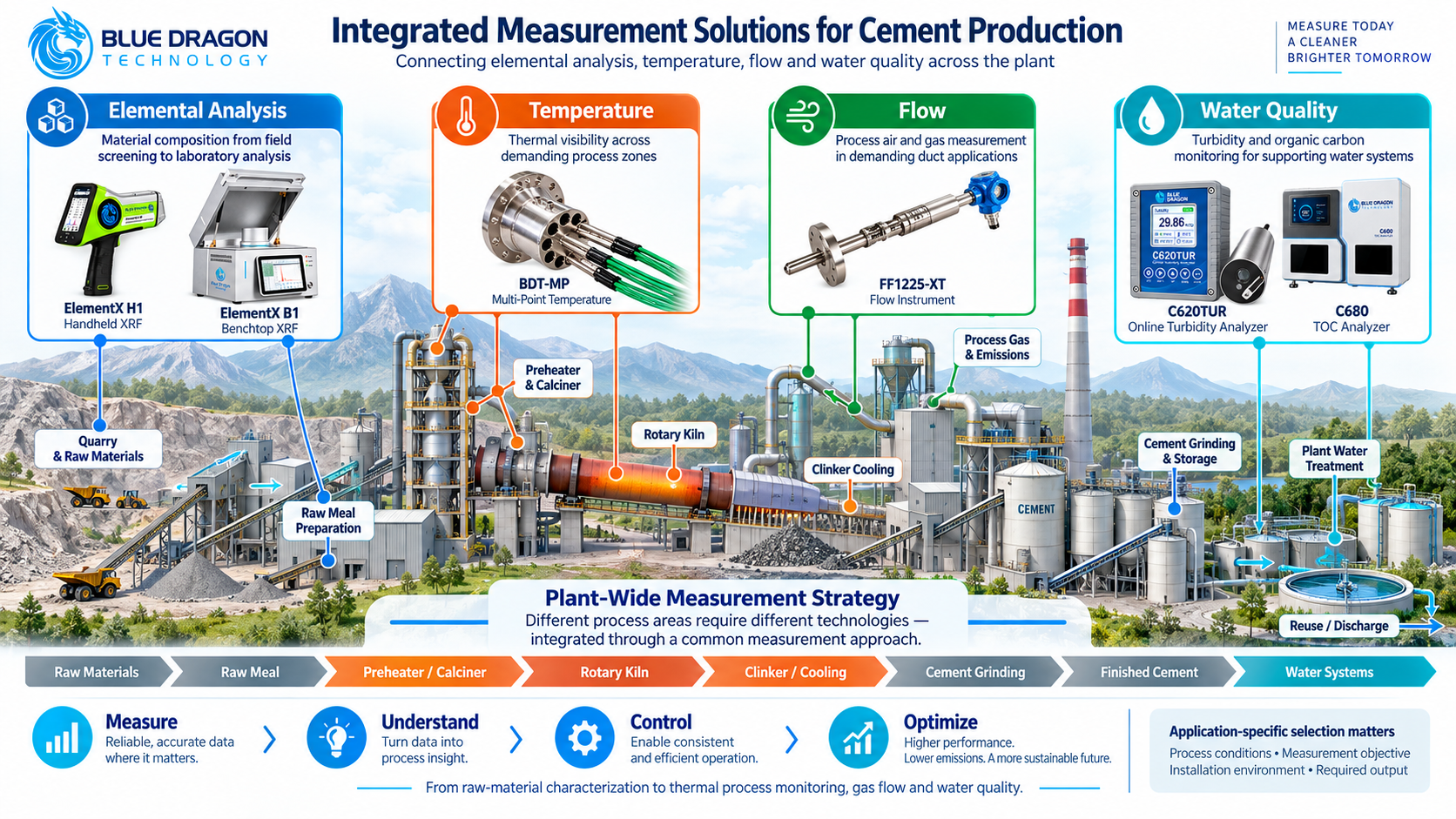
The most effective instrumentation strategy is not necessarily the one with the greatest number of measurement points. It is the one that provides useful information at the locations where measurement can improve understanding of the process.
In cement production, that can mean combining several different measurement disciplines:
- Elemental analysis to understand material composition
- Temperature measurement to observe thermal process conditions
- Flow measurement to understand the movement of process air and gases
- Water-quality analysis where plant utility, treatment or discharge systems require monitoring
Together, these measurements can provide a broader picture of plant conditions than any single instrument can provide independently.
Blue Dragon Technology develops analytical and process-measurement solutions across these measurement categories, allowing individual applications or broader plant requirements to be evaluated within a common instrumentation portfolio.
Frequently Asked Questions About Cement Plant Instrumentation
What instrumentation is used in a cement plant?
Cement plants use many types of instrumentation depending on the process configuration. Common measurement categories include elemental and chemical analysis, temperature, pressure, level, flow, gas analysis, emissions monitoring and water-quality measurement. The appropriate technologies depend on the individual process and measurement objective.
Where is XRF used in cement manufacturing?
XRF can be used for elemental analysis of materials associated with cement production, including quarry materials, raw materials, raw meal, clinker and finished cement. Handheld XRF can support rapid field screening, while laboratory-oriented XRF systems can be used where prepared samples and controlled analytical workflows are preferred.
Why is elemental analysis important in cement production?
Cement manufacture depends on the chemical composition of the materials entering and moving through the process. Elemental analysis helps characterize those materials and identify variations that may be relevant to raw-material selection, process control and quality-control procedures.
Where is temperature measured in a cement plant?
Temperature may be measured at numerous points associated with preheating, calcination, kiln operation, process gases, clinker cooling and other thermal equipment. The correct sensor and installation depend on the temperature range and the mechanical and environmental conditions at the measurement location.
Why is flow measurement challenging in cement plants?
Some cement flow applications involve hot gases, high dust concentrations, large ducts, abrasive particles or non-uniform flow profiles. These conditions can influence both technology selection and installation design, so the process environment should be reviewed before an instrument is specified.
How should instrumentation for a cement plant be selected?
Selection should begin with the measurement objective and process conditions. Important factors include the required range, accuracy, material or gas characteristics, temperature, dust, installation geometry, calibration requirements, maintenance access and system-integration requirements.
Building the Right Measurement Solution for Cement Production
Cement production brings together raw-material chemistry, high-temperature processing, gas and air movement, quality control and supporting utility systems. Each area creates a different measurement challenge.
Rather than approaching these applications as isolated instrument purchases, plants, engineering companies and system integrators can evaluate measurement requirements according to the complete process: what must be measured, where the measurement should occur, how difficult the process conditions are and what decisions will be made from the resulting data.
Blue Dragon Technology provides analytical and process-measurement instruments for applications across cement and clinker production, including XRF elemental analysis, industrial temperature measurement, flow measurement, turbidity monitoring and organic carbon analysis.
Our team can review individual measurement points or broader project requirements to help determine an appropriate instrumentation approach for the specific application and operating conditions.
Discuss Your Cement Plant Measurement Requirements
Blue Dragon Technology can support individual measurement applications or broader instrumentation requirements across cement and clinker production.
Blue Dragon Technology
Measure. Control. Optimize.