

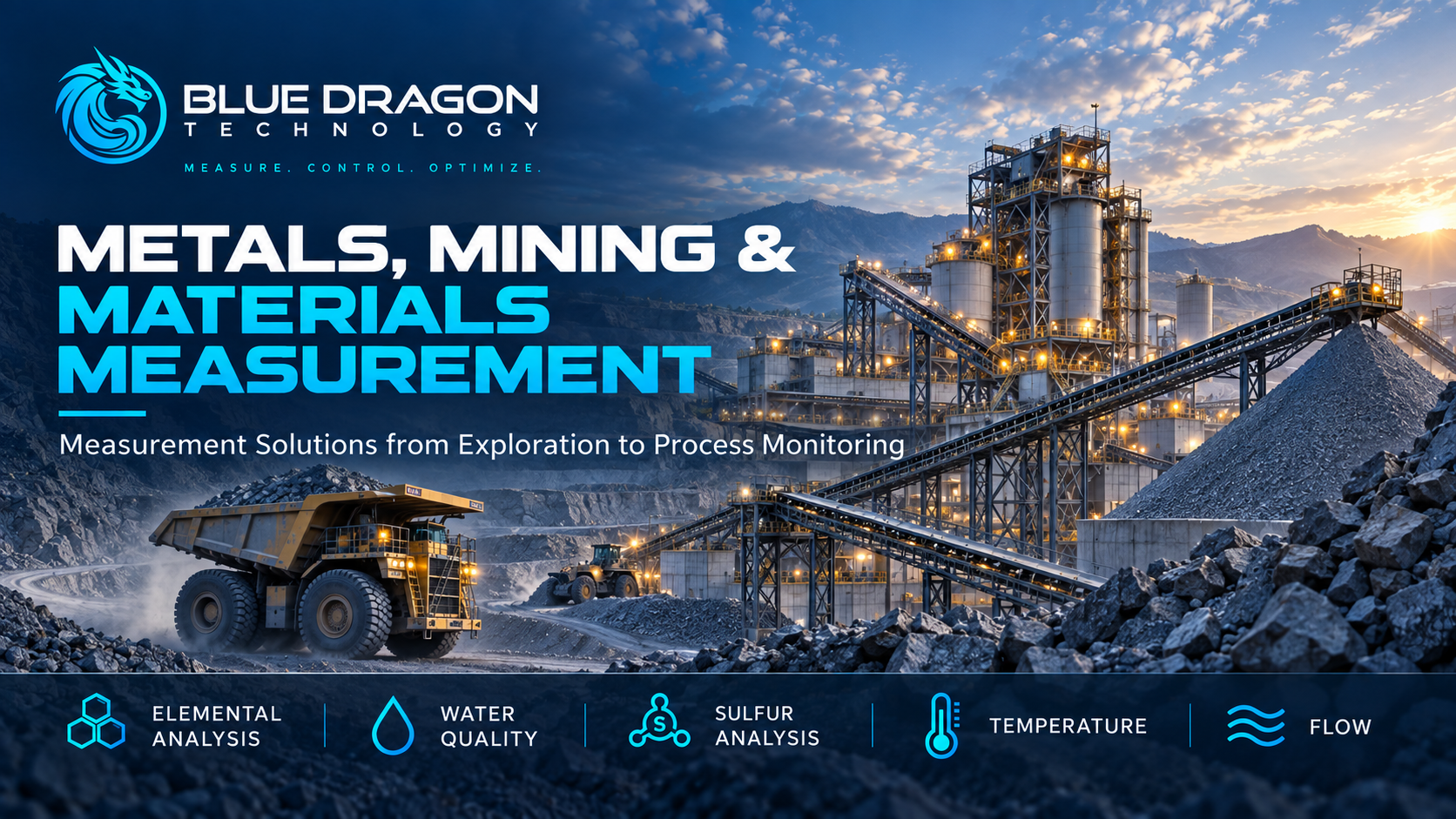
Metals, Mining & Materials Measurement Solutions: From Exploration to Process Monitoring
Mining and materials operations depend on measurement at very different stages—from exploration and mine-face screening through sample preparation, laboratory quality control, water management and metallurgical processing.
The measurement objective changes as material moves through the operation. A field geologist may need rapid information about elemental variation, while a laboratory may require controlled analysis of a prepared sample. Elsewhere in the plant, operators may need continuous visibility into water condition, total sulfur, temperature or flow.
There is therefore no single instrument that addresses every mining and materials measurement requirement. Effective instrumentation combines the appropriate technologies with representative sampling, suitable calibration, application-specific installation and a clear understanding of how the resulting data will be used.
This article examines how field XRF, laboratory XRF, water analysis and process instrumentation can support measurement workflows from exploration through finished-material quality control and metallurgical processing.
Metals, Mining & Materials Measurement Solutions: Video Overview
The Blue Dragon Technology presentation below provides an overview of measurement opportunities across mining and materials operations, including field elemental screening, laboratory verification, water monitoring, total sulfur measurement, temperature measurement and flow measurement.
The sections below expand on these measurement areas and show how different technologies can fit into a broader mine-to-material measurement strategy.
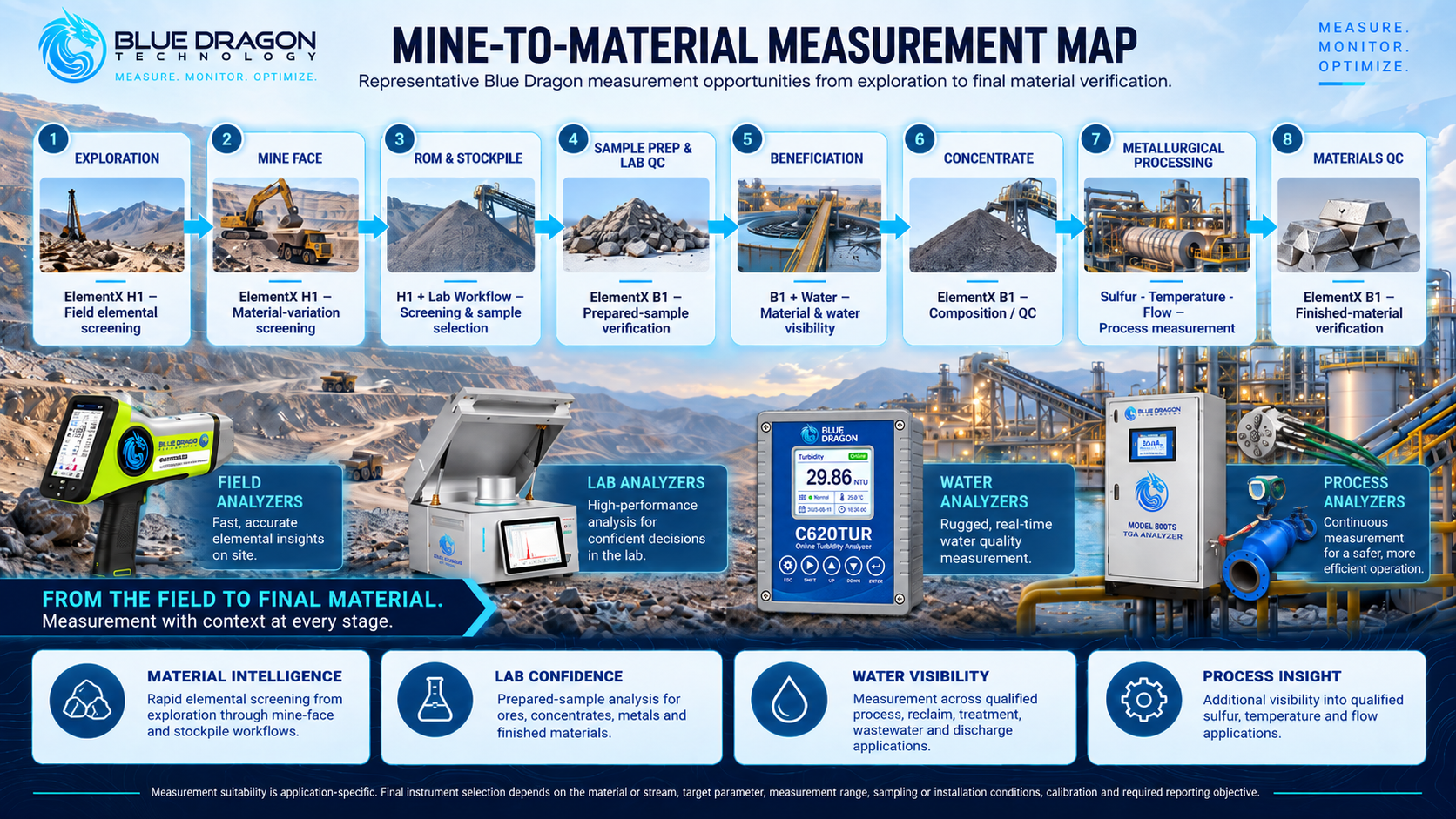
Understanding the Mine-to-Material Measurement Chain
Mining operations transform naturally variable geological material into progressively more defined products. That journey can include exploration, extraction, run-of-mine material handling, crushing and grinding, beneficiation, concentration, metallurgical processing and final material quality control.
Measurement requirements change throughout that chain.
At the beginning of the process, rapid measurements can help identify material variation and determine which samples require further investigation. Laboratory workflows can then provide controlled measurement of prepared samples. Water and process instrumentation add another layer of visibility once material enters processing and metallurgical operations.
A useful way to consider these requirements is through four interconnected measurement functions:
- Material intelligence — understanding elemental variation in the field and mine
- Laboratory confidence — controlled analysis of prepared material samples
- Water visibility — monitoring relevant conditions in process, reclaim and wastewater systems
- Process insight — measuring qualified sulfur, temperature and gas-flow applications
The purpose is not simply to generate more measurements. It is to place useful measurement at the points where better information can support better operational decisions.
Exploration and Geochemical Screening
Exploration teams often work with large numbers of samples collected from outcrops, drill or core material, trenches, stockpiles and other field locations. Rapid access to elemental information can help identify variation and determine where additional sampling or laboratory analysis may be justified.
Portable XRF for Field Screening
X-ray fluorescence spectroscopy, or XRF, provides non-destructive elemental information and can be used as a rapid screening technique when the target elements, sample matrix and analytical method are appropriate.
The Blue Dragon ElementX H1 handheld XRF spectrometer brings elemental screening directly into field geology and exploration workflows.
Potential uses can include:
- Rapid elemental screening of field samples
- Identification of material variation between sampling locations
- Associated-element and pathfinder-element checks where supported by the analytical method
- Sample prioritization for further preparation or laboratory analysis
- Additional information to support geological mapping and sampling strategy
Mine Face and Grade-Control Screening
Once mining begins, the requirement for rapid material information moves from regional exploration into active operating areas.
Portable elemental screening can provide additional information around benches, exposed mine faces, interpreted ore and waste boundaries, run-of-mine areas and stockpiles.
Typical objectives can include:
- Bench and mine-face screening to identify changing material characteristics closer to the source
- Ore and waste boundary support by adding elemental information to a qualified grade-control workflow
- ROM and stockpile screening to observe compositional differences before blending, routing or additional sampling
- Working-area decisions by providing preliminary information without waiting for every sample to complete a full laboratory workflow
Field results should always be interpreted with representative sampling, matrix awareness, appropriate calibration and laboratory confirmation where required by the operational or reporting objective.
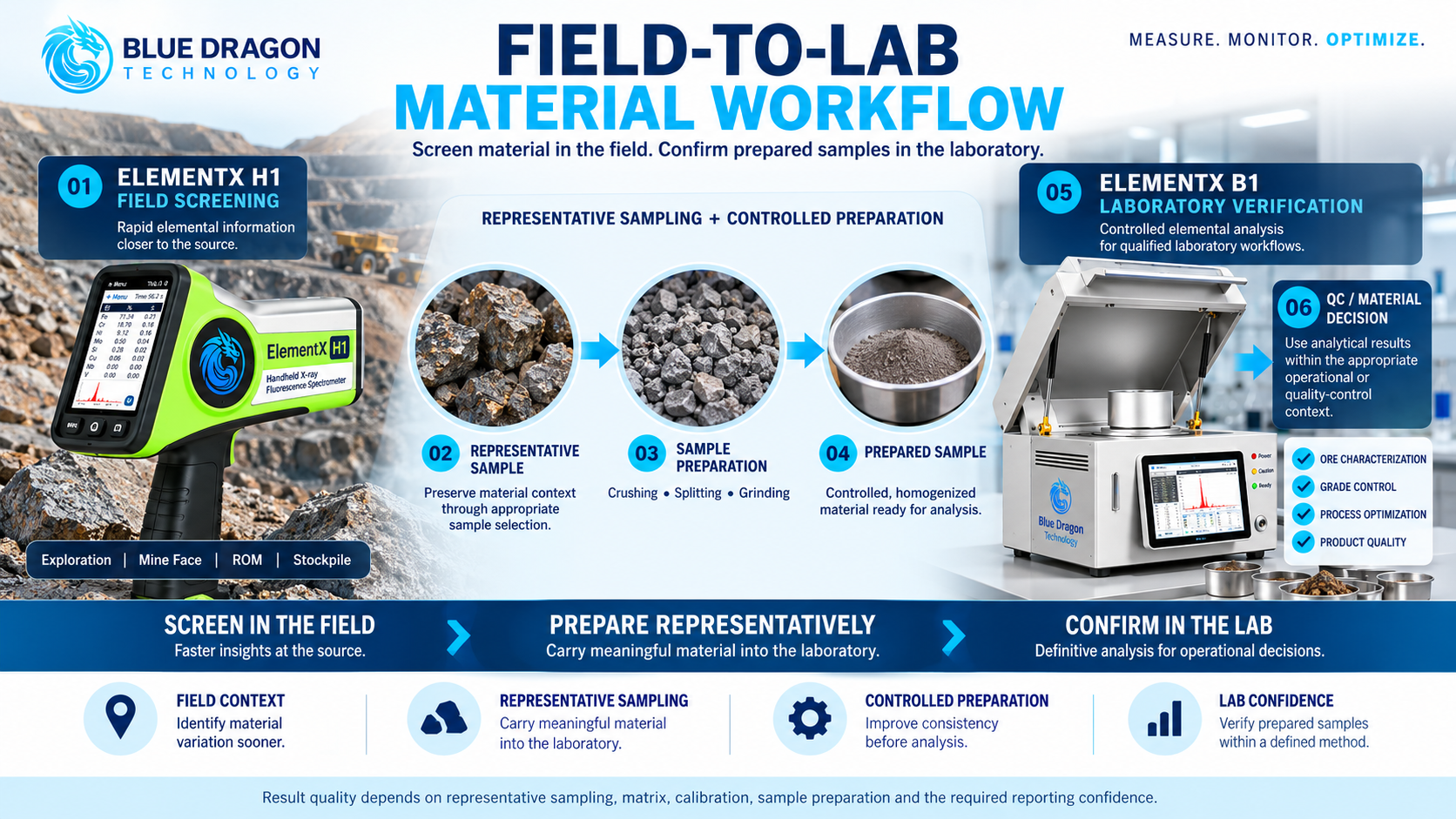
From Field Screening to Laboratory Verification
Field and laboratory measurements should not be considered competing approaches. They answer different questions and can form part of the same material-information workflow.
A typical sequence may involve:
- Field screening to identify variation and prioritize material
- Representative sampling to preserve the context of the material being evaluated
- Sample preparation through suitable crushing, splitting, grinding or homogenization
- Laboratory analysis of the prepared sample under controlled conditions
- Decision or QC action using the result within the appropriate analytical and operational context
The quality of the final result depends on more than the analyzer itself. Representative sampling, sample preparation, matrix effects, calibration and the required reporting confidence all influence analytical performance.
Laboratory Ore and Concentrate Analysis
As material moves from the mine into laboratory and quality-control workflows, measurement becomes more controlled.
Prepared-sample elemental analysis can support comparison and verification of qualified ores, concentrates, processed mineral products, metals and other materials where the installed analytical method is suitable.
The Blue Dragon ElementX B1 provides a benchtop XRF platform for prepared-sample elemental analysis.
Potential laboratory workflows can include:
- Prepared-sample elemental verification
- Ore and concentrate quality control
- Comparison of production batches or material lots
- Controlled analysis within defined preparation and calibration procedures
- Support for operational or reporting decisions where the analytical method is qualified
Critical Minerals and Battery Materials
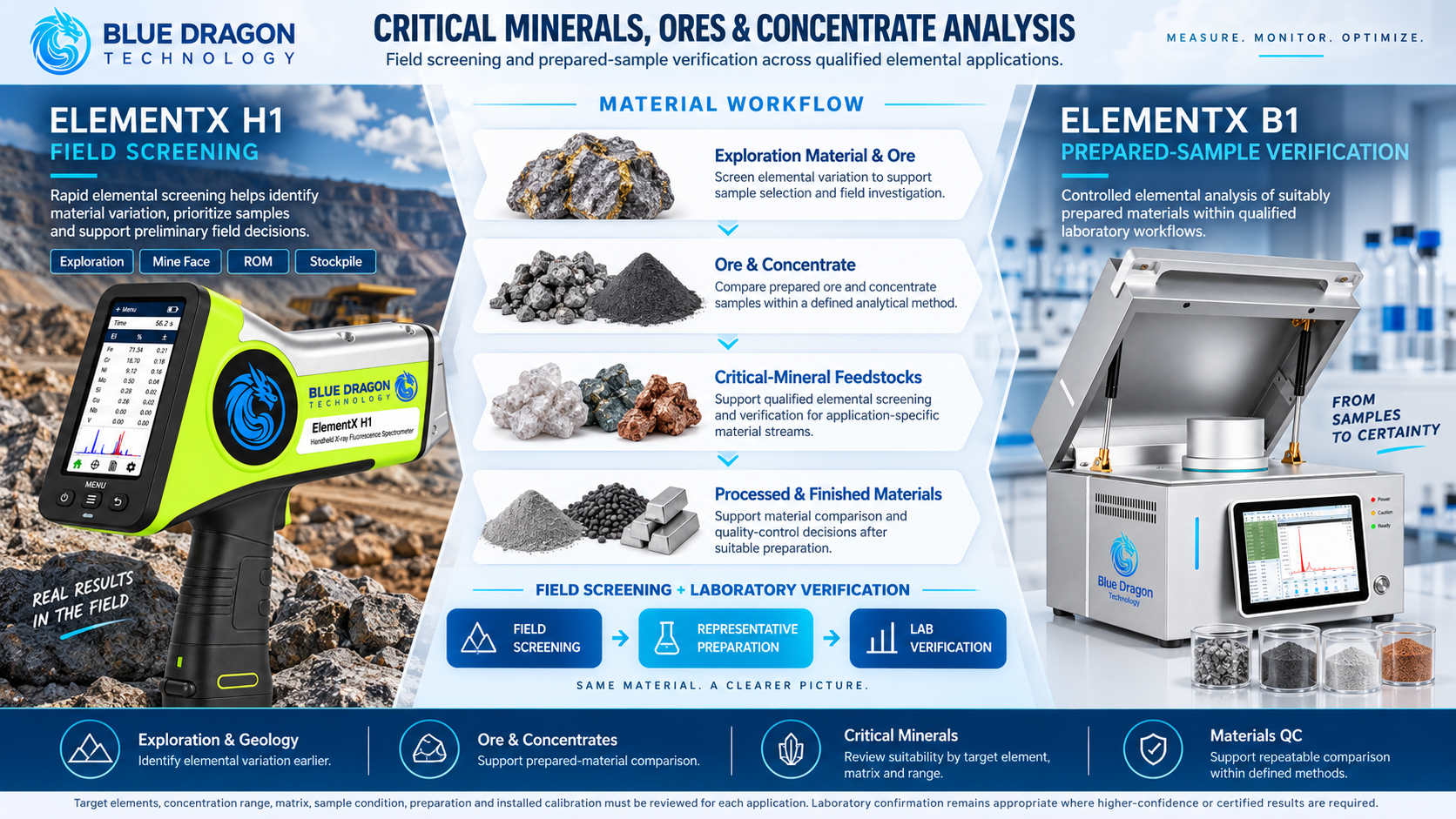
Critical-mineral and battery-material projects can require measurement at several points between geological exploration and processed-material quality control.
Field screening can help identify elemental variation and guide sample selection. Laboratory analysis can then be applied to prepared materials within a defined analytical method.
Potential material streams can include:
- Exploration samples and mineralized material
- Ores and concentrates
- Intermediate products
- Battery-material feedstocks
- Processed materials requiring elemental comparison or QC
Suitability should be reviewed according to the target elements, concentration range, matrix, sample preparation and installed calibration. Light-element and battery-material applications should be evaluated individually rather than assumed to be equivalent across all materials.
Metals, Alloys and Materials Quality Control
Material measurement continues after mineral processing. Metals, alloys and other processed materials may require elemental comparison as part of incoming inspection, production control or finished-material quality workflows.
For suitable materials and qualified analytical methods, a benchtop XRF workflow can support:
- Incoming material QC against an approved reference or specification
- Material comparison by evaluating elemental differences between suitable samples
- Batch consistency through controlled comparison of production lots
- Finished-material QC before release or further processing
Instrument suitability depends on the target elements, matrix, concentration range, sample form, surface condition, preparation, installed calibration and required reporting confidence. Where alloy-grade identification is required, the method should be specifically qualified for the material system involved.
Water Monitoring in Mining and Mineral Processing
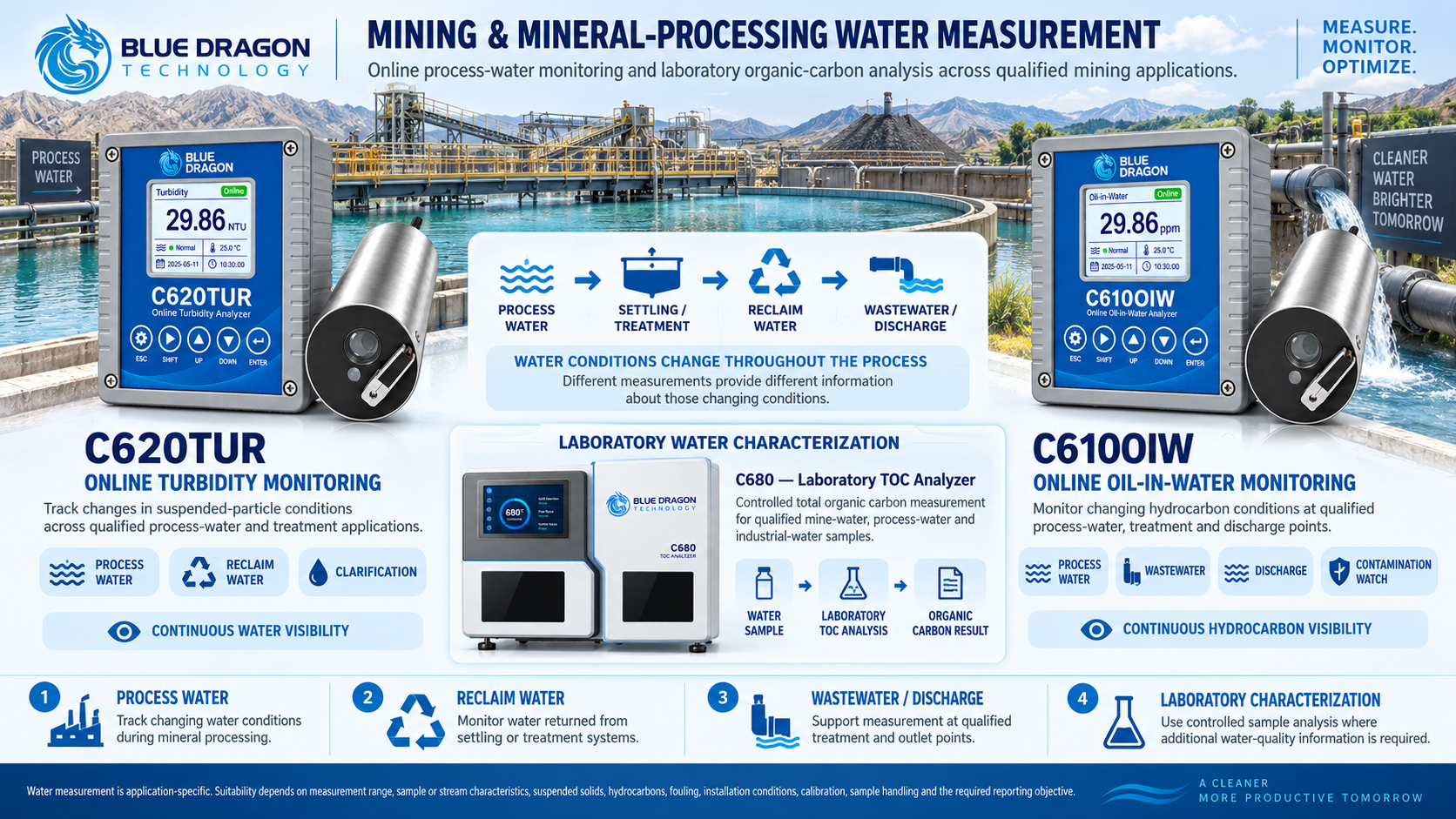
Water moves through many different parts of mining and mineral-processing operations. Depending on the site, measurement requirements can arise in process-water circuits, reclaim systems, treatment and clarification, mine-water management, wastewater systems and discharge points.
Different analytical parameters answer different questions, so the technology should be selected according to the condition the operator actually needs to observe.
Turbidity Monitoring
Turbidity provides optical information related to suspended or scattering material in water. Changes in turbidity can be relevant to circulating process water, clarification, reclaim-water systems, treatment processes and qualified wastewater or discharge applications.
The Blue Dragon C620TUR provides continuous turbidity measurement for suitable water applications.
Total Organic Carbon Analysis
Total organic carbon, or TOC, provides a different view of water condition by measuring carbon associated with organic material in a suitable sample.
The Blue Dragon C680 laboratory TOC analyzer supports controlled laboratory measurement of qualified mine-water, process-water, reclaim-water and industrial-water samples.
Oil-in-Water Monitoring
Hydrocarbon contamination can create another monitoring requirement in suitable mining and industrial-water systems. Potential applications can include process water, reclaim water, wastewater, discharge locations and leak or contamination-watch points.
The Blue Dragon C610OIW online oil-in-water analyzer provides continuous oil-in-water measurement for qualified applications where changing hydrocarbon conditions need to be monitored over time.
Water-analysis suitability depends on factors such as expected concentration range, particle characteristics, oil type, emulsification, turbidity, fouling, sample presentation, cleaning requirements, calibration and the required reporting objective.
Metallurgical Process Measurement
Once material reaches metallurgical or downstream processing, measurement requirements expand beyond elemental composition and water analysis.
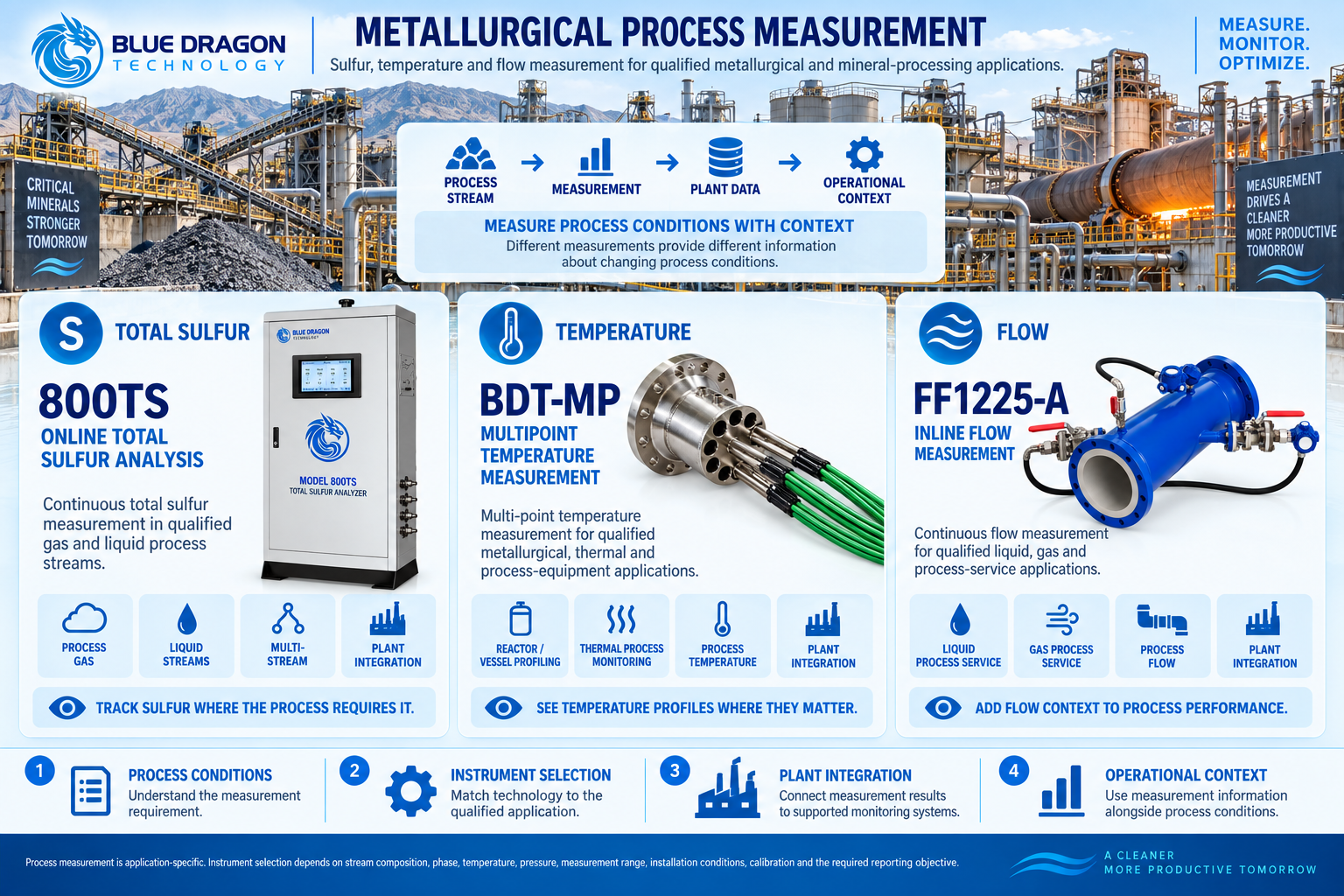
Process instrumentation can provide additional visibility into qualified total sulfur, temperature and gas-flow applications.
These measurements should be considered within the actual process context. Stream composition, phase, pressure, temperature, expected measurement range, installation geometry, hazardous-area requirements and plant-integration requirements can all influence instrument selection.
Total Sulfur Measurement
Continuous total sulfur measurement can provide online visibility where sulfur concentration is an important process parameter. Standard documented configurations are intended for suitable liquid process streams, while gas-phase applications require confirmed project configuration.
The Blue Dragon Model 800TS online total sulfur analyzer supports continuous total sulfur measurement in qualified applications, allowing sulfur information to be incorporated into broader process monitoring and plant-data systems.
Application review should consider sulfur species, concentration range, stream composition and phase, temperature, pressure, sample conditioning, flow conditions, installation environment and calibration requirements.
Multi-Point Temperature Measurement
Temperature distribution can be important in metallurgical, thermal and utility equipment where a single measurement point does not provide enough information about conditions across the process.
The Blue Dragon BDT-MP multipoint temperature assembly supports multi-point temperature measurement in qualified process equipment, allowing operators to observe temperature profiles across selected process zones.
Potential applications can include reactor or vessel profiling, kilns, furnaces and other thermal processes, as well as temperature monitoring associated with qualified utility and heating systems.
Blue Dragon’s temperature measurement portfolio includes solutions for different industrial measurement environments and installation requirements.
Flow Measurement
Flow information can help operators understand movement, throughput and process behaviour in qualified gas and process-service applications.
The Blue Dragon FF1225-A single-path inline ultrasonic gas flow meter represents one approach within the broader Blue Dragon flow measurement portfolio.
Flow measurement is application-specific. Stream composition, phase, pressure, temperature, line size, installation conditions and the required reporting objective should be reviewed before a measurement system is selected.
Mining and Materials Measurement Points and Instrumentation
The following table summarizes the major measurement areas discussed above. It is intended as an application overview rather than a universal specification for every mining or materials operation.
| Application Area | Measurement Need | Technology | Representative Blue Dragon Solution |
|---|---|---|---|
| Exploration and field geology | Rapid elemental screening | Handheld XRF | ElementX H1 |
| Mine face / ROM / stockpile | Material-variation screening | Handheld XRF | ElementX H1 |
| Laboratory / ore / concentrate QC | Prepared-sample elemental analysis | Benchtop XRF | ElementX B1 |
| Process / reclaim / treatment water | Turbidity | Online optical turbidity measurement | C620TUR |
| Mine and industrial water | Total organic carbon | Laboratory TOC analysis | C680 |
| Water / wastewater hydrocarbon monitoring | Oil-in-water | Continuous oil-in-water analysis | C610OIW |
| Metallurgical process streams | Total sulfur | Online total sulfur measurement | Model 800TS |
| Thermal / metallurgical equipment | Temperature profile | Multi-point industrial temperature measurement | BDT-MP / Temperature Portfolio |
| Qualified gas process lines | Gas flow | Inline flow measurement | FF1225-A / Flow Portfolio |
How to Select Instrumentation for Mining and Materials Applications
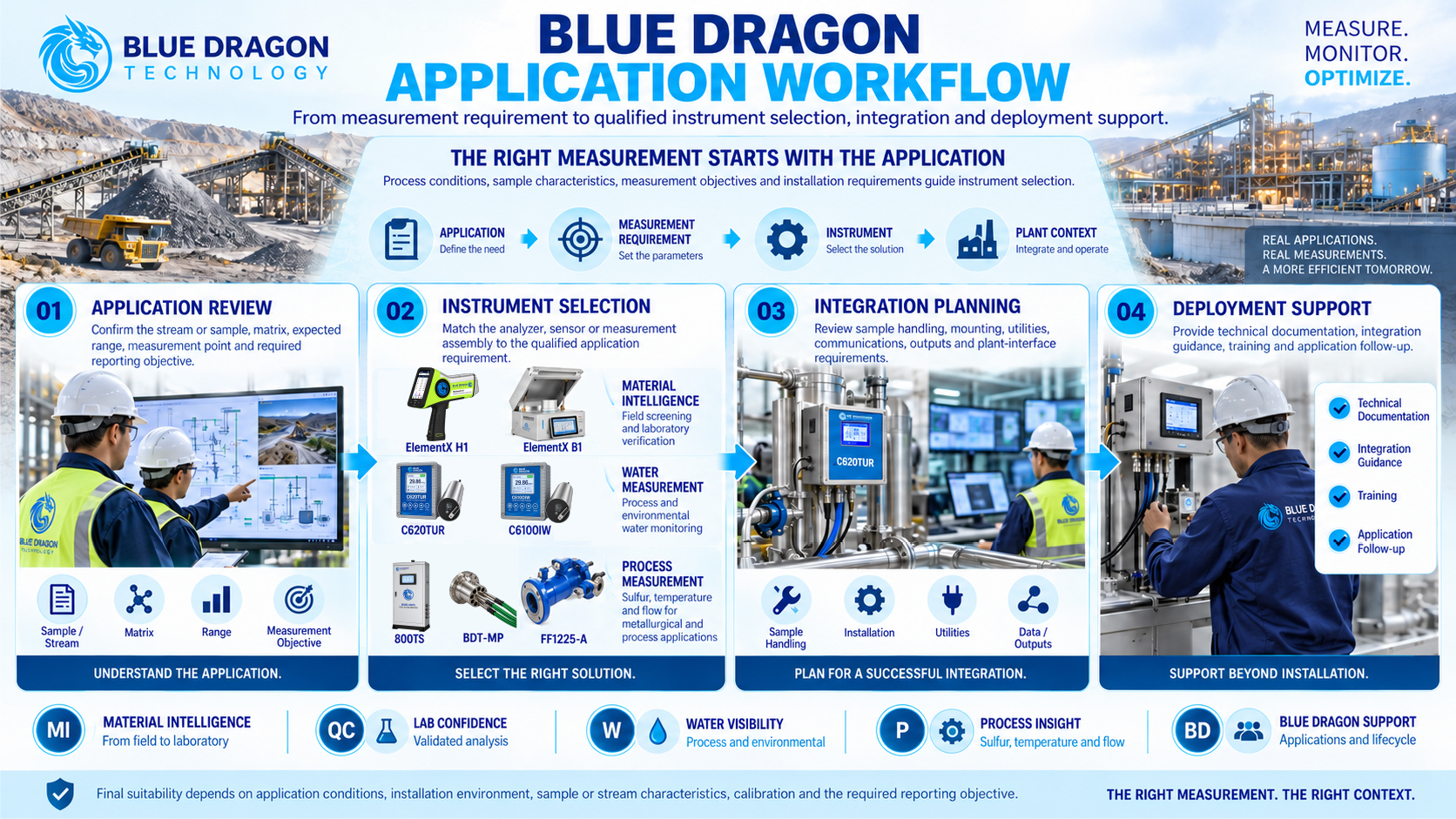
Instrument selection should begin with the application rather than with the product model.
A measurement system that performs well in one mine, laboratory or process stream may not be appropriate for another if the material, matrix, concentration, installation or process conditions are substantially different.
1. Define the Measurement Objective
Determine whether the measurement is intended for preliminary screening, laboratory verification, process monitoring, quality control, troubleshooting or formal reporting.
2. Understand the Material or Stream
Composition, matrix, physical form, particle size, moisture, oil type, suspended solids, process phase and other characteristics can affect measurement performance.
3. Establish the Required Measurement Range
The expected normal range and realistic process variation should both be considered when determining whether a measurement technology is suitable.
4. Review Sampling and Sample Preparation
Analytical performance depends strongly on whether the sample is representative of the material being evaluated and whether preparation is appropriate for the measurement method.
5. Review Process and Environmental Conditions
Temperature, pressure, dust, vibration, fouling, hazardous-area classification, available utilities and physical accessibility can all influence instrument and installation design.
6. Define Calibration and Verification Requirements
The installed method should be appropriate for the target material or process. Reference materials, calibration procedures and ongoing verification requirements should be identified before the measurement is relied upon operationally.
7. Consider Plant Integration
Where measurement data must be transferred to plant monitoring, control or reporting systems, communications, outputs and integration requirements should be established early in the project.
8. Plan for Maintenance and Support
Access, cleaning, calibration, consumables, inspection and long-term maintenance should be considered as part of instrument selection rather than after installation.
From Individual Instruments to an Integrated Measurement Strategy
A mining operation does not become better instrumented simply by installing more analyzers. Measurement creates value when the technology is matched to a clearly defined application and the information can be used within the operating workflow.
An integrated measurement strategy can connect several different disciplines:
- Field elemental screening to identify variation sooner
- Prepared-sample laboratory analysis to confirm composition within controlled workflows
- Water measurement to provide visibility into process, reclaim, treatment and wastewater systems
- Total sulfur measurement for qualified metallurgical process streams
- Temperature measurement to observe thermal conditions and profiles
- Flow measurement to add movement and throughput information to process understanding
Together, these measurements can provide a broader picture of material and process conditions than any individual instrument can provide on its own.
Blue Dragon Technology supports both individual measurement applications and broader projects spanning field, laboratory, water and process instrumentation.
Frequently Asked Questions About Mining and Materials Instrumentation
What instrumentation is used in mining and mineral processing?
Mining and mineral-processing operations use different instrumentation according to the process and measurement objective. Technologies can include elemental analyzers, water-quality analyzers, temperature sensors, flow instrumentation, sulfur analyzers and many other process-measurement systems.
How is handheld XRF used in mining?
Handheld XRF can provide rapid elemental screening in exploration, field geology, mine-face, ROM and stockpile applications where the target elements, matrix, concentration range and analytical method are suitable. It is generally used as a screening technique rather than as a universal replacement for laboratory analysis.
What is the difference between field XRF and laboratory XRF?
Field XRF prioritizes portability and rapid screening close to the material source. Laboratory XRF can analyze prepared samples under more controlled conditions. The two approaches can be combined within the same field-to-laboratory workflow.
Why is representative sampling important?
An analyzer measures the sample presented to it. If that sample does not adequately represent the material or process being evaluated, even a technically accurate measurement may not represent the larger batch, stockpile or process condition.
What water parameters can be monitored in mining operations?
The required parameters depend on the water system and measurement objective. Relevant applications can include turbidity, total organic carbon, oil-in-water and many other water-quality measurements associated with process water, mine water, reclaim water, treatment, wastewater or discharge.
How should mining process instrumentation be selected?
Selection should begin with the measurement objective and actual operating conditions. Important factors can include material or stream composition, phase, measurement range, pressure, temperature, installation geometry, sample handling, calibration, environmental conditions, plant integration and maintenance requirements.
Building the Right Measurement Solution for Mining and Materials Operations
Modern mining and materials operations combine geological variability, material handling, laboratory quality control, water management and process measurement within the same production chain.
The appropriate measurement strategy therefore begins by asking four fundamental questions: what needs to be measured, where the measurement should occur, what conditions the instrument must operate under and how the resulting information will be used.
Blue Dragon Technology provides analytical and process-measurement solutions spanning handheld and benchtop XRF, turbidity monitoring, total organic carbon analysis, oil-in-water measurement, total sulfur analysis, industrial temperature measurement and flow measurement.
Individual measurement points or broader mining and materials projects can be reviewed application by application so that the instrument, calibration, sample handling, installation and integration approach match the actual operating requirement.
Discuss Your Mining & Materials Measurement Requirements
Blue Dragon Technology can support individual measurement applications or broader instrumentation requirements across exploration, mining, laboratory quality control, water systems and metallurgical processing.
Blue Dragon Technology
Measure. Monitor. Optimize.