

Tube-Skin Temperature Measurement
Measure external tube-wall temperature with engineered thermocouple assemblies designed around the tube geometry, thermal environment, movement, routing, and plant installation.

Representative tube-wall measurement in demanding thermal service
Tube-skin temperature measurement helps operating teams understand the external wall temperature of process-heater, boiler, reformer, superheater, and furnace tubes. The assembly must maintain representative thermal contact while tolerating radiant heat, tube movement, vibration, oxidation, and the surrounding furnace environment.
Each application is engineered from tube dimensions, materials, operating temperature, attachment method, sensor type, heat shielding, expansion allowance, routing, termination, and installation drawings.
What the application needs to establish
Measure local external tube-wall temperature at defined points with an engineered contact, attachment, and routing arrangement suitable for the thermal and mechanical environment.
Why the measurement matters
Tube protection
Identify excessive wall temperature that may accelerate damage or reduce tube life.
Thermal performance
Understand heat distribution and operating behavior across fired equipment.
Process optimization
Support firing, load, and operating adjustments using representative temperature information.
Maintenance planning
Identify abnormal locations for inspection, cleaning, repair, or further investigation.
Equipment monitoring
Provide long-term temperature trends for critical tubes and thermal assets.
How the measurement is approached
A thermocouple measuring junction is thermally coupled to the external tube surface. The assembly may include a heat-retention shield, weldable mounting, mineral-insulated sheath, and expansion loops designed to maintain contact and accommodate thermal movement.
Typical operating locations
- Refinery process heaters
- Steam reformers and cracking furnaces
- Petrochemical fired heaters
- Boiler and superheater tubes
- Heat-recovery and thermal-process equipment
- Metallurgical and industrial furnaces
- High-temperature piping and equipment surfaces
Instrument-selection considerations
- Tube diameter, material, wall, and geometry
- Operating and design temperature
- Thermocouple type and sheath material
- Contact design, heat shield, and attachment method
- Thermal expansion and movement allowance
- Routing, support, cable length, and termination
- Plant welding, installation, inspection, and documentation requirements
Where this application is used.


Petrochemicals
Measurement systems for petrochemical feedstocks, reaction processes, fired equipment, utilities, effluent, gas flow, and material quality.
Explore →
Chemical Processing
Application-focused instrumentation for Chemical Processing, covering Trace moisture, H2S and sulfur, TOC, flow, and multipoint temperature across Reactors, columns, specialty gas systems, and utilities.
Explore →
Fertilizers & Chemicals
Analytical and engineered measurement systems for feedstocks, process gases, reactors, utilities, effluent, flow, and material quality.
Explore →
Hydrogen & Syngas
Application-focused instrumentation for Hydrogen & Syngas, covering Ultra-trace moisture, dew point, gas flow, H2S where relevant, and temperature across Electrolysis, reforming, purification, and compression.
Explore →
Coal & Coal Chemical
Application-focused instrumentation for Coal & Coal Chemical, covering Gas moisture, H2S and sulfur, gas flow, XRF coal/ash, and water quality across Gasification, coke oven gas, syngas, and coal chemicals.
Explore →
Power Generation
Measurement systems for fuels, boiler and high-purity water, fired equipment, gas flow, materials, and conventional or nuclear generation.
Explore →Relevant measurement capabilities.
Explore the permanent Blue Dragon capability areas associated with this industry or application.
Temperature Measurement Series
Engineered temperature-measurement assemblies manufactured by MESIT, Italy, and supplied and supported by Blue Dragon Technology.
Explore series →Instruments connected to this application.
 Available
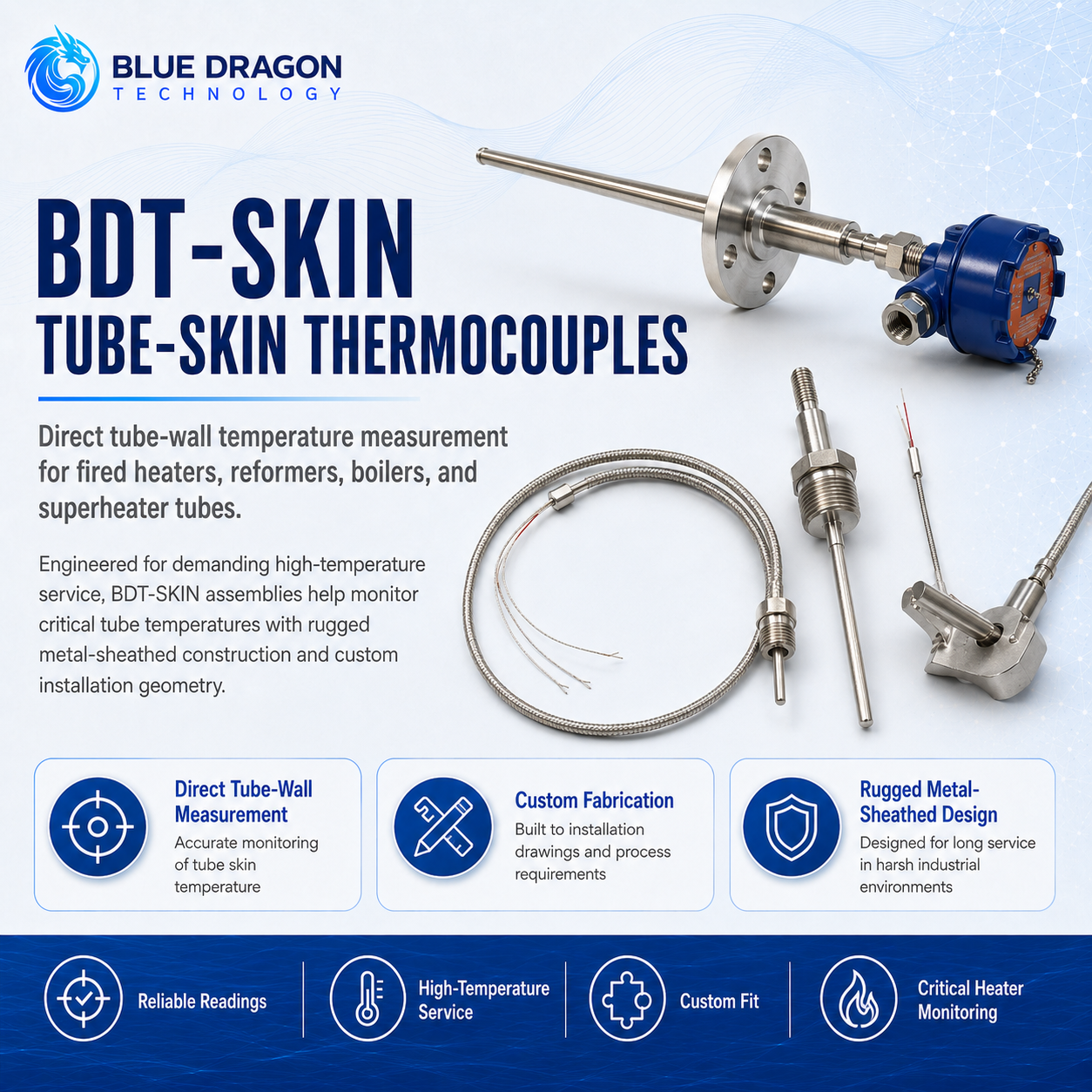
BDT-SKIN Tube-Skin Thermocouples
Engineered tube-skin thermocouple assemblies for direct tube-wall temperature measurement in petrochemical heaters, boiler and superheater tubes, and other demanding thermal-process equipment.
View instrumentApplication questions.
Why not use a standard surface thermocouple?
Tube-skin applications require an engineered thermal contact, heat shield, attachment, routing, and expansion arrangement suited to the furnace and tube movement.
What drawings are required?
Tube size, material, monitored location, furnace geometry, routing, support, termination, and access drawings are typically needed.
Can the assembly be installed during operation?
Installation requirements depend on the plant, access, welding, temperature, safety, and approved procedures. Many applications require planned shutdown work.
How is the thermocouple type selected?
Selection considers temperature range, accuracy, stability, atmosphere, compatibility, cable system, control-system input, and project standards.
Discuss your tube-skin temperature application.
Provide tube drawings, materials, diameter, operating and design temperatures, monitored locations, attachment requirements, routing, termination, installation plan, and project standards.