

Natural Gas Flow Measurement
Natural-gas flow measurement in pipelines/process systems.

Engineering natural Gas Flow Measurement for the real process
Natural-gas flow measurement in pipelines/process systems. The useful result is not defined by the instrument name alone: the measurement point, sample or equipment condition, range, response, pressure and temperature, possible interferences, installation, data interfaces, and reference basis determine whether a configuration is appropriate.
Blue Dragon Technology uses the Core relationship map to identify relevant instruments, then qualifies the final configuration against the project. The system boundary may also include sampling or mounting hardware, utilities, signal integration, alarms, verification, FAT/SAT, commissioning, training, spares, and controlled documentation.
What the application needs to establish
Natural-gas flow measurement in pipelines/process systems. Define the required range, units, response, accuracy or uncertainty, alarm/use case, and comparison or reference basis before configuration.
Why the measurement matters
Process visibility
Measure gas movement for operation, balancing, control, and troubleshooting.
Energy and utility management
Quantify natural gas, fuel gas, process gas, or other qualified services.
Flare and vent monitoring
Provide flow information across low, variable, or demanding gas conditions where a suitable configuration is available.
Measurement confidence
Match meter geometry, signal quality, installation, compensation, calibration, and verification to the required uncertainty.
How the measurement is approached
Ultrasonic transit-time meters measure gas velocity in a defined pipe geometry. Natural-gas service requires the pipe, gas composition, pressure, temperature, flow range, straight run, compensation, communications, and required uncertainty to be specified together.
Typical operating locations
- Oil & Gas
- Pipelines & Midstream
- Petrochemicals
- Refining
- Natural Gas & LNG
- Biogas & Renewable Gas
Instrument-selection considerations
- Pipe size, schedule, material, internal condition, and available access
- Gas composition, pressure, temperature, density or speed-of-sound basis
- Minimum, normal, and maximum flow or velocity
- Required accuracy, repeatability, turndown, response, and reporting basis
- Straight run, upstream/downstream disturbances, flow conditioning, and acoustic path quality
- Inline or insertion installation, hazardous area, power, communications, pressure/temperature compensation, and calibration or verification
Where this application is used.


Natural Gas & LNG
Measurement solutions for gas processing, sweetening, liquefaction, LNG quality, gas flow, utilities, and materials verification.
Explore →
Pipelines & Midstream
Application-focused instrumentation for Pipelines & Midstream, covering Pipeline gas quality, dew point, H2S and sulfur, flow, and portable verification across Transmission pipelines, compressor stations, meter stations, and terminals.
Explore →

Petrochemicals
Measurement systems for petrochemical feedstocks, reaction processes, fired equipment, utilities, effluent, gas flow, and material quality.
Explore →
Chemical Processing
Application-focused instrumentation for Chemical Processing, covering Trace moisture, H2S and sulfur, TOC, flow, and multipoint temperature across Reactors, columns, specialty gas systems, and utilities.
Explore →
Hydrogen & Syngas
Application-focused instrumentation for Hydrogen & Syngas, covering Ultra-trace moisture, dew point, gas flow, H2S where relevant, and temperature across Electrolysis, reforming, purification, and compression.
Explore →
Biogas & Renewable Gas
Application-focused instrumentation for Biogas & Renewable Gas, covering H2S, moisture, gas flow, and pipeline-quality verification across Digesters, upgrading, compression, and injection.
Explore →
Coal & Coal Chemical
Application-focused instrumentation for Coal & Coal Chemical, covering Gas moisture, H2S and sulfur, gas flow, XRF coal/ash, and water quality across Gasification, coke oven gas, syngas, and coal chemicals.
Explore →
Power Generation
Measurement systems for fuels, boiler and high-purity water, fired equipment, gas flow, materials, and conventional or nuclear generation.
Explore →
Cement, Glass & Ceramics
Application-focused instrumentation for Cement, Glass & Ceramics, covering XRF composition, kiln temperature, flue-gas flow, and research QC across Raw mix, kiln, clinker, and glass batch.
Explore →
Environmental Monitoring & Compliance
Application-focused instrumentation for Environmental Monitoring & Compliance, covering Oil-in-water, turbidity, TOC, emissions flow, and XRF soil screening across Wastewater discharge, emissions, contaminated land, and compliance labs.
Explore →Relevant measurement capabilities.
Explore the permanent Blue Dragon capability areas associated with this industry or application.
Blue Dragon BDT Flow Measurement Series
Ultrasonic gas-flow measurement instruments engineered and manufactured by Lauris Technologies, Canada, and supplied and supported by Blue Dragon Technology.
Explore series →Instruments connected to this application.
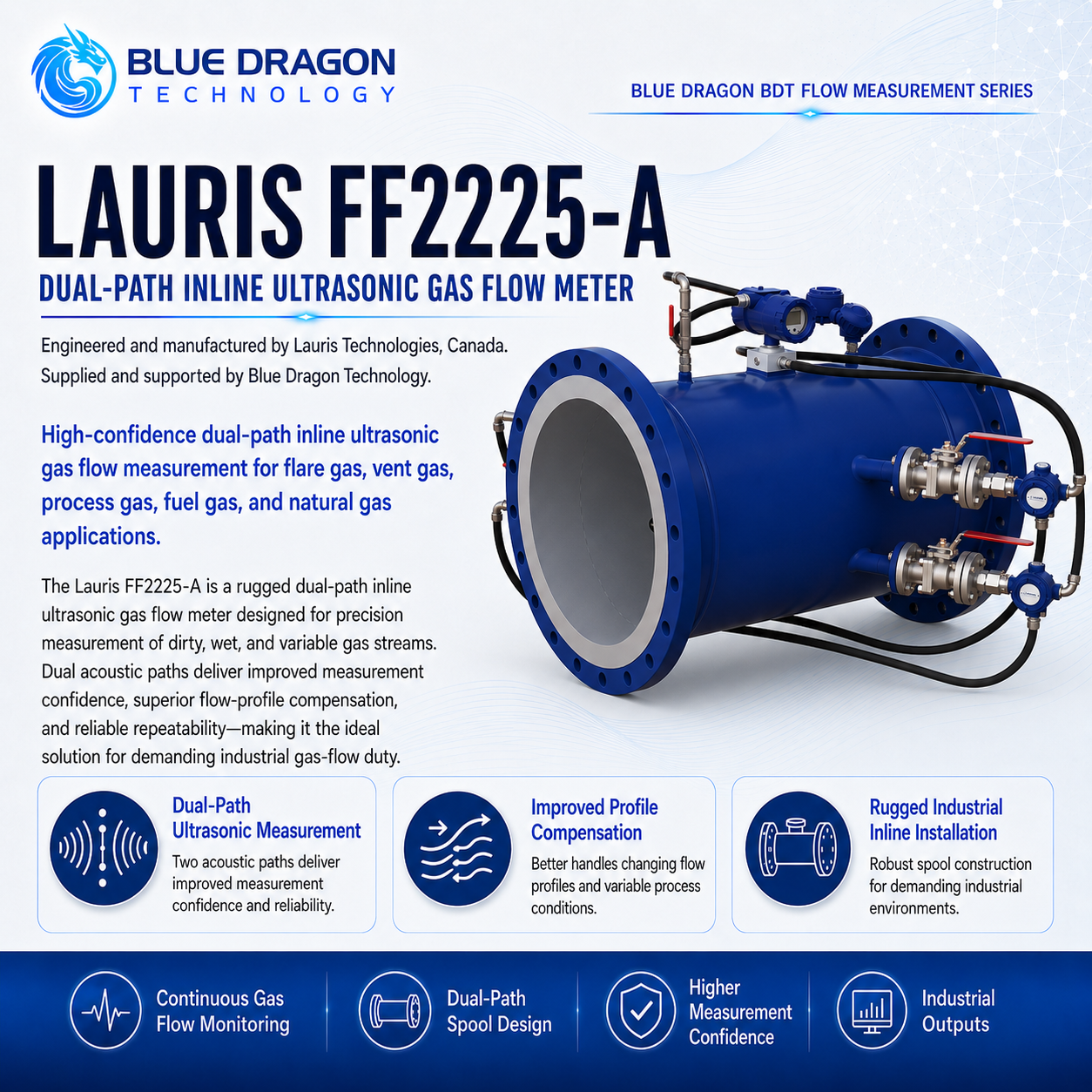 Available
Lauris FF2225-A Dual-Path Inline Ultrasonic Gas Flow Meter
Dual-path inline ultrasonic gas flow meter for flare gas, natural gas, blended gas, associated gas and industrial process streams requiring greater accuracy and measurement confidence.
View instrument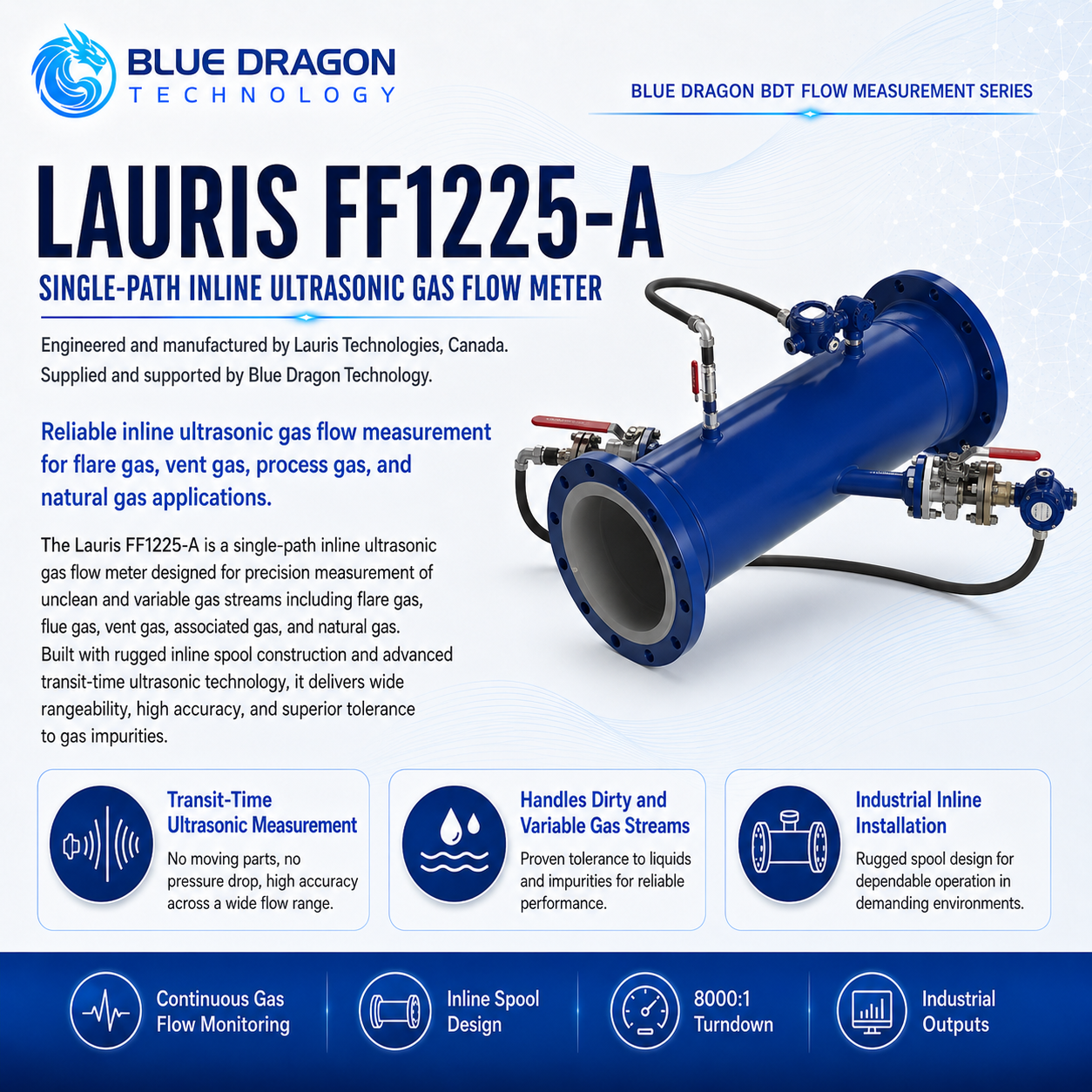 Available
Lauris FF1225-A Single-Path Inline Ultrasonic Gas Flow Meter
Single-path inline ultrasonic gas flow meter for flare gas, vent gas, associated gas, flue gas, natural gas and industrial process-gas measurement across an exceptionally wide velocity range.
View instrument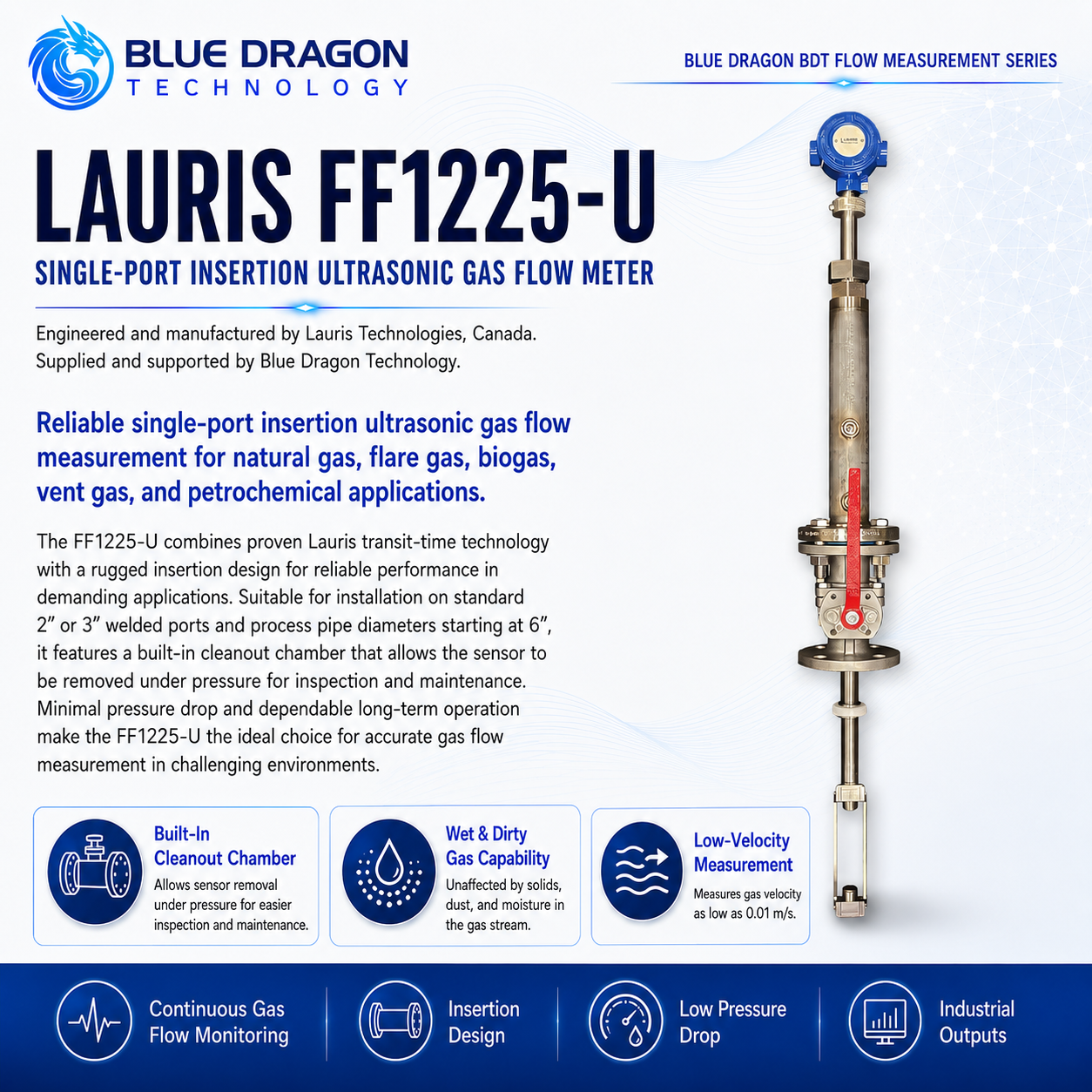 Available
Lauris FF1225-U Single-Port Insertion Ultrasonic Gas Flow Meter
Single-port insertion ultrasonic gas flow meter for low-velocity flare gas, storage-tank vents, process gas and replacement of conventional insertion flow meters.
View instrument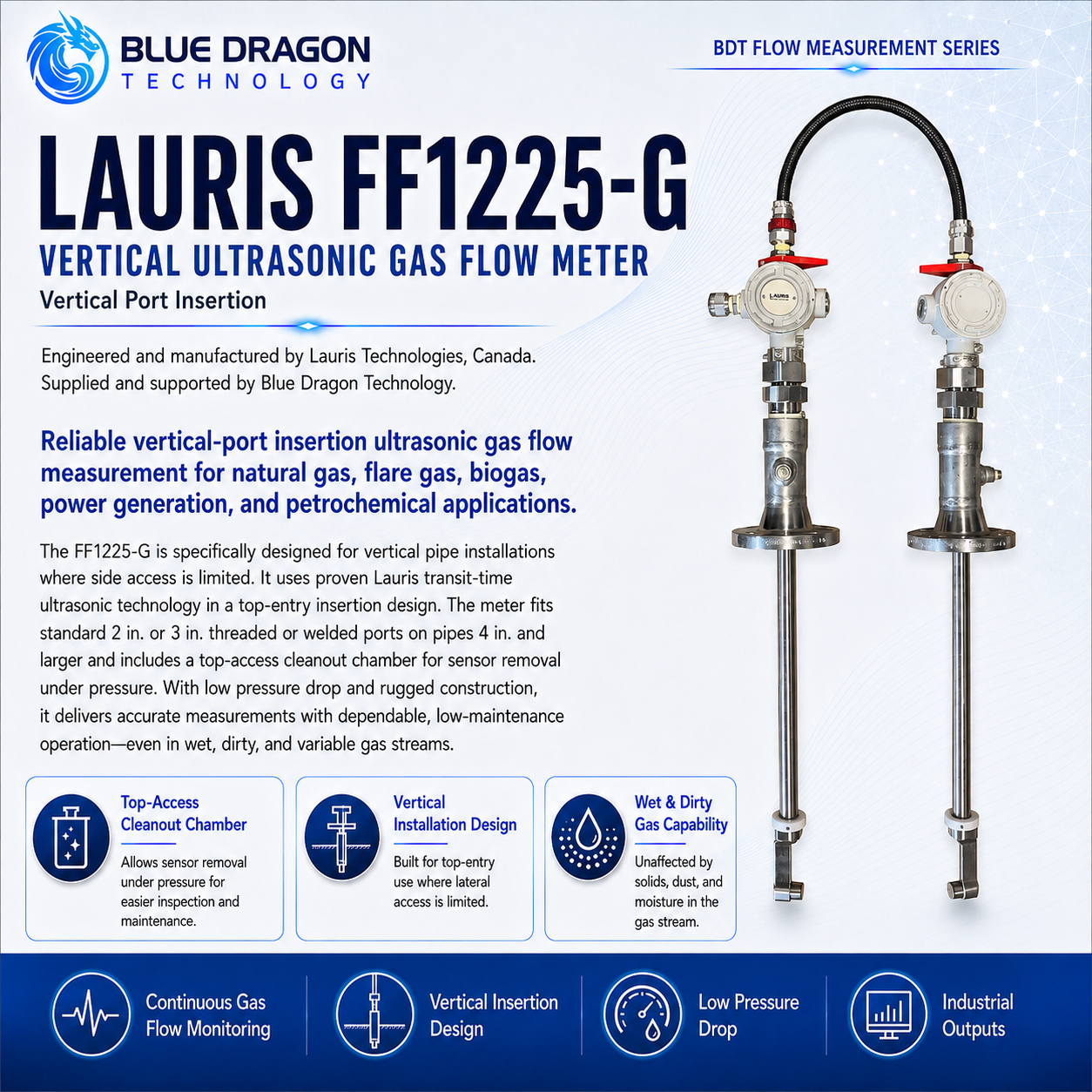 Available
Lauris FF1225-G Vertical-Port Insertion Ultrasonic Gas Flow Meter
Vertical-port insertion ultrasonic gas flow meter for low-velocity flare, vent, natural gas, biogas and process-gas applications where side access is limited.
View instrument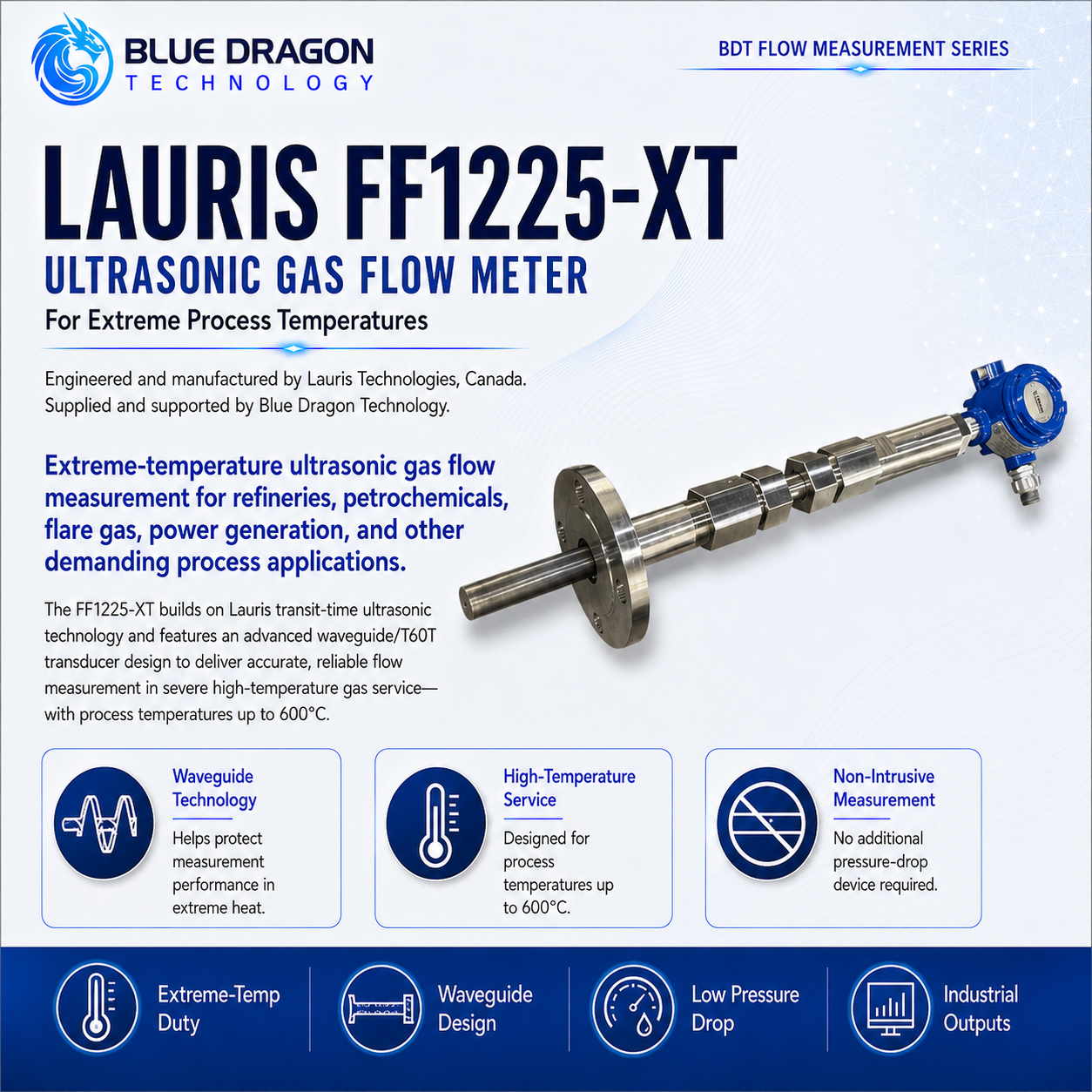 Available
Lauris FF1225-XT Extreme-Temperature Ultrasonic Gas Flow Meter
Extreme-temperature waveguide ultrasonic gas flow meter for cryogenic and high-temperature flare, process-gas, furnace, refinery, petrochemical and power-generation applications.
View instrumentRelated applications.

Industrial Gas Flow Measurement
Ultrasonic gas-flow measurement for inline and insertion applications across natural gas, process gas, fuel gas, flare, vent, and high-temperature services.
Explore →


Extreme-Temperature Gas Flow Measurement
Gas-flow measurement at cryogenic or high process temperatures.
Explore →

Wet / Dirty Gas Flow Measurement
Ultrasonic flow measurement in gas with liquid/solid contamination after review.
Explore →

Custody-Transfer / Fiscal Gas Metering
Fiscal/custody gas measurement only when selected configuration and calibration qualify.
Explore →Application questions.
What information is needed to select an instrument for Natural Gas Flow Measurement?
Define the measurement objective, sample or process, expected range, operating conditions, required performance, installation, utilities, interfaces, verification method, and project schedule.
Does a product relationship mean the instrument is automatically suitable?
No. Core relationships identify relevant products, but final suitability still depends on the controlled product documentation and application qualification.
How should the measurement be verified after installation?
Use the manufacturer and project procedure together with an agreed reference, calibration, comparison, or functional test appropriate to the measurement.
Can Blue Dragon support integration and commissioning?
Yes. Scope can include application review, system boundaries, sample handling or mounting, I/O and communications, alarms, FAT/SAT, commissioning, training, spares, and lifecycle support.
Discuss your natural gas flow measurement requirement.
Provide the process or sample, expected range, pressure and temperature where relevant, composition or matrix, installation conditions, required outputs, reference method, documentation, and project timeline.