Available Available for application review and quotation
Water Quality & Organic Carbon Series
U1600-L

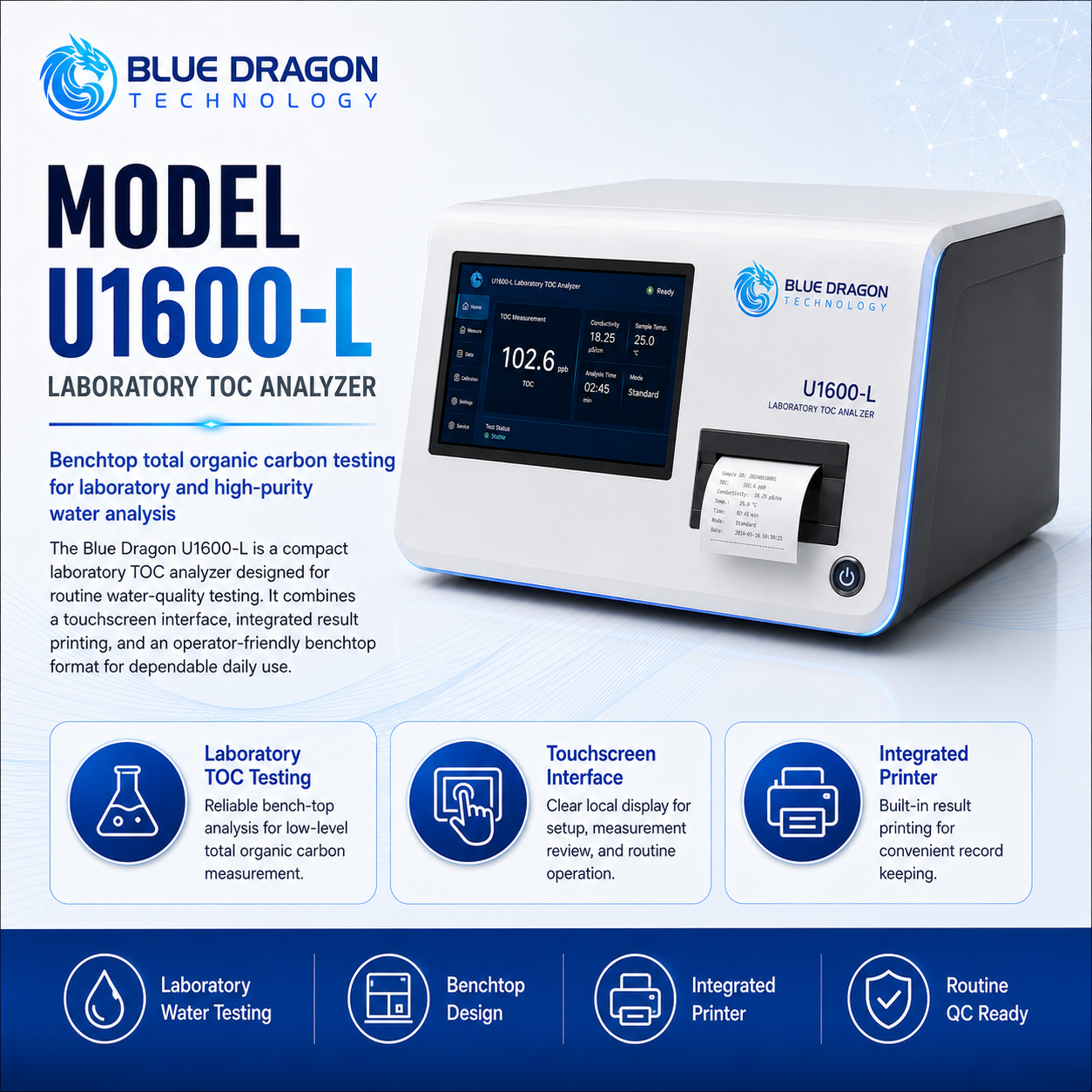
Model U1600-L Laboratory TOC Analyzer

Reagent-free benchtop TOC analysis for pharmaceutical quality control, purified water, WFI, ultrapure water, cleaning validation, and laboratory quality systems.

Brand: Blue Dragon Technology Supply & support: Blue Dragon Technology
Product Overview

Purpose-built measurement, clearly presented.

The U1600-L brings low-level TOC measurement into the quality-control laboratory through a compact benchtop platform with automatic sample draw, matched TIC and TC channels, UV oxidation, differential conductivity detection, touchscreen operation, electronic records, and integrated report printing.

It is designed for offline PW and WFI testing, pharmaceutical investigations and release support, cleaning-validation rinse samples, electronic ultrapure water, deionized water, and other approved low-conductivity laboratory applications. Optional database, remote, integration, standards, and qualification packages support site-specific workflows.

Distinctive Capabilities

  • Offline TOC testing from clean, non-pressurized sample bottles or containers
  • Low-level laboratory analysis using matched, temperature-compensated TIC and TC channels
  • Optional database, remote reporting, integration, standards, and qualification support
Performance & Technical Data

The measurement method and the values that matter.

How it measures

Measurement Principle

The analyzer draws sample from a non-pressurized container and divides it into matched flow paths. The unoxidized path measures total inorganic carbon (TIC), while the second path passes through a titanium-dioxide photocatalytic reactor illuminated by dual-wavelength 185 nm and 254 nm UV light to convert oxidizable organic carbon to carbon dioxide and measure total carbon (TC). Both conductivity responses are temperature compensated, and the analyzer calculates total organic carbon as TOC = TC - TIC.

Measurement Range0.001-1.6000 mg/L carbon (1-1600 µg/L; 1-1600 ppb)
Detection Limit0.001 mg/L (1 µg/L; 1 ppb)
Accuracy±3%
Repeatability≤3%
Analysis TimeApproximately 3 minutes per test
Measurement ParametersTotal organic carbon (TOC)

Complete Technical Data

Model
U1600-L
Analyzer type
Compact benchtop laboratory total organic carbon analyzer
Measurement Principle
UV oxidation with differential conductivity detection
Resolution
0.001 mg/L (1 µg/L; 1 ppb)
Conductivity range
0-10 µS/cm
Approved sample matrix
Low-conductivity water
Process Temperature
1-70 °C
Sample source
Non-pressurized sample bottle or container
Recommended sample volume
At least 300 mL for routine operation unless the approved method states otherwise
Storage
16 GB; more than 1,000,000 records
Interfaces
RS232, RS485, and USB
Display
7-inch colour touchscreen
Print output
Integrated English report printing
Power
220 VAC; confirm delivered nameplate voltage and frequency
Dimensions
370 × 350 × 220 mm
Operating environment
10-40 °C; relative humidity ≤85%; avoid condensation
Calibration interval
Recommended at least annually or according to the approved site program
Compliance support
USP , current Ph. Eur. 2.2.44, applicable ChP requirements, and FDA 21 CFR Part 11-supporting functions
Data integrity
Three-level access, audit trail, and electronic signatures standard; database and app functions depend on configured options
Routine reagents
No routine carrier gas, acid, or oxidant
Warranty
12 months, subject to the sales contract
Availability
Available for application review and quotation
Industrial Use

Applications and industries.

Typical Applications

Offline TOC testing of Purified Water and Water for InjectionPharmaceutical quality-control, investigation, and release-support testingCleaning-validation rinse-water analysisElectronic-grade ultrapure-water and deionized-water testingLow-conductivity water testing for approved environmental and food applicationsResearch, education, and laboratory method development

Industries Served

Academic & Research LaboratoriesEnvironmental MonitoringFood & BeverageHigh-Purity Water SystemsIndustrial LaboratoriesMedical Devices & Healthcare ManufacturingPharmaceutical & BiotechnologySemiconductor & Electronics
Engineering & Integration

Built for specification, installation, and long-term operation.

Laboratory implementation focuses on clean low-TOC sampling, non-pressurized sample presentation, contamination control, grounded power, controlled environmental conditions, data-management procedures, calibration and system suitability, and planned replacement of fluidic and UV consumables.

Sample basisClean, non-pressurized container with at least 300 mL for routine testing
Method scopeLow-conductivity water from 1-1600 µg/L carbon
Laboratory environment10-40 °C; relative humidity no more than 85%; no condensation
Output and recordsIntegrated printer, 16 GB storage, RS232, RS485, and USB

System Configuration

  • StandardBenchtop analyzer with touchscreen controller, sample pump, flow splitter, matched TIC and TC channels, UV photocatalytic reactor, conductivity sensors, integrated printer, storage, and communications
  • StandardThree-level user access, audit trail, electronic signatures, historical records, and English report output
  • OptionalDatabase, custom app or remote reporting, external data integration, standards kit, IQ/OQ/PQ support, and annual service kit
  • Order Specific: Delivered voltage, report format, software functions, interfaces, standards, and qualification documentation are governed by the order and serial-number-specific records
  • StandardBenchtop U1600-L analyzer with 7-inch touchscreen, integrated English report printer, matched TIC and TC flow paths, UV reactor, conductivity detection, internal storage, and standard communications
  • StandardSample inlet and drain tubing for operation from a clean, non-pressurized sample bottle or container

Sensor & Sample Interface

  • StandardDraw sample from a clean, compatible, non-pressurized bottle or container
  • StandardPrepare at least 300 mL for routine operation unless the approved method defines another volume
  • StandardPosition the inlet tube securely below the liquid surface and route the drain to suitable waste without restriction
  • StandardUse low-TOC containers and tubing and avoid contact with internal container, cap, and tubing surfaces
  • Application DependentFilter visible insoluble particles through a low-TOC-compatible membrane of 60 µm or smaller
  • Application DependentFlush after over-range or contaminated samples and remove bubbles before reporting low-level results

Installation & Utilities

  • StandardPlace the analyzer on a stable, level benchtop with ventilation and access for the screen, printer, inlet, drain, power, and service panels
  • StandardProvide a reliably grounded 220 VAC supply matching the delivered nameplate voltage and frequency
  • StandardMaintain 10-40 °C and relative humidity no more than 85%, avoid condensation, corrosive vapours, conductive dust, direct heat, and vibration
  • StandardProvide clean sample containers, suitable waste collection, and dry storage for printer paper and standards
  • Application DependentInstallation in explosive, washdown, corrosive, or uncontrolled environments is not approved without a separately engineered configuration

Controller & Communications

  • StandardLocal touchscreen control, historical record query, integrated English report printing, audit trail, electronic signatures, and storage for more than 1,000,000 records
  • OptionalDatabase package, custom app or remote reporting, and external data-integration kit
  • Order Specific: Protocol, report format, record metadata, data export, retention, backup, restoration, network controls, and interface mapping must be confirmed for the delivered configuration

Calibration & Quality Control

  • StandardCommission with low-TOC water, approved calibration standards, verification, wash cycles, and leak and flow checks
  • StandardRecommended calibration interval is at least annually or the approved laboratory interval
  • StandardPharmacopoeial system suitability may use TOC water, sucrose, and 1,4-benzoquinone standards within expiry
  • StandardRecord as-found and as-left results, standard identity, lot, expiry, acceptance criteria, operator, reviewer, and report traceability
  • Application DependentCalibration range, blank acceptance, replicate strategy, system-suitability frequency, and release criteria must be defined by the validated laboratory method

Cleaning & Maintenance

  • StandardInspect sample and drain flow, leakage, bubbles, inlet and drain tubing, printer, fans, grounding, system clock, records, and backup at the approved preventive-maintenance interval
  • StandardReplace the dual-wavelength UV lamp at about six months of continuous service or justify an extension through an approved risk-based program
  • StandardReplace approved peristaltic-pump tubing at about 12 months or according to condition and operating duty
  • StandardKeep printer paper clean and dry and replace particle filters according to sample condition
  • StandardVerify performance after cleaning, lamp or tubing replacement, major repair, relocation, or extended shutdown
  • StandardInternal service is restricted to trained personnel using serial-compatible parts and approved procedures

Interferences & Application Considerations

  • StandardOnly trained laboratory, quality, and maintenance personnel may install, operate, or service the analyzer
  • StandardDisconnect electrical power before opening a service panel or replacing a fuse, UV lamp, or pump tube
  • StandardUse only non-pressurized sample containers and secure the inlet tube to prevent spills and loss of prime
  • StandardHandle calibration and system-suitability standards according to their safety data sheets and the site chemical-hygiene plan
  • Application DependentThe conductivity method is not intended for wastewater, concentrated process streams, high-salt matrices, suspensions, or samples outside the approved range without written application review
  • Application DependentTOC does not replace microbiological, endotoxin, or other required pharmaceutical-water tests
Application Review

Application Engineering Notes

Configuration authority: The serial-number-specific nameplate, order confirmation, packing list, factory test report, calibration certificate, approved model datasheet, and written Blue Dragon clarification govern the delivered hardware and approved performance. The controlled U1600-L specification uses a 1-1600 µg/L range, 1 µg/L detection limit and resolution, approximately three-minute analysis, 0-10 µS/cm conductivity range, non-pressurized sample presentation, 16 GB storage, RS232/RS485/USB interfaces, and 370 × 350 × 220 mm dimensions.

Sample suitability: Low-level TOC work is highly sensitive to containers, tubing, handling, particles, bubbles, carryover, and environmental contamination. Sampling and wash procedures must be validated for the reporting objective.

Data integrity and compliance: User access, audit-trail, electronic-signature, storage, printing, and communication functions support regulated workflows, but compliance depends on the complete validated laboratory system and site controls.

Method Scope and Intended Use

The U1600-L is intended for offline laboratory measurement of TOC in pharmaceutical PW and WFI, electronic ultrapure water, deionized water, cleaning-validation rinse water, and other approved low-conductivity samples. It is not a general wastewater or high-salt-matrix analyzer.

Laboratory Sampling

Routine testing uses a clean, non-pressurized sample container with at least 300 mL unless the approved method specifies otherwise. Low-TOC container control, filtration where required, flushing, and bubble removal are essential to representative results.

Data Integrity and Validation Support

The standard configuration includes three-level access, audit-trail and electronic-signature functions. USP , current Ph. Eur. 2.2.44, applicable ChP workflows, and FDA 21 CFR Part 11-supporting functions require validation and procedural controls at the user site.

Configuration Control

The delivered nameplate, order confirmation, factory test report, calibration certificate, and approved serial-specific documentation take precedence over general website information.

Technical Resources

Product Documents

Product Sheet first, followed by the Brochure, Manual, and any additional technical documents.

Application Engineering

Discuss your measurement application.

Share the sample, measurement range, operating conditions, project location, and timeline. Blue Dragon Technology will review the application and recommend the appropriate configuration.