Available Available for application review and quotation
Elemental Analysis & Materials Characterization
ElementX H1

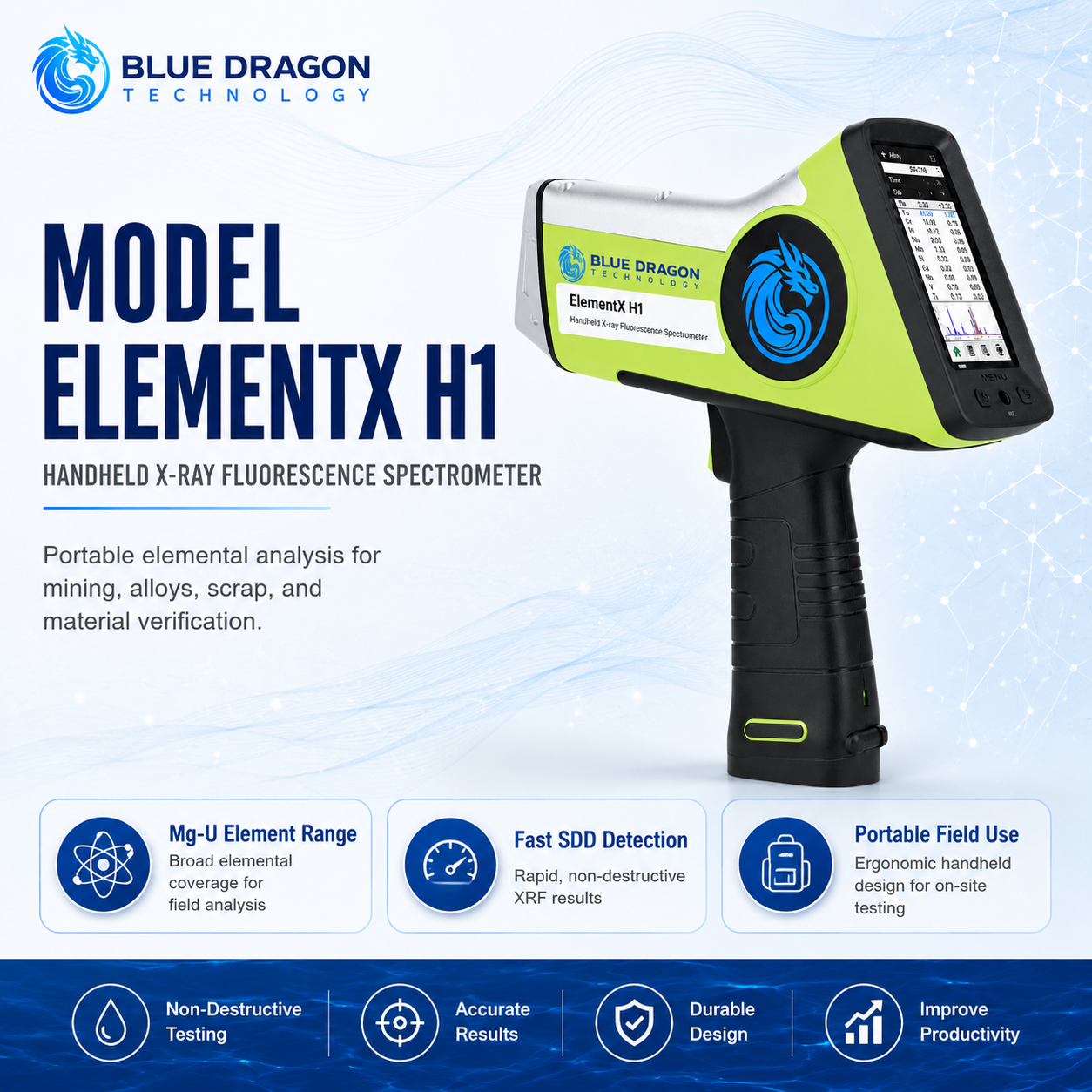
ElementX H1 Handheld XRF Spectrometer

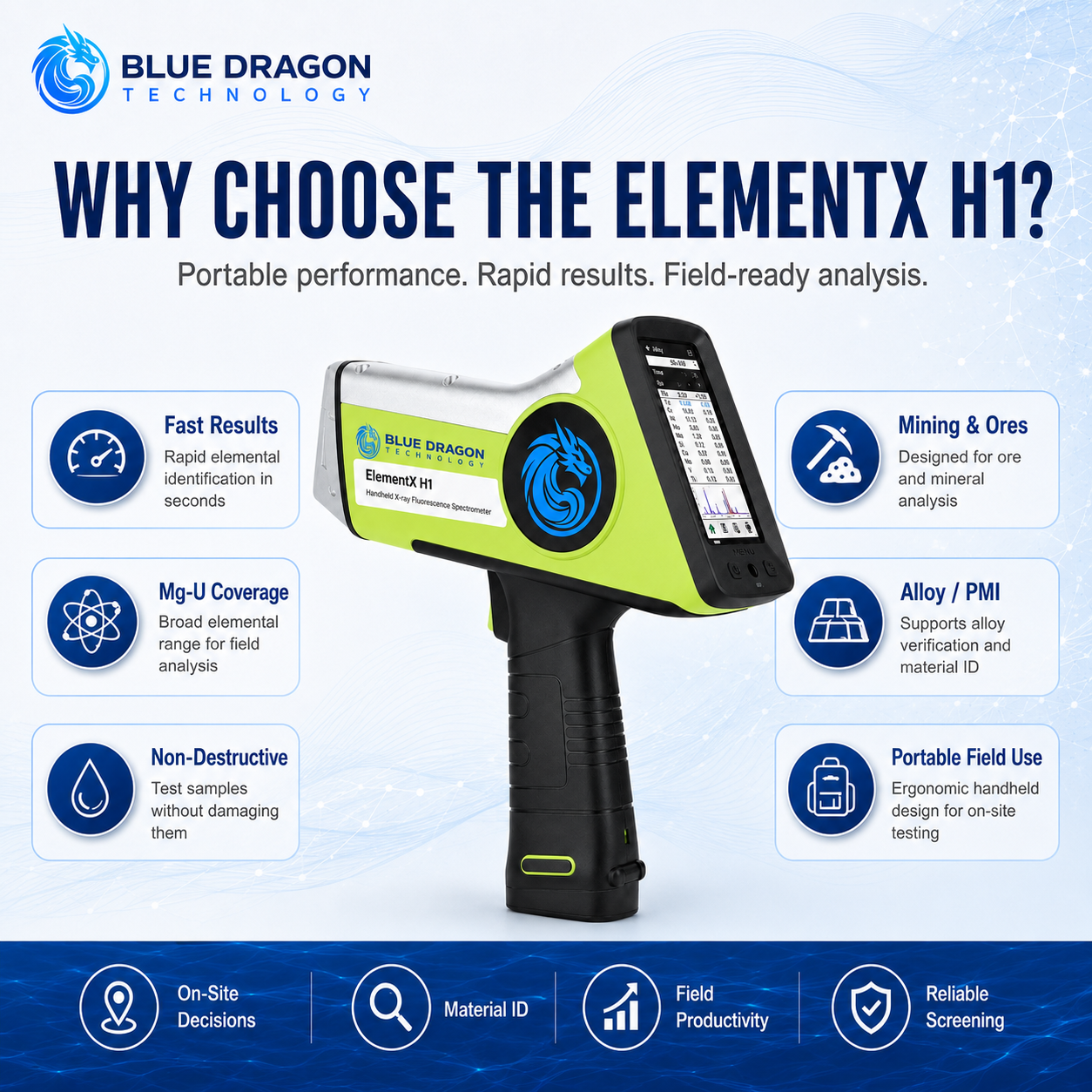
Portable Mg-to-U handheld EDXRF for rapid field screening, with an ore, mineral, and rare-earth focused standard configuration.

Brand: Blue Dragon Technology Supply & support: Blue Dragon Technology
Product Overview

Purpose-built measurement, clearly presented.

The ElementX H1 is a handheld energy-dispersive X-ray fluorescence spectrometer designed for rapid field elemental screening. The documented standard configuration is focused on ore, mineral, geological, mine-site, and rare-earth applications.

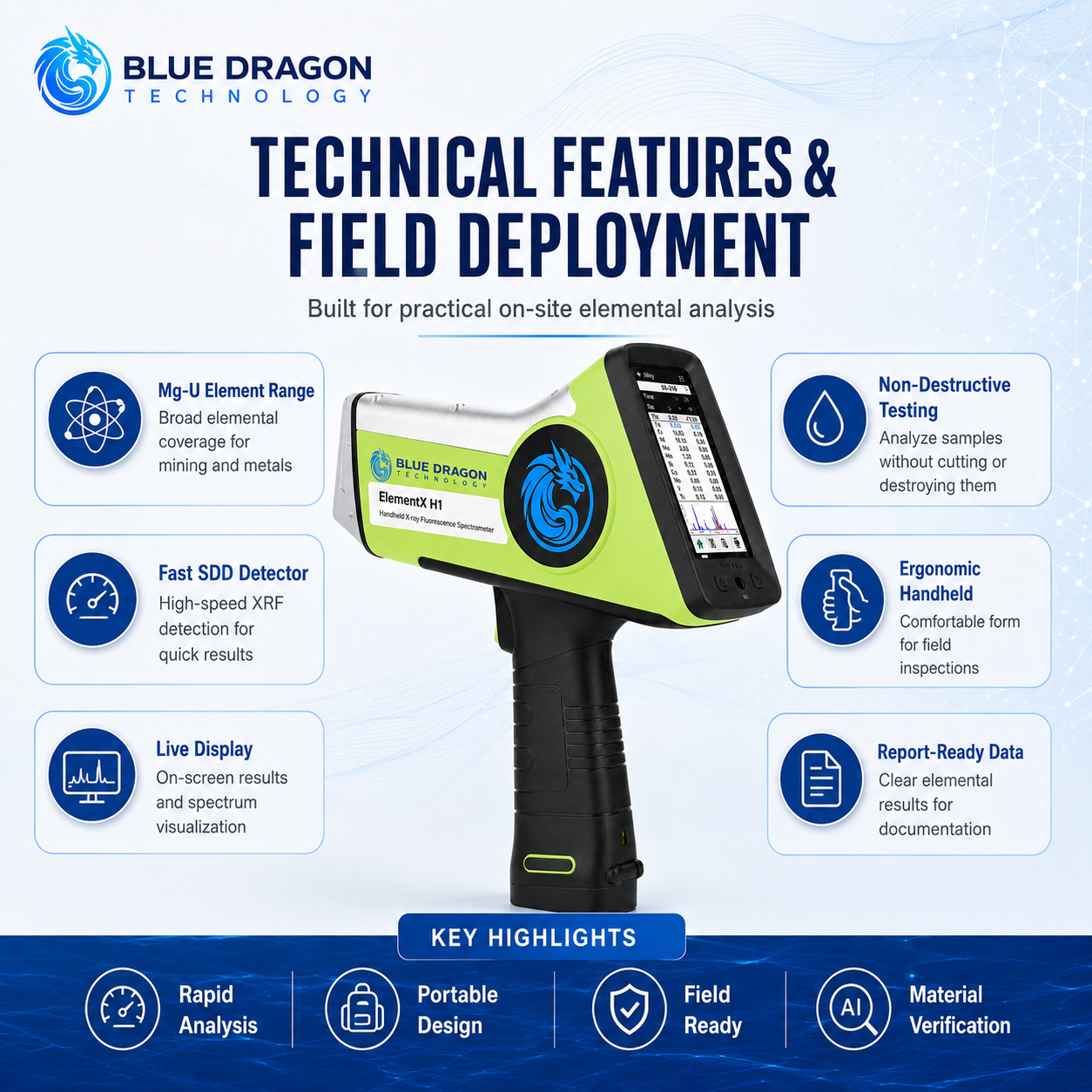
The instrument combines a Fast-SDD detector, Ag-target X-ray tube, integrated touchscreen computer, sample camera, factory calibration, data and report functions, and two hot-swappable batteries. Alloy, soil, RoHS, precious-metal, and other workflows are optional application modes and should not be assumed unless included in the order.

Distinctive Capabilities

  • Rapid non-destructive elemental screening at the sample location
  • Integrated touchscreen software for measurement, spectra, results, reports, and records
  • Dual hot-swappable batteries for extended field operation
  • Sample camera, atmospheric correction, configurable filters, and calibration verification
Performance & Technical Data

The measurement method and the values that matter.

How it measures

Measurement Principle

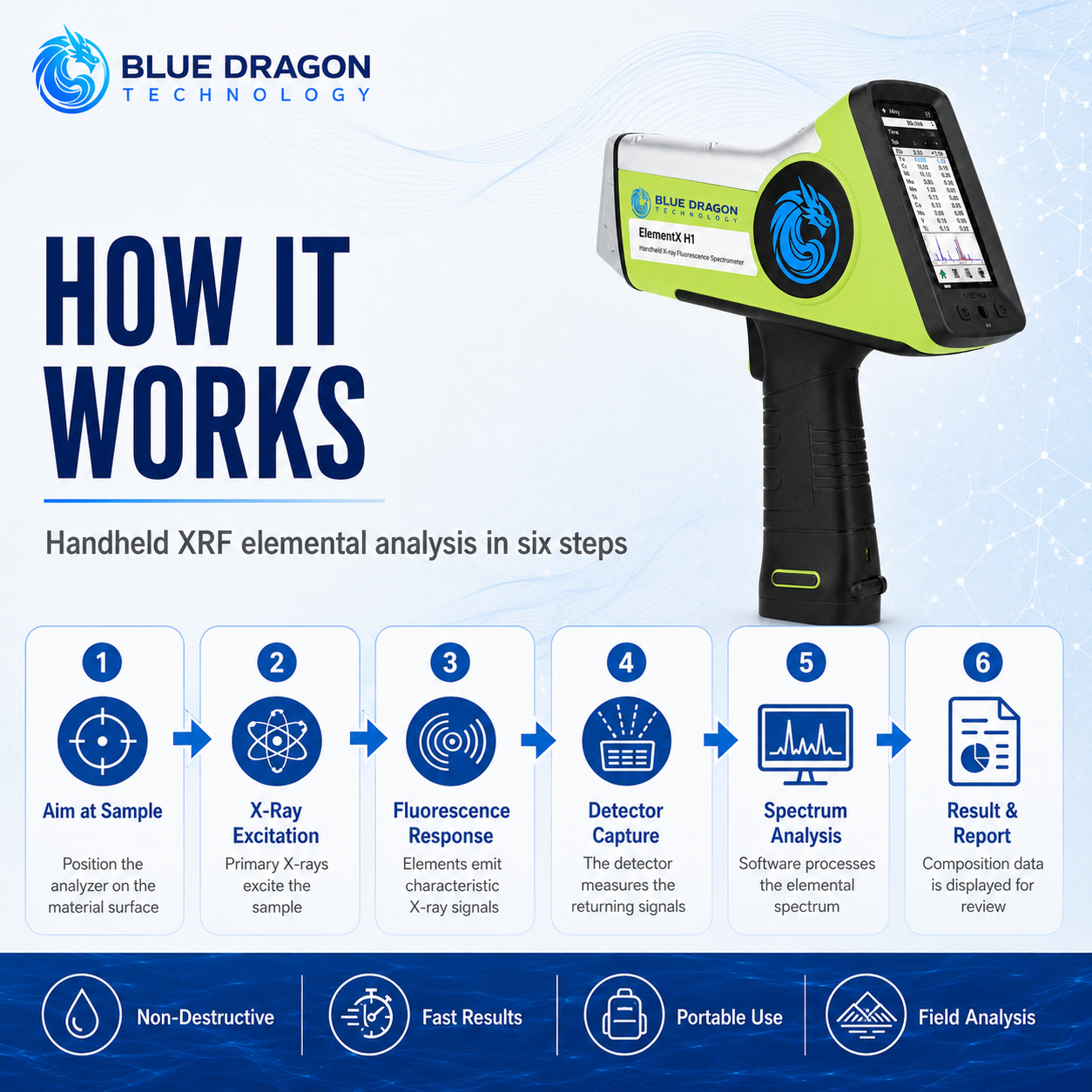
The Ag-target X-ray tube irradiates the sample and the Fast-SDD detector measures the energies and intensities of characteristic fluorescent X-rays. The software identifies elements and calculates concentrations using the selected Fundamental Parameters or working-curve method. Results depend on the installed mode, sample matrix, surface, thickness, geometry, preparation, measurement time, and calibration quality.

Process Temperature-20 to 50 °C
Measurement techniqueHandheld energy-dispersive X-ray fluorescence (EDXRF)
Standard application focusOre, mineral, geological, and rare-earth analysis
Element rangeMg to U; calibration, matrix, and application dependent
Broad concentration range0.0001% to 99.99%; not a universal detection limit or accuracy claim
DetectorElectrically cooled Fast-SDD

Complete Technical Data

Detector resolution
≤125 eV under specified reference conditions
X-ray tube
Ag target, 5–50 kV, 0–200 µA, less than 5 W
Filter system
Eight configurable filter channels
Display
4.5-inch touchscreen, 854 × 480
Operating system
Industrial Linux
Communications & Outputs
Two USB ports, USB OTG, Wi-Fi, and Bluetooth
Camera
Sample macro camera standard; scene camera optional
Battery
6600 mAh lithium-ion; approximately 8 hours per battery, mode dependent
Standard batteries
Two, with hot-swap support
Dimensions
Approximately 27.6 × 24.5 × 8.2 cm
Weight
Approximately 1.5 kg with battery; 1.3 kg without battery
Relative humidity
10–90%
Maximum operating altitude
Less than 5,000 m
Ingress protection
IP54; not suitable for immersion or pressure washing
Published repeatability
RSD ≤2% under stated conditions
Published relative error
≤15% under stated conditions; matrix and calibration dependent
Availability
Available
Customer Comparison

How ElementX H1 compares.

A simplified, customer-facing comparison of representative instruments in the same class. Final suitability depends on the ordered configuration, calibration, sample matrix, and application requirements.

Blue Dragon ElementX H1 handheld XRF comparison with Niton XL5 Plus, Hitachi X-MET8000 Expert Geo, Evident Vanta Max and Bruker TITAN
Comparison based on the configured product information used for this sheet. Product specifications may change by configuration and market. Open full-size comparison
Industrial Use

Applications and industries.

Typical Applications

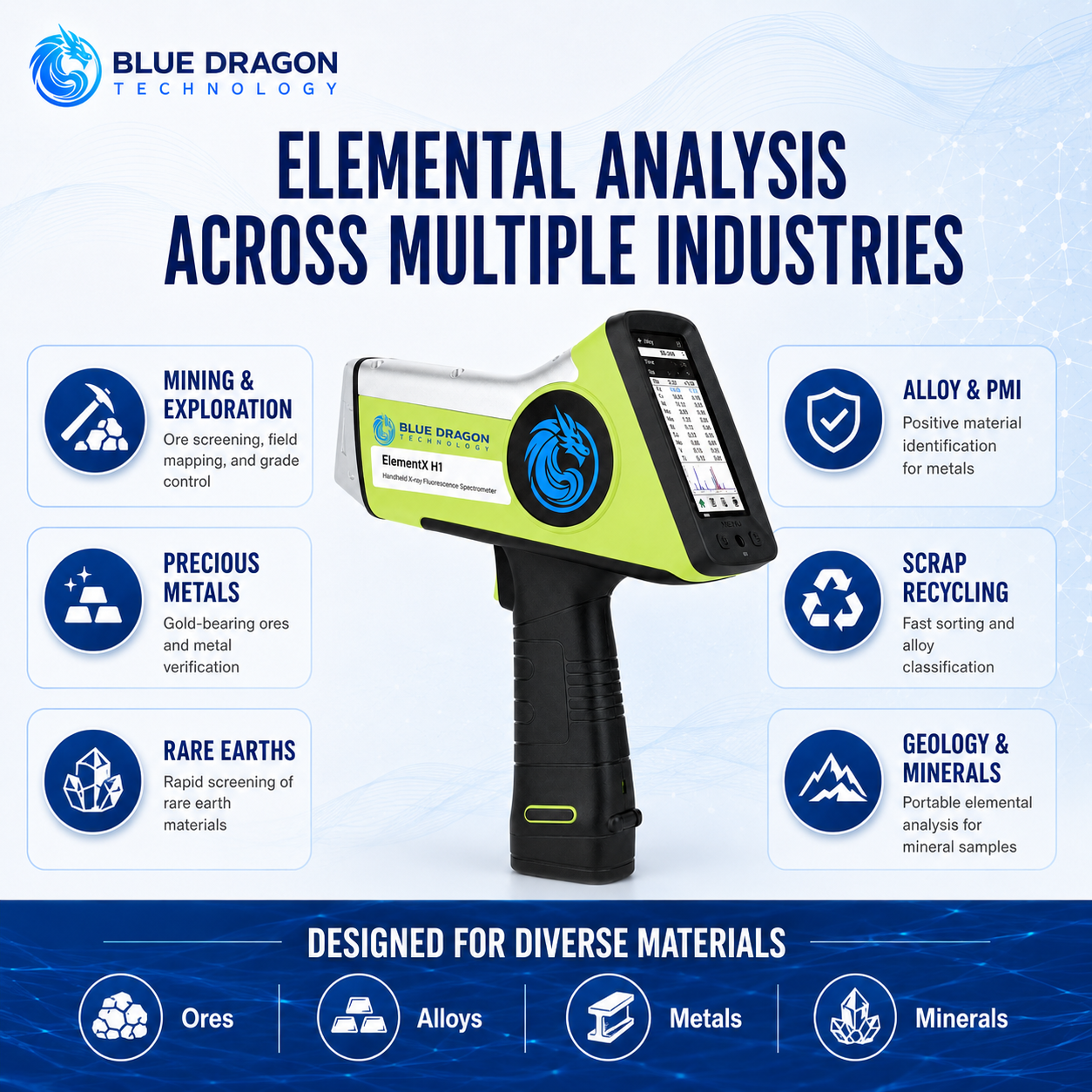
Ore and mineral exploration, mine-face screening, stockpile assessment, and grade controlRare-earth exploration and field geochemical screeningIron, copper, lead-zinc, molybdenum, tungsten, tantalum-niobium, nickel, lithium, gold, and related ore applications with suitable calibrationField screening of rocks, soils, concentrates, and geological materialsOptional alloy, PMI, RoHS, precious-metal, and environmental workflows when the required mode is installedElemental Composition AnalysisLithium / Critical-Mineral ScreeningMaterial Identification & VerificationMining & Geochemical ScreeningOre Grade / Concentrate Analysis

Industries Served

Environmental Monitoring & ComplianceMetals, Mining & MaterialsResearch & Industrial Laboratories
Engineering & Integration

Built for specification, installation, and long-term operation.

Practical requirements for selecting the installed application mode, preparing and presenting samples, verifying calibration, managing field power and data, maintaining the test window, and operating safely around X-rays.

Standard analysis focusOre, mineral, geological, and rare-earth workflows
Detector and sourceFast-SDD with Ag-target X-ray tube
Field enduranceTwo 6600 mAh batteries, approximately 8 hours each
Environmental rating-20 to 50 °C, IP54, below 5,000 m altitude

Instrument Configuration

The standard H1 is a factory-assembled and calibrated handheld XRF system with field power, touchscreen software, a sample camera, and mineral-focused analytical modes.

  • StandardElementX H1 instrument with built-in sample camera
  • StandardTwo 6600 mAh batteries, approved adapter, and dual-port charger
  • StandardUSB-OTG cable, USB drive, wrist strap, protective transport case, and test-window films
  • StandardBuilt-in calibration standard and external verification reference
  • OptionalPositioning, scene camera, shielded stand, printer, additional reference materials, and additional analysis modes
  • Application DependentNames and availability of methods, curves, administrator functions, GPS, cameras, stand, and printer

Sample Preparation

Handheld XRF quality and radiation safety depend on full sample coverage, stable geometry, representative material, and appropriate preparation.

  • StandardPlace the test window flat and stable against a sufficiently large, dense sample
  • StandardUse the sample camera and sensor functions to confirm positioning where available
  • StandardNever hold small, thin, irregular, low-density, or poorly covering samples by hand during measurement
  • OptionalUse a shielded test stand or enclosure for small samples, powders, prepared cups, or repeated bench measurements
  • Application DependentClean or prepare weathered, coated, rough, heterogeneous, or contaminated surfaces as required
  • Application DependentMinerals, soils, powders, and concentrates may require grinding, homogenization, prepared cups, or replicate measurements

Installation Environment

No internal installation is required; commissioning consists of receiving inspection, battery charging, configuration review, calibration verification, and an application check.

  • StandardIP54 protects against limited dust and splashing but does not permit immersion or pressure washing
  • StandardCharge only with the approved adapter and charger
  • StandardInspect the enclosure, trigger, test window, protective film, sample sensor, display, battery lock, and connectors before use
  • StandardSecure the instrument and spare batteries during transport and storage
  • Application DependentLocal radiation licensing, registration, controlled-area, and operator-training requirements

Software & Data Integration

The integrated Linux interface supports analysis, spectra, data, reports, calibration, settings, and communication functions.

  • StandardOn-instrument result display, spectra, history, reports, and records
  • StandardUSB, USB OTG, Wi-Fi, and Bluetooth connectivity
  • StandardConfigurable analysis settings, filters, measurement time, and calibration verification
  • OptionalBluetooth printer and satellite positioning
  • Application DependentRemote connection, report formats, language, scene camera, databases, and installed analytical modes depend on the delivered software build
  • StandardProtect data by completing saves and exports before battery removal or shutdown

Calibration & Analytical Methods

Field XRF results must be verified with suitable references and interpreted within the limits of the installed calibration and sample matrix.

  • StandardFactory calibration with a built-in standard and external verification reference
  • StandardPerform calibration verification during commissioning and at the site-defined quality-control interval
  • StandardUse suitable certified reference materials for the ore, mineral, alloy, soil, or other application
  • StandardRecord mode, time, geometry, sample condition, and quality-control results with field data
  • Application DependentAccuracy and detection capability vary with matrix, surface, particle size, thickness, geometry, preparation, time, and selected curve
  • OptionalAdditional modes, working curves, and reference materials for defined applications

Maintenance & Service

Operator maintenance is limited to external cleaning, battery care, inspection, and test-window film replacement.

  • StandardInspect and clean the exterior, display, trigger, sample sensor, test window film, battery contacts, and transport case
  • StandardReplace damaged, contaminated, wrinkled, or punctured test-window film without touching the detector window
  • StandardInspect batteries for swelling, impact, heat, contamination, or contact damage
  • StandardManage battery state of charge during long storage and prevent terminal short circuit
  • StandardBack up data and verify configuration after software maintenance
  • StandardInternal service, shielding, X-ray source, detector, interlock, or electronics work requires authorized service personnel

Radiation Safety & Application Limits

The H1 is an X-ray instrument and must be controlled by trained, authorized personnel under applicable radiation regulations.

  • StandardNever point the test head at a person or expose any body part to the primary beam
  • StandardNever measure small or poorly covering samples while holding them by hand
  • StandardUse time, distance, shielding, controlled access, and a shielded stand where appropriate
  • StandardThe detector window is fragile and must not be touched, wiped, blown with compressed air, or exposed to sharp objects or powder
  • StandardRemove the battery and stop use if the instrument is cracked, impacted, wet internally, overheated, or otherwise unsafe
  • Application DependentValidate the installed mode before compliance, custody-transfer, grade-control, or safety-critical decisions
Application Review

Application Engineering Notes

Standard application focus

The standard ElementX H1 configuration is intended for ore, mineral, and rare-earth analysis. Alloy PMI, RoHS, precious-metal, soil, and other applications require the corresponding analysis mode and calibration to be included in the ordered configuration.

Sample presentation

Thin, irregular, heterogeneous, weathered, coated, or low-density samples require appropriate preparation, support, measurement technique, or use of a shielded stand to obtain representative results.

Performance basis

The Mg-to-U range, concentration range, repeatability, and relative-error figures describe platform performance under stated conditions. Actual performance depends on the element, matrix, sample condition, calibration, and selected application mode.

Project Delivery

Project Integration & Support Scope

Blue Dragon reviews the measurement objective, interfaces, documentation, commissioning, and lifecycle requirements as part of project configuration. The scope below identifies the principal items to confirm before order placement.

Measurement Objective
Handheld EDXRF analysis for field elemental screening, mineral and geological work, material identification, and other applications supported by the installed analysis mode and calibration.
Signal Outputs
Results, spectra, records, and reports are displayed and stored locally. USB, USB OTG, Wi-Fi, and Bluetooth are standard communication interfaces; a Bluetooth printer and positioning functions are optional.
Data Integration
Field records can include sample identification, spectra, results, and report data. Export format, remote connection, databases, language, positioning, cameras, and installed analytical modes depend on the delivered software configuration.
Alarms & Diagnostics
The instrument provides operating, battery, software, X-ray, and safety-interlock status through the local interface. Exact messages and available diagnostic functions depend on the delivered software build.
Documentation
The package may include the product sheet, operating manual, factory test report, installed-mode information, calibration records, radiation-safety documentation, battery and charger information, and project-specific quality documents.
Commissioning Support
Commissioning can include receiving inspection, battery charging, software and mode review, calibration verification, sample-geometry checks, radiation-safety controls, report and data setup, and operator training.
Lifecycle Support
Lifecycle support covers batteries and charger, test-window films, external cleaning, calibration and method support, software and data backup, accessories, spare parts, troubleshooting, and authorized repairs.
Operational Visibility

Safety Interlock & Diagnostic Matrix

The handheld XRF matrix focuses on radiation-safety conditions, source and detector readiness, calibration verification, battery and environmental status, test-window integrity, and field data handling.

Project Setpoint means the limit is selected for the ordered application. Recommended severity is generic website guidance; the site alarm philosophy is final.

Sample-safety condition not satisfied

Safety Severity: Safety Critical
Trigger / Basis
The test head is not safely and fully covered by a suitable sample or approved shielded stand.
Instrument Response
A measurement must not proceed and the primary beam must never be directed toward a person or exposed body part.
Operator Response
Release the trigger, point the instrument in a safe direction, correct the sample and geometry, and use a shielded stand for small samples.
Reset & Ownership
Operator and instrument safety functions share ownership. Never defeat the sample sensor or other safety feature.

Instrument damaged or unsafe

Safety Severity: Safety Critical
Trigger / Basis
The enclosure is cracked, impacted, wet internally, overheated, or otherwise unable to assure shielding and safe operation.
Instrument Response
The instrument must be removed from service and no X-ray measurement may be made.
Operator Response
Remove the battery when safe, control access, label the unit out of service, and contact authorized service and the radiation-safety responsible person.
Reset & Ownership
Manual safety hold. Return to service requires documented inspection and authorization.

X-ray source or high-voltage fault

Analyzer Severity: Critical
Trigger / Basis
The source cannot initialize or operate at the selected voltage, current, filter, and method settings.
Instrument Response
The measurement cannot run normally and the software presents the available system diagnostic.
Operator Response
Stop testing, record the diagnostic and selected method, perform only approved external checks, and contact authorized service if unresolved.
Reset & Ownership
Instrument owned; internal source, shielding, and high-voltage service is restricted to authorized personnel.

Detector not ready or detector fault

Analyzer Severity: Critical
Trigger / Basis
The Fast-SDD detector or signal-processing system is not ready or cannot acquire a valid spectrum.
Instrument Response
The test is unavailable or its spectrum and result are invalid.
Operator Response
Allow normal initialization, check the active diagnostic, temperature and battery condition, and use authorized service if readiness is not restored.
Reset & Ownership
Instrument owned. Resume only after valid detector status and a successful verification check.

Calibration verification failed

Quality Control Severity: Critical
Trigger / Basis
The built-in standard or approved external reference fails the application-mode acceptance criterion.
Instrument Response
Results for the affected mode must not be accepted for reporting or field decisions.
Operator Response
Confirm the installed mode, reference material, window condition, geometry, measurement time, and calibration settings, then repeat the approved check.
Reset & Ownership
Quality-system owned. Release requires successful documented verification or authorized recalibration.

Test window damaged or contaminated

Maintenance Severity: Warning
Trigger / Basis
The protective film is punctured, wrinkled, damaged, or contaminated, or powder threatens the detector entrance window.
Instrument Response
Measurement quality is compromised and the fragile detector window can be damaged.
Operator Response
Stop testing, replace the approved protective film without touching the detector window, and inspect the test head before use.
Reset & Ownership
Operator maintenance owned. Resume only after inspection and an acceptable reference check.

Battery low or unavailable

Utility Severity: Warning
Trigger / Basis
The installed battery cannot sustain the measurement or a hot-swap is required.
Instrument Response
The instrument warns of low available power or shuts down when power is exhausted.
Operator Response
Complete and save the current record, fit a charged approved battery, inspect contacts and locking, and use the approved charger.
Reset & Ownership
Operator owned. A controlled restart and verification are required after an interrupted test.

Environmental limit exceeded

Environment Severity: Warning
Trigger / Basis
Temperature, humidity, dust, water exposure, or altitude is outside the published operating limits.
Instrument Response
Measurement stability, instrument protection, or safe operation cannot be assured.
Operator Response
Move to a suitable environment, allow the instrument to stabilize, inspect for condensation or damage, and verify calibration before reuse.
Reset & Ownership
Operator owned. The published -20 to 50 °C, IP54, humidity, and altitude limits govern.

Data save, export, or communication failure

Data System Severity: Warning
Trigger / Basis
A result cannot be saved or an installed USB, Wi-Fi, Bluetooth, printer, or optional positioning function fails.
Instrument Response
Local measurement may remain available, but the external record or transfer is incomplete.
Operator Response
Save locally where possible, verify storage, connection, permissions, battery, and configuration, then repeat the controlled export.
Reset & Ownership
Operator or laboratory data-system owned. Do not remove the battery or shut down before confirmed save completion.
Technical Resources

Product Documents

Product Sheet first, followed by the Brochure, Manual, and any additional technical documents.

Application Engineering

Discuss your measurement application.

Share the sample, measurement range, operating conditions, project location, and timeline. Blue Dragon Technology will review the application and recommend the appropriate configuration.