

Total Organic Carbon Measurement
Measure organic carbon in water and liquid samples to support contamination detection, treatment control, process investigation, utility management, and laboratory workflows.
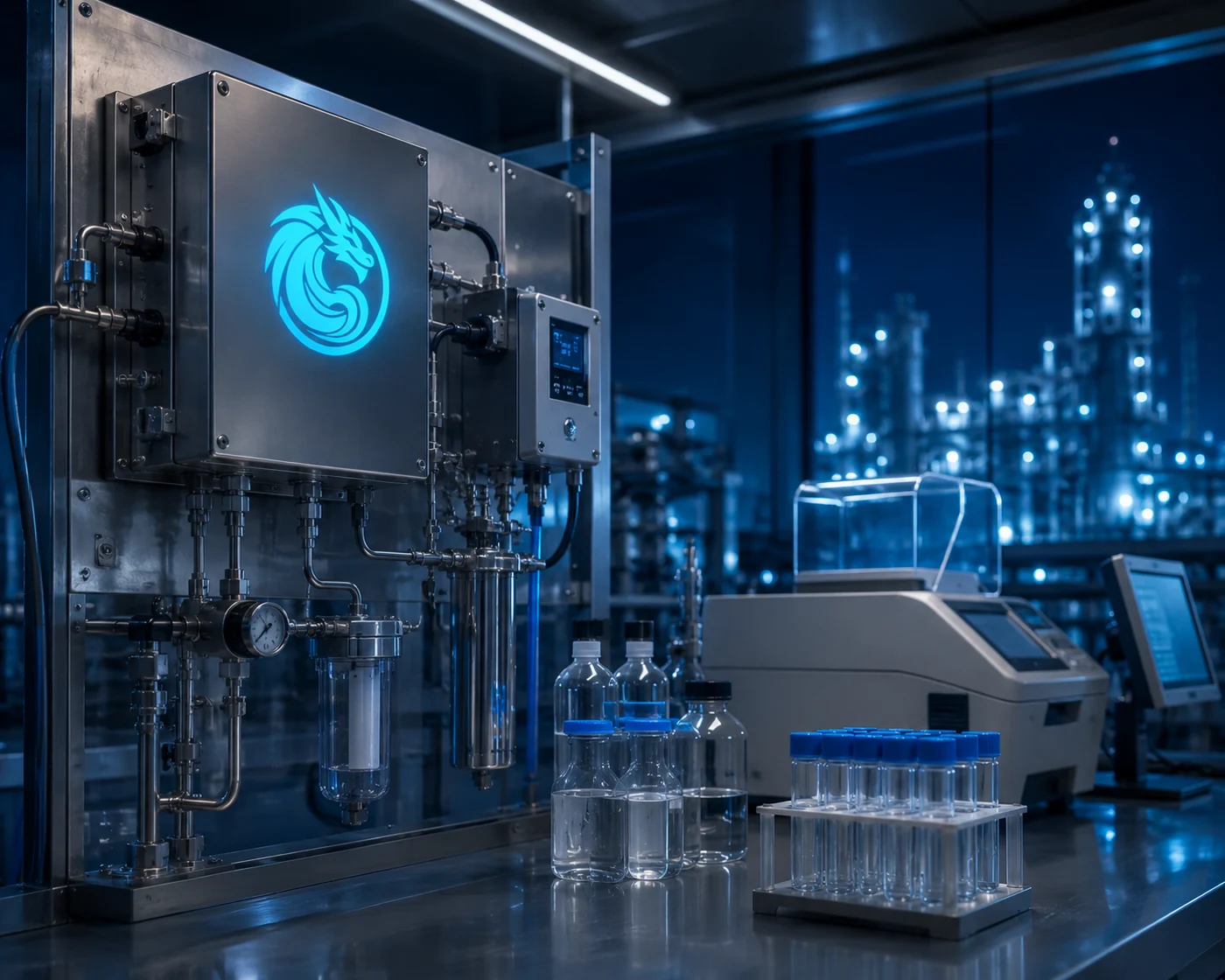
A broad indicator of organic contamination and water quality
Total organic carbon provides an aggregate measure of organic carbon in a sample rather than identifying each individual compound. It is widely useful for water-quality monitoring, treatment performance, contamination investigations, process control, high-purity-water workflows, and laboratory analysis.
Instrument suitability depends on the expected range, sample matrix, solids, salts, acids, oxidation method, carbon-detection method, sample volume, automation, calibration, cleaning, data requirements, and the operating decision supported by the result.
What the application needs to establish
Determine total organic carbon in a representative liquid sample with the range, oxidation capability, quality controls, and reporting needed for the application.
Why the measurement matters
Contamination detection
Identify changes in organic loading that may indicate process intrusion or water-quality deterioration.
Treatment control
Follow removal performance across treatment, polishing, reuse, or discharge systems.
Process investigation
Compare streams, investigate deviations, and evaluate changing operating conditions.
Utility management
Monitor raw, process, cooling, boiler-related, condensate, or high-purity water where TOC is useful.
Laboratory confirmation
Provide controlled analysis, calibration, quality control, and investigation capability.
How the measurement is approached
The Model C680 uses high-temperature combustion to oxidize carbon in the sample, followed by carbon detection and calculation of TOC according to the configured measurement sequence. The pharmaceutical TOC platform under development may use a different final architecture, which will be confirmed before release.
Typical operating locations
- Industrial water and wastewater laboratories
- Process-water and treatment monitoring points
- Utility-water and contamination investigations
- Cooling-water, condensate, and reuse systems
- Environmental and contract laboratories
- High-purity and pharmaceutical water workflows
- Pilot plants and research facilities
Instrument-selection considerations
- Expected TOC range and required detection capability
- Dissolved and suspended organic content
- Salts, acids, solids, particulates, and sample compatibility
- Oxidation method and carbon-detection method
- Sample volume, throughput, automation, and cleaning
- Calibration standards, blanks, controls, and verification
- Data review, reporting, integration, and maintenance
Where this application is used.


Petrochemicals
Measurement systems for petrochemical feedstocks, reaction processes, fired equipment, utilities, effluent, gas flow, and material quality.
Explore →
Chemical Processing
Application-focused instrumentation for Chemical Processing, covering Trace moisture, H2S and sulfur, TOC, flow, and multipoint temperature across Reactors, columns, specialty gas systems, and utilities.
Explore →
Fertilizers & Chemicals
Analytical and engineered measurement systems for feedstocks, process gases, reactors, utilities, effluent, flow, and material quality.
Explore →
Power Generation
Measurement systems for fuels, boiler and high-purity water, fired equipment, gas flow, materials, and conventional or nuclear generation.
Explore →
Water & Wastewater
Online and laboratory instruments for organic carbon, oil contamination, turbidity, treatment control, discharge, reuse, and water-quality investigation.
Explore →
Pharmaceutical
Measurement solutions for purified and high-purity water, TOC monitoring, contamination investigations, materials screening, and quality laboratories.
Explore →
Semiconductor & Electronics
Application-focused instrumentation for Semiconductor & Electronics, covering Ultra-trace gas moisture, UPW TOC, and XRF screening across UPW, specialty gases, fabrication, and incoming materials.
Explore →
Food & Beverage
Application-focused instrumentation for Food & Beverage, covering TOC, turbidity, water quality, and materials screening as applicable across Process water, wastewater, QC laboratories, and utilities.
Explore →
Pulp & Paper
Application-focused instrumentation for Pulp & Paper, covering TOC and turbidity, flow, and temperature across Process water, effluent, boilers, and recovery systems.
Explore →
Environmental Monitoring & Compliance
Application-focused instrumentation for Environmental Monitoring & Compliance, covering Oil-in-water, turbidity, TOC, emissions flow, and XRF soil screening across Wastewater discharge, emissions, contaminated land, and compliance labs.
Explore →
Research & Industrial Laboratories
Flexible analytical instruments for water, organic carbon, elemental composition, material verification, method development, and quality control.
Explore →Relevant measurement capabilities.
Explore the permanent Blue Dragon capability areas associated with this industry or application.
Water Quality & Organic Carbon Series
Online and laboratory analyzers for organic carbon, oil-in-water, turbidity, wastewater, and high-purity water measurement.
Explore series →Instruments connected to this application.
 Available
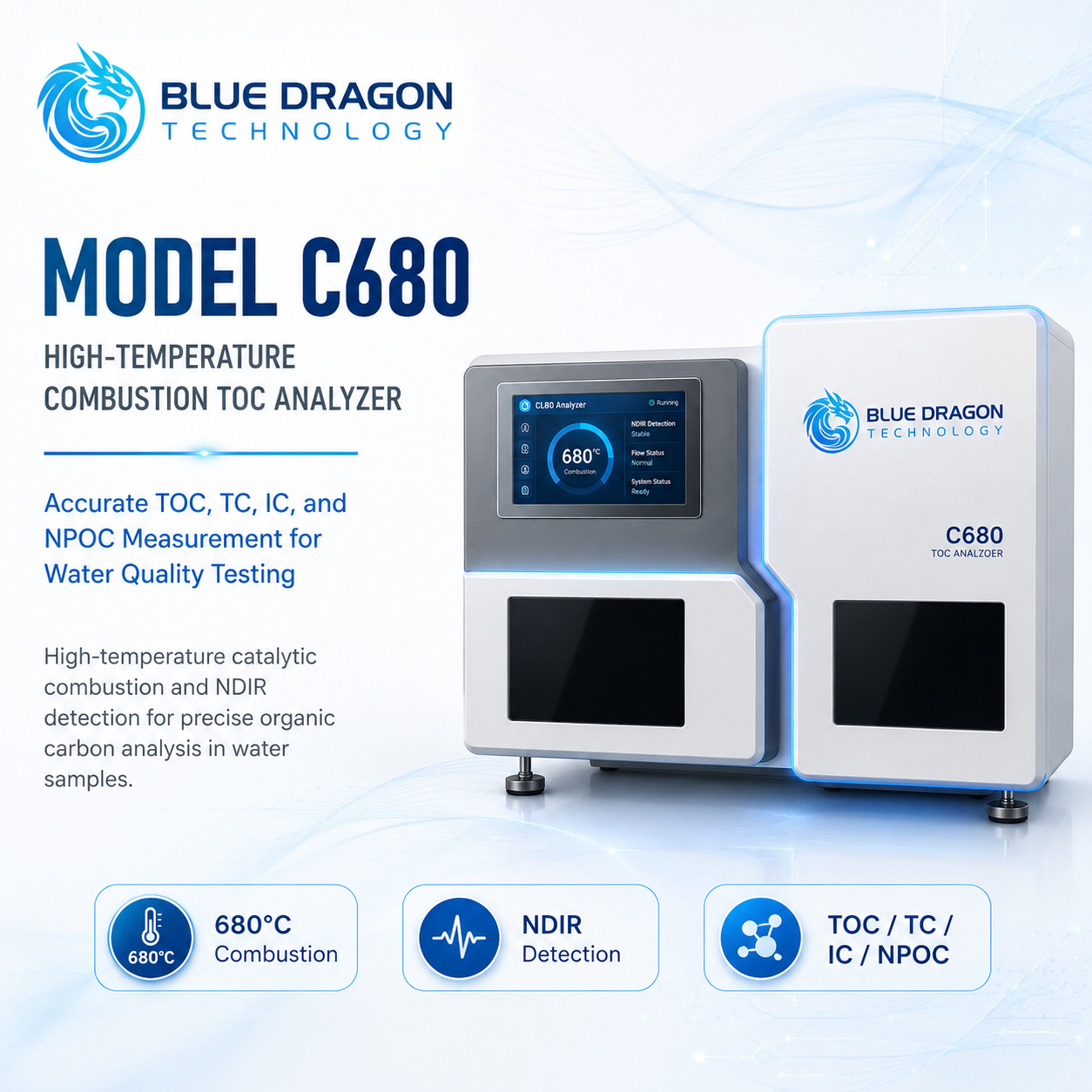
Model C680 High-Temperature Combustion TOC Analyzer
Laboratory total organic carbon analyzer using 680 °C catalytic combustion, separate TC and IC reaction paths, manual microsyringe injection, and NDIR carbon-dioxide detection.
View instrument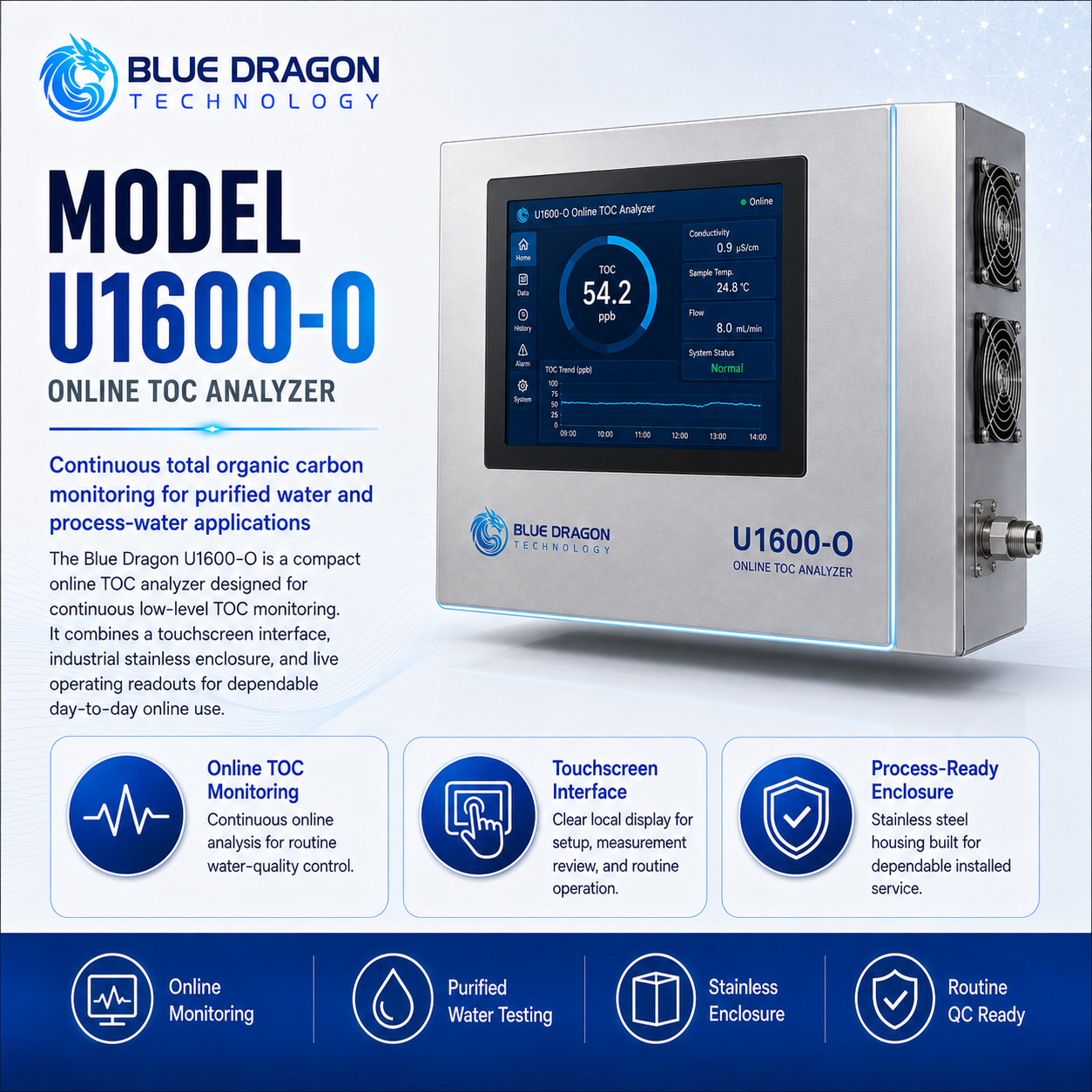 Available
Model U1600-O Online TOC Analyzer
Wall-mounted online TOC analyzer using UV photocatalytic oxidation and differential conductivity detection for continuous or routine low-level monitoring of pharmaceutical and electronic high-purity water.
View instrument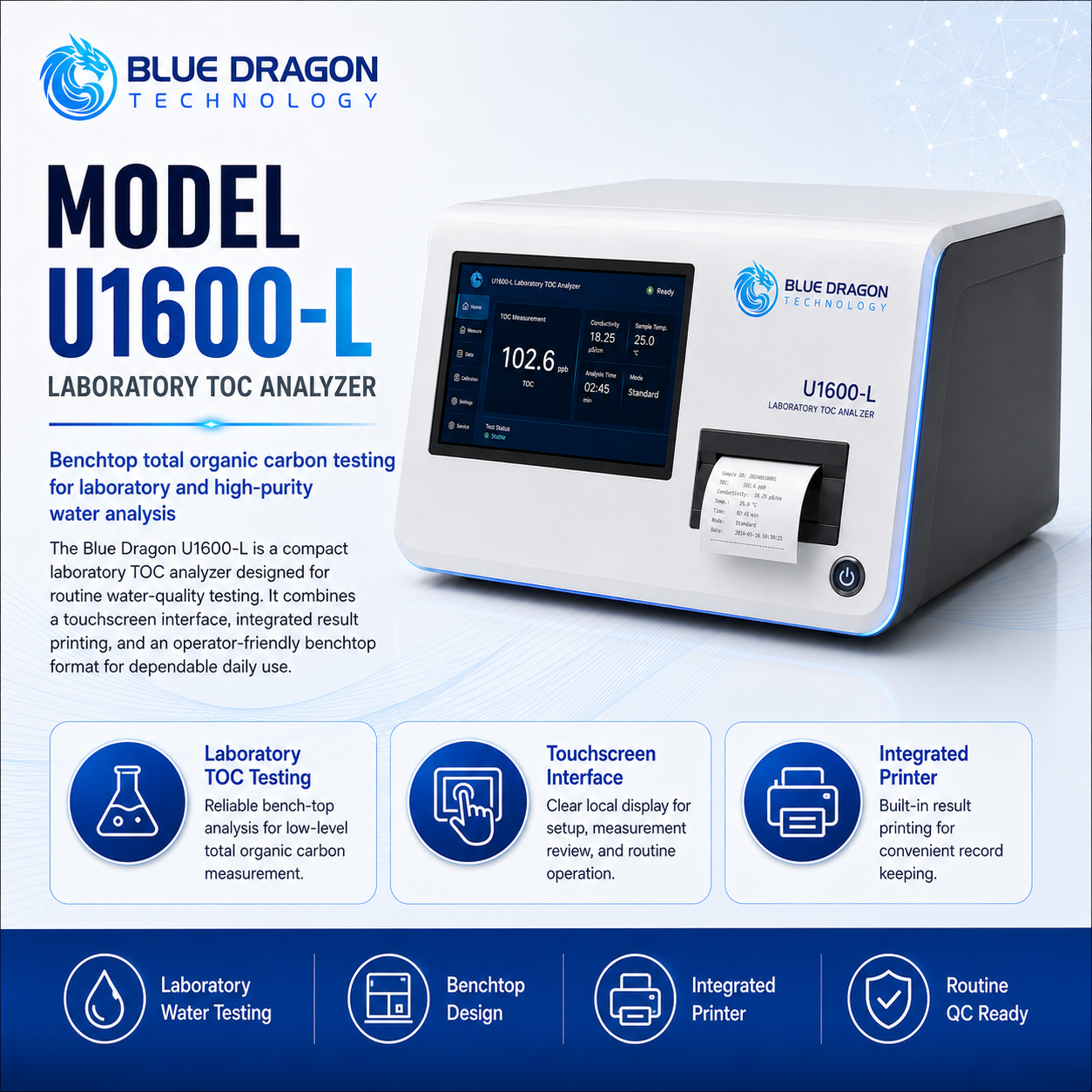 Available
Model U1600-L Laboratory TOC Analyzer
Compact benchtop laboratory TOC analyzer using UV photocatalytic oxidation and differential conductivity detection for offline low-level testing from non-pressurized sample containers.
View instrumentRelated applications.

High-Purity Water TOC Monitoring
TOC measurement for purified, ultrapure, pharmaceutical, biotechnology, semiconductor, and controlled high-purity water systems.
Explore →Application questions.
What does TOC measure?
TOC measures the total amount of organic carbon represented by the configured analytical method. It does not identify each organic compound individually.
How is TOC different from oil-in-water measurement?
TOC is a broad measure of organic carbon, while oil-in-water methods target hydrocarbon-related contamination according to the selected optical response and calibration.
Can high-solids or high-salt samples be measured?
Potentially, but solids, salts, acids, viscosity, sample preparation, dilution, combustion conditions, cleaning, and maintenance must be reviewed for the instrument.
Should an online or laboratory TOC analyzer be used?
Online systems provide continuous process visibility; laboratory systems support controlled testing and varied samples. The application may require one or both.
Discuss your total organic carbon application.
Provide the water or sample type, expected TOC range, solids and salts, sample volume, throughput, required method, data needs, and installation or laboratory conditions.