

Online Total Sulfur Measurement
Measure total sulfur continuously in conditioned liquid or gas samples to support process control, treatment performance, product quality, and operational decisions.
Continuous sulfur information for process and product streams
Total sulfur measurement determines the combined sulfur contribution of compounds present in a representative sample. Online measurement can provide timely information for feed monitoring, process adjustment, treatment verification, blending, transfer, and finished-product quality workflows.
The correct system depends on the sample phase, expected range, composition, pressure, temperature, moisture, possible interferences, required method, response time, stream count, hazardous-area requirements, and sample-conditioning design.
What the application needs to establish
Determine total sulfur concentration in a representative conditioned sample at the range, response time, and repeatability required for the operating decision.
Why the measurement matters
Process control
Detect changes in feed or process streams early enough to support operating adjustments.
Product quality
Provide continuous information for blending, transfer, and product-quality management.
Treatment performance
Evaluate sulfur-removal and gas- or liquid-treatment processes.
Compliance support
Support the plant's verified method and quality workflow where the instrument configuration is suitable.
Operational visibility
Reduce dependence on intermittent laboratory results for time-sensitive decisions.
How the measurement is approached
Where ultraviolet fluorescence is appropriate, sulfur compounds are converted to sulfur dioxide under controlled oxidation and the resulting fluorescence response is measured. The final method, sample introduction, conditioning system, range, and calibration basis must match the stream and instrument configuration.
Typical operating locations
- Process and product analyzer shelters
- Liquid hydrocarbon sample-conditioning systems
- Natural-gas and process-gas sample systems
- Fuel blending and transfer points
- Treatment-unit inlet and outlet streams
- Multi-stream analyzer systems
- Quality-control and process-support locations
Instrument-selection considerations
- Gas or liquid sample phase
- Expected concentration range and normal variability
- Stream composition, moisture, particulates, and possible interferences
- Pressure reduction, vaporization, filtration, and sample transport
- Required response time and number of streams
- Calibration, verification, and method requirements
- Area classification, shelter, utilities, and maintenance access
Where this application is used.


Natural Gas & LNG
Measurement solutions for gas processing, sweetening, liquefaction, LNG quality, gas flow, utilities, and materials verification.
Explore →
Pipelines & Midstream
Application-focused instrumentation for Pipelines & Midstream, covering Pipeline gas quality, dew point, H2S and sulfur, flow, and portable verification across Transmission pipelines, compressor stations, meter stations, and terminals.
Explore →

Sulfur Recovery & Gas Treating
Application-focused instrumentation for Sulfur Recovery & Gas Treating, covering H2S, SO2, sulfur ratio, tail gas, and gas moisture across Amine units, Claus SRU, tail gas, and incinerator.
Explore →
Petrochemicals
Measurement systems for petrochemical feedstocks, reaction processes, fired equipment, utilities, effluent, gas flow, and material quality.
Explore →
Chemical Processing
Application-focused instrumentation for Chemical Processing, covering Trace moisture, H2S and sulfur, TOC, flow, and multipoint temperature across Reactors, columns, specialty gas systems, and utilities.
Explore →
Fertilizers & Chemicals
Analytical and engineered measurement systems for feedstocks, process gases, reactors, utilities, effluent, flow, and material quality.
Explore →
Biofuels & Renewable Fuels
Application-focused instrumentation for Biofuels & Renewable Fuels, covering Fuel sulfur, TOC/water, flow, and materials/quality screening across Renewable diesel, SAF, biodiesel, and ethanol.
Explore →
Biogas & Renewable Gas
Application-focused instrumentation for Biogas & Renewable Gas, covering H2S, moisture, gas flow, and pipeline-quality verification across Digesters, upgrading, compression, and injection.
Explore →
Coal & Coal Chemical
Application-focused instrumentation for Coal & Coal Chemical, covering Gas moisture, H2S and sulfur, gas flow, XRF coal/ash, and water quality across Gasification, coke oven gas, syngas, and coal chemicals.
Explore →
Environmental Monitoring & Compliance
Application-focused instrumentation for Environmental Monitoring & Compliance, covering Oil-in-water, turbidity, TOC, emissions flow, and XRF soil screening across Wastewater discharge, emissions, contaminated land, and compliance labs.
Explore →Relevant measurement capabilities.
Explore the permanent Blue Dragon capability areas associated with this industry or application.
Sulfur Analysis Series
Online analyzers for total sulfur, hydrogen sulfide, sulfur ratio, and sulfur recovery unit process monitoring.
Explore series →Instruments connected to this application.
 Available
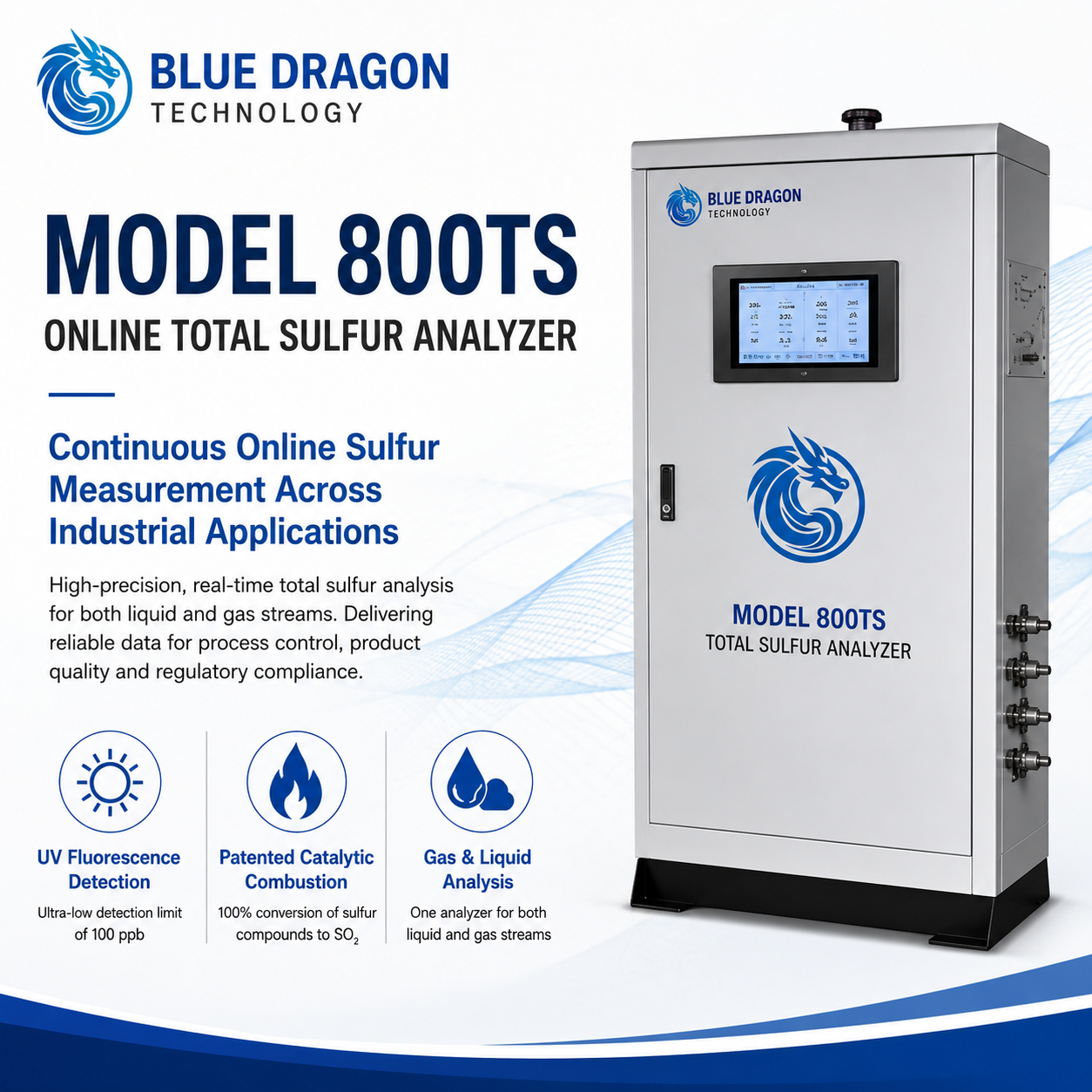
Model 800TS Online Total Sulfur Analyzer
Industrial online total sulfur analyzer for continuous process and product-quality monitoring, with quantitative injection, UV fluorescence detection, and optional multi-stream operation.
View instrument Coming Soon
Model 810H2S-TS Online Hydrogen Sulfide & Total Sulfur Tape Analyzer
Online tape analyzer for selective H₂S measurement plus Total Sulfur measurement through a dedicated heated hydrogen-conversion section.
View instrumentRelevant verified references.
Applicability depends on the instrument configuration, sample matrix, method scope, and project requirements. Confirm the final method basis during application review.
- ASTM D5453 — confirm the instrument, sample introduction, matrix, and method scope
- ISO 20846 — confirm the instrument, sample introduction, matrix, and method scope
Related applications.

Total Sulfur in Liquid Hydrocarbon Streams
Total sulfur in gasoline, diesel, naphtha, kerosene, gas oil and similar qualified liquids.
Explore →
Hydrogen Sulfide Measurement
Specific H2S measurement for gas treatment, product quality, process monitoring, and safe handling applications.
Explore →Application questions.
What is the difference between total sulfur and hydrogen sulfide measurement?
Total sulfur measures the combined sulfur contribution of sulfur compounds after conversion in the analyzer method. Hydrogen sulfide measurement targets H2S specifically. The required measurement depends on the process decision.
Can one analyzer measure several streams?
A multi-stream configuration may be possible, but stream composition, phase, pressure, range, switching sequence, purge requirements, and response time must be reviewed.
Is sample conditioning part of the analyzer application?
Yes. Representative sampling, filtration, pressure control, vaporization where required, temperature management, transport time, and safe disposal are essential to system performance.
Can the analyzer replace all laboratory sulfur testing?
Online analysis and laboratory testing serve different purposes. The plant should define correlation, verification, calibration, quality control, and the role of each result in its operating and reporting procedures.
Discuss your online total sulfur application.
Provide the sample phase and composition, expected range, pressure and temperature, required response time, stream count, method basis, area classification, and project schedule.