
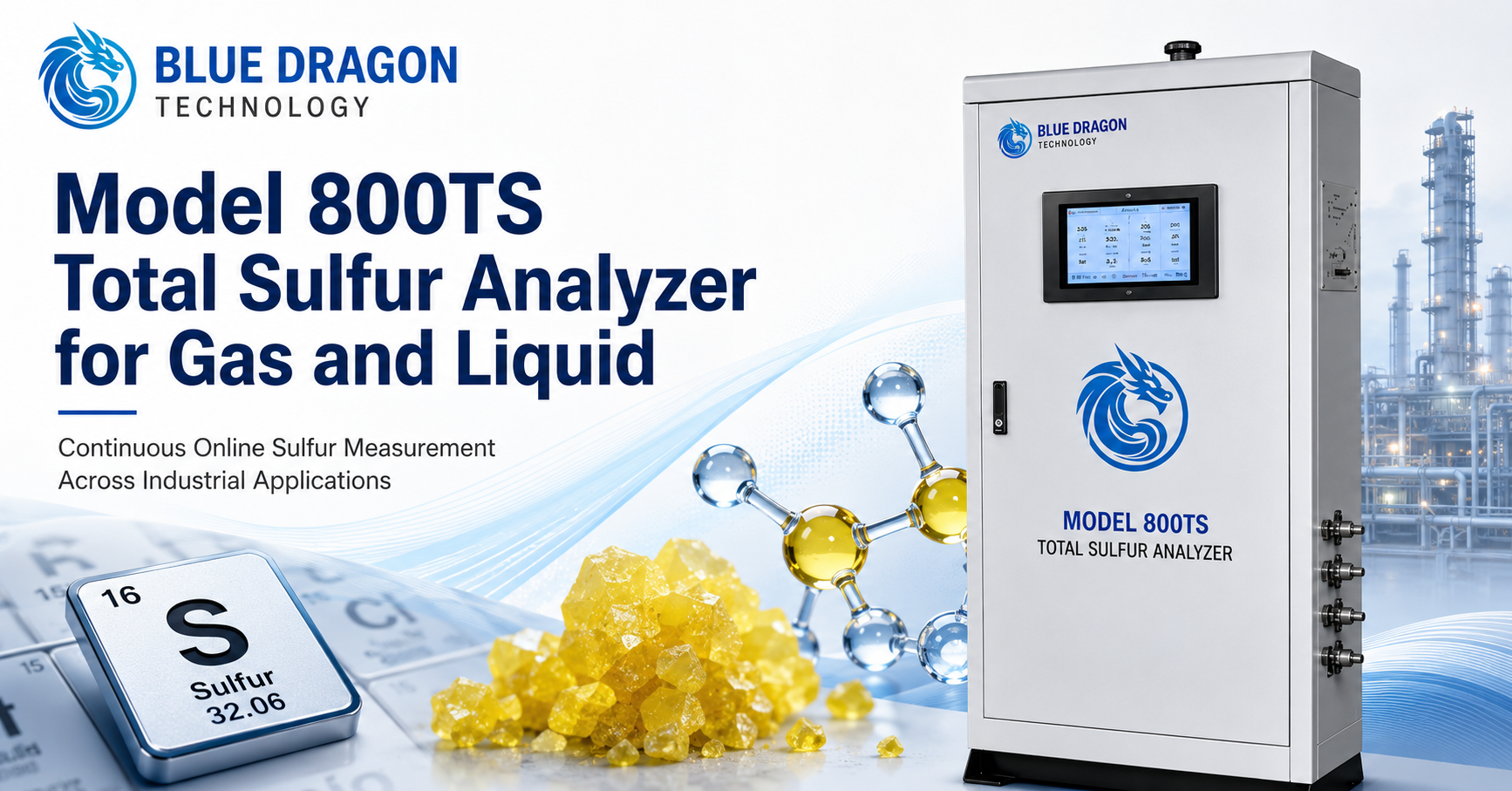
Sulfur measurement is a critical part of modern industrial process control. From refineries and LNG plants to petrochemical, fertilizer, gas-processing, and environmental monitoring applications, accurate total sulfur analysis helps operators protect catalysts, meet product specifications, reduce emissions, and maintain safe, reliable plant operation.
The Blue Dragon Technology Model 800TS Online Total Sulfur Analyzer is designed for continuous, real-time sulfur measurement in both gas and liquid samples. Using ultraviolet fluorescence detection and high-efficiency catalytic combustion, the Model 800TS provides dependable sulfur data for demanding industrial environments.
Quick Overview
The Model 800TS is a continuous online total sulfur analyzer for gas and liquid applications. It is built for industrial users who require accurate sulfur monitoring across process streams, feedstocks, finished products, and compliance-related applications.
- Measurement principle: Catalytic combustion with ultraviolet fluorescence detection
- Applications: Gas and liquid total sulfur analysis
- Stream capability: Up to six sample streams with automatic switching
- Detection capability: Suitable for low-level sulfur monitoring, with detection down to 100 ppb
- Compliance support: ASTM D5453, ASTM D6667, ISO 20846, and GB/T 34100
- Typical industries: Oil & gas, refining, LNG, petrochemicals, fertilizer, coal chemical, environmental, and process R&D
Why Sulfur Measurement Matters
Sulfur appears in many industrial feedstocks and process streams, including crude oil, natural gas, refinery intermediates, fuels, chemical solvents, hydrocarbon gases, condensates, petrochemical feedstocks, and process by-products. Even when present at low concentrations, sulfur compounds can create major operational and commercial challenges.
In refineries, sulfur affects product quality, emissions compliance, catalyst performance, corrosion risk, and downstream processing efficiency. In gas and LNG operations, sulfur compounds can damage equipment, interfere with purification systems, and create safety concerns. In petrochemical and fertilizer plants, sulfur can influence catalyst life, reaction efficiency, product purity, and environmental performance.
Continuous online sulfur analysis gives operators a faster and more actionable view of their process than periodic laboratory testing alone. Instead of waiting for manual sampling and lab results, plant teams can see sulfur changes in near real time and respond before process deviations become costly.
Common Sulfur Compounds in Industrial Streams
Industrial sulfur is rarely present in only one simple form. Depending on the process, sulfur may appear as inorganic sulfur, organic sulfur compounds, reduced sulfur species, or oxidized sulfur compounds. A total sulfur analyzer is valuable because it measures the overall sulfur content rather than only one individual compound.
Reduced Sulfur Species
- Hydrogen sulfide, H₂S
- Mercaptans
- Sulfides
- Disulfides
Organic and Oxidized Sulfur
- Thiophenes
- Benzothiophenes
- Dibenzothiophenes
- Sulfur oxides formed during combustion
Because sulfur compounds vary widely by process and matrix, total sulfur measurement is often preferred for process monitoring, quality control, and compliance support.
Sulfur in Industrial Reactions and Processes
Combustion of Fossil Fuels
When coal, crude-derived fuels, diesel, fuel oil, or other sulfur-containing materials are burned, sulfur compounds can oxidize into sulfur dioxide and sulfur trioxide. These emissions contribute to air-quality concerns, acid rain formation, and regulatory compliance requirements. Accurate sulfur measurement helps operators manage emissions and control the quality of fuel inputs.
Hydrodesulfurization in Refineries
Refineries use hydrodesulfurization to remove sulfur from fuels and feedstocks. In this process, organic sulfur compounds react with hydrogen over a catalyst and are converted into hydrogen sulfide, which can then be removed. Online sulfur analysis supports this process by monitoring feed quality, treatment performance, and finished-product sulfur levels.
Gas Sweetening and LNG Processing
Natural gas, refinery gas, and LNG-related process streams must be carefully monitored for sulfur compounds. Sulfur contamination can impact gas quality, damage downstream equipment, affect liquefaction processes, and create safety and environmental concerns. Continuous sulfur analysis helps operators verify gas treatment performance and maintain product specifications.
Petrochemical Production
Petrochemical plants often depend on sensitive catalysts and tightly controlled feedstock quality. Sulfur contamination can reduce catalyst activity, shorten catalyst life, and negatively affect product yield. Monitoring total sulfur in feedstocks and intermediate streams helps protect plant performance.
Fertilizer and Chemical Manufacturing
Fertilizer and chemical plants may encounter sulfur in feed gases, process intermediates, solvents, combustion systems, and environmental streams. Online sulfur measurement helps operators control impurities, maintain process stability, and support emission-management programs.
Metal Smelting, Mining, and Sulfur Recovery
Smelting and roasting of sulfide ores can release sulfur-containing gases that require capture, treatment, or conversion. In sulfur recovery and tail-gas treatment applications, sulfur measurement is important for process optimization, environmental control, and recovery efficiency.
Where Total Sulfur Is Measured
Oil & Gas
Sulfur analysis supports crude quality assessment, gas sweetening, sour-gas processing, condensate monitoring, pipeline quality, and downstream treatment control.
Refining
Refineries monitor sulfur in feedstocks, intermediate streams, fuel blending components, finished products, and hydrodesulfurization units.
LNG and Gas Processing
LNG plants and gas processors use sulfur data to protect equipment, verify treatment systems, and maintain gas quality before liquefaction or distribution.
Petrochemicals
Petrochemical complexes monitor sulfur to protect catalysts, maintain feedstock quality, and improve process stability across sensitive reaction systems.
Fertilizer Plants
Fertilizer producers may require sulfur monitoring in gas streams, combustion systems, acid-gas treatment, feedstock preparation, and environmental compliance points.
Environmental Monitoring
Sulfur measurement supports air-emission control, flue-gas treatment, sulfur recovery, and environmental reporting applications.
Emerging Applications for Sulfur Analysis
As industrial processes evolve, sulfur measurement is becoming increasingly important beyond conventional refining and fuel applications. New feedstocks, new catalysts, and stricter environmental expectations all increase the need for reliable low-level sulfur monitoring.
- Biofuels and renewable diesel: Biomass-derived feedstocks can vary significantly in sulfur content, requiring close process monitoring.
- Green and blue hydrogen: Sulfur contaminants can poison catalysts and affect purification systems.
- E-fuels and power-to-X: Synthetic fuel and ammonia processes require clean inputs to preserve catalyst performance.
- Carbon capture and solvent regeneration: Sulfur contamination can affect solvent performance, corrosion, and process efficiency.
- Battery and solar-grade chemicals: High-purity chemical production may require trace sulfur control in solvents, reagents, and recycled streams.
- Circular economy and waste-to-energy: Variable waste-derived feedstocks often require sulfur monitoring to control emissions and equipment damage.
Introducing the Blue Dragon Technology Model 800TS Online Total Sulfur Analyzer
The Model 800TS Online Total Sulfur Analyzer is engineered for continuous total sulfur measurement in both gas and liquid samples. It is designed for industrial applications where sulfur data must be accurate, repeatable, and available in real time.
The analyzer uses catalytic combustion to convert sulfur compounds into sulfur dioxide, followed by ultraviolet fluorescence detection. This method is widely used for total sulfur analysis because it provides strong sensitivity, broad applicability, and dependable performance across different sample types.
For plants that need to monitor more than one process point, the Model 800TS supports automatic multi-stream switching for up to six channels. This allows a single analyzer system to monitor multiple gas or liquid streams while reducing the need for multiple standalone instruments.
How the Model 800TS Works
- Sample introduction: The gas or liquid sample is introduced into the analyzer through the configured sample-handling system.
- Catalytic combustion: Sulfur compounds are converted into sulfur dioxide through high-efficiency combustion.
- UV fluorescence detection: The generated sulfur dioxide is measured using ultraviolet fluorescence.
- Signal processing: The analyzer converts the detector response into total sulfur concentration data.
- Output and integration: Results are displayed locally and can be integrated into plant control, reporting, or data-acquisition systems.
Key Features of the Model 800TS
UV Fluorescence Detection
Provides precise and repeatable total sulfur measurement for industrial gas and liquid applications.
Catalytic Combustion Technology
Converts sulfur compounds into sulfur dioxide for reliable total sulfur detection.
Gas and Liquid Compatibility
Suitable for a wide range of hydrocarbon, process, and industrial sample matrices.
Up to Six Sample Streams
Automatic stream switching allows multiple process points to be monitored from one analyzer platform.
Low-Level Sulfur Detection
Designed for demanding applications requiring sulfur measurement down to 100 ppb.
Compliance-Oriented Design
Supports sulfur analysis requirements aligned with ASTM D5453, ASTM D6667, ISO 20846, and GB/T 34100.
Benefits for Industrial Operators
- Real-time process visibility: Continuous online analysis helps operators detect sulfur changes quickly.
- Improved product quality: Supports tighter control of feedstocks, intermediates, and finished products.
- Better catalyst protection: Helps identify sulfur contamination before it damages sensitive catalyst systems.
- Reduced laboratory dependency: Complements laboratory testing by providing faster online sulfur data.
- Lower operating risk: Helps prevent off-spec production, corrosion issues, emissions problems, and unplanned downtime.
- Multi-stream efficiency: One analyzer can monitor multiple process streams with automatic switching.
- Regulatory confidence: Provides consistent sulfur data for compliance, reporting, and process documentation.
Typical Applications for the Model 800TS
| Industry | Typical Measurement Points |
|---|---|
| Refineries | Feedstocks, fuels, hydrocarbon streams, blending components, desulfurization units |
| Oil & Gas | Natural gas, condensate, sour gas, treated gas, pipeline-quality gas |
| LNG | Feed gas, treated gas, gas purification systems, pre-liquefaction monitoring |
| Petrochemicals | Olefin feedstocks, aromatics, solvents, process intermediates, catalyst-protection points |
| Fertilizer and Chemicals | Feed gases, acid gas systems, process streams, combustion and emission-related streams |
| Environmental Monitoring | Emission-control systems, sulfur recovery, flue-gas treatment, compliance-related monitoring |
Why Choose Blue Dragon Technology?
Blue Dragon Technology supplies advanced analytical instruments and process-measurement solutions for industrial customers across oil & gas, petrochemical, environmental, laboratory, and manufacturing sectors. Our focus is practical: reliable instruments, clear technical support, and solutions that fit real plant operating conditions.
The Model 800TS reflects this approach. It is not simply a laboratory-style sulfur analyzer placed in a process environment. It is designed as an online industrial analyzer for continuous operation, multi-stream monitoring, and integration into process-control workflows.
- Industrial focus: Built for demanding process environments, not only laboratory use.
- Application flexibility: Supports both gas and liquid total sulfur measurement.
- Technical support: Blue Dragon Technology supports customers with product selection, application review, commissioning, and after-sales service.
- Regional reach: Blue Dragon Technology serves customers through its international business structure and partner network.
Request Information on the Model 800TS
To learn more about the Blue Dragon Technology Model 800TS Online Total Sulfur Analyzer, request a quotation, or discuss your application with our technical team, please visit the product page or contact us directly.
Product Page:
Model 800TS Online Total Sulfur Analyzer
Website:
bluedragontechnology.com
Frequently Asked Questions
What does a total sulfur analyzer measure?
A total sulfur analyzer measures the overall sulfur content in a sample, rather than only one specific sulfur compound. This is useful when the sample may contain multiple sulfur species such as hydrogen sulfide, mercaptans, sulfides, thiophenes, and other organic sulfur compounds.
Can the Model 800TS measure both gas and liquid samples?
Yes. The Model 800TS is designed for total sulfur measurement in both gas and liquid applications, depending on the required sample-conditioning and system configuration.
How many sample streams can the Model 800TS monitor?
The Model 800TS can support up to six sample streams with automatic switching, making it suitable for plants that need to monitor multiple process points from one analyzer system.
What industries use online total sulfur analyzers?
Online total sulfur analyzers are commonly used in oil & gas, refining, LNG, petrochemical, fertilizer, chemical, coal chemical, sulfur recovery, environmental monitoring, and process research applications.
Why use online sulfur analysis instead of only laboratory testing?
Laboratory testing remains important, but it usually provides delayed results. Online sulfur analysis gives operators continuous process visibility, allowing faster response to process changes, contamination events, and product-quality deviations.