

Hydrogen Sulfide Measurement
Measure hydrogen sulfide specifically in representative gas samples to support treatment performance, gas quality, process monitoring, and operational protection.
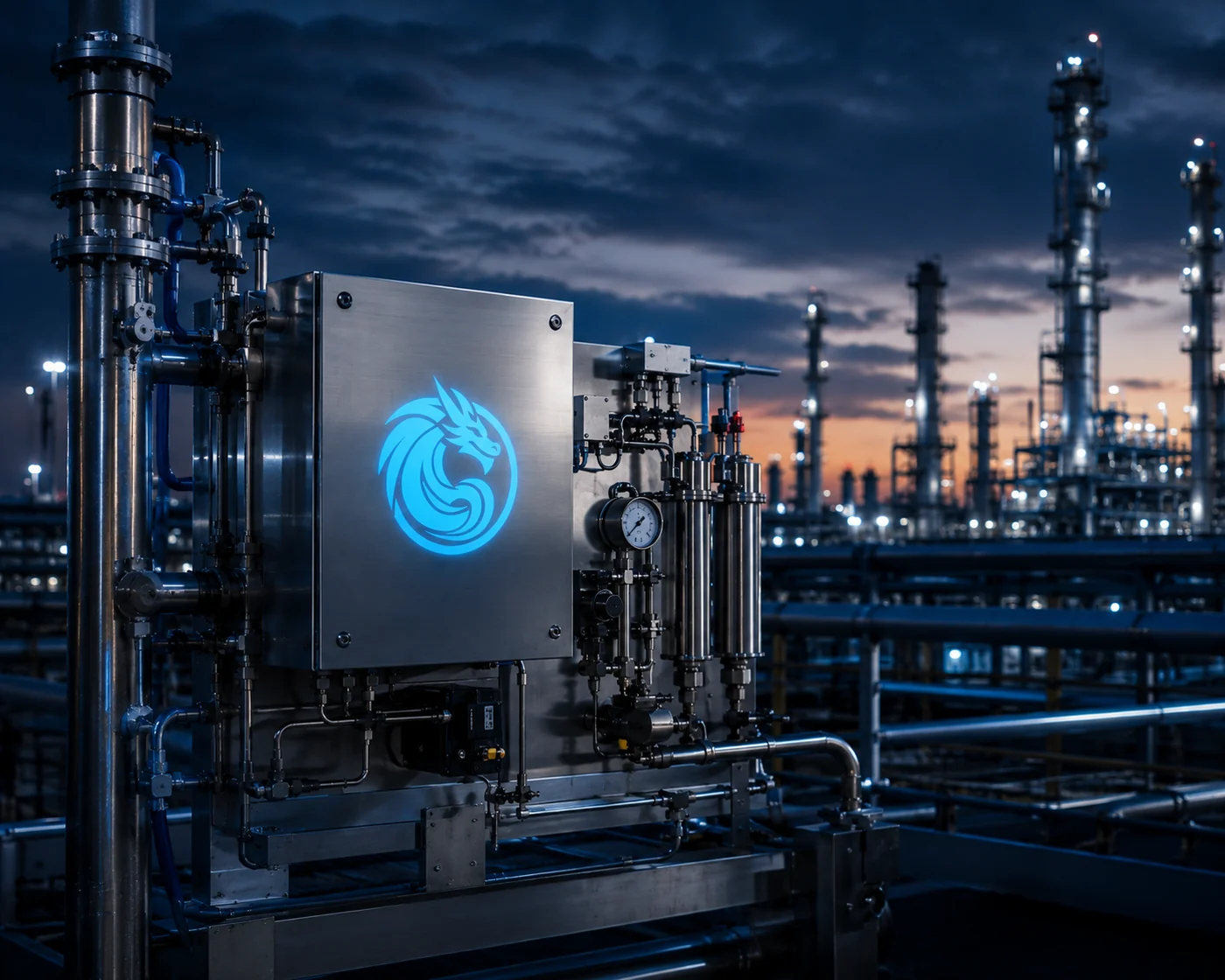
Targeted H2S measurement for gas and process applications
Hydrogen sulfide is often measured separately from total sulfur because the operating decision depends on H2S concentration itself. Applications include gas sweetening, natural-gas quality, refinery and petrochemical gas systems, process treatment, product monitoring, and selected safety-related process measurements.
The analyzer and sample system must be selected for the expected range, gas composition, pressure, moisture, condensables, response time, materials, calibration strategy, and area classification.
What the application needs to establish
Determine hydrogen sulfide concentration in a representative gas sample with sufficient specificity, range, and response for the treatment, quality, or operating decision.
Why the measurement matters
Treatment control
Evaluate sweetening, scavenging, adsorption, or other H2S-removal processes.
Gas quality
Support product, transfer, or downstream gas-quality requirements.
Equipment protection
Identify H2S conditions that may contribute to corrosion or process risk.
Operational response
Provide timely indication of changing feed or treatment performance.
Process understanding
Separate the H2S contribution from broader total-sulfur measurement.
How the measurement is approached
Blue Dragon H2S tape analyzers expose conditioned sample gas to lead-acetate tape and optically measure the resulting reaction. Sample flow, humidification where applicable, tape condition, range, interferents, venting, and calibration/verification must be defined for the installation.
Typical operating locations
- Natural-gas sweetening inlet and outlet streams
- Refinery and petrochemical process-gas systems
- Fuel-gas and product-gas monitoring
- Gas-treatment and scavenger systems
- Biogas and renewable-gas treatment
- Analyzer shelters and packaged sample systems
Instrument-selection considerations
- Expected H2S range and normal variability
- Gas composition, moisture, aerosols, and condensables
- Pressure reduction and sample transport
- Required response time and alarm or control use
- Calibration gas, verification, and maintenance frequency
- Sensing-tape life and consumable planning
- Area classification, utilities, shelter, and ventilation
Where this application is used.


Natural Gas & LNG
Measurement solutions for gas processing, sweetening, liquefaction, LNG quality, gas flow, utilities, and materials verification.
Explore →
Pipelines & Midstream
Application-focused instrumentation for Pipelines & Midstream, covering Pipeline gas quality, dew point, H2S and sulfur, flow, and portable verification across Transmission pipelines, compressor stations, meter stations, and terminals.
Explore →

Sulfur Recovery & Gas Treating
Application-focused instrumentation for Sulfur Recovery & Gas Treating, covering H2S, SO2, sulfur ratio, tail gas, and gas moisture across Amine units, Claus SRU, tail gas, and incinerator.
Explore →
Petrochemicals
Measurement systems for petrochemical feedstocks, reaction processes, fired equipment, utilities, effluent, gas flow, and material quality.
Explore →
Chemical Processing
Application-focused instrumentation for Chemical Processing, covering Trace moisture, H2S and sulfur, TOC, flow, and multipoint temperature across Reactors, columns, specialty gas systems, and utilities.
Explore →
Fertilizers & Chemicals
Analytical and engineered measurement systems for feedstocks, process gases, reactors, utilities, effluent, flow, and material quality.
Explore →
Hydrogen & Syngas
Application-focused instrumentation for Hydrogen & Syngas, covering Ultra-trace moisture, dew point, gas flow, H2S where relevant, and temperature across Electrolysis, reforming, purification, and compression.
Explore →
Industrial Gases
Application-focused instrumentation for Industrial Gases, covering Trace and ultra-trace moisture, gas flow, quality control, and laboratory verification across Bulk gases, specialty gases, purification, and filling.
Explore →
Biogas & Renewable Gas
Application-focused instrumentation for Biogas & Renewable Gas, covering H2S, moisture, gas flow, and pipeline-quality verification across Digesters, upgrading, compression, and injection.
Explore →
Coal & Coal Chemical
Application-focused instrumentation for Coal & Coal Chemical, covering Gas moisture, H2S and sulfur, gas flow, XRF coal/ash, and water quality across Gasification, coke oven gas, syngas, and coal chemicals.
Explore →Relevant measurement capabilities.
Explore the permanent Blue Dragon capability areas associated with this industry or application.
Sulfur Analysis Series
Online analyzers for total sulfur, hydrogen sulfide, sulfur ratio, and sulfur recovery unit process monitoring.
Explore series →Instruments connected to this application.
 Coming Soon
Model 810H2S Online Hydrogen Sulfide Tape Analyzer
Online H₂S tape analyzer for continuous selective hydrogen sulfide monitoring in natural gas, refinery, petrochemical, LNG, fuel-gas, hydrogen, biogas, and other process-gas applications.
View instrument
Coming Soon
Model 810H2S-TS Online Hydrogen Sulfide & Total Sulfur Tape Analyzer
Online tape analyzer for selective H₂S measurement plus Total Sulfur measurement through a dedicated heated hydrogen-conversion section.
View instrument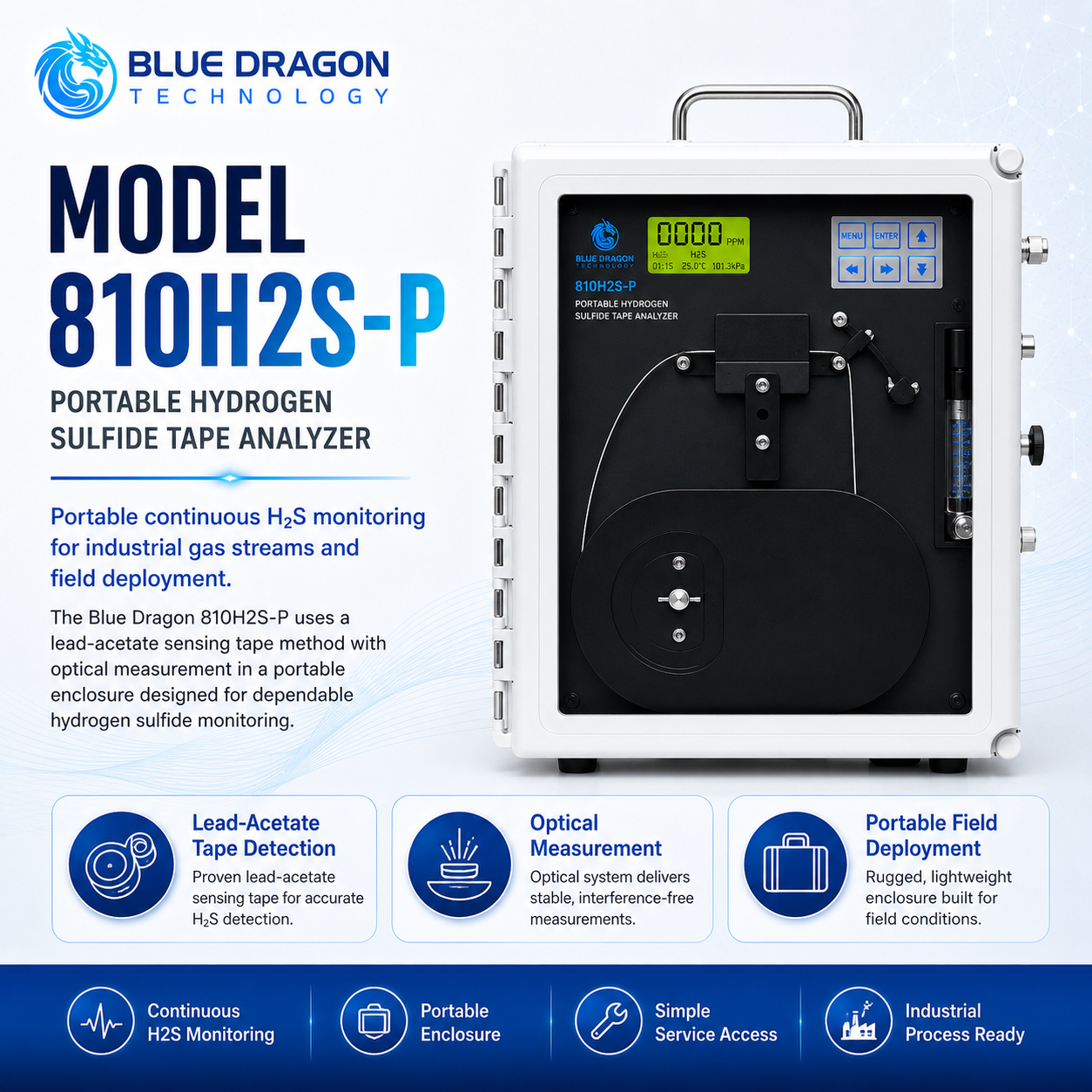 Available
Model 810H2S-P Portable Hydrogen Sulfide Tape Analyzer
Portable industrial H₂S analyzer for field verification, temporary monitoring, process troubleshooting, and sheltered laboratory support, with 1 ppb resolution, one-second analysis, and configurable ppb-to-ppm ranges.
View instrumentRelated applications.

Online Total Sulfur Measurement
Continuous total-sulfur measurement for representative liquid or gas samples in process, product-quality, and treatment applications.
Explore →
Portable H2S Field Verification
Portable H2S verification, troubleshooting and temporary field measurement.
Explore →Application questions.
Why measure H2S separately from total sulfur?
A total-sulfur result combines sulfur species, while an H2S analyzer targets hydrogen sulfide specifically. Process treatment, gas quality, corrosion, or handling decisions may require the H2S value.
What sample information is needed?
Provide gas composition, expected H2S range, pressure, temperature, moisture, condensables, particulates, sample location, transport distance, and required response time.
Does a sensing-tape analyzer require consumables?
Yes. Tape usage and replacement depend on the analyzer design, range, exposure, duty cycle, and maintenance plan. Consumable access should be included in the application review.
Can the H2S analyzer include total sulfur measurement?
A total-sulfur option may be available for the Model 810H2S configuration. The final arrangement, range, sample system, and measurement sequence must be confirmed.
Discuss your hydrogen sulfide measurement requirement.
Share the gas composition, expected H2S range, pressure and temperature, moisture and condensables, response-time requirement, area classification, and maintenance expectations.