Available Available for project application review and quotation
Temperature Measurement Series
BDT-MP

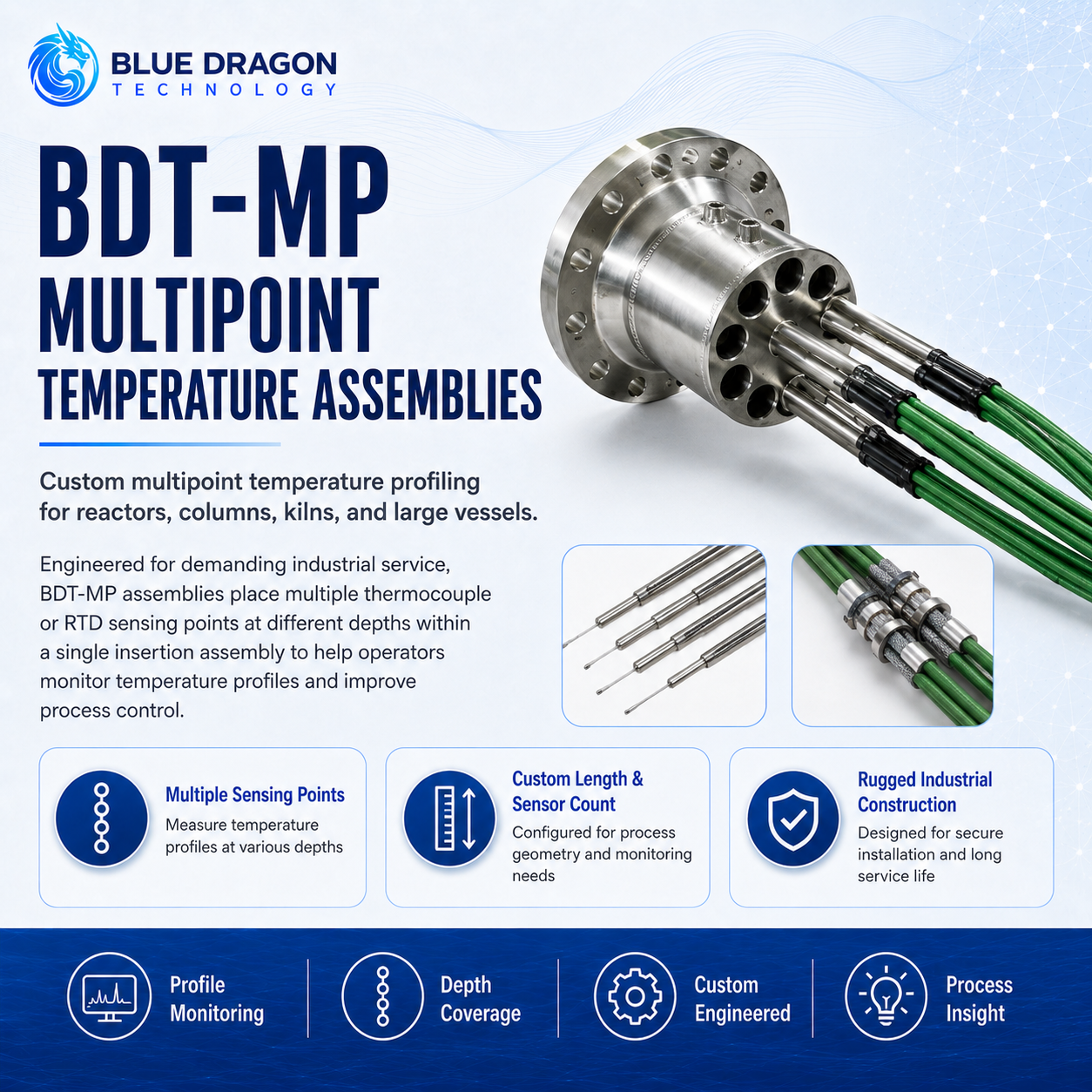
BDT-MP Multipoint Temperature Assemblies

Custom multipoint temperature profiling for reactors, distillation columns, vessels, tanks, kilns, catalyst beds, and industrial process systems.

Brand: Blue Dragon Technology Manufactured by: MESIT, Italy Supply & support: Blue Dragon Technology
Product Overview

Purpose-built measurement, clearly presented.

The BDT-MP is a project-engineered multipoint temperature assembly for applications requiring measurements at several defined depths or elevations within one reactor, distillation column, vessel, storage tank, kiln, catalyst bed, or process system.

A single assembly can contain multiple thermocouple or RTD sensing points, protective pipe wells, a project-specific process connection, and an integrated junction box. The number and position of measurement points, overall length, sensor type, materials, pressure rating, protection arrangement, and termination are engineered around the process geometry and operating conditions.

Distinctive Capabilities

  • Custom sensor count, spacing, and overall insertion length
  • Thermocouple or RTD sensing configurations
  • Assemblies ranging from compact installations to lengths exceeding 100 ft
Performance & Technical Data

The measurement method and the values that matter.

How it measures

Measurement Principle

Multiple temperature-sensing points are positioned at specified depths or elevations within one engineered assembly. Each sensing point produces an individual temperature signal, allowing the plant control or monitoring system to construct a temperature profile across the reactor, column, vessel, tank, kiln, or catalyst bed. Depending on the selected configuration, the sensing points may use thermocouples operating through the thermoelectric Seebeck effect or resistance temperature detectors whose electrical resistance changes with temperature.

Measurement ParametersTemperature profile at multiple defined depths or elevations
Sensor technologyThermocouples or RTDs within one engineered assembly
Documented assembly scaleApproximately 3 ft with 2–3 sensors to over 100 ft with 12 or more sensors
Number of measurement pointsProject specific
Sensor spacing and locationsDefined by process geometry and measurement objectives
Overall and insertion lengthProject specific

Complete Technical Data

Protection arrangement
Pipe protection wells available for pressure and corrosive environments
Termination
Integrated junction box for secure sensor termination
Process connection
Flanged, threaded, or project-engineered connection
Materials and pressure rating
Selected for the vessel, process, and environmental conditions
Temperature range
Dependent on sensor type, protection system, and materials of construction
Calibration and documentation
Specified for each measurement point according to project requirements
Availability
Available for project application review and quotation
Industrial Use

Applications and industries.

Typical Applications

Catalytic-cracker temperature profilingLime-kiln temperature measurementDistillation and fractionation column profilingPressurized reactor-vessel temperature measurementUrea-reactor and fertilizer-process monitoringCatalyst-bed and chemical-reactor profilingLarge tank and vessel temperature profilingProcess-development and thermal-mapping systemsMultipoint Temperature Profiling

Industries Served

Academic & Research LaboratoriesCement, Glass & CeramicsChemical ProcessingFertilizer & AgrochemicalsFertilizers & ChemicalsHydrogen & SyngasIndustrial LaboratoriesMetals, Mining & MaterialsNatural Gas & LNGPetrochemicalPetrochemicalsPower GenerationProcess Reactors & Distillation ColumnsRefineriesRefiningResearch & Industrial Laboratories
Engineering & Integration

Built for specification, installation, and long-term operation.

Engineering defines the measurement-point locations, sensor technologies, protection arrangement, process connection, structural support, signal termination, and maintainability required to obtain a representative process-temperature profile.

ArchitectureMultiple sensing points within one assembly
Documented scale2–3 sensors at approximately 3 ft to 12 or more sensors above 100 ft
Process protectionPipe protection wells for pressure and corrosive service
TerminationIntegrated junction box with individually identified sensor circuits

Sensor Construction

  • Project EngineeredThe number of sensors, measurement-point elevations, sensor spacing, insertion length, process connection, protection wells, support arrangement, and junction box are designed for the vessel.
  • Project EngineeredThermocouple, RTD, or mixed sensing arrangements are selected according to the required temperature range, response, accuracy, and plant instrumentation.
  • Application DependentFlexible, rigid, protected, or modular mechanical arrangements are evaluated against vessel access, installation sequence, maintenance strategy, and process conditions.

Materials & Junction Design

  • StandardNo extracted process sample is required; the sensing points measure temperature directly at their installed process locations.
  • Project EngineeredThe assembly interfaces with the vessel through the specified nozzle, flange, threaded connection, thermowell, protection pipe, support, or other approved mechanical arrangement.
  • Application DependentExposure to process pressure, corrosion, erosion, catalyst movement, vibration, and mechanical loading must be considered in the design.

Mounting & Installation

  • Project EngineeredInstallation requirements are determined from the vessel drawings, nozzle orientation, insertion length, internal clearances, support points, lifting requirements, and access limitations.
  • Project EngineeredLong assemblies may require dedicated handling, transport protection, lifting plans, internal supports, or staged installation procedures.
  • Application DependentPressure-boundary connections, gaskets, bolting, material compatibility, and allowable mechanical loads must comply with the project design.
  • StandardPassive thermocouple or RTD sensors require no local operating power; transmitters or multiplexing equipment have separate utility requirements.

Signal & Termination

  • Project EngineeredEach sensing point is individually identified and terminated for connection to plant temperature inputs, transmitters, remote I/O, DCS, PLC, or monitoring systems.
  • Application DependentDirect thermocouple, direct RTD, head-mounted transmitter, remote transmitter, or multiplexed signal arrangements may be used according to the project.
  • Project EngineeredCable schedules, terminal numbering, sensor polarity, RTD wiring configuration, grounding, shielding, and junction-box entries must match the plant documentation.

Calibration & Quality

  • Project EngineeredSensor type, tolerance class, calibration points, certificates, channel identification, and traceability requirements are defined for the project.
  • Application DependentIndividual sensing points may require point-by-point calibration, verification, or documentation before assembly.
  • StandardFinal inspection should verify sensor positions, circuit continuity, insulation, terminal identification, overall dimensions, and process-connection details.

Maintenance & Replacement

  • StandardRoutine checks should include sensor-circuit continuity, insulation condition, terminal tightness, junction-box sealing, and signal comparison between adjacent points.
  • Application DependentThe maintenance strategy must consider whether the assembly can be withdrawn, inspected, repaired, or replaced without internal vessel access.
  • Project EngineeredSpare assemblies, replaceable sensing elements, protection components, and terminal parts may be defined for critical installations.

Process & Application Considerations

  • Project EngineeredPressure rating, materials, connection design, protection wells, supports, and mechanical loads must be verified against the process design.
  • Application DependentCorrosive media, catalyst movement, erosion, vibration, thermal expansion, and differential movement can affect the assembly design.
  • Project EngineeredLong or heavy assemblies require approved lifting, handling, transport, and installation procedures.
  • StandardNo pressure, material, hazardous-area, or functional-safety claim should be published until it is confirmed for the ordered configuration.
Application Review

Application Engineering Notes

Required application data include the vessel or reactor drawings, nozzle and flange details, number and exact position of measurement points, overall and insertion lengths, operating and design temperatures, operating and design pressures, process composition, corrosion conditions, sensor preference, response requirements, junction-box location, cable routing, hazardous-area classification, and required testing or documentation.

MESIT material cites a multipoint installation designed for 62 temperature measurement points in the QAFCO 6 urea-reactor expansion. Client names, project details, photographs, and performance claims should be used publicly only after MESIT confirms the approved case-study wording.

Application Engineering

Discuss your measurement application.

Share the sample, measurement range, operating conditions, project location, and timeline. Blue Dragon Technology will review the application and recommend the appropriate configuration.