

Scrap & Recycling Material Sorting
Rapid XRF screening/identification for recycling streams. Select the measurement approach from the actual sample or process conditions, required result, installation, interfaces, and verification basis.

Engineering scrap & Recycling Material Sorting for the real process
Rapid XRF screening/identification for recycling streams. The useful result is not defined by the instrument name alone: the measurement point, sample or equipment condition, range, response, pressure and temperature, possible interferences, installation, data interfaces, and reference basis determine whether a configuration is appropriate.
Blue Dragon Technology uses the Core relationship map to identify relevant instruments, then qualifies the final configuration against the project. The system boundary may also include sampling or mounting hardware, utilities, signal integration, alarms, verification, FAT/SAT, commissioning, training, spares, and controlled documentation.
What the application needs to establish
Rapid XRF screening/identification for recycling streams. Define the required range, units, response, accuracy or uncertainty, alarm/use case, and comparison or reference basis before configuration.
Why the measurement matters
Material identification
Identify elemental composition to support material selection, segregation, or verification.
Quality control
Screen incoming materials, products, ores, alloys, or process samples against defined criteria.
Field decisions
Provide rapid screening where laboratory turnaround would delay the next action.
Traceable workflows
Use suitable calibrations, reference materials, sample preparation, and confirmation methods for the required decision.
How the measurement is approached
Handheld or benchtop XRF can support rapid material identification and sorting using suitable alloy/mineral libraries and calibration. Surface contamination, coatings, mixed pieces, geometry, battery/field workflow, data capture, and confirmation rules should be built into the sorting procedure.
Typical operating locations
- Metals, Mining & Materials
- Research & Industrial Laboratories
- Cement, Glass & Ceramics
- Chemical Processing
- Environmental Monitoring & Compliance
- Industrial Manufacturing
Instrument-selection considerations
- Elements of interest and required detection or quantification objective
- Material matrix, homogeneity, particle size, thickness, surface condition, and sample geometry
- Field screening versus laboratory analysis
- Calibration, application mode, reference materials, sample preparation, and confirmation method
- Required repeatability, reporting, libraries, traceability, and acceptance criteria
- Radiation-safety controls, operator training, accessories, and data management
Where this application is used.

Chemical Processing
Application-focused instrumentation for Chemical Processing, covering Trace moisture, H2S and sulfur, TOC, flow, and multipoint temperature across Reactors, columns, specialty gas systems, and utilities.
Explore →
Fertilizers & Chemicals
Analytical and engineered measurement systems for feedstocks, process gases, reactors, utilities, effluent, flow, and material quality.
Explore →
Coal & Coal Chemical
Application-focused instrumentation for Coal & Coal Chemical, covering Gas moisture, H2S and sulfur, gas flow, XRF coal/ash, and water quality across Gasification, coke oven gas, syngas, and coal chemicals.
Explore →
Semiconductor & Electronics
Application-focused instrumentation for Semiconductor & Electronics, covering Ultra-trace gas moisture, UPW TOC, and XRF screening across UPW, specialty gases, fabrication, and incoming materials.
Explore →
Metals, Mining & Materials
Elemental, temperature, and gas-flow instruments for exploration, grade control, alloy verification, production, recycling, and materials laboratories.
Explore →
Cement, Glass & Ceramics
Application-focused instrumentation for Cement, Glass & Ceramics, covering XRF composition, kiln temperature, flue-gas flow, and research QC across Raw mix, kiln, clinker, and glass batch.
Explore →
Industrial Manufacturing
Application-focused instrumentation for Industrial Manufacturing, covering Surface temperature, exhaust gas flow, XRF material verification, gas flow, and XRF alloy verification across Engine test cells, exhaust, rotating equipment, and materials QC.
Explore →
Environmental Monitoring & Compliance
Application-focused instrumentation for Environmental Monitoring & Compliance, covering Oil-in-water, turbidity, TOC, emissions flow, and XRF soil screening across Wastewater discharge, emissions, contaminated land, and compliance labs.
Explore →
Research & Industrial Laboratories
Flexible analytical instruments for water, organic carbon, elemental composition, material verification, method development, and quality control.
Explore →Relevant measurement capabilities.
Explore the permanent Blue Dragon capability areas associated with this industry or application.
Elemental Analysis & Materials Characterization
X-ray fluorescence instruments for elemental composition, material identification, quality control, field screening, and industrial laboratories.
Explore series →Instruments connected to this application.
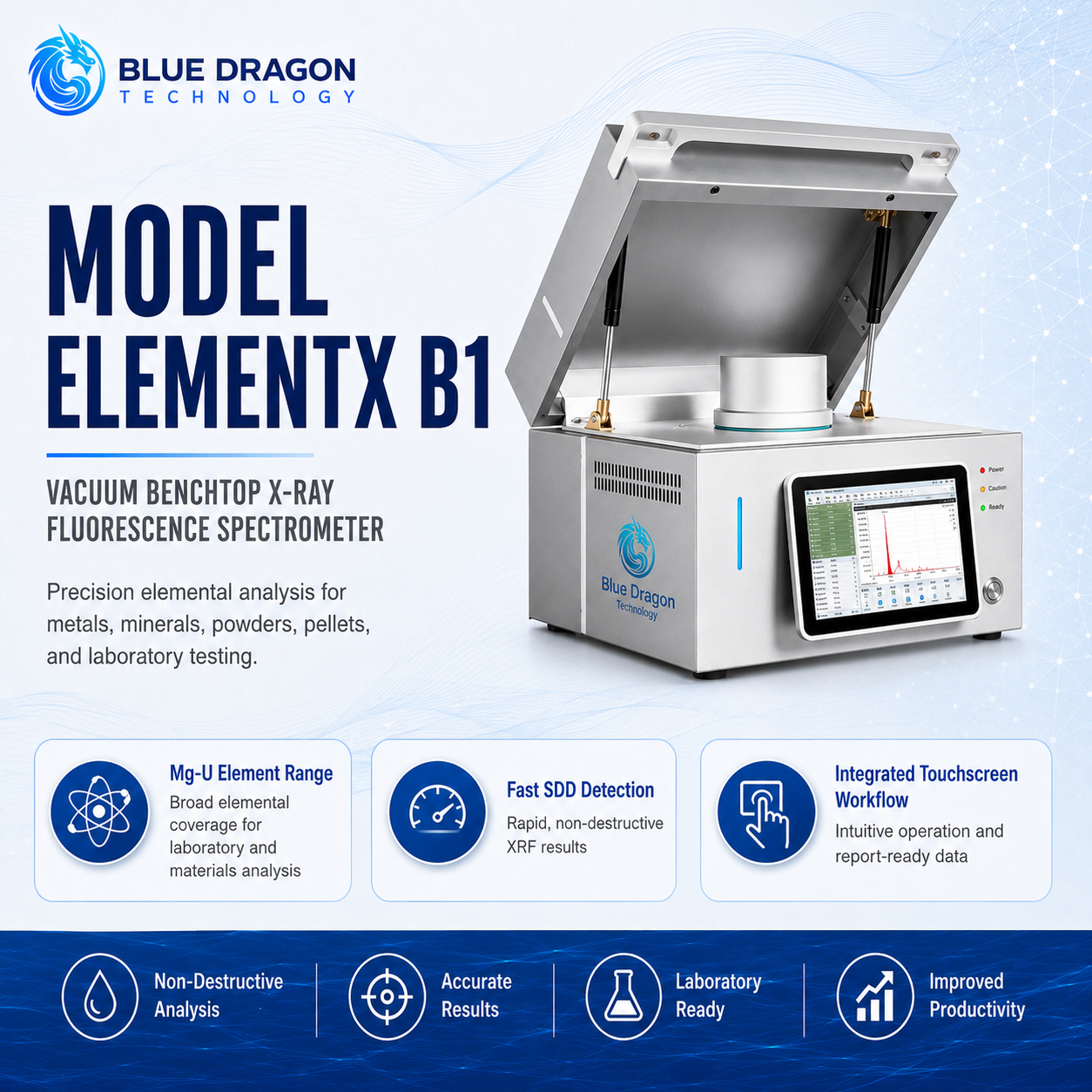 Available
ElementX B1 Vacuum Benchtop XRF Spectrometer
Vacuum benchtop EDXRF platform with a 50 kV tungsten-target tube, Fast-SDD detector, 6 mm collimator, sample camera, integrated touchscreen computer, and elemental-analysis software.
View instrumentRelated applications.

Elemental Composition Analysis
XRF measurement of elemental composition in metals, minerals, powders, solids, filters, soils, and prepared samples.
Explore →
Material Identification & Verification
XRF-based identification and verification of alloys, metals, components, incoming materials, maintenance replacements, and recycled material.
Explore →
Positive Material Identification (PMI)
Alloy/material PMI using suitable calibration and configuration.
Explore →
Mining & Geochemical Screening
Field and laboratory XRF screening for exploration, ore, minerals, grade control, geochemistry, soils, concentrates, and mine-site decisions.
Explore →
Ore Grade / Concentrate Analysis
Elemental analysis of ores, concentrates and mineral products.
Explore →
Lithium / Critical-Mineral Screening
Field screening for critical-mineral exploration subject to calibration.
Explore →
Cement / Glass / Ceramics Analysis
Elemental composition of cementitious, glass and ceramic raw materials/products.
Explore →
Application questions.
What information is needed to select an instrument for Scrap & Recycling Material Sorting?
Define the measurement objective, sample or process, expected range, operating conditions, required performance, installation, utilities, interfaces, verification method, and project schedule.
Does a product relationship mean the instrument is automatically suitable?
No. Core relationships identify relevant products, but final suitability still depends on the controlled product documentation and application qualification.
How should the measurement be verified after installation?
Use the manufacturer and project procedure together with an agreed reference, calibration, comparison, or functional test appropriate to the measurement.
Can Blue Dragon support integration and commissioning?
Yes. Scope can include application review, system boundaries, sample handling or mounting, I/O and communications, alarms, FAT/SAT, commissioning, training, spares, and lifecycle support.
Discuss your scrap & recycling material sorting requirement.
Provide the process or sample, expected range, pressure and temperature where relevant, composition or matrix, installation conditions, required outputs, reference method, documentation, and project timeline.