

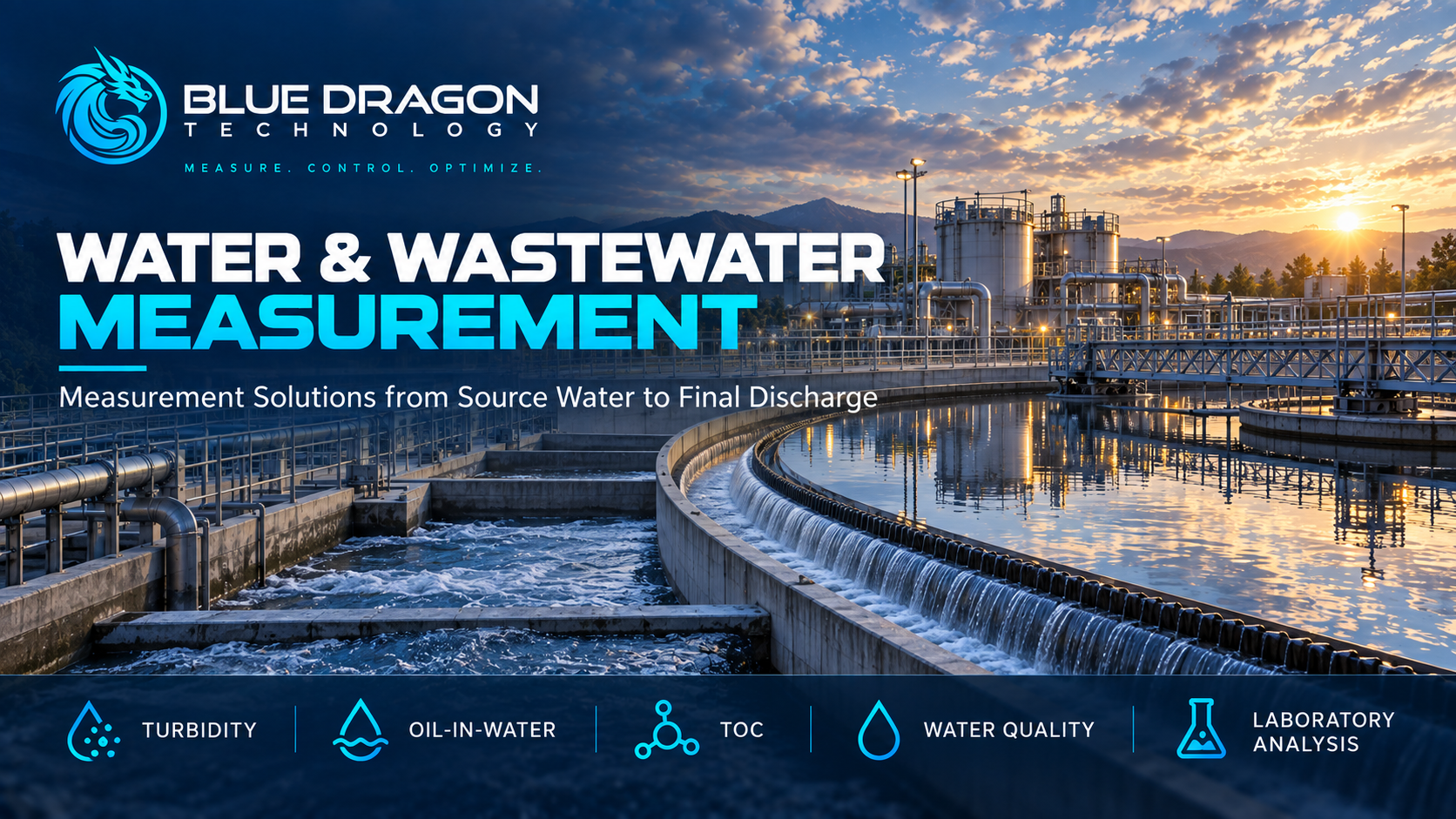
Water & Wastewater Measurement Solutions: From Treatment Monitoring to Laboratory TOC
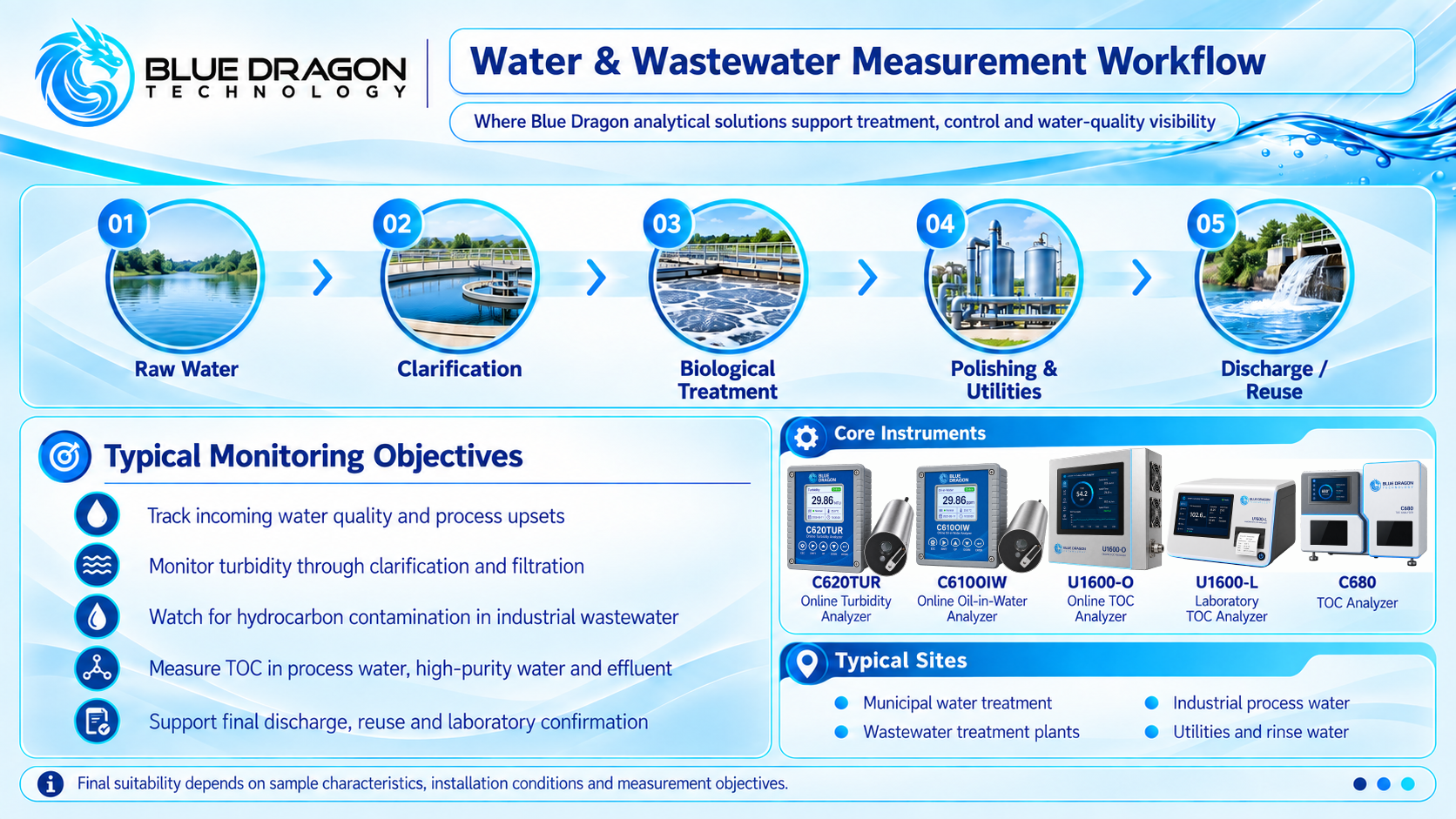
Water and wastewater systems require measurement at very different points—from raw-water intake and treatment-process monitoring through industrial wastewater, final discharge, high-purity utility water and laboratory quality control.
The measurement objective changes with the water matrix. An operator may need continuous visibility into turbidity through clarification and filtration, a contamination alarm for hydrocarbons in an oily-water system, broad-matrix laboratory TOC analysis, or low-level TOC monitoring within a controlled high-purity-water loop.
There is therefore no single analyzer that addresses every water-quality requirement. Effective instrumentation begins with the parameter, sample or process location, expected range, matrix, installation conditions, calibration requirements and the way the resulting information will be used.
This article examines how online turbidity, oil-in-water fluorescence, laboratory TOC and high-purity-water TOC measurement can support water and wastewater workflows from treatment-process visibility through laboratory verification.
Water & Wastewater Measurement Solutions: Video Overview
The Blue Dragon Technology presentation below provides an overview of measurement opportunities across water and wastewater operations, including turbidity monitoring, oil-in-water measurement, broad-matrix laboratory TOC analysis, high-purity-water TOC and plant-data integration.
The sections below expand on these measurement areas and show how different technologies can fit into a broader water-quality and process-monitoring strategy.
Understanding Water and Wastewater Measurement Requirements
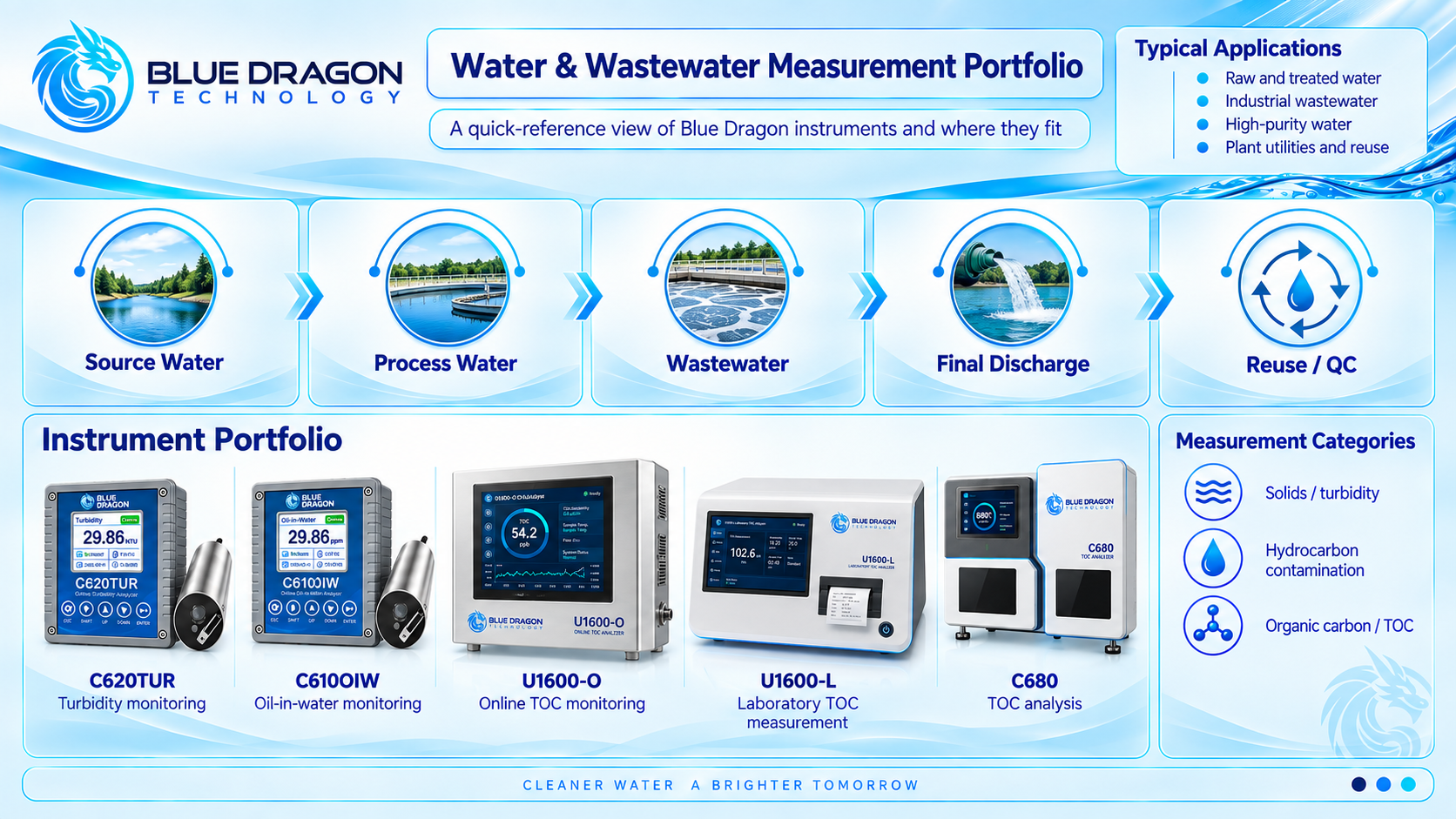
Water systems are often discussed as though they form a single linear treatment chain, but real facilities contain several different measurement environments. Raw-water intake, clarification, filtration, industrial wastewater treatment, reuse systems, utility-water loops, high-purity-water generation and laboratory QA/QC can all require different analytical approaches.
A useful way to organize these requirements is around four measurement functions:
- Treatment-process visibility — observing changing particulate conditions through intake, clarification, filtration, treatment or final-water applications
- Industrial contamination monitoring — detecting and trending oil contamination where hydrocarbons are a credible process or discharge risk
- Laboratory organic-carbon analysis — measuring TOC under controlled laboratory methods across qualified water matrices
- High-purity-water assurance — monitoring low-level TOC in approved low-conductivity water systems through online and laboratory workflows
The purpose is not to install the largest possible number of analyzers. It is to place the appropriate measurement at the points where the data can support treatment performance, contamination response, quality control, investigation or release decisions.
Turbidity Monitoring Across Water Treatment
Turbidity is an optical measurement related to the scattering of light by suspended material in water. It can provide useful process visibility where changing particulate conditions matter to treatment performance or downstream water quality.
The Blue Dragon C620TUR Online Turbidity Analyzer is designed for continuous industrial and municipal wastewater, process-water, surface-water intake, treatment-process, utility-water and discharge monitoring where the range and matrix are suitable.
How the C620TUR Measures Turbidity
The standard C620TUR uses an 850 ±10 nm infrared light source and approximately 90-degree scattered-light detection. Its self-wiping immersion sensor periodically cleans the quartz optical window to reduce normal deposit buildup, while the local controller provides measurement indication, alarms, history and plant outputs.
The standard sensor range is 0–4000 NTU. Plant integration can include an isolated 4–20 mA output and RS485 Modbus RTU communication for supported PLC, DCS, SCADA or PC connections.
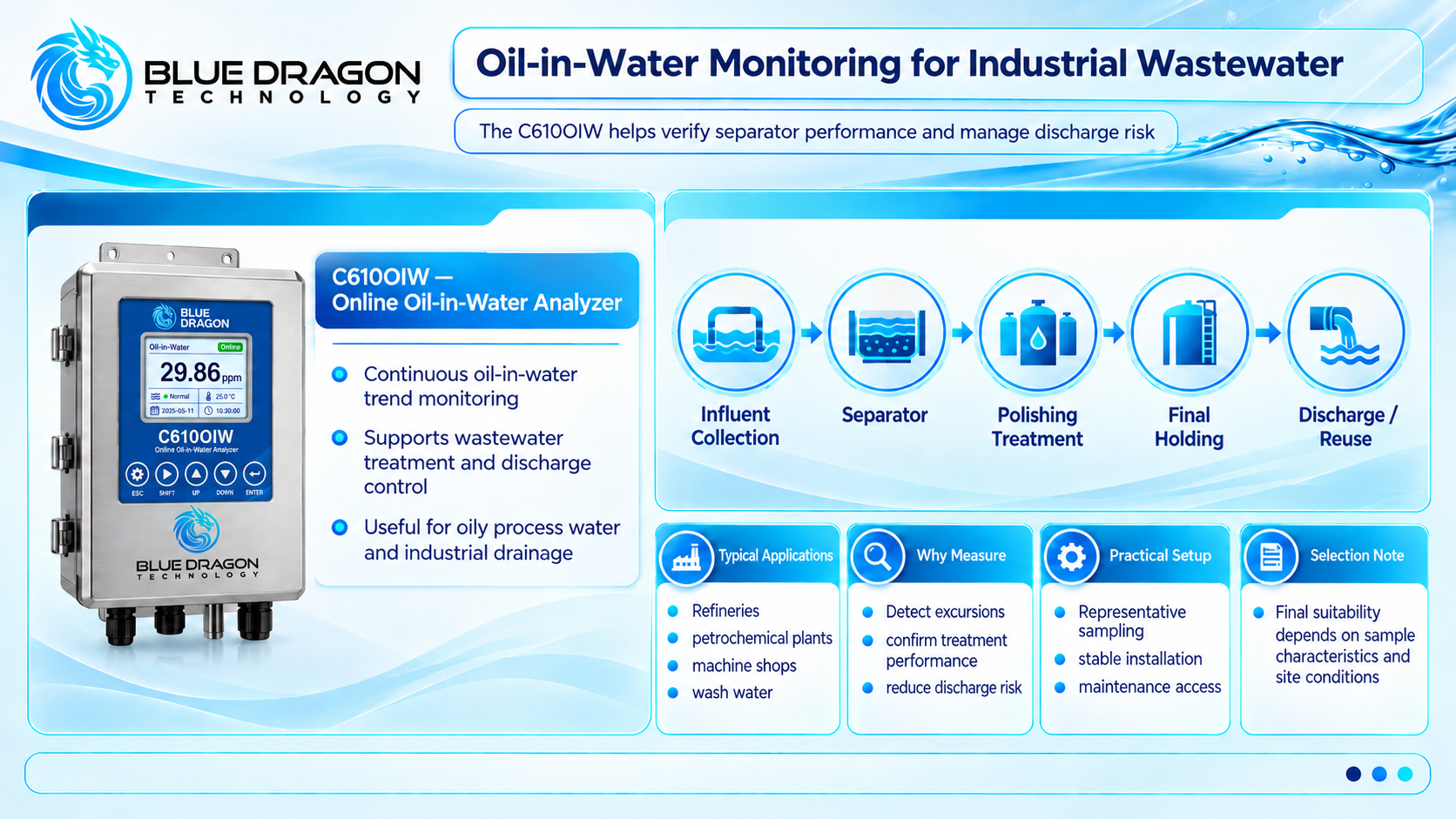
Typical Turbidity Measurement Points
Depending on the treatment process and measurement objective, representative locations can include:
- Raw-water or surface-water intake to follow changing incoming conditions where the range and matrix are suitable
- Clarifier or settling outlets to observe treatment trends downstream of coagulation, flocculation or settling
- Filter outlets to monitor changing filter performance and potential breakthrough trends
- Treated or reuse-water streams where turbidity provides relevant process information
- Industrial wastewater and final effluent where continuous turbidity is part of the site monitoring strategy
Oil-in-Water Monitoring in Industrial Wastewater
Turbidity cannot answer every contamination question. In industrial systems where oil ingress is a credible risk, dedicated oil-in-water measurement can provide a more direct indication of changing hydrocarbon conditions.
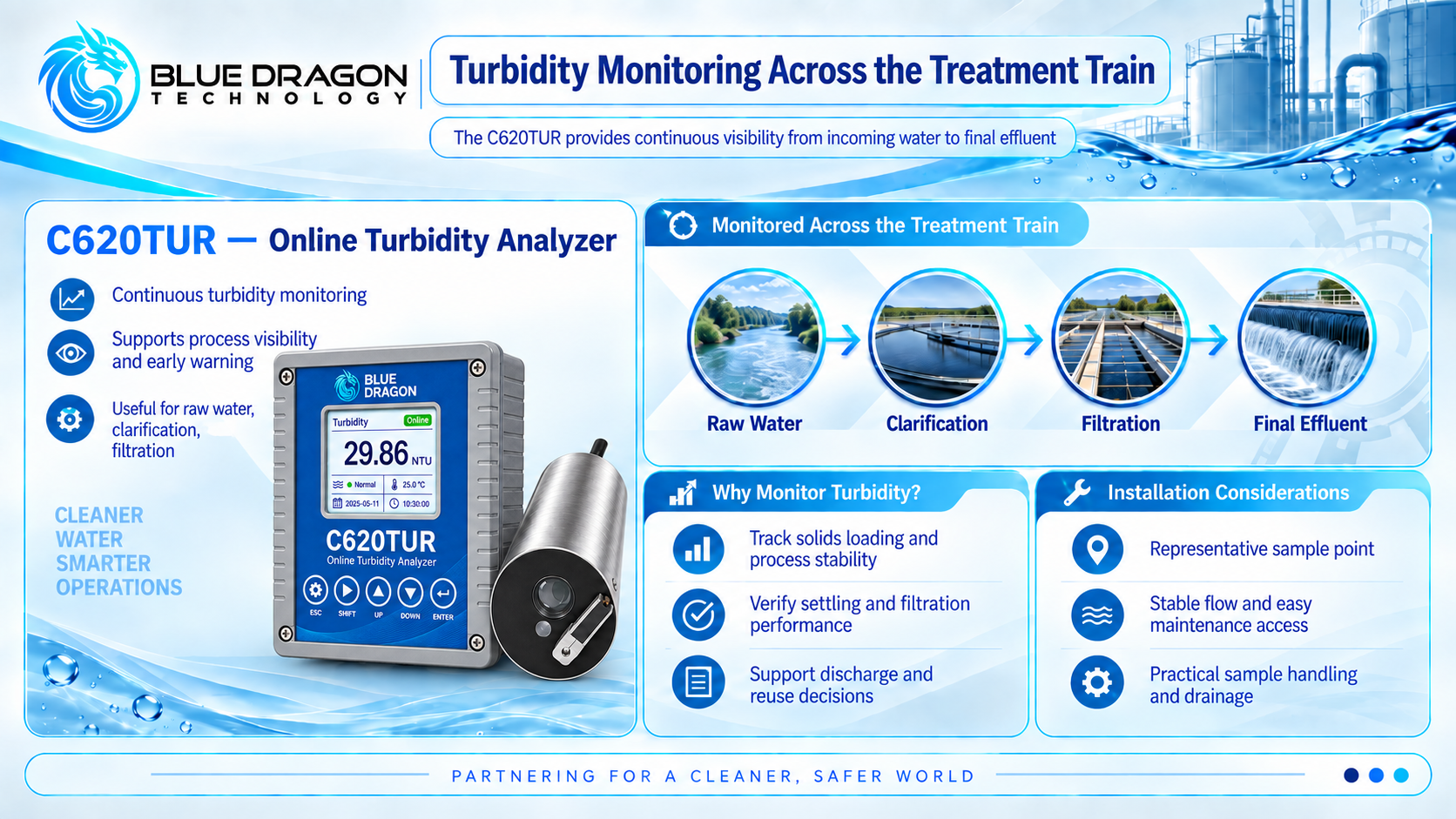
The Blue Dragon C610OIW Online Oil-in-Water Analyzer is an online monitoring and process-control system for ppm-level oil response in industrial water. The standard configuration combines a 0–150 ppm self-wiping UV fluorescence sensor with a local controller and plant communication outputs.
UV Fluorescence for Hydrocarbon Trending
The standard sensor excites fluorescent hydrocarbon compounds at 365 nm and detects emitted light near 465 nm. The optical response is converted into an oil-in-water indication using the active calibration, while a motorized wiper helps reduce optical-window fouling.
The standard 365 nm configuration is best suited to heavy oils, crude-oil fractions, produced water, refinery wastewater and dirty or turbid industrial-water streams where ppm-level trending and contamination alarms are required.
Typical Industrial Oily-Water Measurement Points
- Oily wastewater collection or equalization
- Oil-water separator or DAF outlet
- Industrial wastewater polishing stages
- Qualified discharge or alarm points
- Cooling-water, utility-water or process-water systems where oil ingress is a credible failure mode
The C610OIW can be installed by direct immersion or through an optional pressure-free overflow flow-through arrangement, depending on the process and sampling conditions.
Laboratory Total Organic Carbon for Broad Water Matrices
Total organic carbon, or TOC, provides a different view of water condition by measuring carbon associated with organic material in a sample. Unlike turbidity or oil-in-water fluorescence, TOC does not identify a specific suspended-solid or hydrocarbon condition. It answers a different analytical question.
The Blue Dragon C680 High-Temperature Combustion TOC Analyzer is a laboratory platform for quantitative carbon measurement across qualified water matrices including purified water, surface water, process water, municipal water and wastewater, reclaimed water and industrial wastewater.
High-Temperature Combustion and NDIR Detection
The standard C680 uses manual microsyringe injection, high-temperature catalytic combustion and non-dispersive infrared carbon-dioxide detection. Total Carbon and Inorganic Carbon are measured through separate reaction paths, allowing TOC to be calculated as TC minus IC. The analyzer also supports NPOC workflows after acidification and purge removal of inorganic carbon.
The nominal combustion method temperature is approximately 680 °C. The exact validated working range, injection volume, standards, dilution strategy and quality-control plan should be established for the sample matrix and reporting objective rather than assumed from a single universal range.
From Representative Sample to Laboratory Result
Laboratory TOC performance depends on more than the analyzer itself. A reliable workflow begins with a representative sample point and suitable sample handling, followed by method selection, calibration, controlled injection and quality-control procedures.
Potential applications can include:
- Industrial wastewater and plant effluent investigation
- Municipal raw water, treated water, sewage influent, effluent and reclaimed-water samples
- Surface water, groundwater and environmental monitoring samples
- Process water, cooling water and boiler-feedwater laboratory analysis
- Method development, troubleshooting, research and laboratory QA/QC
High-Purity Water TOC: Online Monitoring and Laboratory Verification
High-purity-water systems present a different analytical environment from municipal or industrial wastewater. Low-conductivity matrices, low TOC concentrations, contamination control, validation and data integrity become central to the measurement strategy.
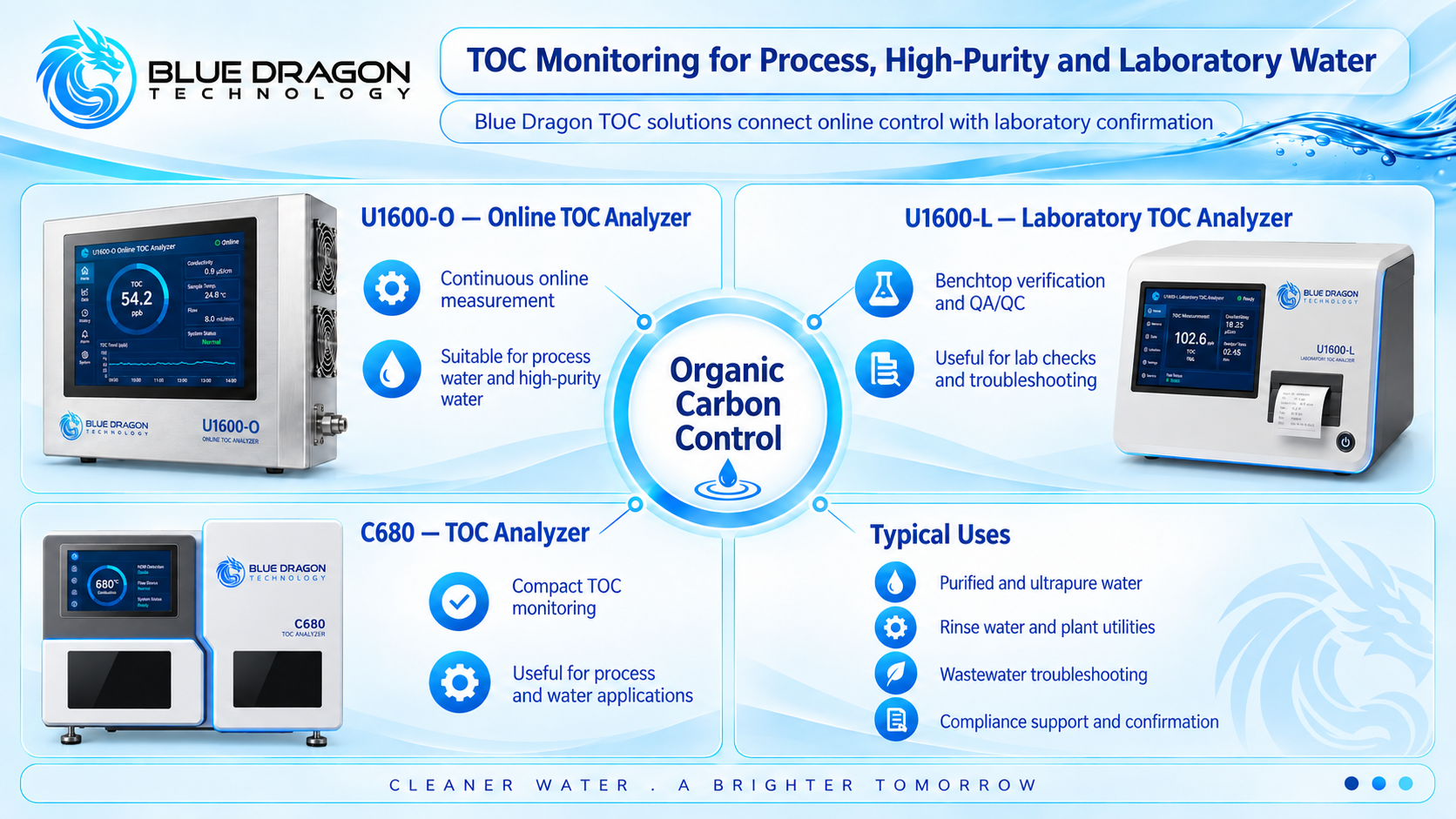
Blue Dragon provides two related low-level TOC platforms for these applications: the U1600-O Online TOC Analyzer for continuous or routine online monitoring and the U1600-L Laboratory TOC Analyzer for controlled offline testing.
U1600-O for Online Low-Level TOC Monitoring
The U1600-O is intended for Purified Water, Water for Injection, electronic-grade ultrapure water, deionized-water preparation and other approved high-purity-water applications. It uses reagent-free UV oxidation with differential conductivity detection and calculates TOC from the difference between Total Carbon and Total Inorganic Carbon paths.
The approved standard configuration provides a 1–1600 µg/L carbon, or 1–1600 ppb, working range, a 1 ppb detection limit and approximately three-minute analysis. Standard interfaces include RS232, RS485, USB and Ethernet, supporting local records and integration within qualified high-purity-water monitoring systems.
U1600-L for Offline Laboratory Verification
The U1600-L applies the same low-conductivity UV oxidation and differential-conductivity principle in a compact laboratory platform. It is intended for offline testing of Purified Water and Water for Injection, pharmaceutical QC and investigation, cleaning-validation rinse samples, electronic-grade ultrapure water, deionized water and other approved low-conductivity samples.
The standard U1600-L also covers 1–1600 µg/L carbon, or 1–1600 ppb, with a 1 ppb detection limit and approximately three-minute analysis. It draws from a clean, non-pressurized sample container and includes local records, integrated report printing and RS232, RS485 and USB interfaces.
From Analyzer to Plant Data
An online analyzer only becomes operationally useful when the measurement point, installation, communication path and plant workflow are engineered together.
The C620TUR and C610OIW provide local controller functions together with standard plant outputs for supported monitoring and alarm applications. The U1600-O adds online low-level TOC records and communication interfaces for qualified high-purity-water systems. These signals can be incorporated into the site’s control or monitoring architecture according to the delivered configuration and integration requirements.
Laboratory instruments follow a different information path. The U1600-L produces controlled low-level TOC results and local reports, while the C680 supports laboratory methods, calibration and result history. Laboratory data can inform investigation, QA/QC and process decisions without being treated as a real-time online process signal.
Measurement technology is therefore one layer of a complete information architecture. Representative sampling, installation design, calibration, communications, alarm philosophy, data review and operator response determine how useful the measurement becomes in practice.
Advanced Treatment, Reuse and High-Purity Water
As water progresses from general treatment and reuse toward low-conductivity high-purity systems, the relevant measurement strategy changes with the matrix.
Pretreatment and General Water
Clarification, filtration, pretreatment and feed-water applications may benefit from turbidity monitoring where suspended-material trends are relevant and the process conditions fit the C620TUR measurement method.
Industrial and Reuse Water
Industrial or reuse-water systems may require different measurements according to the water-quality question. Turbidity can support particulate-condition monitoring, C680 laboratory TOC can support organic-carbon characterization, and C610OIW can be applied where heavy-oil or crude-oil contamination is a relevant risk and the matrix has been qualified.
Low-Conductivity High-Purity Water
After appropriate purification and polishing, the analytical objective changes again. U1600-O can provide routine online low-level TOC monitoring, while U1600-L can support offline laboratory verification and controlled QC workflows within approved low-conductivity matrices.
The cleaner and more controlled the water matrix becomes, the more the measurement objective, method and contamination-control requirements change.
Water & Wastewater Measurement Points and Instrumentation
The following table summarizes the major measurement areas discussed above. It is intended as an application overview rather than a universal specification for every water or wastewater plant.
| Application Area | Measurement Need | Technology | Representative Blue Dragon Solution |
|---|---|---|---|
| Raw water / surface-water intake | Changing particulate condition | Online turbidity | C620TUR |
| Clarification / settling / filtration | Treatment and filter-performance trend | Online turbidity | C620TUR |
| Treated water / reuse / industrial discharge | Turbidity trend where applicable | Online turbidity | C620TUR |
| Oily wastewater / separator effluent | Hydrocarbon contamination trend | 365 nm UV fluorescence | C610OIW |
| Process-water leak / contamination watch | Oil ingress where heavy-oil response is relevant | Online oil-in-water fluorescence | C610OIW |
| Water / wastewater laboratory | Broad-matrix TOC, TC, IC or NPOC analysis | High-temperature combustion + NDIR | C680 |
| High-purity-water online monitoring | Low-level TOC trend | UV oxidation + differential conductivity | U1600-O |
| High-purity-water laboratory QA/QC | Offline low-level TOC verification | UV oxidation + differential conductivity | U1600-L |
How to Select Instrumentation for Water and Wastewater Applications
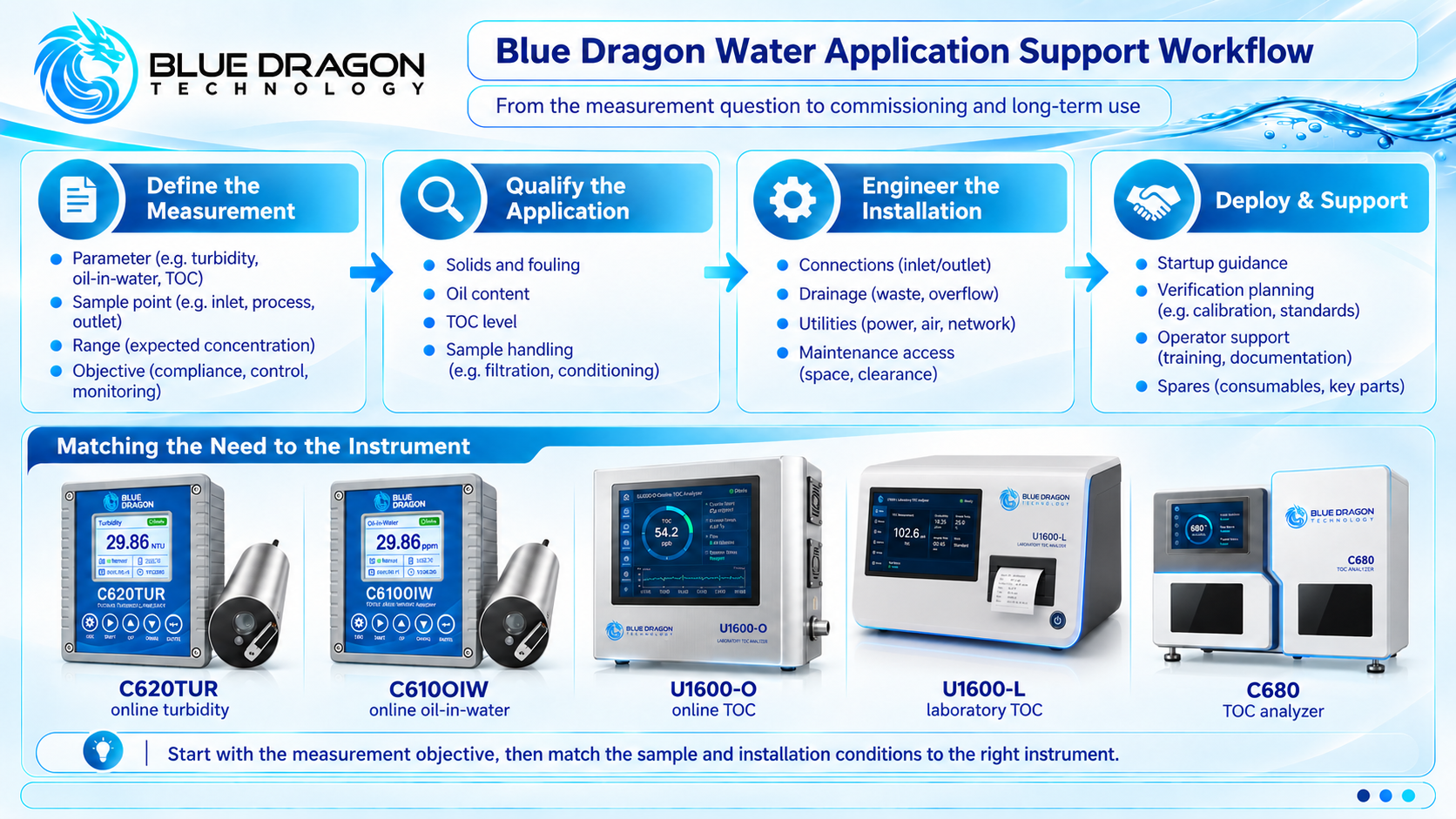
Instrument selection should begin with the measurement question rather than with the product model.
1. Define the Measurement Objective
Determine whether the requirement is for treatment-process trending, contamination alarm, laboratory investigation, quality control, high-purity-water monitoring, troubleshooting or formal reporting.
2. Characterize the Water Matrix
Turbidity, suspended solids, salinity, conductivity, oil type, emulsification, dissolved organics, particles, bubbles, pH, temperature and process chemicals can influence analyzer suitability and measurement response.
3. Select a Representative Measurement Point
An analyzer only measures the water presented to it. The installation should represent the process condition of interest and avoid dead zones, stratification, trapped gas, unstable sampling or other conditions that make the reading unrepresentative.
4. Match the Measurement Range and Method
Expected normal values, upset conditions, required sensitivity and the measurement principle should all be reviewed. A method designed for high-purity water should not be assumed suitable for wastewater, and an industrial oil-in-water fluorescence sensor should not be assumed equivalent to a low-range clear-water method.
5. Review Installation and Environmental Conditions
Pressure, temperature, flow velocity, fouling, chemical compatibility, access, enclosure protection, hazardous-area classification, sample conditioning, drainage and available utilities can all affect the installation design.
6. Define Calibration and Verification Requirements
Calibration should reflect the measurement principle and reporting objective. Oil-in-water fluorescence may require site correlation to the actual oil and water matrix, turbidity requires suitable standards and representative comparison, and laboratory TOC methods require appropriate standards, blanks, system checks and validated procedures.
7. Plan Plant and Data Integration
Where analyzer data must be transferred to a PLC, DCS, SCADA, laboratory record or reporting system, the required outputs, communication protocol, alarm philosophy, data retention and operator workflow should be established before installation.
8. Plan Maintenance and Support
Cleaning, wiping systems, calibration, verification, UV-lamp life, tubing, standards, consumables, inspection intervals, spare parts and service access should be considered as part of the measurement system from the beginning.
From Individual Analyzers to an Integrated Water-Measurement Strategy
A water or wastewater facility does not become better instrumented simply by installing more analyzers. Measurement creates value when each technology is matched to a clearly defined question and the information can be used within the treatment, maintenance, quality or laboratory workflow.
An integrated strategy can connect several different disciplines:
- Turbidity monitoring to follow changing particulate conditions through selected treatment stages
- Oil-in-water monitoring to provide contamination visibility in qualified industrial oily-water systems
- Broad-matrix laboratory TOC to support investigation, QA/QC and organic-carbon analysis
- Online low-level TOC to provide ongoing visibility within qualified high-purity-water systems
- Laboratory low-level TOC to support offline verification, system suitability, investigation and controlled QC workflows
- Plant and data integration to connect measurement outputs with alarms, trends, records and operational decisions
Together, these measurements provide different forms of information about water condition. The correct combination depends on the process and the decision the measurement is intended to support.
Frequently Asked Questions About Water and Wastewater Instrumentation
What does a turbidity analyzer measure?
A turbidity analyzer measures optical scattering caused by suspended material in water. Turbidity can indicate changing particulate conditions, but it is not automatically equivalent to suspended-solids concentration unless a site-specific correlation has been established.
When is oil-in-water fluorescence appropriate?
UV fluorescence is useful where hydrocarbons are a relevant contamination risk and the sensor wavelength is appropriate for the oil type and expected concentration. The standard C610OIW 365 nm configuration is intended primarily for heavy-oil, crude-oil, produced-water, refinery-wastewater and dirty industrial-water applications.
Can online oil-in-water measurement replace a laboratory reference method?
Not automatically. Fluorescence response varies with oil type and water matrix. Where quantitative agreement with a laboratory method is required, the online response should be correlated using representative site samples and an appropriate comparison program.
What is the difference between C680 and the U1600 TOC analyzers?
The C680 is a broad-matrix laboratory TOC analyzer using high-temperature catalytic combustion and NDIR detection. The U1600-O and U1600-L are low-level TOC platforms using UV oxidation and differential conductivity for approved low-conductivity high-purity-water matrices, with online and laboratory configurations respectively.
Can U1600-O or U1600-L be used for wastewater?
The standard U1600-O and U1600-L methods are intended for low-conductivity high-purity water. They should not be applied to generic wastewater, high-salt matrices, suspensions or concentrated process streams without a specific application review and approved method.
How should a water or wastewater analyzer be selected?
Selection should begin with the measurement objective and actual water matrix. Important factors include parameter, expected range, sample location, solids, conductivity, oil type, temperature, pressure, fouling, chemical compatibility, sampling, calibration, communications, maintenance and the required reporting confidence.
Building the Right Measurement Strategy for Water and Wastewater Operations
Modern water and wastewater systems combine treatment-process control, contamination monitoring, utility-water management, laboratory analysis and—in some industries—high-purity-water quality assurance within the same facility.
The appropriate measurement strategy therefore begins by asking four fundamental questions: what needs to be measured, where the measurement should occur, what conditions the instrument must operate under and how the resulting information will be used.
Blue Dragon Technology provides complementary solutions spanning online turbidity monitoring, oil-in-water measurement, broad-matrix laboratory TOC, online high-purity-water TOC and laboratory low-level TOC.
Individual measurement points or broader water-quality projects can be reviewed application by application so that the analyzer, method, sample presentation, installation, calibration, integration and maintenance approach match the actual operating requirement.
Discuss Your Water & Wastewater Measurement Requirements
Blue Dragon Technology can support individual measurement applications or broader instrumentation requirements across treatment water, industrial wastewater, plant utilities, high-purity-water systems and laboratory analysis.
Blue Dragon Technology
Measure. Monitor. Optimize.